
Gaining admission to a competitive art school is about more than just technical skill—it's about demonstrating vision, originality, and the potential to grow as an artist. With thousands of applicants submitting portfolios each year, standing out requires intentionality, preparation, and authenticity. Admissions committees look for students who not only create compelling work but also think critically, communicate ideas clearly, and show commitment to their artistic development. The most successful applications don’t just showcase talent—they tell a story.
Build a Cohesive and Thoughtful Portfolio
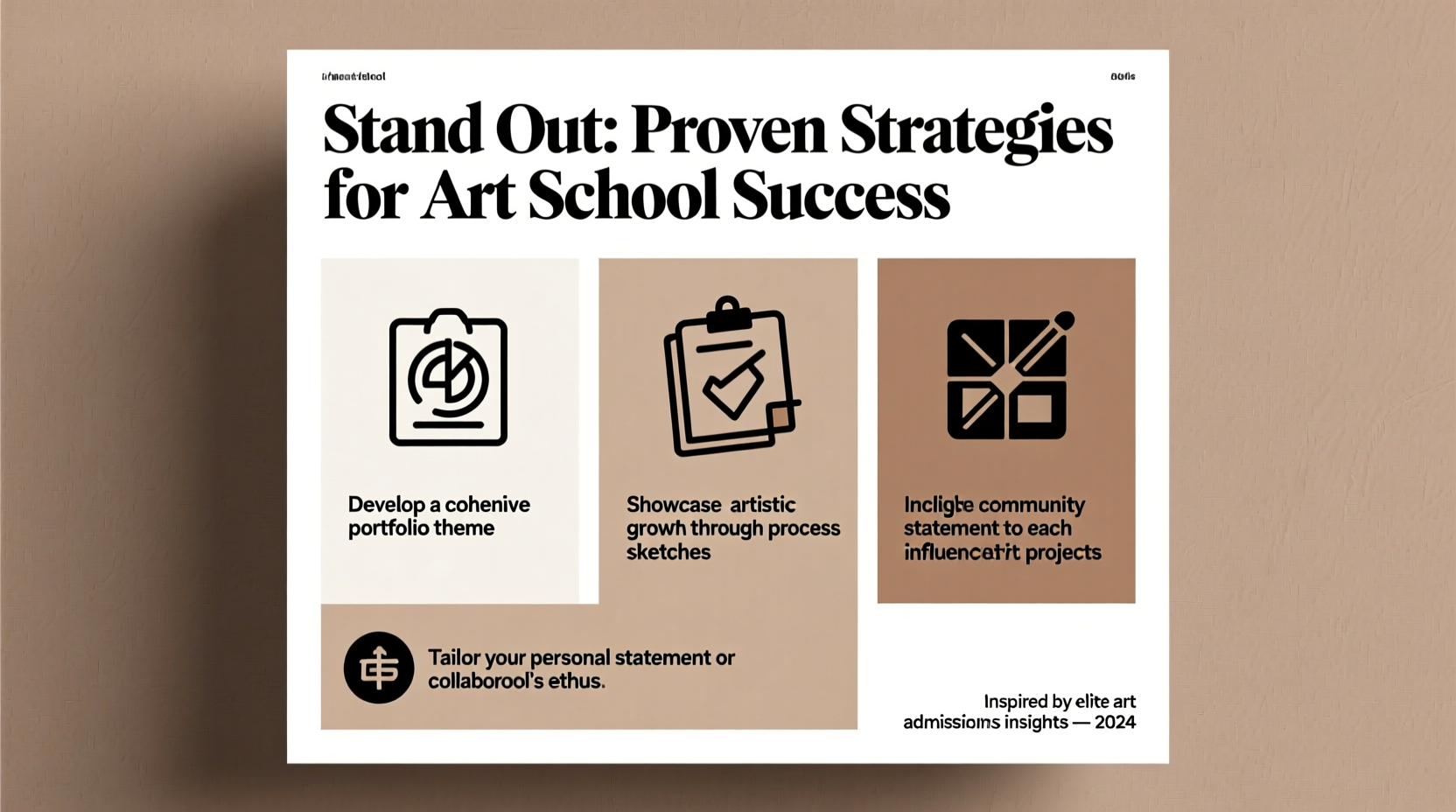
Your portfolio is the centerpiece of your application. It’s not just a collection of your best pieces; it’s a curated narrative that reflects your interests, process, and growth. Schools typically request 10–20 pieces, and how you select and sequence them matters deeply.
Focus on quality over quantity. Choose works that demonstrate a range of techniques, media, and conceptual depth. Avoid redundancy—don’t include five charcoal portraits if one strong example suffices. Instead, show variety: a mixed-media sculpture, a digital illustration, a series of observational drawings, and a conceptual photography project can illustrate both versatility and focus.
Include developmental work when allowed. Some schools welcome sketches, process photos, or artist statements alongside finished pieces. These materials reveal your creative thinking and problem-solving skills, which are often as important as the final product.
Craft a Compelling Personal Statement
The personal statement is where you move beyond images and give context to your work. This is your chance to explain why you create, what drives your curiosity, and how your experiences have shaped your artistic voice.
Admissions officers read hundreds of essays. To stand out, avoid generic statements like “I’ve loved art since I was a child.” Instead, begin with a specific moment—a childhood memory of drawing on the back of grocery receipts, a mural that changed how you saw your neighborhood, or a family tradition that inspired a recent series. Use vivid details to ground your story.
Connect your past to your future. Explain why a particular program resonates with you. Mention faculty whose work aligns with your interests, access to specialized studios, or interdisciplinary opportunities. Show that you’ve done your research and see yourself thriving in their community.
“Authenticity wins. We’re not looking for perfect artists—we’re looking for thoughtful ones who are eager to learn.” — Dr. Lena Torres, Director of Admissions, Rhode Island School of Design
Secure Strong Letters of Recommendation
Letters of recommendation provide third-party validation of your talent, work ethic, and potential. Choose recommenders who know you well and can speak concretely about your artistic journey—your high school art teacher, a mentor from a summer program, or a supervisor from an arts internship.
A powerful letter doesn’t just say you’re talented; it illustrates it. The best recommendations describe specific projects, moments of growth, or leadership in collaborative settings. They might recount how you revised a painting through seven iterations or led a peer critique session with empathy and insight.
Avoid asking someone solely because of their title or prestige. A lukewarm letter from a famous artist carries less weight than an enthusiastic one from a teacher who has watched you evolve over two years.
Follow a Strategic Application Timeline
Art school applications require time and multiple drafts. Starting early prevents last-minute stress and allows room for refinement.
- June–July (12–10 months before deadline): Research schools, attend virtual tours, and identify programs that match your artistic goals.
- August–September: Begin drafting your personal statement and selecting portfolio pieces.
- October–November: Request letters of recommendation and finalize portfolio selections. Seek feedback from teachers or mentors.
- December: Submit applications by early deadlines (often January 1–15). Double-check formatting, file sizes, and supplemental materials.
- January–March: Prepare for interviews or portfolio reviews if required. Follow up on submission confirmations.
Many students make the mistake of treating the portfolio as a final exam rather than a work-in-progress. Use the months leading up to the deadline to experiment, revise, and refine. Your strongest work may be created during this period.
Do’s and Don’ts: Common Application Pitfalls
| Do’s | Don’ts |
|---|---|
| Show process work when permitted | Include unfinished or low-quality images |
| Tailor your statement to each school | Submit a generic essay copied across applications |
| Demonstrate risk-taking and experimentation | Only submit safe, technically correct assignments |
| Proofread all written materials | Ignore spelling or grammar errors |
| Seek honest feedback from trusted mentors | Isolate yourself during the preparation process |
Real Example: How One Student Stood Out
Maria, a high school senior from Chicago, applied to several top-tier art schools with a portfolio centered on cultural hybridity. Her parents immigrated from Guatemala, and her work explored the tension between heritage and assimilation through textile installations and self-portraiture.
Instead of simply showing polished final pieces, she included photographs of her abuela teaching her traditional weaving techniques, annotated sketches exploring pattern symbolism, and a video still from a performance piece where she unraveled a dress live. Her personal statement began with the smell of corn masa and ended with a reflection on code-switching in art spaces.
She requested a letter from her AP Art teacher, who highlighted Maria’s initiative in starting a student-led exhibition on immigrant narratives. Though her technical skills were strong, it was her conceptual clarity and emotional honesty that earned her acceptance to three highly selective programs.
Essential Checklist Before Submission
- ✅ Portfolio includes 10–20 high-resolution, well-lit images of original work
- ✅ Each piece is labeled with title, medium, dimensions, and year
- ✅ Personal statement is under 650 words, free of clichés, and tailored to each school
- ✅ Recommenders have submitted letters on time and through the correct portal
- ✅ Supplemental materials (artist statement, resume, process work) are included if required
- ✅ All links and uploads have been tested for accessibility
- ✅ Deadlines are confirmed and submissions are completed at least 48 hours early
Frequently Asked Questions
Can I include collaborative work in my portfolio?
Yes, but be transparent about your role. Clearly state what you contributed—concept development, execution, editing, etc. If possible, include documentation such as rehearsal photos or planning sketches to support your involvement.
Should I apply to reach, match, and safety schools?
Absolutely. Art schools vary widely in selectivity, resources, and focus. Apply to 2–3 reach schools, 2–3 match schools where your profile aligns closely, and 1–2 safety options with strong programs and higher acceptance rates. Consider factors like scholarship availability, location, and alumni success when ranking choices.
What if my portfolio lacks diversity in medium?
It’s better to excel in one or two mediums than to force variety. However, consider adding one experimental piece—such as a digital collage, zine, or sound-based artwork—to show openness to exploration. Growth potential often matters more than breadth.
Take Action Today
Strengthening your art school application isn’t about perfection—it’s about presence. It’s about showing who you are, where you’ve been, and where you’re headed. Every sketch, every revision, every sentence you write builds toward a body of work that is unmistakably yours. Start curating with purpose, writing with honesty, and seeking feedback with humility. The right program isn’t just looking for skilled applicants—they’re looking for future artists. That artist is you.




 浙公网安备
33010002000092号
浙公网安备
33010002000092号 浙B2-20120091-4
Comments
No comments yet. Why don't you start the discussion?