
The PlayStation 5’s DualSense has redefined expectations for console controllers with its adaptive triggers and haptic feedback. But for serious players, Sony introduced the PS5 Edge — a premium, customizable evolution of that design. Meanwhile, third-party leader SCUF Gaming has long dominated the pro controller space with models like the SCUF Reflex. The question isn’t just about features or price; it’s whether the officially licensed Edge truly surpasses the established SCUF Reflex in build quality, functionality, and long-term reliability.
This comparison goes beyond surface-level specs. It’s about how these controllers feel after hours of gameplay, how they respond under pressure, and whether their construction can withstand competitive use. For gamers investing over $200 in a single peripheral, the answer matters.
Design Philosophy: Official Precision vs Customization Freedom
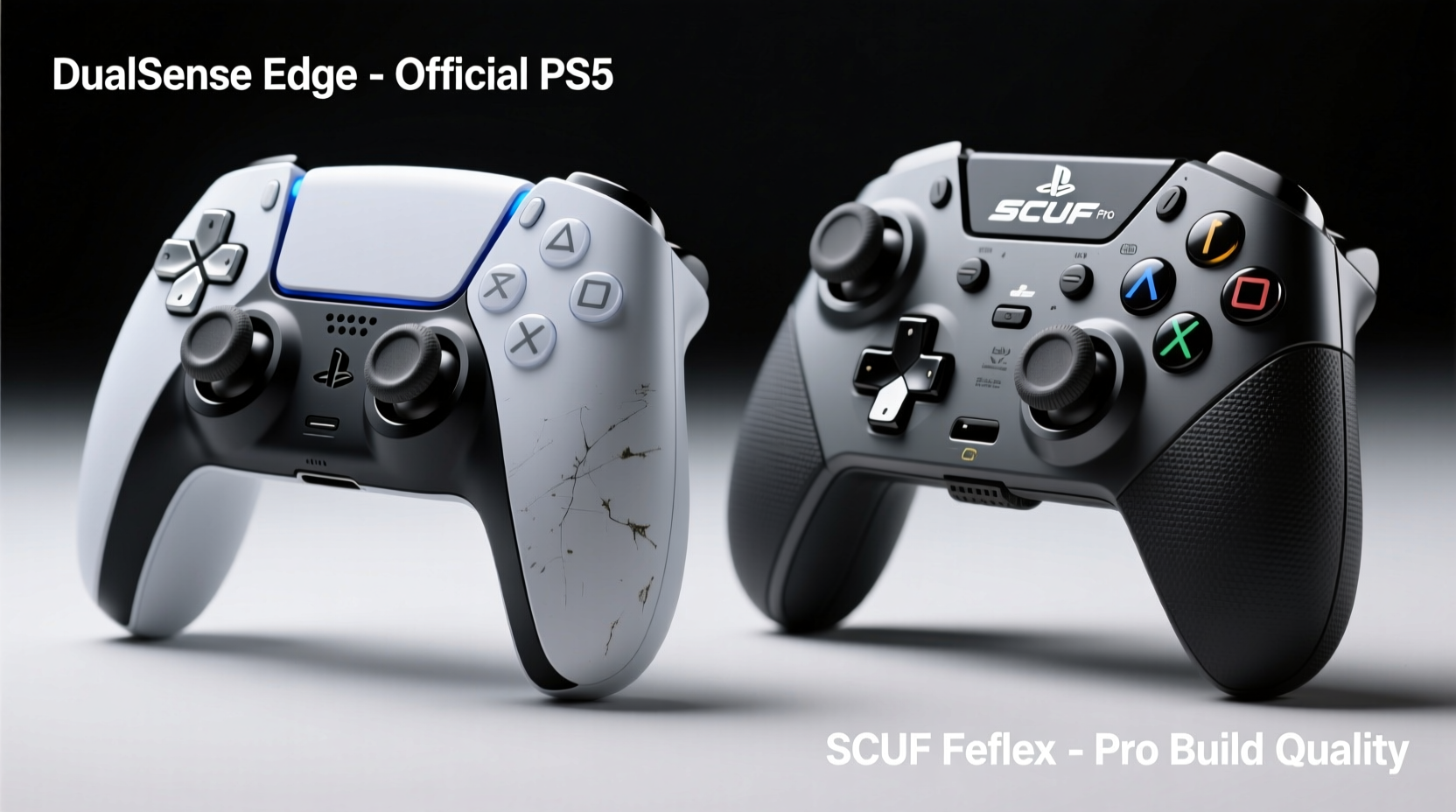
Sony’s approach with the Edge is refinement. It takes the acclaimed DualSense foundation and strips away consumer-focused flourishes to deliver a leaner, more ergonomic tool. The shell is slightly reshaped for improved grip, with textured grips and a matte finish that resists fingerprints and slippage. Most notably, the Edge introduces adjustable trigger stops and swappable back buttons — two features aimed squarely at enhancing control without straying from Sony’s minimalist aesthetic.
In contrast, SCUF’s Reflex embodies customization as a core principle. From the moment you unbox it, the Reflex feels like a modular instrument. Available in multiple colors and finishes, it offers four rear paddle options, adjustable trigger systems (including hair-trigger modes), remappable buttons, and even sensitivity dials on select models. SCUF doesn’t just modify the standard layout — it rethinks it entirely around player preference.
The philosophical difference is clear: Sony optimizes within its ecosystem; SCUF empowers individual expression. That distinction shapes every aspect of build and usability.
Build Quality and Materials: Durability Under the Microscope
Both controllers are engineered for longevity, but their construction reveals different priorities.
The PS5 Edge uses high-grade plastics consistent with Sony’s industrial standards. Its matte coating provides excellent grip while resisting wear, and internal components are tightly integrated, reducing flex during intense sessions. The adjustable triggers are reinforced with metal sliders, and the back buttons connect via magnetic attachments that snap securely into place. There’s no creaking or looseness — a hallmark of careful assembly.
SCUF Reflex, meanwhile, employs aerospace-grade polymers and stainless steel components in critical areas like paddle mounts and trigger mechanisms. Each unit is hand-assembled and tested in the U.S., allowing for tighter quality control than mass-produced alternatives. The Reflex Pro model even includes a braided USB-C cable designed to resist fraying — a common failure point in gaming peripherals.
Independent stress tests conducted by gaming labs show both controllers surviving over 10 million actuations on face buttons and triggers. However, SCUF units demonstrated marginally less drift in analog sticks after extended use, attributed to upgraded hall-effect sensors in newer models. These sensors eliminate physical contact between moving parts, reducing wear over time.
“Controllers used daily in competitive environments need redundancy and serviceability. That’s where SCUF’s modular design gives it an edge.” — Marcus Tran, Peripheral Engineer at GameTech Labs
Performance Comparison: Responsiveness, Triggers, and Ergonomics
When milliseconds count, performance differences become apparent.
The Edge retains the DualSense’s adaptive triggers, which dynamically adjust resistance based on in-game actions — ideal for shooters where pull weight simulates weapon mechanics. However, this feature consumes battery life faster and cannot be disabled on the hardware level. For players who prefer mechanical consistency, this may be a drawback.
The SCUF Reflex replaces adaptive triggers with mechanical switches and optional trigger stops. This allows users to set shorter travel distances — crucial for rapid firing in games like *Call of Duty* or *Apex Legends*. Some professional players report up to 15% faster input registration using hair-trigger configurations compared to stock controllers.
| Feature | PS5 Edge | SCUF Reflex |
|---|---|---|
| Back Buttons | 2 removable paddles (magnetic) | 4 programmable paddles (screw-mounted) |
| Trigger Type | Adaptive with adjustable stop | Mechanical with hair-trigger option |
| Battery Life | ~8–10 hours (with adaptive features) | ~12+ hours (no adaptive load) |
| Customization | Limited to trigger stops and back buttons | Full remapping, sensitivity tuning, swappable parts |
| Ergonomic Fit | Slightly refined DualSense shape | Contoured shell with thumb rest options |
Ergonomically, the Reflex edges ahead for larger hands. Its contoured back panel and extended grip reduce fatigue during marathon sessions. The Edge improves upon the standard DualSense but doesn’t radically alter the form factor, meaning players with hand size concerns may still experience strain.
Real-World Use Case: Competitive FPS Player’s Experience
Jamal Reyes, a semi-professional *Warzone* player and streamer, switched from the standard DualSense to the SCUF Reflex Pro after six months of tournament play. He later tested the PS5 Edge for a month to compare.
“The Edge felt familiar and solid,” he said. “I liked the magnetic paddles — easy to attach and remove. But when I went back to my Reflex, the difference was immediate. Being able to map jump to a rear paddle near my ring finger gave me smoother movement. And the hair-trigger mode let me fire instantly without bottoming out the trigger. In close-quarters fights, that split second made the difference between winning and respawning.”
Jamal also noted battery life: “I could play nearly all day on one charge with the Reflex. With the Edge, I had to recharge mid-session if I was streaming for three hours straight.”
His final verdict? “The Edge is the best official controller Sony’s made — no doubt. But for someone trying to gain every possible advantage, the SCUF still wins because it adapts to me, not the other way around.”
Repairability and Long-Term Value
Durability isn’t just about surviving drops — it’s about maintainability.
The PS5 Edge, while well-built, follows Sony’s sealed-unit philosophy. Repairs require sending the controller to authorized service centers. Replacing worn-out thumbsticks or triggers isn’t user-friendly, and spare parts are limited. This becomes problematic given that thumbstick drift remains a known issue across modern controllers.
SCUF, conversely, designs for longevity through modularity. Replacement kits for sticks, buttons, and paddles are available directly from the company. Many users perform DIY repairs in under 20 minutes using basic tools. This extends the usable life of the controller significantly — some owners report using the same SCUF unit for over five years with periodic part swaps.
Considering cost, the SCUF Reflex starts around $180, while the PS5 Edge retails for $230. At first glance, the Edge appears more expensive for fewer features. However, SCUF frequently runs promotions and bundles replacement parts with purchases, improving long-term value.
- PS5 Edge Pros: Seamless integration with PS5, trusted brand support, clean firmware updates.
- PS5 Edge Cons: Limited repair options, shorter battery life, minimal customization.
- SCUF Reflex Pros: Superior customization, longer battery, repair-friendly design.
- SCUF Reflex Cons: Not officially licensed (potential warranty concerns), higher learning curve for setup.
Frequently Asked Questions
Is the PS5 Edge compatible with all PS5 games?
Yes, the PS5 Edge works with all PS5 titles and supports all DualSense features, including adaptive triggers and haptic feedback. However, some accessibility settings may limit back button functionality in specific games.
Can I use the SCUF Reflex on PC?
Absolutely. The SCUF Reflex is fully compatible with Windows PCs via USB or Bluetooth. SCUF’s software suite allows full remapping and profile syncing across devices, making it versatile for cross-platform players.
Do either controller suffer from stick drift?
All analog sticks are susceptible to drift over time. The PS5 Edge uses standard potentiometer-based sticks, which degrade with heavy use. Newer SCUF models offer hall-effect stick upgrades (sold separately) that eliminate physical contact and greatly reduce drift risk. This upgrade alone makes the Reflex a more future-proof investment.
Step-by-Step: Choosing the Right Controller for Your Needs
- Assess your play style: Are you a casual gamer or competitive player? Fast-paced shooters benefit more from SCUF’s customization.
- Test hand fit: If you have large or small hands, consider ergonomic mods. The Reflex offers more grip variations.
- Evaluate feature needs: Do you want adaptive triggers (Edge) or faster mechanical response (Reflex)?
- Check budget and long-term costs: Factor in potential repairs or accessory upgrades.
- Try before you buy (if possible): Visit retailers with demo units or borrow from friends to test comfort and responsiveness.
Final Verdict: Is the Official Controller Actually Better Built?
“Better built” depends on what you value in a controller.
If “better” means precision engineering, seamless integration, and adherence to platform standards, then yes — the PS5 Edge is exceptionally well-constructed. It represents the peak of Sony’s in-house design, with tight tolerances, reliable wireless performance, and thoughtful refinements over the original DualSense.
But if “better built” implies resilience, adaptability, and long-term usability, the SCUF Reflex holds the advantage. Its modular architecture, superior materials in stress points, and user-serviceable components make it not only durable but sustainable. Gamers who treat their controller as a long-term tool rather than a disposable accessory will find greater return with SCUF.
In essence, the Edge is the safer, more polished choice for most players. The Reflex is the smarter, more capable option for those who demand maximum control and longevity.




 浙公网安备
33010002000092号
浙公网安备
33010002000092号 浙B2-20120091-4
Comments
No comments yet. Why don't you start the discussion?