
The next generation of gaming has arrived, and with it comes a familiar crossroads: should you go all-in on the latest console hardware or invest in a powerful custom PC build? The PlayStation 5 Pro enters the arena as Sony’s most capable console yet—engineered for 4K gaming, ray tracing, and smoother frame rates. Meanwhile, modern PC builds can surpass even high-end consoles in raw performance, offering higher resolutions, faster refresh rates, and unmatched flexibility. But performance isn’t everything. Convenience, ease of use, and long-term ownership matter just as much. So, is the PS5 Pro’s plug-and-play simplicity worth accepting a noticeable performance gap compared to a well-built gaming PC?
Performance: Where the Hardware Stands
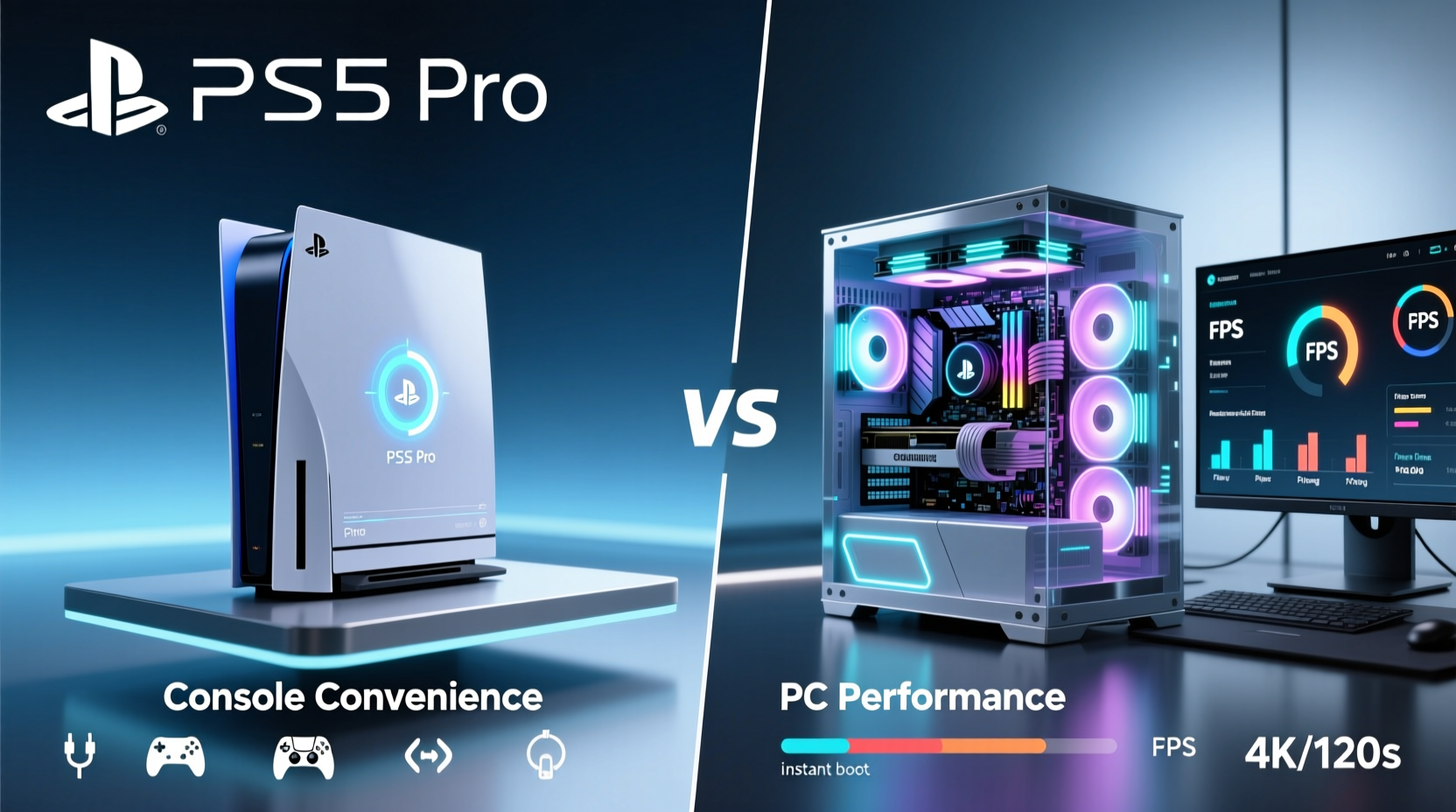
The PS5 Pro boasts significant upgrades over the original PS5. With a more powerful GPU (estimated at 33.5 TFLOPs of performance), enhanced ray tracing capabilities, and improved memory bandwidth, it’s designed to deliver native 4K gaming in select titles and consistently hit 60 FPS—even in demanding games like Spider-Man 2 and Horizon Forbidden West: Burning Shores. It also supports advanced upscaling via PSSR (PlayStation Spectral Super Resolution), Sony’s answer to NVIDIA’s DLSS.
However, even with these improvements, the PS5 Pro remains constrained by fixed hardware. Most games still target 4K at 30–60 FPS, and while PSSR helps, it doesn’t match the fidelity or fluidity possible on high-end PCs. A mid-range gaming PC—say, one built around an AMD Ryzen 5 7600X, NVIDIA RTX 4070, and 16GB DDR5 RAM—can already push 1440p at 100+ FPS in most titles. Upgrade to an RTX 4080 or 4090, and you’re looking at stable 4K at 120 FPS with maxed-out settings and full ray tracing.
The performance gap isn’t trivial—it’s transformative. High refresh rates, ultra-wide monitors, mod support, and unlocked framerates change how games feel. On PC, you’re not limited by developer-imposed caps or console optimization bottlenecks.
“Consoles are about consistency; PCs are about potential. One guarantees a baseline experience, the other lets you chase the ceiling.” — Adrian Chen, Senior Hardware Analyst at GameFrame Labs
Cost Comparison: Upfront and Long-Term
The PS5 Pro retails for $699. That includes the console, controller, HDMI cable, and power cord. No additional investment is required to start playing immediately. In contrast, a competitive gaming PC starts around $1,000 for solid 1080p/1440p performance and quickly climbs to $1,800–$2,500 for true 4K dominance.
But cost isn’t just about upfront price. Consider longevity. Consoles typically last 6–7 years before becoming obsolete. During that time, game developers optimize for the same fixed specs, ensuring consistent performance. However, once new-gen consoles arrive, backward compatibility may limit enhancements.
PCs, meanwhile, are modular. You can upgrade your GPU, RAM, or storage independently. This means a $1,500 build today could see extended life with a $500 GPU upgrade three years from now—something impossible on console. Over a decade, this scalability often makes PC more cost-efficient per year of high-performance gaming.
| Platform | Initial Cost | Max Realistic Gaming Tier | Upgrade Flexibility | Lifespan (High Perf) |
|---|---|---|---|---|
| PS5 Pro | $699 | 4K @ 60 FPS (targeted) | None | 5–6 years |
| Mid-Tier PC (RTX 4070) | $1,200 | 1440p @ 100+ FPS | Full (modular) | 6–8 years (with upgrades) |
| High-End PC (RTX 4080+) | $2,200+ | 4K @ 120+ FPS | Full (modular) | 7–10 years |
Convenience and User Experience
This is where the PS5 Pro shines. From unboxing to first launch, setup takes minutes. No drivers, no BIOS updates, no troubleshooting RAM compatibility. Plug it in, pair the DualSense, connect to Wi-Fi, log into your PSN account, and you’re ready. The UI is intuitive, loading times are fast thanks to the custom SSD, and game installations are seamless.
PC gaming, by comparison, requires technical literacy. Building a PC involves component selection, physical assembly, OS installation, driver management, and ongoing maintenance. Even prebuilt PCs often require post-setup tuning. Issues like stuttering due to background apps, incorrect power plans, or audio glitches are common without proper configuration.
Moreover, the PS5 Pro integrates tightly with Sony’s ecosystem. Features like Activities, Game Help, and Share Play enhance gameplay without third-party tools. Resume multiple games instantly. Use voice commands to capture clips. These conveniences create a frictionless experience that appeals to casual and hardcore gamers alike.
On PC, achieving similar polish requires effort. Tools like Steam, Discord, NVIDIA GeForce Experience, and OBS must be configured manually. Achievements, recording, streaming, and cloud saves are fragmented across platforms unless you centralize them.
Game Library and Exclusivity
Exclusive titles remain Sony’s strongest argument. Games like God of War Ragnarök, The Last of Us Part I, and Marvel’s Spider-Man 2 are only available on PS5. These narrative-driven, visually stunning experiences are optimized perfectly for the console’s hardware and are a major draw for many players.
PC, however, wins on breadth and versatility. It hosts every major digital storefront—Steam, Epic, GOG—and supports indie titles, early access games, emulators, and mods. Platforms like Xbox Game Pass for PC offer hundreds of games for $10/month, including day-one Microsoft exclusives.
Additionally, PC supports peripherals beyond controllers: racing wheels, flight sticks, VR headsets, and multi-monitor setups. Emulation allows you to play classics from PS1 to GameCube in HD with save states and rewind features. Mods can transform games entirely—improving textures, adding gameplay mechanics, or enabling uncapped framerates.
That said, exclusivity cuts both ways. While PC has more games overall, it lacks Sony’s marquee single-player experiences. And though services like Remote Play allow streaming PS5 games to PC, they don’t replace owning the console for native play.
Mini Case Study: Alex’s Dilemma
Alex, a 28-year-old software engineer, faced this decision last fall. He loved immersive single-player games and owned a 55” 4K OLED TV. He valued quality-of-life features and didn’t want to spend weekends troubleshooting drivers. After researching, he bought the PS5 Pro. “I wanted to play Final Fantasy VII Rebirth without building a PC or learning about VRR settings,” he said. “The setup was instant, and the HDR visuals blew me away.”
But six months later, he built a mid-tier PC anyway—mainly for modding The Witcher 3 and playing competitive shooters at 144Hz. His verdict? “The PS5 Pro is my living room machine for story games. My PC is my playground for experimentation and high-FPS action.” For him, both platforms serve distinct roles.
Future-Proofing and Ecosystem Lock-In
One often overlooked factor is ecosystem lock-in. Buying a PS5 Pro ties you to Sony’s platform: PSN, PlayStation Store, proprietary accessories, and closed architecture. You can’t install alternative operating systems or repurpose the hardware. When the PS6 arrives, your PS5 Pro becomes a legacy device—still usable, but no longer cutting-edge.
PCs avoid this trap. Your components retain resale value. Your monitor, keyboard, and headset work across generations. You’re not locked into a single storefront. Steam keys, CD keys, and region-free distribution mean greater freedom in how and where you buy games.
Furthermore, PC is inherently future-proof in a way consoles aren’t. Technologies like AI upscaling (DLSS, FSR), variable refresh rate, and spatial audio are adopted faster on PC. Developers experiment with new input methods, cloud integration, and VR—all more accessible on open platforms.
Checklist: How to Decide Between PS5 Pro and PC
- Choose the PS5 Pro if:
- You prioritize exclusive Sony titles.
- You want a simple, plug-and-play setup.
- Your primary display is a 4K TV (not a high-refresh monitor).
- You dislike technical troubleshooting.
- You play mostly single-player or couch co-op games.
- Choose a PC build if:
- You value high frame rates (100+ FPS) and low input lag.
- You want to mod games or use emulators.
- You plan to upgrade hardware over time.
- You play competitive multiplayer titles.
- You already own peripherals or a good monitor.
FAQ
Can a PS5 Pro match a $1,500 PC in performance?
No. While the PS5 Pro delivers excellent 4K performance, a $1,500 PC with an RTX 4070 or AMD RX 7800 XT will outperform it in resolution, frame rate, and visual settings. The PC also supports higher refresh rates and advanced features like DLSS and modding.
Is it cheaper to game on PS5 Pro long-term?
In the short term, yes. Console games are often cheaper, and subscriptions like PlayStation Plus offer monthly titles. However, PC platforms like Steam sales, Epic giveaways, and Game Pass provide deep discounts and broader access over time, potentially reducing long-term costs.
Can I use my PC to play PS5 exclusives?
Not natively. Some PS5 games come to PC months or years later (e.g., Horizon Zero Dawn, Ghost of Tsushima), but flagship exclusives like Spider-Man 2 or God of War remain console-only for years—if they come to PC at all.
Conclusion: Balancing Performance and Practicality
The PS5 Pro is a triumph of console engineering—offering near-4K performance, elegant design, and effortless usability. For gamers who value exclusives, simplicity, and living room integration, it’s an outstanding choice. But it exists within hard limits. You cannot upgrade it. You cannot mod it. You cannot push beyond its thermal and architectural constraints.
A gaming PC, by contrast, is a gateway to the full spectrum of what interactive entertainment can be. It demands more upfront investment and technical engagement, but rewards you with superior performance, customization, and longevity. The performance gap isn’t just measurable in FPS—it’s felt in responsiveness, immersion, and creative freedom.
So, is console convenience worth the performance gap? For some, absolutely. If your priority is turning on the TV and diving into a cinematic adventure without fuss, the PS5 Pro delivers. But if you crave control, scalability, and the best possible visual experience, a PC build remains the ultimate gaming platform.




 浙公网安备
33010002000092号
浙公网安备
33010002000092号 浙B2-20120091-4
Comments
No comments yet. Why don't you start the discussion?