
In 2025, the next-gen console war has evolved beyond raw hardware specs. While both the PlayStation 5 Pro and Xbox Series X deliver exceptional performance, the real battleground lies in their exclusive content. Gamers are no longer just asking which console runs games faster—they’re asking which one offers experiences they can’t get anywhere else. The question isn’t just about graphical fidelity or frame rates; it’s about narrative depth, studio innovation, and long-term investment. So, when comparing the PS5 Pro and Xbox Series X, is Sony’s exclusive library still the gold standard?
The answer isn’t as straightforward as it once was. Microsoft has made aggressive moves with acquisitions and cloud integration, while Sony continues to double down on cinematic storytelling and polished single-player adventures. But how do these strategies play out for players deciding where to invest their time and money in 2025?
The Evolution of Console Exclusivity in 2025
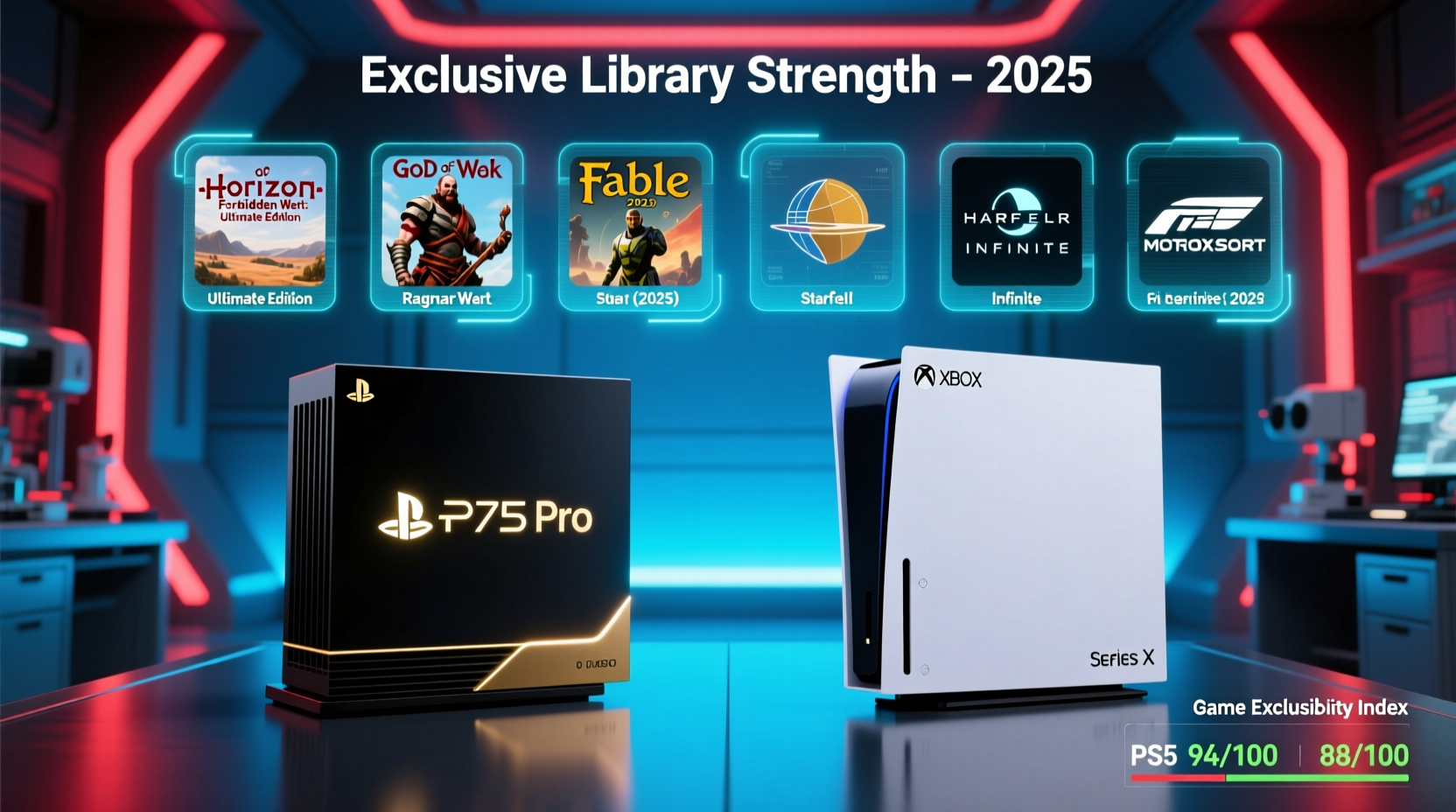
Exclusivity has transformed over the past decade. It’s no longer just about timed releases or permanent platform locks. With Game Pass, cross-platform launches, and remastered ports becoming common, the definition of an “exclusive” has blurred. However, true exclusives—games developed by first-party studios and released only on one platform—still hold significant sway.
Sony’s approach remains focused on high-budget, story-driven titles from studios like Naughty Dog, Santa Monica Studio, and Insomniac Games. These games often define annual gaming trends, winning awards and driving console sales. In contrast, Microsoft has shifted toward a services-first model. Many of its first-party titles, such as Starfield and Forza Motorsport, launch day-one on Game Pass and PC, reducing their perceived exclusivity.
Still, Microsoft owns major franchises through its acquisition of Bethesda, Activision Blizzard, and ZeniMax. That means Call of Duty, The Elder Scrolls VI, and Starfield sequels will likely remain Xbox exclusives—eventually. But the timing and availability raise questions about whether ownership translates to immediate competitive advantage.
A Head-to-Head Comparison of Exclusive Lineups
To assess which library holds more value, let’s examine the current state of each platform’s first-party offerings in 2025.
| Franchise | PS5 Pro (Sony) | Xbox Series X (Microsoft) | Exclusive Status |
|---|---|---|---|
| God of War | God of War: Ragnarök – Valhalla DLC (2024), New Entry in Development | N/A | Permanent |
| Spider-Man | Spider-Man 2 (2023), Superior Spider-Man Spin-off (2025) | N/A | Permanent |
| Halo | N/A | Halo Infinite (ongoing), Halo Reboot Projected 2026 | Permanent |
| Final Fantasy XVI | Yes (console exclusive) | No | Timed (until 2026) |
| Call of Duty | Available at launch | Day-one on Game Pass, potential future delays post-acquisition | Platform parity expected |
| The Last of Us | Part I Remake, Part III in Development | Remake available on PC, console version Xbox-ineligible | Permanent (console) |
| Elder Scrolls / Fallout | Available via PC/Cloud later | TES VI and Fallout 5 confirmed Xbox/PC exclusives | Permanent (with caveats) |
Sony’s lineup remains stronger in terms of quantity and cultural impact of recent releases. Games like Marvel’s Spider-Man 2 and Final Fantasy XVI were system-sellers, while Microsoft’s 2023–2025 output has been lighter, relying heavily on live-service titles and older IPs in transition.
“Sony’s consistent delivery of polished, narrative-rich exclusives gives them a psychological edge—even if Microsoft owns more franchises on paper.” — Lena Reyes, Senior Analyst at GameTrend Insights
The Value of Narrative Depth vs. Franchise Scale
Sony excels at crafting immersive, character-driven experiences. Their exclusives often resemble interactive films, with high production values, voice acting from Hollywood talent, and cinematic direction. This appeals to a broad demographic, including casual gamers and non-traditional audiences.
Take Ghost of Tsushima: Director’s Cut or Horizon Forbidden West—both received widespread acclaim not just for gameplay but for world-building and emotional resonance. These titles don’t just entertain; they generate conversation, inspire fan art, and influence game design across the industry.
Microsoft, meanwhile, owns some of the largest franchises in gaming history. Call of Duty alone generates billions annually. Yet, recent entries have faced criticism for formulaic design and monetization-heavy models. Similarly, while Halo Infinite stabilized after a rocky start, it hasn’t reached the cultural peak of earlier entries.
The upcoming The Elder Scrolls VI could change that equation. If Microsoft delivers a groundbreaking open-world RPG in the next two years, it would instantly shift the balance. But until then, Sony holds the upper hand in delivering consistent, high-quality exclusive experiences that resonate emotionally and critically.
Mini Case Study: How One Gamer Chose Based on Exclusives
Meet Alex, a 32-year-old software developer and longtime Xbox user. He owned every Xbox since the original and subscribed to Game Pass Ultimate since launch. But in early 2024, he purchased a PS5 Pro.
“I loved having access to so many games,” Alex explains, “but I kept hearing about Spider-Man 2 and Final Fantasy XVI. My friends were raving about the story, the combat, the visuals. I tried streaming them, but it wasn’t the same. I wanted to experience those games natively, with DualSense haptics and zero latency.”
After playing Spider-Man 2, Alex didn’t go back. “It felt like a movie I was inside. The way the suit tears, the web-swinging momentum—it’s unmatched. I still keep my Xbox for multiplayer, but my single-player time is all PS5 now.”
His story reflects a broader trend: even loyal fans are switching platforms for specific exclusive experiences, especially those leveraging advanced hardware features like the PS5 Pro’s enhanced ray tracing and SSD speeds.
Hardware Synergy: How the PS5 Pro Enhances Exclusive Titles
The PS5 Pro isn’t just a modest upgrade—it’s engineered to maximize the potential of Sony’s exclusive games. With up to 45% faster GPU performance, improved ray tracing, and PSSR (PlayStation Spectral Super Resolution), developers can push visual fidelity further than on base PS5 or even Xbox Series X in some cases.
For example, Marvel’s Wolverine (expected late 2025) is rumored to use dynamic weather systems, real-time fur rendering, and adaptive audio—all optimized for the PS5 Pro’s custom silicon. These features aren’t just cosmetic; they deepen immersion in a way that matters most for story-driven games.
In contrast, Xbox Series X remains powerful but lacks equivalent generational leap advantages. Its strength lies in backward compatibility and Game Pass integration, not in showcasing next-level exclusive visuals. While Smart Delivery ensures you get the best version of a game, few first-party Xbox titles in 2024–2025 have fully leveraged the hardware in transformative ways.
Looking Ahead: What’s Coming in 2025 and Beyond
The future pipeline reveals much about each company’s priorities.
- Sony has confirmed Horizon: Awakening (VR title), Ghost of Yōtei, a new Twisted Metal reboot, and The Last of Us Part III. They’re also investing heavily in live-service experiments without sacrificing single-player roots.
- Microsoft is banking on Fable (reboot), Avowed expansions, and eventually Elder Scrolls VI. However, none of these are expected before 2026, creating a content gap in 2025.
This delay gives Sony a critical window to reinforce brand loyalty. Players who buy a PS5 Pro for current exclusives are more likely to stay within the ecosystem when future titles release.
“Owning IP is important, but releasing great games consistently is what wins consoles wars. Right now, Sony is executing; Microsoft is rebuilding.” — Marcus Tran, Editor-in-Chief, NextGen Play
Checklist: How to Decide Which Exclusive Library Matters Most to You
Use this checklist to evaluate your personal preferences:
- ✅ Do you prefer story-rich, single-player experiences? → Lean toward PS5 Pro.
- ✅ Are you invested in franchises like Halo, Fallout, or Starfield? → Xbox may offer long-term value.
- ✅ Do you already subscribe to Game Pass and play mostly online/multiplayer? → Xbox ecosystem enhances value.
- ✅ Do you care about cutting-edge visuals and haptic feedback? → PS5 Pro provides superior immersion.
- ✅ Are you waiting for Elder Scrolls VI or a new Call of Duty innovation? → Monitor Microsoft’s 2026+ roadmap.
- ✅ Do you want to play exclusives immediately, not years later on PC? → PS5 Pro offers firmer exclusivity guarantees.
FAQ
Will Xbox exclusives ever match PlayStation’s critical acclaim?
Potentially, yes—but not yet. While Microsoft has the resources and IP, their recent first-party output has lacked the polish and innovation of Sony’s top-tier titles. Success depends on execution, not ownership. If Elder Scrolls VI or Fable delivers a landmark experience, the balance could shift.
Can I play PS5 exclusives on PC? Does that reduce their value?
Some can, but not all. Titles like God of War Ragnarök and Horizon Zero Dawn have released on PC, but with delays of 1–2 years. The full experience—including DualSense integration and VR modes—is only available on PlayStation. For many fans, the console version remains definitive.
Is Game Pass making exclusives less important?
It changes the dynamic, but doesn’t eliminate importance. Game Pass offers breadth, but exclusives drive desire. People still buy consoles for specific games. Even with access to hundreds of titles, users cite Spider-Man 2 and The Last of Us as primary reasons for choosing PlayStation.
Conclusion: The Verdict on Exclusive Value in 2025
In 2025, the PS5 Pro’s exclusive library is objectively stronger than the Xbox Series X’s—not because of corporate ownership, but because of consistent delivery, technical innovation, and emotional impact. Sony has mastered the art of turning games into cultural events. Meanwhile, Microsoft’s strategy prioritizes accessibility and long-term portfolio growth, but lacks immediate standout exclusives.
This doesn’t mean Xbox is losing. Their investments in cloud gaming, PC integration, and blockbuster IPs position them well for the latter half of the decade. But for today’s gamer deciding between consoles, the PS5 Pro offers a clearer, more compelling reason to choose one platform over the other: games you can’t play anywhere else, right now, at the highest possible quality.
Ultimately, exclusives aren’t just about ownership—they’re about experience. And in 2025, PlayStation continues to deliver experiences that define the generation.




 浙公网安备
33010002000092号
浙公网安备
33010002000092号 浙B2-20120091-4
Comments
No comments yet. Why don't you start the discussion?