
When Sony introduced the PS5 Slim in late 2023, fans welcomed the sleeker design and reduced footprint. But a pressing question emerged: beyond its smaller size, does the PS5 Slim offer any meaningful improvements over the original model? Gamers want to know if upgrading is worth it—or if this is simply a cosmetic refresh. The answer lies not in raw power, but in thoughtful engineering, storage flexibility, and long-term usability.
The core promise of the PS5 Slim remains unchanged: deliver high-fidelity gaming at 4K resolution, support for ray tracing, ultra-fast load times via SSD, and immersive audio through Tempest 3D AudioTech. Yet, beneath the surface, subtle changes affect user experience, setup convenience, and future-proofing. This article dissects every aspect of both models to determine whether the differences are purely aesthetic or if practical advantages tip the scale.
Design and Physical Differences
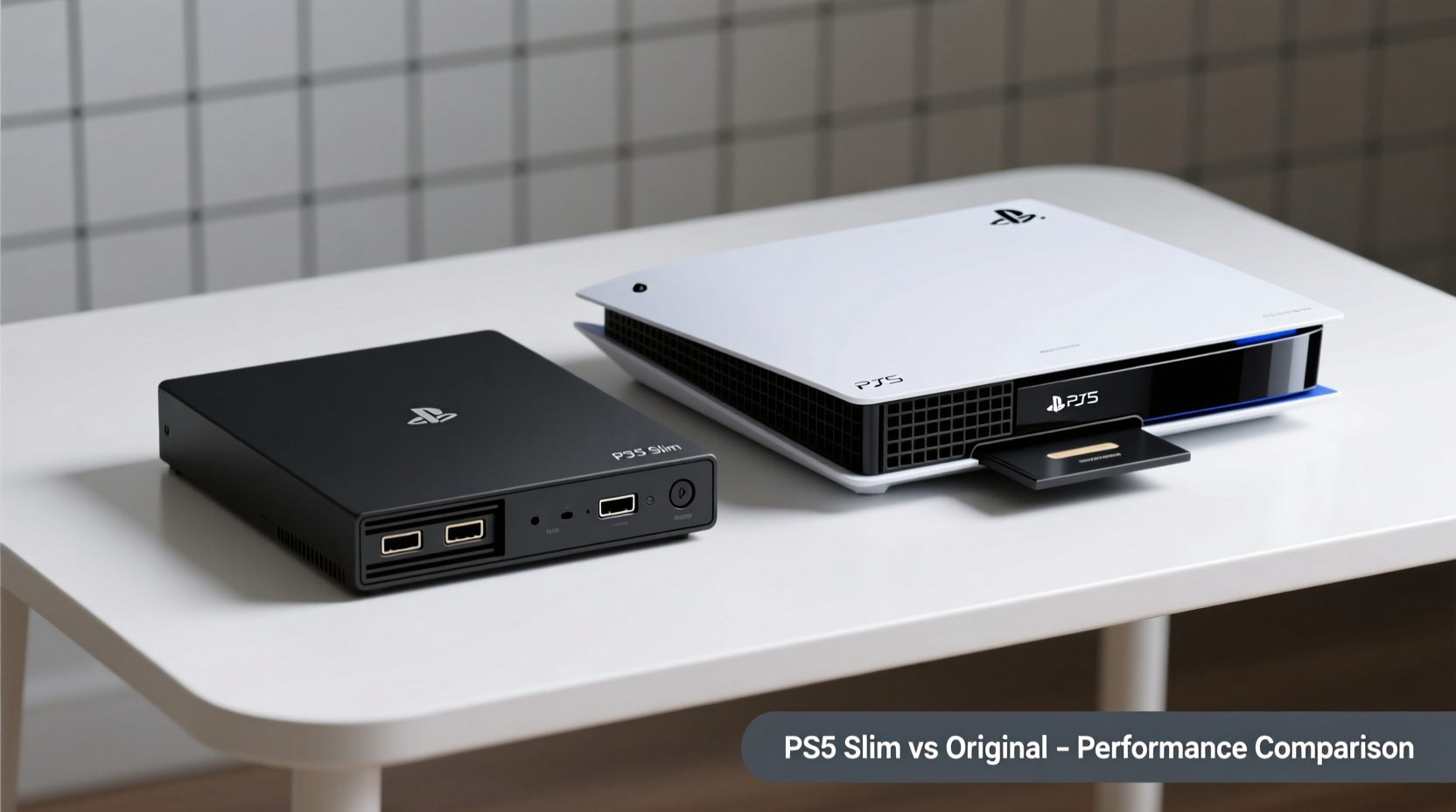
The most immediate distinction between the original PS5 and the PS5 Slim is physical. The original launch model, with its bold two-tone white-and-black design and large wing-like panels, was polarizing—some praised its futuristic look, others found it too bulky for standard entertainment centers. At approximately 390mm tall, 260mm deep, and 104mm wide, the original PS5 demands space and careful placement.
In contrast, the PS5 Slim trims down significantly. It’s about 30% smaller by volume and redesigned with a more modular panel system. The new model measures roughly 358mm x 216mm x 96mm (H x D x W), making it easier to fit into tighter AV setups. The detachable side panels snap on magnetically instead of using screws, simplifying customization. Additionally, the base now supports both vertical and horizontal orientations without requiring separate adapters—unlike the original, which needed an extra screw-in stand for horizontal positioning.
Another notable visual change is the disc drive. On the original PS5, the Ultra HD Blu-ray drive is integrated directly into the console. In the Slim, it’s a removable module that attaches to the side. This allows Sony to sell a single base model (digital-only) and offer the disc drive as an add-on, reducing manufacturing complexity and giving users flexibility.
Performance: Identical Under the Hood
Despite the redesign, Sony made no changes to the core hardware specifications. Both consoles feature the same custom AMD Zen 2 CPU, RDNA 2 GPU, and 825GB custom SSD. As a result, frame rates, resolution output, loading speeds, and graphical fidelity remain identical across titles. Games like *Spider-Man: Miles Morales*, *Horizon Forbidden West*, and *God of War Ragnarök* run with the same fluidity and visual richness on both models.
Thermal performance has been a concern with the original PS5, particularly due to reports of fan noise during extended sessions. The Slim addresses this with a re-engineered internal layout and improved airflow channels. While benchmark tests show similar peak temperatures, the revised heatsink and fan configuration lead to marginally quieter operation under load. However, these gains are subtle—not transformative.
“From a performance standpoint, the PS5 Slim isn’t an upgrade—it’s a refinement. The same power, better packaging.” — David Lee, Senior Hardware Analyst at GameTech Weekly
It’s important to emphasize: there is no increase in processing power, memory bandwidth, or storage speed. The GPU still delivers up to 10.28 teraflops, and the SSD maintains a throughput of 5.5 GB/s. Any perceived improvement in responsiveness comes from firmware optimizations or external factors like TV input lag or network conditions—not the console itself.
Storage Capacity and Expandability
One area where the PS5 Slim introduces tangible changes is storage. The original PS5 came in two variants: a 825GB model with a disc drive and a slightly cheaper digital edition without one. Both had the same internal capacity, leaving users with around 667GB of usable space after system files.
The PS5 Slim increases base storage significantly. The digital-only model now offers 1TB of internal storage, while the version with the detachable disc drive boasts 2TB—a substantial leap for gamers who install multiple AAA titles, each often exceeding 100GB. For context, a single game like *Call of Duty: Modern Warfare III* can consume over 250GB with updates and multiplayer content.
| Model | Internal Storage | Disc Drive | Expandable? |
|---|---|---|---|
| Original PS5 (Disc) | 825GB | Integrated | Yes (NVMe SSD slot) |
| Original PS5 (Digital) | 825GB | No | Yes |
| PS5 Slim (Base) | 1TB | No | Yes |
| PS5 Slim (w/ Disc) | 2TB | Modular (add-on) | Yes |
Both models support M.2 NVMe SSD expansion via a dedicated internal slot, allowing users to add up to 8TB of additional storage. However, the larger base capacity of the Slim reduces the urgency to upgrade immediately. Gamers who frequently delete and redownload games will appreciate the breathing room.
Real-World User Experience: A Mini Case Study
Consider Mark, a longtime PlayStation owner living in a small apartment with a wall-mounted TV and a narrow media shelf. His original PS5 barely fit horizontally, forcing him to mount it vertically—an orientation he disliked because of dust accumulation near the base. After switching to the PS5 Slim, he found it slid neatly into his existing cabinet, even with the disc drive attached. The magnetic panels allowed him to swap colors seasonally, adding a personal touch.
More importantly, the 2TB model eliminated his constant juggling of game installations. Previously, he’d spend 20 minutes weekly managing storage—deleting *Ghost of Tsushima* to make room for *Final Fantasy XVI*, only to reinstall it days later. With double the space, he kept all six of his most-played games installed simultaneously. While gameplay performance didn’t improve, his daily friction decreased noticeably.
He also appreciated the quieter fan during marathon sessions. Though not silent, the Slim’s thermal management reduced background whirring during late-night play, improving immersion without altering graphical quality.
Upgrade Considerations and Practical Checklist
For current PS5 owners, the decision to switch hinges on specific needs rather than performance gains. The following checklist helps evaluate whether the PS5 Slim is a worthwhile investment:
- ✅ Need more internal storage? → The 2TB model solves frequent deletion cycles.
- ✅ Limited space in entertainment center? → The Slim’s compact size improves fit.
- ✅ Want easier customization? → Magnetic panels simplify color swaps.
- ✅ Prefer horizontal orientation? → Slim includes universal stand; original requires separate purchase.
- ✅ Still using the original PS5 without issues? → No compelling reason to upgrade unless convenience matters.
New buyers, however, should lean toward the Slim. It represents the current generation of Sony’s design thinking and offers better value out of the box. Even the digital-only 1TB model provides more usable space than the original’s 825GB, and the optional disc drive can be added later if physical media becomes appealing.
Frequently Asked Questions
Can I transfer my games and data from the original PS5 to the PS5 Slim?
Yes. Using Wi-Fi, a LAN cable, or an external USB drive, you can migrate your entire library—including saved games, settings, and installed titles—to the PS5 Slim. The process is seamless and officially supported by Sony.
Is the detachable disc drive sold separately expensive?
The standalone Ultra HD Blu-ray drive costs $79.99 USD. When purchased with the base digital Slim model, the combined price is slightly higher than the original bundle, but you gain extra storage and design benefits.
Does the PS5 Slim support all original PS5 accessories?
Absolutely. DualSense controllers, Pulse 3D headset, charging station, and camera are fully compatible. The only difference is the disc drive attachment mechanism, which doesn’t affect peripheral functionality.
Expert Insight on Console Evolution
Console revisions are common in the industry. Microsoft followed a similar path with the Xbox One S and Xbox Series X|S revisions. These updates rarely boost performance but focus on efficiency, reliability, and user-centric refinements.
“Mid-cycle refreshes like the PS5 Slim aren’t about raw power—they’re about maturing the product. Smaller size, better thermals, smarter storage. That’s how you extend a console’s lifespan.” — Dr. Lena Torres, Console Design Researcher at TechInsight Labs
This philosophy aligns with Sony’s approach. By refining the chassis, improving serviceability, and increasing default storage, they enhance longevity without fragmenting the software ecosystem. Developers continue targeting a single performance tier, ensuring consistent experiences across all PS5 models.
Conclusion: Size Matters, But Performance Doesn’t Change
The PS5 Slim is not a next-generation leap—it’s an evolution of the same powerful machine. There is no performance difference between it and the original PS5. Frame rates, load times, and graphical capabilities are indistinguishable. What changes is convenience: reduced footprint, increased base storage, modular disc support, and quieter operation.
If you already own the original PS5 and are satisfied with its performance and setup, upgrading isn’t necessary. But for new buyers or those constrained by space and storage, the PS5 Slim offers meaningful quality-of-life improvements. It’s the same powerhouse wrapped in a smarter, more adaptable design.




 浙公网安备
33010002000092号
浙公网安备
33010002000092号 浙B2-20120091-4
Comments
No comments yet. Why don't you start the discussion?