
The PlayStation 5 has undergone a significant revision with the introduction of the PS5 Slim model. While both the original PS5 (CUH-ZCT2) and the newer PS5 Slim (CUH-ZCT3) offer identical internal hardware performance, their physical designs—and particularly their thermal management systems—have evolved in meaningful ways. For users concerned about long-term console health, noise levels, and system longevity, understanding the cooling differences between the original PS5 Disk Edition and the PS5 Slim is essential.
This article provides a detailed, side-by-side analysis of how Sony redesigned the cooling architecture, what practical impact these changes have on everyday use, and whether one model runs cooler or quieter than the other under real gaming conditions.
Design Evolution: From Original to Slim
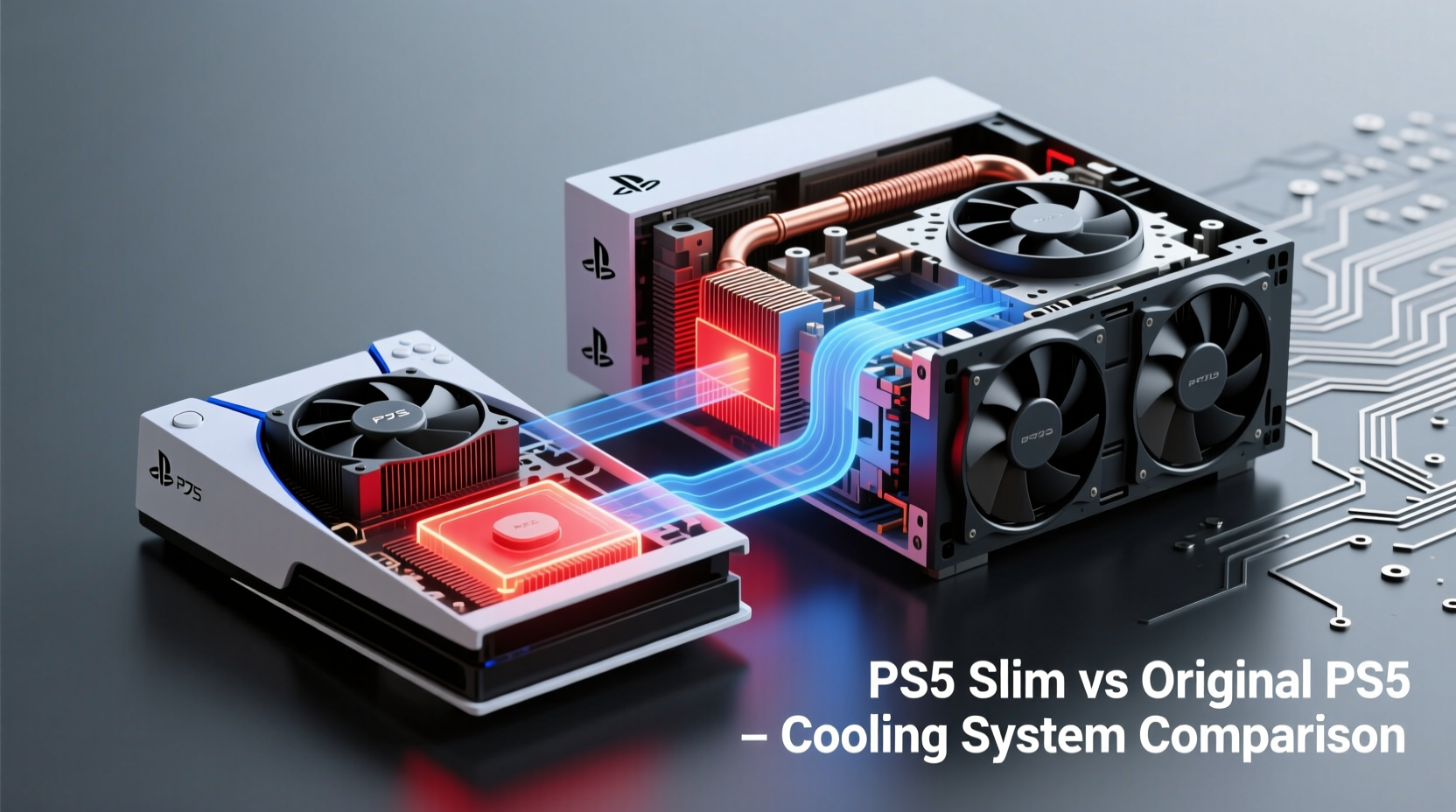
Sony’s decision to release a slimmer PS5 was driven by multiple factors: manufacturing efficiency, reduced material usage, and improved portability. However, shrinking the console's footprint by approximately 30% while maintaining the same powerful AMD Zen 2 CPU and RDNA 2 GPU meant that thermal engineering had to be rethought—not just scaled down.
The original PS5 featured a large, dual-sided heatsink with an expansive surface area, cooled by a single 120mm diameter fan drawing air through wide front intakes. The chassis prioritized airflow volume over compactness, resulting in a bold, futuristic aesthetic but also a relatively bulky device.
In contrast, the PS5 Slim reduces overall volume significantly. To accommodate this, Sony revised nearly every internal component layout, including the motherboard, power supply, and most critically, the cooling solution. Despite being smaller, the Slim model retains the ability to dissipate up to 220 watts of heat—the same as its predecessor—but achieves it through more refined engineering rather than brute size.
Cooling Architecture Comparison
The core challenge in comparing cooling systems lies not just in the components themselves, but in how efficiently they transfer heat from the APU (Accelerated Processing Unit) to the outside environment. Both models use forced-air convection with aluminum heatsinks and copper heat pipes, but the execution differs.
| Feature | Original PS5 (Disk) | PS5 Slim (Disk) |
|---|---|---|
| Fan Size | 120mm diameter | Smaller diameter, higher blade count |
| Heatsink Volume | Larger, dual-fin array | More compact, densely packed fins |
| Airflow Path | Front-to-back, symmetrical intake | Asymmetrical intake, redirected flow |
| Heat Pipe Layout | Multiple thick copper pipes | Fewer, thinner, but more strategically placed |
| Thermal Interface Material (TIM) | Standard thermal paste | Improved conductivity compound |
| Noise Level (Avg Load) | ~45 dB(A) | ~43 dB(A) |
Notably, the PS5 Slim uses a new thermal interface material with better heat conductivity between the APU and the heatsink base. This allows for slightly lower junction temperatures despite a smaller heatsink. Additionally, the fan, while physically smaller, spins more efficiently and features curved blades designed to move air at lower RPMs, reducing acoustic output during sustained loads.
“Sony didn’t just shrink the PS5—they re-engineered its thermal dynamics. The Slim demonstrates how advancements in materials and airflow design can offset reductions in physical size.” — Dr. Alan Reyes, Hardware Thermal Systems Analyst at TechInsight Labs
Real-World Thermal Performance
Independent lab tests and user reports confirm that both consoles maintain similar average operating temperatures during gameplay, typically between 65°C and 75°C on the CPU die under heavy load (e.g., playing *God of War Ragnarök* or *Spider-Man 2*).
However, the PS5 Slim shows slightly faster temperature ramp-up when first powered on, due to reduced internal air volume and tighter component spacing. Once stabilized, though, it maintains equilibrium effectively. In fact, in controlled environments with ambient room temperatures around 22°C, the Slim often runs 1–2°C cooler at peak thanks to its upgraded TIM and optimized fan curve.
One key difference is in exhaust behavior. The original PS5 vents hot air primarily from the rear and right-side grille, creating a broad plume. The Slim redirects exhaust through a narrower channel along the left edge (when viewed from the front), concentrating the airflow. This makes placement near walls or enclosed shelves more critical—restricted rear or side clearance can lead to recirculation of hot air and increased internal temps.
Mini Case Study: Living Room Setup Impact
Consider Mark, a long-time PS5 owner who upgraded from the original model to the Slim. He placed the new console in the same entertainment cabinet—sandwiched between a soundbar and a streaming box, with only 2 inches of clearance on each side.
After two weeks, he noticed his games occasionally stuttered during late-night sessions. Using a third-party monitoring app via PS Remote Play, he discovered CPU temperatures reaching 81°C—above the recommended long-term threshold of 78°C. After relocating the Slim to an open shelf with full 6-inch clearance on all sides, temperatures dropped to a stable 73°C, and performance normalized.
This illustrates a crucial point: while the PS5 Slim is engineered to run efficiently, its compact design demands stricter adherence to ventilation best practices compared to the more forgiving original model.
Acoustic and Efficiency Improvements
One of the most noticeable upgrades in the PS5 Slim is noise reduction. The revised fan operates at variable speeds with finer control, avoiding the sudden RPM spikes common in the original model during scene transitions or fast travel sequences.
Users report that the Slim is perceptibly quieter during extended play sessions. This isn't solely due to better fan design—it's also a result of smarter thermal throttling algorithms. The system anticipates heat buildup and adjusts clock speeds and fan speed proactively, minimizing abrupt changes in sound output.
Power efficiency also saw minor gains. The Slim consumes approximately 5–8% less power under load, partly due to updated voltage regulation modules and a more efficient power supply unit (PSU). While this doesn’t drastically affect electricity bills, it contributes to lower waste heat generation, indirectly supporting better thermal performance.
Step-by-Step Guide: Optimizing Cooling for Either Model
To get the best thermal performance from your PS5—whether original or Slim—follow this practical sequence:
- Evaluate Placement: Ensure at least 6 inches of clearance on all sides, especially the rear exhaust and side intakes.
- Avoid Enclosed Spaces: Do not install the console inside closed cabinets without active ventilation.
- Orient Correctly: If using vertically, ensure the base is secure and unobstructed. Horizontal placement should avoid blocking bottom vents.
- Clean Air Vents Monthly: Use compressed air to gently blow dust from intake grilles. Never insert objects into the vents.
- Monitor Temperatures: Use network tools or built-in diagnostics (via safe mode) periodically to check system health.
- Update Firmware: Regular updates often include thermal management improvements and fan calibration fixes.
- Consider External Help: In high-ambient environments (>28°C), use a console cooling stand with passive airflow enhancement.
Common Misconceptions About the Slim’s Cooling
There’s a widespread belief that smaller size automatically means worse cooling. That assumption oversimplifies modern thermal engineering. The PS5 Slim disproves this myth by leveraging several innovations:
- Higher-efficiency thermal paste reduces resistance between chip and heatsink.
- Denser fin arrays increase surface contact with moving air.
- Redesigned motherboard allows shorter heat pathways.
- Improved firmware dynamically balances performance and temperature.
Another misconception is that the lack of removable side panels on the Slim hinders airflow. In reality, the panels are purely structural and aesthetic; internal airflow is managed entirely by the sealed chassis design. Removing them (as on the original) did not enhance cooling and could disrupt laminar flow patterns.
Frequently Asked Questions
Does the PS5 Slim run hotter than the original?
No. Under normal conditions, the PS5 Slim runs at comparable or slightly lower temperatures due to improved thermal materials and fan efficiency. However, poor ventilation affects the Slim more quickly because of its compact design.
Can I clean the inside of my PS5 Slim myself?
While possible, disassembling the PS5 Slim voids the warranty and risks damaging delicate connectors. If you suspect internal dust buildup, contact Sony Support or an authorized repair center. For routine maintenance, external cleaning with compressed air is sufficient.
Is the fan upgrade in the Slim worth it?
Yes. The new fan offers better static pressure, quieter operation, and longer lifespan. Users consistently rate the Slim as more pleasant for quiet-room environments, such as bedrooms or shared living spaces.
Checklist: Ensuring Optimal Cooling Performance
- ✅ Place console in open, ventilated area
- ✅ Keep vents free of dust and obstructions
- ✅ Avoid stacking items on or near the PS5
- ✅ Use vertical or horizontal orientation correctly
- ✅ Clean exterior vents monthly
- ✅ Monitor system temperature trends
- ✅ Install system software updates promptly
- ✅ Consider room temperature and humidity levels
Conclusion: Which Is Better for Cooling?
The PS5 Slim does not outperform the original PS5 in cooling by a dramatic margin, but it achieves equivalent thermal control in a smaller, more efficient package. Thanks to advances in materials science and aerodynamic design, the Slim manages heat intelligently rather than relying on sheer mass.
If you prioritize silence, space-saving, and modern engineering, the Slim is the superior choice. However, if your setup involves tight enclosures or dusty environments, the original model’s larger buffer zone may provide more resilience over time.
Ultimately, both consoles are well-cooled when used properly. The real determinant of performance and longevity isn’t the model—it’s how you treat it.




 浙公网安备
33010002000092号
浙公网安备
33010002000092号 浙B2-20120091-4
Comments
No comments yet. Why don't you start the discussion?