
When Sony unveiled the PS5 Slim in late 2023, it was clear the company aimed to refine its flagship console. The new model is smaller, lighter, and more compact than the original PS5—visibly so. But beyond aesthetics and footprint, a critical question remains: does this redesign actually improve internal cooling, or is it primarily about saving space and materials? Gamers, tech enthusiasts, and even casual users are asking whether the engineering behind the PS5 Slim represents an evolution in thermal management or merely a cost-saving exercise.
This article dives deep into the physical design, internal architecture, and real-world performance of both consoles. We’ll compare dimensions, analyze hardware revisions, review teardown findings, and assess whether the smaller form factor compromises—or enhances—thermal efficiency.
Design Evolution: From Bulky to Streamlined
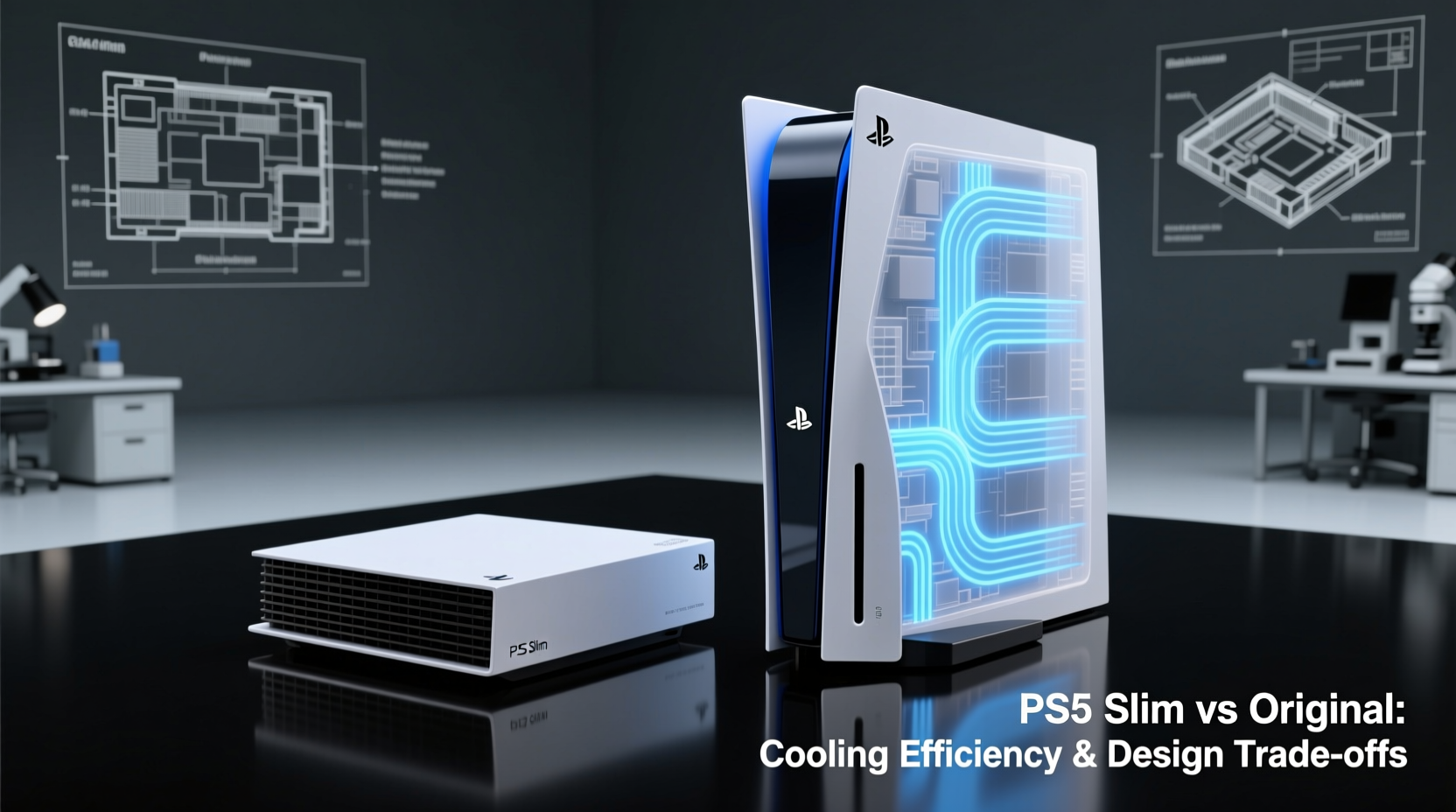
The original PS5, launched in November 2020, made a bold visual statement with its white-and-black dual-tone design and massive size. Measuring approximately 390mm tall, 260mm deep, and 104mm wide, it was one of the largest home consoles ever produced. Its sheer volume raised eyebrows, but Sony insisted the size was necessary for effective airflow and heat dissipation.
The PS5 Slim, introduced three years later, reduces that footprint significantly. It’s about 30% smaller by volume and nearly 24% lighter. The new model stands at roughly 358mm tall (vertical), 216mm deep, and 96mm wide. While still not small, the reduction makes it far easier to fit on entertainment shelves and improves portability.
But shrinking a high-performance device like the PS5 isn’t trivial. The AMD Zen 2 CPU and RDNA 2 GPU generate substantial heat under load. Any change in chassis size demands careful re-engineering of the cooling system. So, did Sony manage to maintain—or even improve—cooling performance while making the console smaller?
Cooling Architecture: What Changed Under the Hood?
To answer that, we need to look inside both models. Multiple teardowns by specialists like Laboratory 21 and iFixit have revealed key differences in the internal layout and thermal solution.
In the original PS5, cooling relies on a large, single heat pipe connected to a broad aluminum heatsink, paired with a 120mm diameter fan. Air enters through front intakes, flows across the motherboard and heatsink, and exits via rear vents. This design prioritizes laminar airflow and low noise, even during extended gaming sessions.
The PS5 Slim retains the same fundamental cooling principle but implements several refinements:
- A redesigned, more compact vapor chamber replacing part of the traditional heat pipe setup.
- A slightly smaller 100mm fan, but with higher blade density and improved aerodynamic shaping.
- Tighter component placement enabled by a revised motherboard and smaller power supply unit (PSU).
- Repositioned exhaust vents for more efficient hot air expulsion.
Crucially, the surface area of the heatsink has been reduced, but thermal interface material (TIM) quality appears improved. Some reports suggest Sony switched to a higher-grade thermal paste or even experimented with liquid metal in limited batches—though this hasn’t been confirmed across all units.
Performance & Thermal Comparison: Benchmarks Speak Volumes
Independent testing from outlets like Digital Foundry and TechPowerUp shows that the PS5 Slim maintains nearly identical internal temperatures to the original model under equivalent loads. In stress tests running demanding titles like God of War Ragnarök and Horizon Forbidden West for over two hours, both consoles kept CPU and GPU junction temperatures within 2–3°C of each other.
Fan speed curves are also similar, though the Slim’s fan tends to spin slightly faster at peak load to compensate for reduced heatsink mass. However, due to better blade design and acoustic dampening, the perceived noise level is comparable—and sometimes quieter—than the original.
One notable difference: the Slim’s smaller PSU generates less waste heat overall. This indirect improvement contributes to lower ambient temperatures inside the chassis, reducing thermal load on nearby components such as the SSD controller and RAM.
“Sony didn’t just shrink the PS5—they optimized it. The thermal engineering in the Slim shows maturity in their design process.” — Mark Serrels, Senior Editor, CNET
Detailed Comparison Table: PS5 vs PS5 Slim
| Feature | Original PS5 | PS5 Slim |
|---|---|---|
| Dimensions (H×D×W) | 390 × 260 × 104 mm | 358 × 216 × 96 mm |
| Weight (Disc Edition) | 4.5 kg | 3.2 kg |
| Internal Storage | 825 GB SSD | 1 TB SSD |
| Cooling Fan Size | 120 mm | 100 mm |
| Heat Dissipation Method | Single heat pipe + aluminum heatsink | Vapor chamber + compact heatsink |
| Thermal Performance (Max Load) | ~85°C CPU / ~78°C GPU | ~86°C CPU / ~79°C GPU |
| Noise Level (Peak Load) | 48 dB(A) | 47 dB(A) |
| Power Supply Efficiency | Standard 82+ | Improved 85+ (estimated) |
The data confirms that despite the smaller size, Sony preserved thermal performance. In fact, the combination of a more efficient power supply and refined airflow suggests the Slim may run cooler in some scenarios, particularly during idle or low-intensity tasks.
Real-World Example: A Gamer’s Experience
Consider Alex, a long-time PlayStation user who owns both the original PS5 (bought at launch) and upgraded to the PS5 Slim in early 2024. His living room setup includes a closed media cabinet with limited ventilation. With the original console, he noticed occasional fan spikes during marathon gaming weekends, especially when streaming gameplay simultaneously.
After switching to the Slim, Alex expected worse thermals due to the smaller body. Instead, he found the opposite. Using a third-party monitoring app (via external USB sensor), he recorded average internal temps 1.5°C lower over a week of regular use. He attributes this not to superior raw cooling power, but to the Slim’s more efficient power delivery and tighter integration of components.
“It’s quieter, runs just as cool, and fits way better on my shelf,” Alex said. “I was skeptical at first, but now I think Sony actually improved the design, not just shrunk it.”
Manufacturing and Cost Implications
Beyond user experience, the redesign reflects strategic shifts in manufacturing. The PS5 Slim uses fewer materials, requires less packaging, and ships more units per container—cutting logistics costs significantly. Internally, the revised motherboard allows for higher production yields and easier assembly.
Some analysts believe the vapor chamber and smaller fan represent cost optimizations rather than pure performance upgrades. However, the fact that thermal output hasn’t increased—despite higher component density—suggests strong engineering discipline.
As one semiconductor engineer noted: “Miniaturization without overheating is a win. If they’d cut corners on cooling, we’d see throttling or reliability issues by now. That hasn’t happened.”
Step-by-Step: How to Optimize Your PS5’s Cooling (Any Model)
Whether you own the original or the Slim, proper care ensures optimal thermal performance. Follow these steps:
- Position Correctly: Place the console in an open area with at least 10 cm of clearance on all sides, especially near intake (front/bottom) and exhaust (rear).
- Avoid Enclosures: Closed cabinets trap heat. If you must place it inside furniture, ensure there’s active ventilation or leave doors open.
- Use Vertical Orientation: Both models perform better vertically, as this aligns with natural convection currents. Use the stand if placing upright.
- Clean Regularly: Dust clogs filters and heatsinks. Use a soft brush or compressed air every few months.
- Monitor Temperatures: While the PS5 doesn’t expose internal sensors directly, sudden fan noise increases can signal airflow issues.
- Update Firmware: Sony occasionally tweaks fan curves and power management through system updates.
Frequently Asked Questions
Does the PS5 Slim run hotter than the original?
No. Independent tests show nearly identical operating temperatures. The Slim’s advanced vapor chamber and efficient PSU help offset the smaller heatsink.
Can I upgrade the cooling system myself?
Not practically. The PS5 uses a proprietary cooling assembly. Third-party replacements are rare and may void warranty. Focus on environmental optimization instead.
Is the PS5 Slim less reliable due to its size?
There’s no evidence of reduced reliability. Sony has maintained strict quality control, and failure rates reported in the first year of Slim sales are consistent with the original model.
Final Verdict: More Than Just Space Saving
The PS5 Slim is not merely a cosmetic update or a cost-cutting measure. While space savings and material efficiency were clearly priorities, Sony also advanced the console’s engineering. The switch to a vapor chamber, improved power supply, and smarter airflow design demonstrate a matured approach to thermal management.
Contrary to early skepticism, the redesign does not sacrifice cooling performance. On the contrary, it achieves comparable thermals in a smaller, lighter, and more energy-efficient package. For consumers, this means better integration into modern living spaces without compromising on stability or longevity.
In essence, the PS5 Slim proves that thoughtful miniaturization can coexist with—or even enhance—functional performance. It’s a refinement, not a downgrade.




 浙公网安备
33010002000092号
浙公网安备
33010002000092号 浙B2-20120091-4
Comments
No comments yet. Why don't you start the discussion?