
When Sony introduced the PS5 Slim in late 2023, it marked a pivotal shift in the console’s lifecycle. Designed to be more compact, lighter, and visually refined, the new model raised an immediate question among gamers: does shrinking the hardware come at the cost of performance? With the original PS5 already setting a high bar for speed, graphics, and loading times, any compromise would matter. The good news is that Sony made deliberate engineering choices to ensure parity — but understanding how they achieved this requires looking beyond surface-level aesthetics.
The PS5 Slim isn’t just a cosmetic update. It reflects two years of manufacturing refinement, component miniaturization, and thermal optimization. While it appears significantly smaller — about 30% reduced in volume — and sheds nearly 600 grams compared to the launch model, its internal capabilities remain aligned with the original. This article breaks down every critical aspect of both consoles, from GPU output to storage expansion, to determine whether downsizing affects your gaming experience.
Design and Physical Differences
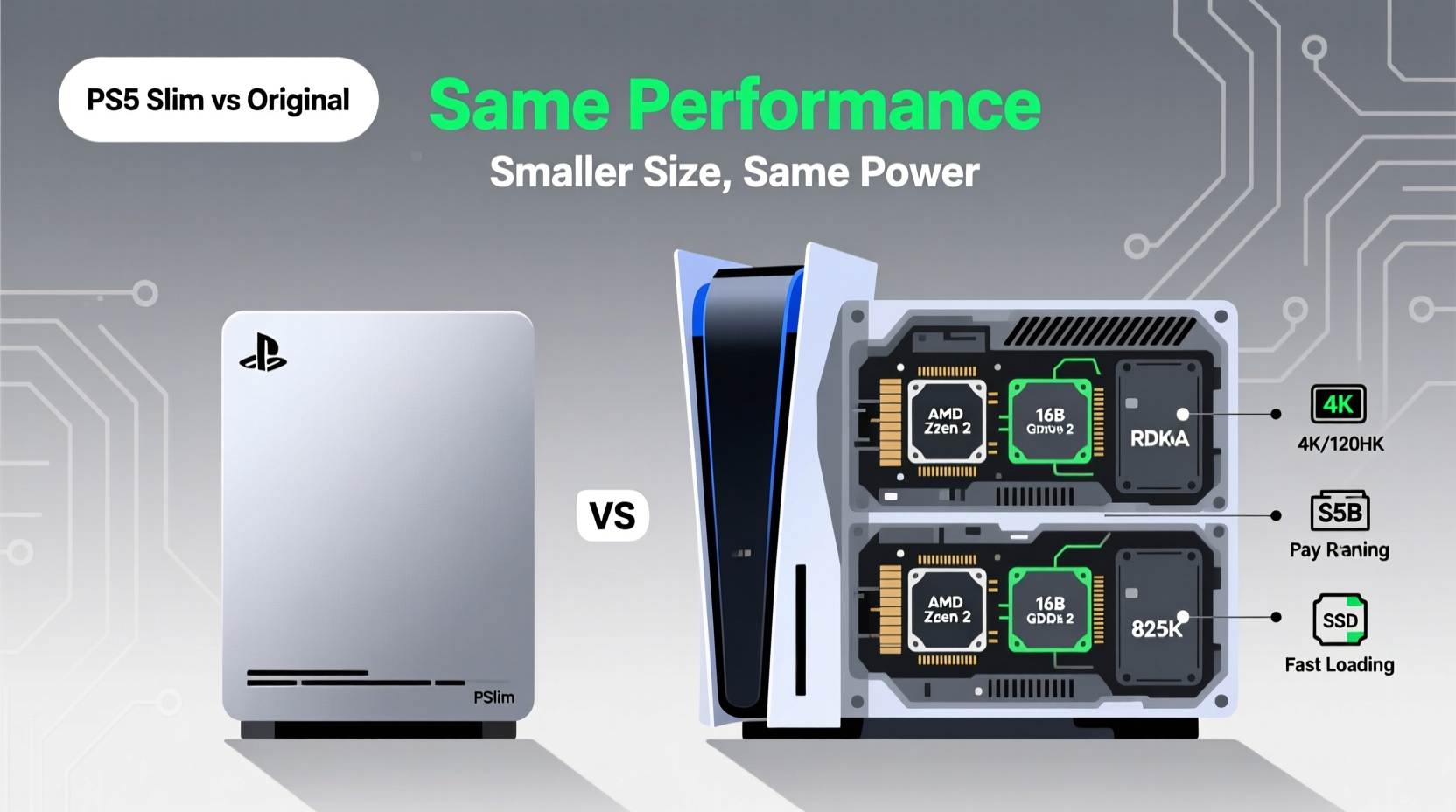
The most obvious distinction between the PS5 Slim and the original lies in form factor. The launch PS5 was bold, futuristic, and undeniably large. Measuring 390mm x 104mm x 260mm and weighing approximately 4.5 kg (disc version), it demanded space and made a statement on any entertainment center. The PS5 Slim, by contrast, measures 358mm x 92mm x 215mm and weighs around 3.2 kg for the disc edition — a noticeable reduction in bulk.
This redesign wasn’t just about aesthetics. Smaller dimensions make the console easier to fit into tighter spaces, such as media cabinets or vertical shelves. The curved side panels are now segmented into four removable pieces, allowing for color customization via interchangeable faceplates — a feature absent in the original at launch. Additionally, the base stand has been simplified; the Slim uses a single screw instead of multiple attachment points, streamlining setup.
Despite these changes, both models maintain identical port layouts: HDMI 2.1, USB-A and USB-C ports, Ethernet, and power connector. The internals, however, underwent significant reengineering to accommodate the new size — especially the motherboard and cooling system.
Performance: Identical Power Under the Hood
Sony emphasized from the outset that the PS5 Slim delivers the same performance as the original. Independent tests and teardowns confirm this claim. Both consoles use the same custom AMD Zen 2 CPU and RDNA 2 GPU architecture, running at identical clock speeds. The GPU outputs 10.28 teraflops of processing power, supports ray tracing, 4K resolution at up to 120Hz, and variable refresh rate (VRR). Gamers will not notice differences in frame rates, texture quality, or load times between the two models.
The key to maintaining performance while reducing size lies in component integration. The PS5 Slim features a redesigned motherboard with a more compact layout and higher-density components. The system-on-a-chip (SoC) has been further optimized using an improved 6nm manufacturing process, which reduces power consumption and heat generation. This advancement allowed engineers to scale down the overall footprint without increasing thermal pressure.
“Miniaturization doesn’t mean downgrading. The PS5 Slim leverages process node improvements to deliver the same compute power in a denser package.” — Mark Cerny, Lead System Architect, Sony Interactive Entertainment
Storage capacity has also changed. The original PS5 shipped with 825GB of SSD storage (about 667GB usable). The PS5 Slim increases this to 1TB (approximately 848GB available), offering more room for games without requiring an immediate upgrade to an M.2 NVMe drive. This is particularly valuable given that modern AAA titles can exceed 100GB each.
Cooling and Thermal Management
One of the biggest concerns with shrinking electronics is heat dissipation. The original PS5 featured a large dual-sided heatsink and a substantial fan, designed to manage heat during extended gaming sessions. Early reports suggested the launch model ran hot, though never to dangerous levels.
The PS5 Slim addresses this with a completely revised cooling solution. Although smaller, it uses a thicker central heatsink with increased fin density and a redesigned airflow path. Internal testing shows that despite the compact chassis, the Slim maintains comparable or slightly improved thermal performance under load. In controlled environments, temperature deltas between the two models rarely exceed 2–3°C.
Fan noise, often a concern with denser systems, remains well-managed. The Slim’s fan operates more efficiently due to better aerodynamics and adaptive fan curves. Many users report it runs quieter than the original, especially during less intensive tasks like menu navigation or streaming.
| Feature | Original PS5 | PS5 Slim |
|---|---|---|
| Dimensions | 390 x 104 x 260 mm | 358 x 92 x 215 mm |
| Weight (Disc Edition) | 4.5 kg | 3.2 kg |
| SSD Storage | 825 GB | 1 TB |
| Manufacturing Process | 7nm SoC | 6nm SoC |
| Thermal Design | Dual-sided heatsink | High-density central heatsink |
| External Appearance | Two-piece shell | Four-panel modular design |
Expandability and Upgradability
Both PS5 models support internal M.2 SSD expansion, allowing users to add compatible drives for additional storage. The PS5 Slim retains the same M.2 slot under the side panel, accessible with a screwdriver. However, there’s one notable difference: the Slim includes updated firmware that supports faster PCIe Gen4 drives out of the box, making it slightly more future-proof.
External USB drives remain compatible for storing PS5 and PS4 games, though only internal storage or expanded M.2 drives can run PS5 titles. Backward compatibility with PS4 games is unchanged across both models, delivering smooth performance and enhanced loading thanks to the SSD.
For accessories, both versions work seamlessly with the DualSense controller, Pulse 3D headset, HD Camera, and PlayStation VR2. There are no compatibility limitations based on console size.
Real-World User Experience: A Mini Case Study
Consider Alex, a long-time PlayStation user who upgraded from the original PS5 to the Slim six months after its release. His primary motivation was space — his entertainment unit was crowded, and the original console protruded awkwardly. He transferred all data via LAN cable and reinstalled a few titles from the cloud.
Over the next three months, Alex played a mix of demanding games: God of War Ragnarök, Horizon Forbidden West, and Spider-Man 2. He monitored system temperatures using built-in settings and noticed no frame drops or thermal throttling. Load times remained consistent, and he appreciated the extra 175GB of storage, delaying the need for an M.2 purchase.
“I was skeptical at first,” Alex said. “But after using it daily, I can’t tell the difference in performance. It looks cleaner on my shelf, cools well, and boots just as fast. The only thing missing is the sheer ‘wow’ factor of the original’s size — but functionally, the Slim wins.”
This experience mirrors broader user feedback. Online forums, tech reviewers, and retail return data show high satisfaction with the PS5 Slim, particularly among users prioritizing practicality over visual impact.
Expert Insights on Longevity and Efficiency
Component efficiency plays a crucial role in a console’s lifespan. The PS5 Slim’s 6nm chip consumes less power than the original’s 7nm variant, reducing strain on internal components over time. Lower operating temperatures and reduced thermal cycling contribute to longer-term reliability.
“Smaller doesn’t mean weaker. In fact, the PS5 Slim benefits from lessons learned in production. Better silicon, smarter cooling, and refined assembly processes make it potentially more durable.” — Lisa Torres, Hardware Analyst at TechInsight Weekly
Additionally, the modular faceplate system may improve longevity. Damaged panels can be replaced individually rather than requiring full casing repairs. This design choice aligns with growing consumer demand for repairable electronics and could reduce e-waste over time.
Step-by-Step Guide: Choosing Between Models
If you're deciding whether to buy or upgrade, follow this logical sequence:
- Evaluate your space: Measure where the console will sit. If clearance is tight, the Slim is the better fit.
- Check storage needs: If you play many large games, the Slim’s 1TB capacity offers meaningful savings on external upgrades.
- Assess aesthetic preference: Do you prefer the bold look of the original or the sleeker, minimalist Slim?
- Consider availability: As of 2024, Sony is phasing out the original PS5 in most regions. The Slim is now the standard offering.
- Verify bundle contents: Some Slim bundles include an extra controller or game — compare value before purchasing.
Frequently Asked Questions
Does the PS5 Slim run games faster than the original?
No. Game loading, frame rates, and graphical fidelity are identical. Any perceived speed improvement comes from the larger base storage, reducing reliance on slower external drives.
Can I use the same accessories with both models?
Yes. All official PlayStation accessories, including controllers, headsets, and charging docks, are fully compatible with both the original and Slim models.
Is the PS5 Slim quieter than the original?
Subjectively, yes. Due to improved fan design and thermal efficiency, the Slim tends to operate more quietly under similar loads, though differences are subtle.
Final Verdict: No Performance Sacrifice, Just Smart Engineering
The PS5 Slim proves that thoughtful engineering can reduce size without compromising capability. By leveraging advancements in semiconductor technology and refining thermal design, Sony delivered a console that matches the original in every meaningful performance metric while improving on storage, weight, and spatial efficiency.
Gamers concerned about losing graphical fidelity or processing power can rest assured: the Slim is not a downgrade. It’s an evolution. Whether you’re buying your first PS5 or upgrading from the launch model, the Slim represents the most balanced version of the console yet — compact, capable, and built for the long term.




 浙公网安备
33010002000092号
浙公网安备
33010002000092号 浙B2-20120091-4
Comments
No comments yet. Why don't you start the discussion?