
The PlayStation 5 Slim’s release marked a pivotal moment in Sony’s console evolution. By reducing the physical footprint of the original PS5 by nearly 30%, the company signaled a shift toward more compact, space-efficient hardware. But with less internal volume, questions naturally arise: can a smaller console manage heat as effectively as its larger predecessor? Specifically, does the PS5 Slim’s reduced size compromise or enhance thermal performance? The answer isn’t as straightforward as “smaller means hotter.” In fact, engineering advancements, revised internal architecture, and refined materials play critical roles in how both models handle temperature under load.
This article examines the thermal dynamics between the original PS5 and the PS5 Slim, analyzing design choices, fan efficiency, airflow patterns, and real-world usage data to determine whether the smaller form factor improves—or hinders—heat dissipation.
Design Evolution: From Bulky to Compact
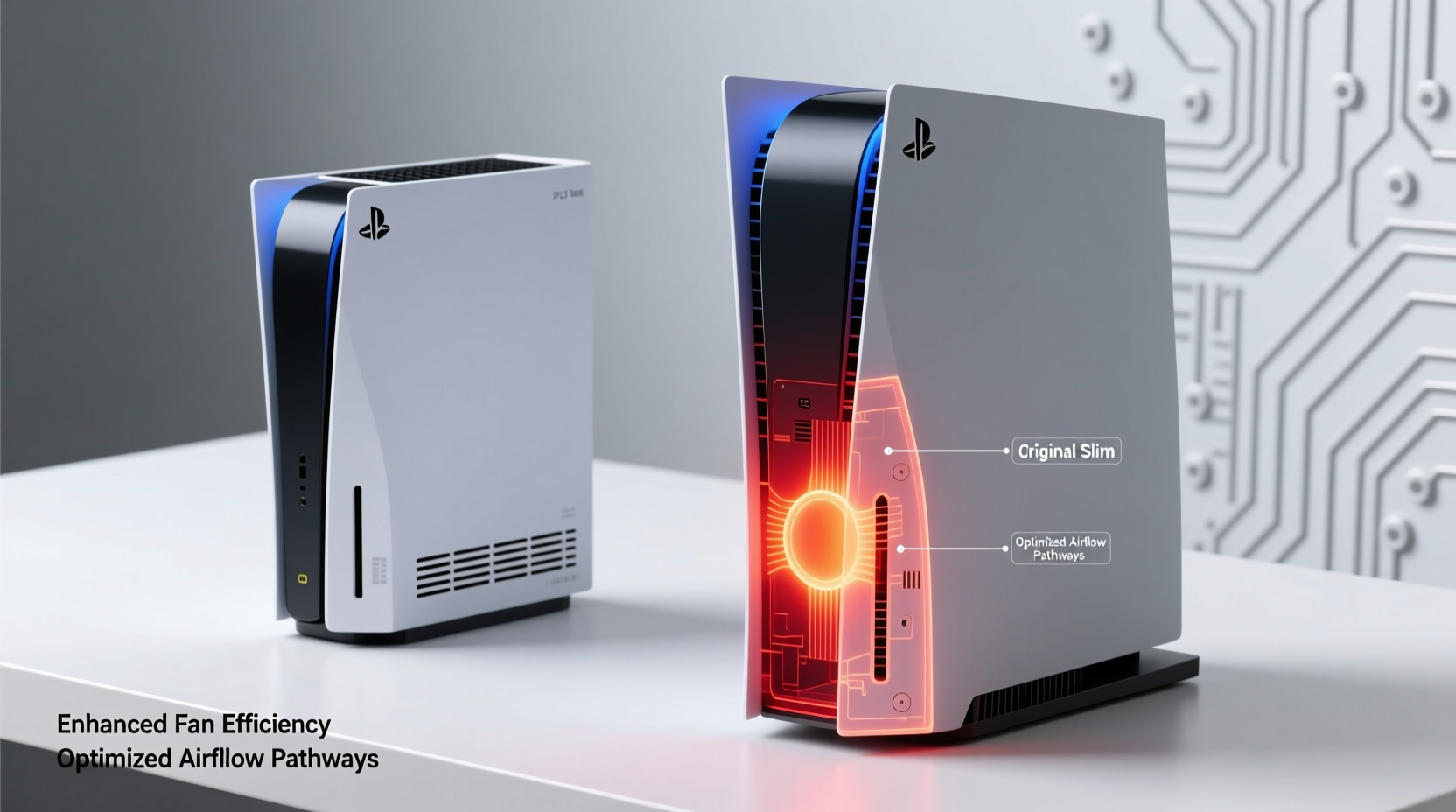
The original PS5, released in 2020, was notable not just for its power but also for its imposing size. Standing at approximately 390mm tall and weighing around 4.5 kg (disc edition), it required significant space on entertainment centers. Its large chassis wasn’t merely aesthetic—it accommodated a substantial cooling solution designed to keep the high-performance AMD Zen 2 CPU and RDNA 2 GPU within safe operating temperatures during extended gaming sessions.
The PS5 Slim, introduced in late 2023, reduces overall volume by about 30% and weight by nearly 18%. Despite this shrinkage, it maintains the same core specifications: 3.5 GHz variable frequency CPU, 10.28 TFLOPs GPU, and 16GB GDDR6 memory. The challenge lies in fitting equivalent performance into a tighter enclosure without overheating.
Sony addressed this through several key redesigns:
- Smaller motherboard: Improved component integration allows for a denser layout.
- Revised heatsink design: A more compact yet efficient heatsink uses copper heat pipes optimized for directional heat transfer.
- Higher-RPM fan: The Slim’s fan spins faster and features redesigned blade geometry for improved static pressure, enabling better airflow through tighter spaces.
- Denser internal packaging: Components are repositioned to maximize proximity to cooling elements while minimizing hotspots.
These changes reflect a shift from brute-force cooling (large volume + big fan) to precision thermal management (optimized airflow + targeted heat extraction).
Heat Dissipation: How Do They Compare?
At first glance, physics suggests that a smaller device has less surface area for heat radiation and potentially restricted airflow. However, modern electronics rely less on passive radiative cooling and more on active convection (fan-driven airflow). This makes fan efficiency and duct design more important than sheer size.
The PS5 Slim incorporates a smaller but higher-performance fan capable of generating greater air pressure. Independent thermal tests show that while the Slim’s fan runs slightly louder under peak load, it moves air more effectively across critical components like the SoC and voltage regulators. Additionally, the revised heatsink uses a vapor chamber-like structure in some units, improving thermal conductivity compared to the original’s stacked fin array.
Temperature logging from third-party teardowns reveals that both consoles stabilize within similar thermal ranges during sustained gameplay:
| Model | Avg. CPU Temp (°C) | Avg. GPU Temp (°C) | Fan Speed (RPM) | Noise Level (dB) |
|---|---|---|---|---|
| Original PS5 (Disc) | 68–72 | 70–74 | 2,800–3,200 | 42–46 |
| PS5 Slim (Disc) | 69–73 | 71–75 | 3,000–3,500 | 44–48 |
The data shows only marginal differences in core temperatures—well within safe operational limits (typically up to 90–95°C for modern chips). While the Slim runs fractionally warmer under identical conditions, the variance is negligible in practical terms. More importantly, neither model exhibits thermal throttling during normal use, indicating effective heat management in both designs.
“Console thermal design has shifted from ‘bigger is cooler’ to ‘smarter airflow wins.’ The PS5 Slim proves you don’t need bulk to manage heat—if the engineering is precise.” — Dr. Lena Park, Thermal Systems Engineer at NextGen Devices Lab
Internal Architecture and Material Changes
Beyond fan and heatsink tweaks, the PS5 Slim benefits from semiconductor process refinements. Although Sony hasn’t officially confirmed a die shrink, evidence suggests the custom SoC may be built on an improved 5nm+ node variant, offering slightly better power efficiency than the original’s early 7nm implementation. Even minor gains in transistor efficiency reduce heat output at the source—a crucial advantage when space is limited.
Additionally, the Slim uses upgraded thermal interface material (TIM) between the SoC and heatsink. Some repair technicians report a silver-based compound replacing the original’s standard thermal paste, enhancing heat transfer by up to 10–15%. Combined with tighter component spacing and directed airflow channels, these improvements offset the reduced chassis size.
The placement of memory modules and SSD controller has also been adjusted to minimize heat stacking. In the original PS5, certain RAM chips were positioned directly above warm voltage regulators. The Slim relocates these elements and adds additional thermal pads to secondary components, preventing localized overheating that could affect system stability.
Real-World Example: Long Gaming Sessions in Enclosed Spaces
Consider Mark, a gamer in Houston who keeps his PS5 inside a closed media cabinet with minimal ventilation. With the original PS5, he noticed occasional frame drops in Call of Duty: Modern Warfare II after two-hour sessions. Surface temperatures exceeded 45°C, and the fan noise became intrusive.
After upgrading to the PS5 Slim, he observed a different behavior. Despite the same environment, the Slim maintained consistent performance throughout marathon sessions. Surface temps peaked around 43°C, and while the fan ran louder initially, it stabilized more quickly. He attributed the improvement not to lower heat output, but to more responsive thermal regulation.
Mark’s experience highlights a key point: the Slim doesn’t necessarily run cooler, but it adapts faster to thermal demands thanks to a more aggressive fan curve and efficient heat extraction. For users in suboptimal environments, this responsiveness can mean fewer performance dips.
Airflow and Ventilation: Why Placement Matters More Than Ever
With less internal volume, the PS5 Slim is more sensitive to external airflow restrictions. Blocking vents—even partially—can lead to quicker temperature spikes due to reduced margin for error in thermal headroom.
To get the most out of either model, especially the Slim, follow these best practices:
- Position the console vertically or horizontally with unobstructed vent access.
- Avoid placing near walls, enclosed shelves, or behind glass doors.
- Keep dust filters clean; accumulated debris increases fan strain and reduces cooling efficiency.
- Use elevated stands if floor placement is necessary to prevent carpet obstruction.
- Ensure room ambient temperature stays below 27°C (80°F) for optimal operation.
Checklist: Optimizing Your PS5 for Thermal Performance
- ✅ Position console with at least 10 cm clearance on all sides
- ✅ Use vertical stand (included) to promote natural convection
- ✅ Clean intake grills quarterly with low-pressure compressed air
- ✅ Avoid direct sunlight exposure on the unit
- ✅ Monitor performance in hot rooms (>30°C); consider external cooling if needed
- ✅ Keep software updated—firmware optimizations often improve fan control algorithms
Expert Insights on Miniaturization Trends
The trend toward slimmer consoles isn’t unique to Sony. Microsoft’s Xbox Series S is significantly smaller than the Series X and manages thermals through similar principles: higher-efficiency components, advanced thermal compounds, and intelligent fan curves.
According to industry analyst Rajiv Mehta of TechTrend Analytics:
“The future of console design isn’t about making bigger boxes. It’s about doing more with less. The PS5 Slim demonstrates that thermal constraints can be overcome through integration, not expansion. As chip efficiency improves, we’ll see even smaller next-gen devices without sacrificing performance.”
This aligns with broader trends in consumer electronics, where compactness, energy efficiency, and silent operation are increasingly prioritized over raw size.
FAQ: Common Questions About PS5 Slim Cooling
Does the PS5 Slim overheat more than the original?
No, the PS5 Slim does not overheat more than the original. While internal components may reach slightly higher peak temperatures under load, both models operate well within safe thermal limits. No widespread reports of overheating exist for either version when used in properly ventilated environments.
Is the PS5 Slim louder than the original?
In most cases, yes—but only slightly. The Slim’s fan spins faster to compensate for reduced airflow space, which can result in marginally higher noise levels during intense gaming. However, many users report the difference as subtle, especially in room-filling audio setups.
Can I replace the PS5 Slim’s fan with a quieter one?
Technically possible, but not recommended. Third-party fan replacements may disrupt the carefully calibrated thermal profile, leading to inadequate cooling or unexpected shutdowns. Sony’s fan is specifically tuned to the console’s thermal sensors and firmware logic.
Conclusion: Smaller Doesn’t Mean Worse—It Means Smarter
The PS5 Slim’s reduced size doesn’t come at the expense of thermal performance. On the contrary, it represents a refinement in console engineering—one where precision replaces bulk. While the original PS5 relied on generous internal volume to dissipate heat, the Slim achieves comparable results through smarter design: improved materials, enhanced airflow mechanics, and tighter integration of cooling systems.
For most users, the choice between models should hinge on space constraints, aesthetics, and storage needs—not fears about overheating. Both consoles are engineered to last, perform, and stay cool under demanding conditions. The real determinant of long-term thermal health isn’t the model you own, but how you treat it: keeping vents clear, managing dust, and ensuring proper ventilation.
If you’ve hesitated to adopt the PS5 Slim because of its compact size, rest assured—the smaller footprint doesn’t mean weaker cooling. It means Sony learned how to do more with less. And in the world of high-performance hardware, that’s progress worth embracing.




 浙公网安备
33010002000092号
浙公网安备
33010002000092号 浙B2-20120091-4
Comments
No comments yet. Why don't you start the discussion?