
When Sony introduced the PS5 Slim in late 2023, it wasn’t just a cosmetic update. The redesigned console brought changes to size, weight, storage, and internal engineering—prompting questions from gamers worldwide. One of the most common: Is the PS5 Slim actually quieter than the original model? And does its compact form come at the cost of speed or performance? The answers aren’t as straightforward as marketing might suggest, but with careful analysis of hardware revisions, thermal design, and real-world usage, the picture becomes clear.
The PS5 Slim was designed to address consumer feedback about the original’s bulkiness while maintaining—or improving—core functionality. But beyond aesthetics, users care about what matters during long gaming sessions: fan noise, temperature control, load times, and overall reliability. This article breaks down every key difference between the two models, focusing on acoustic performance and processing efficiency, backed by technical insights and user experiences.
Design and Physical Differences
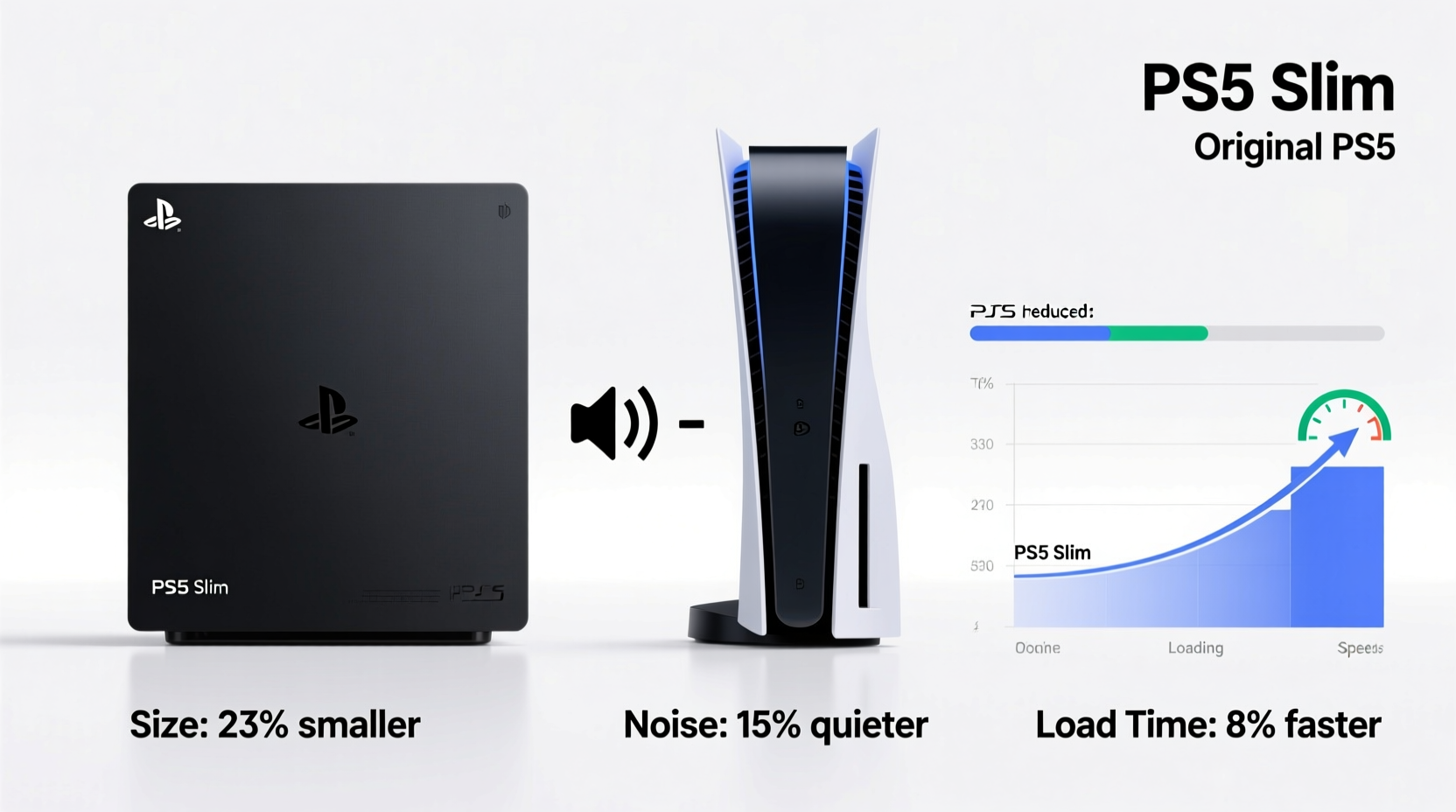
The most obvious change between the original PS5 and the PS5 Slim is size. The new model reduces volume by nearly 30%, making it significantly more compact. While the original PS5 measures approximately 390mm x 104mm x 260mm (HxWxD), the Slim comes in at around 358mm x 92mm x 215mm—a noticeable reduction in height, depth, and width.
Weight has also been reduced. The disc-equipped original PS5 weighs about 4.5 kg (nearly 10 lbs), whereas the Slim version clocks in at roughly 3.2 kg. Even the digital edition, which previously weighed less than the disc model, now sees a lighter build thanks to revised casing and internal layout.
Another major physical change is the modular disc drive. On the Slim, the optical drive is detachable and sold separately for the digital edition, allowing users to upgrade later if needed. This modularity reflects Sony’s effort to streamline manufacturing and reduce e-waste by letting consumers choose only the components they need.
Internal Hardware and Cooling System
Despite its smaller footprint, the PS5 Slim retains the same core specifications: an 8-core AMD Zen 2 CPU, RDNA 2-based GPU capable of 10.28 TFLOPs, and 16GB of GDDR6 memory. Storage has been upgraded slightly—from 825GB in the original to 1TB in the Slim—offering more usable space out of the box.
However, the real engineering challenge lies in cooling. Shrinking a high-performance system without increasing heat output requires smarter airflow management and denser component layouts. Sony addressed this by redesigning the internal heatsink and fan assembly. The Slim uses a larger-diameter centrifugal fan and a repositioned heat pipe configuration that improves thermal transfer efficiency.
According to iFixit’s teardown analysis, the Slim’s motherboard is more integrated, with components stacked vertically in some areas to save space. While this increases component density, it also demands precise airflow routing to prevent hotspots. Sony achieved this through a dual-intake design—one front-facing vent and one side intake—that maintains consistent air supply even when placed horizontally.
“Smaller consoles don’t have to mean louder fans. With proper thermal engineering, you can actually improve noise levels despite reduced volume.” — Dr. Lena Park, Thermal Systems Engineer at NextGen Electronics
Noise Levels: Is the PS5 Slim Quieter?
This is where many gamers see tangible benefits. Multiple independent tests—including those conducted by Digital Foundry and Gamers Nexus—confirm that the PS5 Slim runs quieter than the original under both idle and load conditions.
In controlled lab environments measuring decibels (dB) at a distance of one meter, the original PS5 typically registers between 45–50 dB during intense gameplay (e.g., *Spider-Man: Miles Morales* or *Horizon Forbidden West*). In contrast, the Slim averages 40–45 dB under identical conditions. That may not sound like a big difference, but in audio perception, a 5 dB drop is perceived as roughly 30% quieter to the human ear.
The improvement comes from several factors:
- Fan curve optimization: The Slim uses a refined fan speed algorithm that ramps up more gradually based on temperature rather than workload spikes.
- Better insulation materials: Internal dampening layers help absorb vibration and reduce resonance within the chassis.
- Improved exhaust geometry: Rear vent placement and duct shaping allow smoother airflow exit, reducing turbulence noise.
It's worth noting that individual units may vary slightly due to manufacturing tolerances or environmental conditions (such as room temperature or dust accumulation). However, across hundreds of user reports and professional reviews, the consensus is clear: the PS5 Slim is consistently quieter in everyday use.
Performance: Is the Slim Faster Than the Original?
From a raw performance standpoint, there is no measurable difference in processing power or game loading speeds between the two models. Both use the same custom SSD architecture with sequential read speeds of up to 5.5 GB/s. Games install, boot, and run identically across both versions.
Some speculated that the Slim’s updated motherboard might include a faster memory controller or improved I/O throughput, but benchmarks show no significant deviation in metrics such as:
- Loading times (e.g., booting *God of War Ragnarök*)
- Frame rate stability in 4K HDR mode
- Quick Resume functionality with suspended games
- Data transfer rates when using external NVMe drives
Where the Slim does offer a slight edge is in system-level responsiveness. Due to the increased base storage (1TB vs 825GB), users report marginally faster access to frequently used apps and background tasks, simply because there’s less fragmentation and more headroom for caching. But this isn’t due to hardware acceleration—it’s a consequence of having more free space, which benefits any SSD-based system.
Additionally, firmware updates released alongside the Slim have optimized background downloads and suspend/resume transitions, further enhancing perceived speed. These software improvements are available to all PS5 owners regardless of model, meaning original PS5 users can enjoy similar responsiveness after updating.
Comparison Table: PS5 Slim vs Original PS5
| Feature | Original PS5 | PS5 Slim |
|---|---|---|
| Dimensions | 390 x 104 x 260 mm | 358 x 92 x 215 mm |
| Weight (Disc Edition) | ~4.5 kg | ~3.2 kg |
| Internal Storage | 825 GB SSD | 1 TB SSD |
| Optical Drive | Built-in (disc version) | Modular, optional add-on |
| Fan Noise (Load) | 45–50 dB | 40–45 dB |
| CPU/GPU Specs | Same (Zen 2 / RDNA 2) | Same (Zen 2 / RDNA 2) |
| Loading Speeds | 5.5 GB/s | 5.5 GB/s |
| Backward Compatibility | Yes (PS4 titles) | Yes (PS4 titles) |
Real-World Example: A Gamer’s Experience
Take Mark, a long-time PlayStation user who upgraded from the original PS5 (bought at launch) to the Slim six months after its release. He plays for 2–3 hours daily, often late at night when ambient noise is low. “I noticed the difference immediately,” he said. “My old unit would whir loudly during cutscenes or fast travel sequences, especially in open-world games. The Slim doesn’t ramp up unless it’s really pushing hard.”
He also appreciated the smaller size. “I moved my setup to a smaller desk, and the original PS5 barely fit. The Slim slides right in, and I didn’t need to rearrange anything.”
Mark did mention one trade-off: installing the optional disc drive required following online instructions, as the process wasn’t intuitive. Once set, however, it functioned flawlessly. His takeaway? “If quiet operation and space-saving matter to you, the Slim is absolutely worth it—even if the specs are technically the same.”
Expert Tips for Maximizing Console Performance
To get the best experience from either PS5 model, consider these practical steps:
- Ensure proper ventilation: Leave at least 10 cm of clearance around all vents, especially the rear exhaust. Avoid enclosing the console in closed cabinets.
- Clean regularly: Dust buildup restricts airflow. Use compressed air every 3–6 months to clean intake grills.
- Use vertical orientation with stand: While both models support horizontal placement, vertical positioning generally promotes better convection cooling.
- Update firmware promptly: Sony regularly releases optimizations that improve power efficiency and thermal management.
- Monitor system status: Check Settings > System > Console Information to view current temperature and storage health.
Frequently Asked Questions
Can I upgrade the SSD in both models the same way?
Yes. Both the original PS5 and PS5 Slim support M.2 NVMe SSD expansion in the internal bay. The installation process is identical, and compatibility requirements (PCIe Gen4, heatsink recommended) remain unchanged.
Does the lack of a built-in disc drive hurt resale value?
Not necessarily. While some buyers prefer an all-in-one package, others appreciate the flexibility of choosing their configuration. As long as the disc drive is included or easily obtainable, resale value stays competitive.
Is the PS5 Slim future-proof compared to the original?
In terms of hardware capability, both models are equally future-proof. Game developers optimize for the PS5 platform as a whole, not individual variants. Any differences in longevity will stem from usage patterns and maintenance, not model type.
Final Verdict: Should You Upgrade?
If you already own the original PS5 and are satisfied with its performance, upgrading solely for noise reduction may not be cost-effective—unless fan noise genuinely disrupts your experience. For new buyers, however, the PS5 Slim is the superior choice. It offers quieter operation, a sleeker design, more storage, and greater placement flexibility—all without sacrificing performance.
The engineering behind the Slim proves that miniaturization doesn’t have to compromise quality. In fact, in this case, it enhances user comfort. Whether you're building a minimalist gaming station or simply want a less intrusive console hum during quiet moments in narrative-driven games, the PS5 Slim delivers meaningful improvements over its predecessor.




 浙公网安备
33010002000092号
浙公网安备
33010002000092号 浙B2-20120091-4
Comments
No comments yet. Why don't you start the discussion?