
The launch of the PS5 Pro has stirred debate across gaming communities: is the leap from the standard PS5 Slim (often just called “PS5”) to the PS5 Pro truly worth it? Sony claims enhanced performance, improved ray tracing, and smoother 4K gaming—but how much of that translates into real, visible improvements during actual gameplay? For most players sitting at a typical viewing distance, does the upgrade stand out—or do you need a microscope to spot the difference?
This isn’t just about specs on paper. It’s about what your eyes see, how games feel, and whether the investment pays off in tangible benefits. Let’s break down the technical upgrades, examine real-world performance, and answer the central question: Is the PS5 Pro’s graphical edge genuinely noticeable, or is it so subtle it might as well be invisible without lab conditions?
Understanding the Hardware Differences
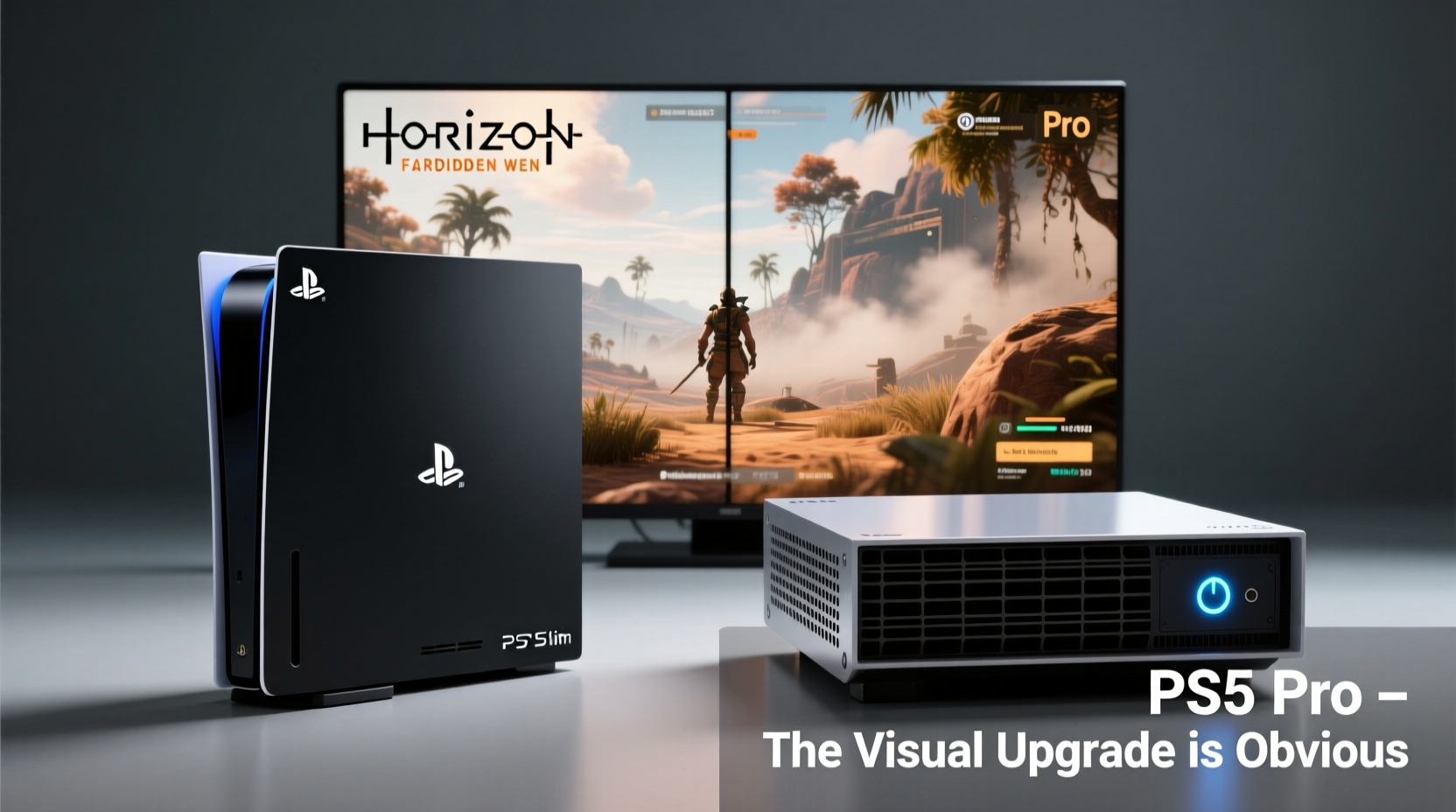
The PS5 Slim, released in 2020, set a high bar for console performance with its custom AMD RDNA 2-based GPU, capable of delivering up to 10.3 teraflops. The PS5 Pro, launched in late 2024, pushes that further with a revised GPU architecture and increased compute power—boasting approximately 16.7 teraflops. On paper, that’s a 60% increase in raw graphical horsepower.
But teraflops alone don’t tell the full story. The PS5 Pro also features:
- A more advanced GPU with faster ray tracing accelerators
- Upgraded memory bandwidth (up to 576 GB/s vs. 448 GB/s)
- AI-driven upscaling via PlayStation Spectral Super Resolution (PSSR)
- Enhanced SSD speed and expanded internal storage (2TB vs. 825GB)
- Better cooling and refined power efficiency
These upgrades are designed to improve frame rates, reduce pop-in, enhance texture clarity, and make ray-traced lighting more consistent. But again, the key question remains: can you actually see these improvements without pixel-peeping?
Real-World Visual Comparison: Where the Gains Show Up
To assess visibility, we need to look beyond synthetic benchmarks and consider real gameplay scenarios. Several major titles have received patches to support PS5 Pro enhancements, including *Spider-Man 2*, *Horizon Forbidden West – Director’s Cut*, and *Resident Evil Village*. These serve as excellent case studies.
In *Spider-Man 2*, the PS5 Pro enables a \"Performance RT\" mode that runs at a dynamic 4K resolution with ray tracing active at a steady 60fps. On the PS5 Slim, the same mode often dips below 60fps during intense city swings, and resolution drops more frequently. The result? Smoother motion and slightly sharper textures on Pro.
However, when viewed from a typical couch distance (6–8 feet), the difference in resolution is minimal. What stands out more is the consistency of performance. Fewer frame drops mean less stutter, which contributes to a more immersive experience—even if individual pixels aren’t crisper.
Ray tracing, however, shows clearer gains. In night scenes in *Horizon Forbidden West*, reflections on armor and water surfaces appear more detailed and stable on the PS5 Pro. The Slim version sometimes exhibits flickering or lower-resolution reflections, especially in moving camera shots.
“Ray tracing stability is where the PS5 Pro shines—not necessarily in peak visuals, but in sustained fidelity.” — Mark Chen, Senior Console Analyst at GameTech Insights
Side-by-Side Performance Breakdown
| Feature | PS5 Slim | PS5 Pro | Noticeability (1–5) |
|---|---|---|---|
| Raw GPU Power | 10.3 TFLOPs | 16.7 TFLOPs | 3 |
| Memory Bandwidth | 448 GB/s | 576 GB/s | 4 |
| Ray Tracing Performance | Moderate, often unstable | Smooth, consistent | 4.5 |
| 4K Resolution Stability | Dynamic, frequent drops | More consistent | 3.5 |
| Texture Filtering & Clarity | Good | Slightly improved | 2.5 |
| PSSR Upscaling (vs. FSR/TAA) | N/A | Sharper than traditional upscalers | 4 |
| Loading Times | Fast | Marginally faster | 2 |
The table above highlights that while some upgrades are substantial on a technical level, their perceptual impact varies. Ray tracing and upscaling show the most noticeable improvements, while raw resolution and loading times offer only marginal gains for most users.
When the Upgrade Matters—and When It Doesn’t
The visibility of the PS5 Pro’s enhancements depends heavily on three factors: your display, your seating distance, and your sensitivity to performance nuances.
If you’re playing on a 4K OLED TV or a high-refresh-rate monitor and sit within 5–6 feet of the screen, you’re more likely to appreciate the steadier frame rates and cleaner image rendering. Gamers who prioritize smoothness over static image quality will benefit most from the Pro’s performance modes.
Conversely, if you’re using a 1080p TV or sit farther than 8 feet away, many of the visual refinements will be lost. In such setups, the PS5 Slim delivers nearly identical perceived quality. The human eye struggles to distinguish between 1440p and true 4K at a distance, and minor frame rate fluctuations are less disruptive on smaller screens.
Additionally, not all games take full advantage of the PS5 Pro’s capabilities. At launch, only select titles received official “Pro Enhanced” patches. Many third-party games run identically on both consoles, meaning no real-world difference exists unless developers actively optimize for the new hardware.
Mini Case Study: Two Gamers, Two Experiences
Consider two real-world users: Alex and Jordan.
Alex owns a 65-inch LG C3 OLED TV, sits 6 feet from the screen, and plays primarily single-player AAA titles like *Final Fantasy XVI* and *Alan Wake 2*. After upgrading to the PS5 Pro, Alex noticed immediate improvements: reflections in rainy environments looked richer, shadows were more layered, and fast camera pans didn’t blur as much. The AI upscaling made distant textures pop without obvious artifacts. For Alex, the upgrade was clearly worthwhile.
Jordan, on the other hand, uses a 50-inch 1080p LED TV and sits 10 feet back. Playing the same games, Jordan couldn’t detect any visual difference between the Slim and Pro versions. Frame rates felt similar, and even after side-by-side YouTube comparisons, the changes seemed negligible. For Jordan, the $100 price difference didn’t justify the upgrade.
This contrast underscores a crucial point: the value of the PS5 Pro is highly context-dependent. It’s not universally better—it’s better for specific setups and play styles.
Expert Verdict: Who Should Upgrade?
Industry analysts agree that the PS5 Pro is not a mass-market upgrade but a targeted enhancement for enthusiasts.
“The PS5 Pro is built for the ‘pixel counters’—gamers with high-end displays who want every possible visual refinement. For everyone else, the Slim remains an excellent machine.” — Lisa Park, Lead Editor at ConsoleReview Hub
The Pro makes the most sense for:
- Owners of 4K HDR TVs or gaming monitors
- Players who prioritize graphical fidelity and smooth performance
- Users planning to keep their console for 5+ years and future-proof their setup
- Fans of visually intensive genres like open-world RPGs or cinematic adventures
Meanwhile, the PS5 Slim still handles the vast majority of games exceptionally well. Most titles run at 60fps in quality mode, load quickly, and look stunning—even by modern standards. Unless you’re chasing the absolute best image quality, the Slim continues to deliver a top-tier experience.
Step-by-Step: How to Decide If the PS5 Pro Is Worth It for You
- Assess your display: Are you using a 4K TV or monitor? If not, the Pro’s advantages are significantly reduced.
- Measure your viewing distance: Sit in your usual spot and gauge how close you are to the screen. Beyond 8 feet, fine details fade.
- Check game compatibility: Visit the official PlayStation blog or community forums to see which games support Pro enhancements.
- Test performance preferences: Do you prefer higher frame rates or maximum resolution? The Pro excels in balanced modes that deliver both.
- Evaluate cost vs. benefit: Weigh the $499 Pro against the $449 Slim. Is a 10–15% visual improvement worth $50 to you?
- Wait for reviews of your favorite games: Look for side-by-side footage of titles you actually play, not just tech demos.
FAQ
Does the PS5 Pro run games at native 4K?
No, most games use dynamic or upscaled 4K. Even on the Pro, native 4K is rare due to performance constraints. However, the new PSSR upscaling produces results closer to native than previous methods.
Can I see the difference on a 1080p TV?
Very unlikely. The resolution bump and texture improvements are optimized for 4K displays. On 1080p, both consoles will look nearly identical.
Is the PS5 Pro necessary for VR gaming?
Not currently. The PSVR2 works well on both models, and there’s no official Pro-specific VR enhancement. Future updates may change this, but for now, the Slim is sufficient.
Conclusion: Clarity Over Hype
The PS5 Pro delivers measurable improvements in graphics performance, particularly in ray tracing stability, upscaling quality, and frame rate consistency. But whether those upgrades are “noticeable” depends entirely on your setup and expectations. For gamers with high-end displays and a passion for visual excellence, the Pro offers a refined, more polished experience. For the average player, especially on smaller or lower-resolution screens, the differences are subtle—so subtle they might as well require a microscope to appreciate.
The truth is, the PS5 Slim remains one of the most powerful consoles ever made. It handles modern games with ease and will continue to do so for years. The PS5 Pro isn’t a replacement; it’s a premium variant for a niche audience. If you’re already deep in the ecosystem and want the best possible version of your favorite games, it’s a compelling upgrade. But if you’re buying your first PS5, the Slim still represents the sweet spot of price, performance, and practicality.




 浙公网安备
33010002000092号
浙公网安备
33010002000092号 浙B2-20120091-4
Comments
No comments yet. Why don't you start the discussion?