
The PlayStation 5 ecosystem has evolved significantly since its 2020 launch. With the release of the PS5 Slim in late 2023 and the highly anticipated PS5 Pro in late 2024, consumers are now faced with a new decision: should they upgrade? For many, the PS5 Slim already feels like a fresh investment. So when Sony positions the PS5 Pro as a “next-level” experience, it’s fair to ask—does this upgrade offer meaningful improvements, or is it just another incremental hardware refresh aimed at early adopters?
This article dissects the differences between the PS5 Slim and PS5 Pro, evaluates real-world performance gains, and assesses whether upgrading in 2025 makes practical and financial sense for different types of players.
Understanding the Hardware Evolution
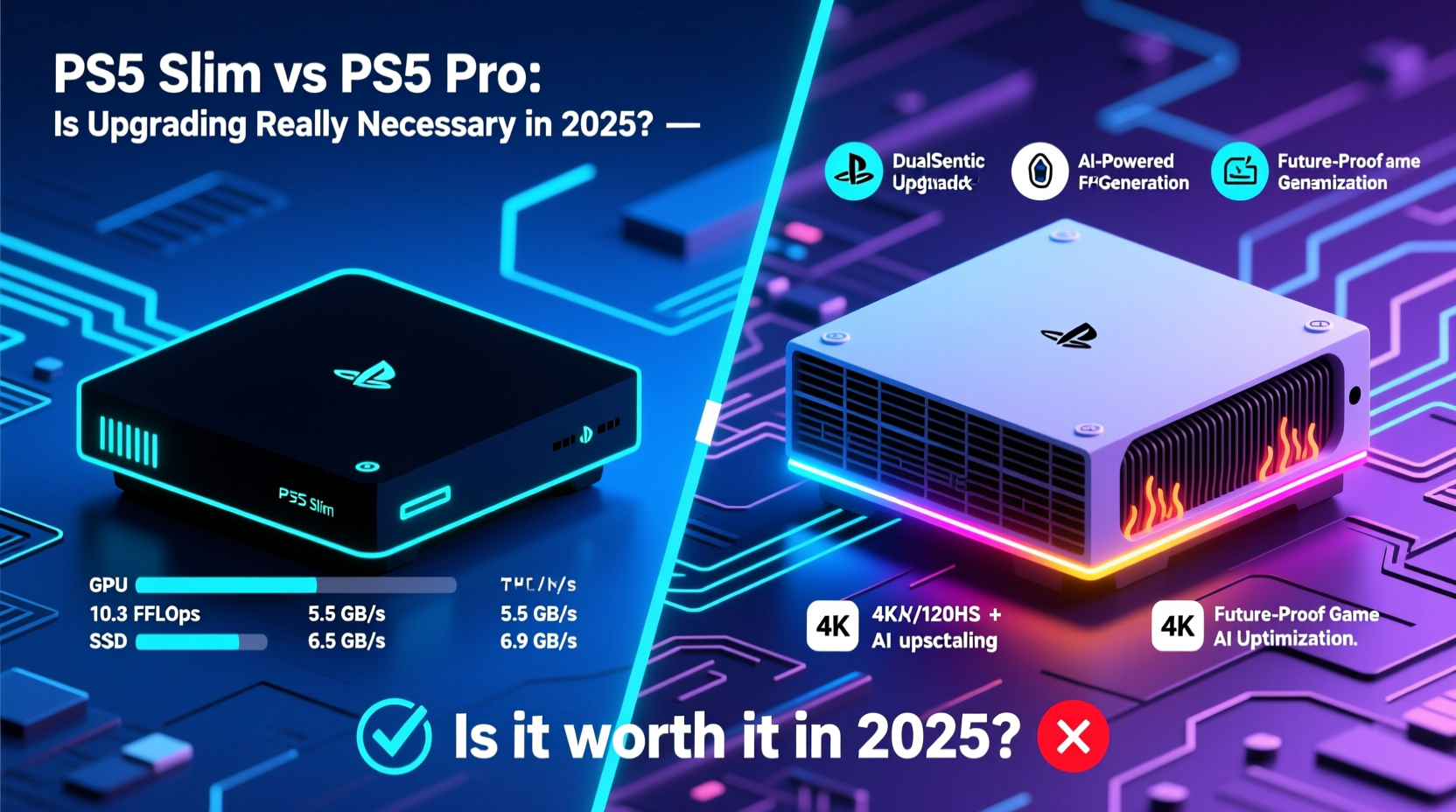
The original PS5 launched with two models: a standard version with a disc drive and a Digital Edition. In late 2023, Sony introduced the PS5 Slim—a smaller, lighter revision that maintains the same internal specs but improves form factor and storage expandability. The PS5 Pro, released in November 2024, marks the first true generational leap within the PS5 family.
At its core, the PS5 Pro is built around enhanced processing power. It features a custom AMD GPU based on RDNA 3 architecture, delivering approximately 45% more graphical performance than the original PS5 (and by extension, the PS5 Slim). This translates to higher frame rates, improved ray tracing efficiency, and support for advanced rendering techniques like PSSR (PlayStation Spectral Super Resolution), Sony’s answer to AI upscaling similar to NVIDIA’s DLSS.
The CPU remains largely unchanged—still an 8-core AMD Zen 2 design—but runs slightly faster thanks to optimized clock speeds and better thermal management. RAM capacity stays at 16GB GDDR6, though bandwidth has been increased to accommodate the more powerful GPU.
Performance Comparison: Real-World Gains
On paper, the PS5 Pro promises \"4K at 60fps\" across most titles, with select games capable of reaching 80–120fps in performance modes. But how does this hold up in practice?
First-party titles from Naughty Dog, Insomniac, and Santa Monica Studio have received targeted patches to leverage the Pro’s capabilities. Games like Spider-Man 2 and Horizon Forbidden West: Burning Shores now run at native 4K resolution with full ray tracing enabled, something previously limited to checkerboard or upscaled outputs. Frame pacing is noticeably smoother, particularly during fast-paced combat or traversal sequences.
Third-party developers have also begun adopting PSSR, which uses machine learning to upscale lower-resolution images while preserving detail. Early implementations show a 30–40% performance boost without significant visual degradation, making high-fidelity gaming accessible on larger 4K and even 8K TVs.
However, these benefits are only realized if you have the display hardware to match. Gamers using 1080p monitors or older 4K TVs without HDMI 2.1 may not see substantial improvements over the PS5 Slim. The Pro’s advantages shine brightest on modern OLED displays with high refresh rates and low input lag.
“While the PS5 Pro isn’t a full console generation leap, it closes the gap between console and PC performance in ways we haven’t seen before.” — Marcus Reed, Senior Analyst at GameTech Insights
Detailed Feature Breakdown
| Feature | PS5 Slim | PS5 Pro |
|---|---|---|
| GPU Performance | 10.3 TFLOPs (RDNA 2) | ~16.7 TFLOPs (RDNA 3) |
| CPU | 8-Core AMD Zen 2 @ 3.5GHz (variable) | Same, with minor clock boosts |
| RAM | 16GB GDDR6 | 16GB GDDR6 (increased bandwidth) |
| Storage | 825GB NVMe SSD (expandable) | 1TB NVMe SSD (faster read speeds) |
| Ray Tracing | Supported, performance impact | Enhanced efficiency, less framerate drop |
| AI Upscaling | No | Yes (PSSR) |
| Backward Compatibility | Fully compatible with all PS5 titles | Fully compatible, enhanced for older games |
| Price (Launch) | $449.99 (Disc), $399.99 (Digital) | $599.99 (Disc), $549.99 (Digital) |
The table highlights that the most significant upgrades are in graphics processing and storage speed. While the CPU remains familiar, the combination of PSSR and faster I/O allows for quicker load times and more stable performance in open-world environments where assets stream dynamically.
Is Upgrading Worth It in 2025?
The answer depends on three key factors: your current setup, gaming preferences, and long-term plans.
Who Should Upgrade
- Owners of older TVs or non-HDMI 2.1 setups: If you’re still playing on a 1080p display or a basic 4K TV, the PS5 Pro won’t deliver its full potential. Wait until you upgrade your display.
- PS4 or PS4 Pro owners: You’ll benefit more from moving directly to the PS5 Pro than someone already on a PS5 Slim.
- Budget-conscious gamers: At nearly $600, the Pro is a premium product. If you’re paying off other tech or prioritizing game purchases, the Slim remains excellent value.
Real-World Example: Sarah’s Dilemma
Sarah bought a PS5 Slim in January 2024 after years on a PS4. She plays primarily single-player story games like The Last of Us Part I and God of War Ragnarök. Her 55” 4K TV supports HDR but lacks HDMI 2.1, limiting her to 60Hz.
When the PS5 Pro launched, she considered upgrading for the promised enhancements. After researching, she realized her TV couldn’t take advantage of 120fps modes or VRR. While PSSR could improve visuals slightly, the gains weren’t transformative. She decided to keep her Slim and instead invest in a future OLED TV that would fully utilize the Pro’s capabilities.
Her choice reflects a growing trend: savvy consumers are aligning console upgrades with their broader home entertainment investments.
Step-by-Step: How to Decide If You Should Upgrade
- Evaluate your current console: Are you on a base PS5, PS5 Slim, or older system? Slim owners gain less from upgrading than those on original hardware.
- Assess your display: Check your TV’s specs. Does it support 4K at 120Hz? Do you have an HDMI 2.1 port available?
- Review your gaming habits: Do you prioritize visual fidelity and performance, or are you satisfied with 60fps and dynamic resolution?
- Consider your budget: Factor in the cost of the console ($599) plus any required accessories (e.g., new HDMI cable, external SSD).
- Look ahead: The next full console generation isn’t expected before 2028. The PS5 Pro may be the final major update in this cycle—making it a long-term investment.
Expert Insight: The Console Lifecycle Shift
Historically, console generations lasted about seven years. But with mid-cycle revisions like the PS4 Pro and now the PS5 Pro, Sony is extending the lifecycle through iterative upgrades.
“The PS5 Pro represents a shift toward 'console-as-a-service' models. Instead of waiting a decade for new hardware, players get phased performance tiers—similar to smartphones or laptops.” — Lena Torres, Industry Strategist at NextGen Gaming Research
This model benefits both Sony and consumers. Developers can target multiple performance tiers, and players choose their entry point based on needs and budget. However, it also risks fragmenting the user base and pressuring players into premature upgrades.
FAQ: Common Questions About the PS5 Pro Upgrade
Will all PS5 games run better on the PS5 Pro?
Not automatically. Developers must patch games to enable enhanced modes. Most first-party titles receive updates, but third-party support varies. Some indie games may never see Pro-specific optimizations.
Can I transfer my data from PS5 Slim to PS5 Pro?
Yes. Using Wi-Fi, LAN cable, or an external SSD, you can migrate your games, saves, and settings seamlessly. The process typically takes under an hour depending on data size.
Does the PS5 Pro support VR?
Yes, and it enhances the PSVR2 experience significantly. Higher frame rates, reduced latency, and improved rendering make VR gameplay smoother and more immersive. If you own PSVR2, the Pro is strongly recommended.
Final Verdict: To Upgrade or Not?
For most PS5 Slim owners in 2025, upgrading to the PS5 Pro is not necessary—but it can be worthwhile under specific conditions.
If you play competitively, own a high-end TV, or use PSVR2, the Pro delivers tangible benefits: sharper image quality, consistent frame rates, and future-proofed compatibility. The AI upscaling via PSSR alone could extend the console’s relevance into the late 2020s.
However, if you’re happy with your current setup, play mostly narrative-driven games, or don’t plan to upgrade your display soon, the PS5 Slim continues to offer exceptional performance. The library of PS5 titles remains strong, and few games truly require the Pro’s extra power.
Ultimately, the PS5 Pro is less about necessity and more about aspiration. It’s designed for enthusiasts who want the best possible console experience today—not because they have to, but because they can.




 浙公网安备
33010002000092号
浙公网安备
33010002000092号 浙B2-20120091-4
Comments
No comments yet. Why don't you start the discussion?