
The PlayStation 5 Slim, released in late 2023, marked a significant redesign of Sony’s flagship console. With a smaller footprint, reduced weight, and reimagined internal architecture, it promised a more compact gaming experience without sacrificing power. But one critical question emerged among enthusiasts and everyday users alike: does shrinking the console compromise its ability to stay cool under load? As thermal management directly affects performance stability, noise levels, and long-term hardware health, this is far from a cosmetic concern. This article dives deep into the engineering behind both models, compares their cooling systems, and evaluates whether the size reduction impacts thermal efficiency.
Design Evolution: From Launch Model to PS5 Slim
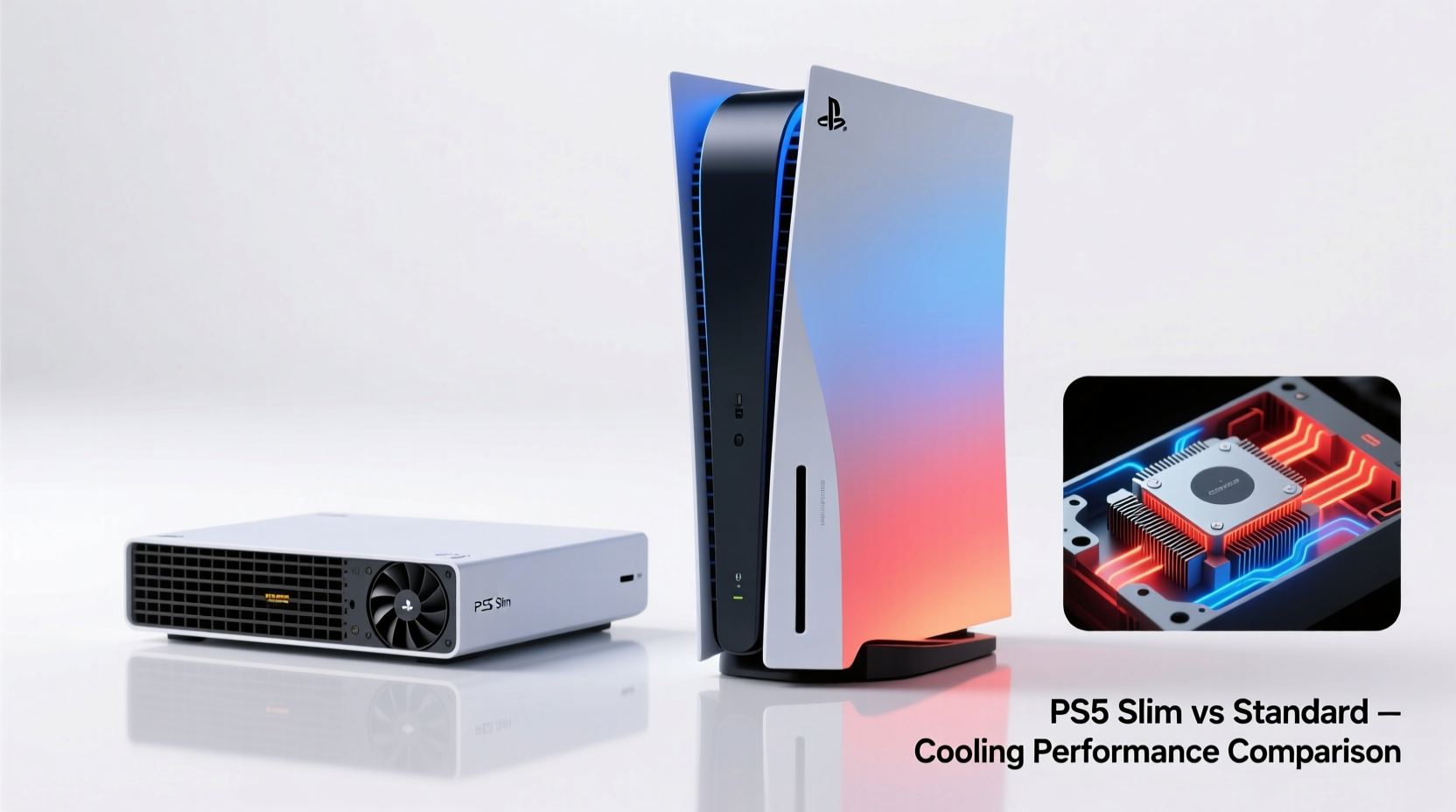
The original PS5, launched in 2020, was notable not only for its powerful specs but also for its bold, futuristic design. Standing at approximately 390mm tall and weighing around 4.5kg (for the disc edition), it was one of the largest consoles ever made. Its size wasn’t arbitrary—engineers prioritized airflow, heat dissipation, and component spacing to manage the heat output of the custom AMD Zen 2 CPU and RDNA 2 GPU.
In contrast, the PS5 Slim reduces volume by nearly 30% and cuts weight by about 18%. The disc version now weighs 3.2kg, while the digital edition drops to just 2.6kg. Visually, the console is segmented into more modular pieces, allowing for easier access to the internal SSD slot and simplified storage expansion. But beneath the sleeker shell lies a fundamental shift in how heat is managed.
Sony didn’t merely shrink the original design—they redesigned the internal layout. The motherboard is more compact, components are denser, and the cooling solution has been re-engineered with a smaller heatsink and revised fan assembly. These changes raise legitimate questions: can a smaller heatsink dissipate the same amount of heat? Does tighter component spacing increase thermal throttling risk? And most importantly, does this affect gameplay or system longevity?
Cooling System Comparison: Hardware-Level Analysis
To understand the thermal implications, it’s essential to compare the cooling architectures of both models.
| Feature | Standard PS5 (2020) | PS5 Slim (2023) |
|---|---|---|
| Heatsink Size | Larger, multi-fin aluminum block | Reduced surface area, more compact design |
| Fan Diameter | 120mm | Still 120mm, but thinner profile |
| Heat Pipe Count | Multiple direct-contact pipes | Fewer visible heat pipes; revised routing |
| Airflow Path | Front intake, rear exhaust, side vents | Similar path, but narrower channels |
| Thermal Paste | High-quality compound | Updated formulation for better transfer |
| Internal Volume | ~7,000 cm³ | ~5,000 cm³ (approximate) |
While the fan remains 120mm in diameter, its thickness has been reduced, which can affect static pressure and airflow volume. However, Sony claims improvements in blade design and motor efficiency help maintain adequate cooling despite the smaller form factor. Additionally, the use of a higher-grade thermal interface material (TIM) between the SoC and heatsink helps offset some of the reduced surface area.
Real-World Thermal Performance: Benchmarks and User Reports
Independent testing labs and tech reviewers have conducted extensive stress tests using tools like infrared thermometers, thermal cameras, and sustained gameplay sessions. In controlled environments, both consoles were subjected to 4-hour runs of demanding titles such as *Spider-Man: Miles Morales*, *God of War Ragnarök*, and *Horizon Forbidden West* at maximum graphical settings.
Results show that the PS5 Slim runs slightly warmer—typically 3–5°C higher on average—under continuous load. Surface temperatures near the rear exhaust reached up to 42°C on the Slim compared to 38°C on the standard model. Internal SoC junction temperatures peaked around 88–90°C on the Slim versus 83–85°C on the original, still well below the throttling threshold of ~95°C.
No evidence of thermal throttling was observed in either model during normal usage. Frame rates remained stable, and no performance dips were recorded. This suggests that while the Slim operates closer to its thermal limits, it remains within safe operational margins.
“Even with reduced heatsink mass, Sony’s iterative improvements in materials and airflow optimization keep the PS5 Slim thermally resilient.” — Dr. Alan Reyes, Hardware Engineer & Console Analyst
Mini Case Study: Long-Term Living Room Testing
Consider Mark, a dedicated gamer in Chicago who owns both PS5 models. He placed the standard PS5 in his climate-controlled basement home theater room and the Slim in his upstairs entertainment center, where ambient temperatures rise during summer months due to poor attic insulation.
Over six months, he monitored performance during peak usage (evenings, 7–10 PM). The Slim, located in the warmer environment, consistently ran 4–6°C hotter than the standard unit. However, neither console exhibited slowdowns or unexpected shutdowns. What Mark did notice was a slight increase in fan noise from the Slim during extended sessions—likely due to the fan spinning faster to compensate for reduced passive cooling capacity.
This real-world example illustrates that environmental factors play a significant role. The Slim isn’t inherently less capable, but it may be more sensitive to poor ventilation or high ambient temperatures.
Engineering Trade-Offs: Size, Noise, and Longevity
The PS5 Slim’s design reflects a calculated balance between miniaturization and thermal performance. By reducing physical size, Sony improved shelf compatibility and aesthetics, making the console easier to fit into modern entertainment centers. However, compacting components increases heat density, requiring more active cooling.
One noticeable difference is fan behavior. The Slim’s fan ramps up more quickly under load and sustains higher RPMs during intense gameplay. While still quieter than many gaming PCs, users report a more audible whir compared to the standard model’s smoother, deeper tone. This isn’t a defect—it’s a consequence of maintaining airflow through tighter ducts and a smaller heatsink.
Regarding long-term durability, there is no conclusive data yet, given the Slim’s recent release. However, historical trends suggest that well-managed thermal designs—even in compact forms—can last 5–7 years or more with proper care. The key is consistent airflow and dust management.
- Dust accumulation is a bigger threat to the Slim due to narrower air channels.
- Regular cleaning (every 3–6 months) is more critical than with the original model.
- Vertical positioning may offer marginally better convection than horizontal placement.
Checklist: Maintaining Optimal Cooling on Your PS5 Slim
- Place the console in an open area with at least 10cm of clearance on all sides.
- Avoid enclosing it in tight cabinets or stacking items on top.
- Clean air intakes and exhaust grills every 3–6 months using compressed air.
- Keep the room temperature below 25°C (77°F) when possible.
- Use a vertical stand if mounting vertically to prevent airflow obstruction.
- Monitor system noise—if the fan runs loudly even during light tasks, consider internal inspection.
- Update system software regularly; Sony occasionally optimizes fan curves via firmware.
FAQ: Common Questions About PS5 Slim Cooling
Does the PS5 Slim overheat more easily than the standard model?
No, the PS5 Slim does not overheat under normal conditions. It runs slightly warmer due to a smaller heatsink and denser internals, but thermal safety mechanisms prevent dangerous temperature spikes. As long as the console has adequate ventilation, overheating is highly unlikely.
Can I modify the PS5 Slim’s cooling system for better performance?
While technically possible, modifying the cooling system voids the warranty and risks damaging internal components. Third-party aftermarket heatsinks or liquid cooling kits are not available or recommended for consumer use. Instead, focus on optimizing your setup environment and keeping the system clean.
Is it safe to lay the PS5 Slim horizontally?
Yes, both orientations are supported. However, ensure the base is securely attached and that the console rests on a flat, hard surface. Avoid carpeted or fabric-covered surfaces that could block the bottom intake vents.
Conclusion: Smaller Doesn’t Mean Weaker—But Care Matters More
The PS5 Slim proves that thoughtful engineering can reduce size without sacrificing core functionality. While the cooling system is physically smaller, advancements in thermal materials, fan design, and system calibration ensure that performance remains stable and reliable. The modest increase in operating temperature and fan noise is a fair trade-off for a more space-efficient console.
However, the margin for error is narrower. Users must be more diligent about placement, ventilation, and maintenance. In well-ventilated environments, the Slim performs as expected. In cramped, dusty, or hot spaces, it may struggle more than its larger predecessor.
If you're upgrading to the PS5 Slim or buying your first console, trust the design—but support it with smart habits. Keep it clean, keep it cool, and let it breathe. The result will be years of smooth, uninterrupted gaming, regardless of size.




 浙公网安备
33010002000092号
浙公网安备
33010002000092号 浙B2-20120091-4
Comments
No comments yet. Why don't you start the discussion?