
In modern urban apartments, dorm rooms, or minimalist entertainment setups, space is a premium commodity. Gamers no longer have the luxury of dedicated media centers with deep shelves and expansive AV racks. As a result, the physical footprint of gaming consoles has become as important as their performance. The PlayStation 5 Slim and Xbox Series S represent two of the most compact next-gen consoles on the market—but when every inch counts, which one truly wins in tight spaces?
This comparison dives beyond marketing claims to evaluate real-world dimensions, ventilation needs, orientation flexibility, and aesthetic integration. Whether you're placing your console on a narrow shelf, tucking it behind a TV stand, or integrating it into a multi-use entertainment unit, understanding the spatial realities of each system can make all the difference.
Physical Dimensions: A Side-by-Side Breakdown
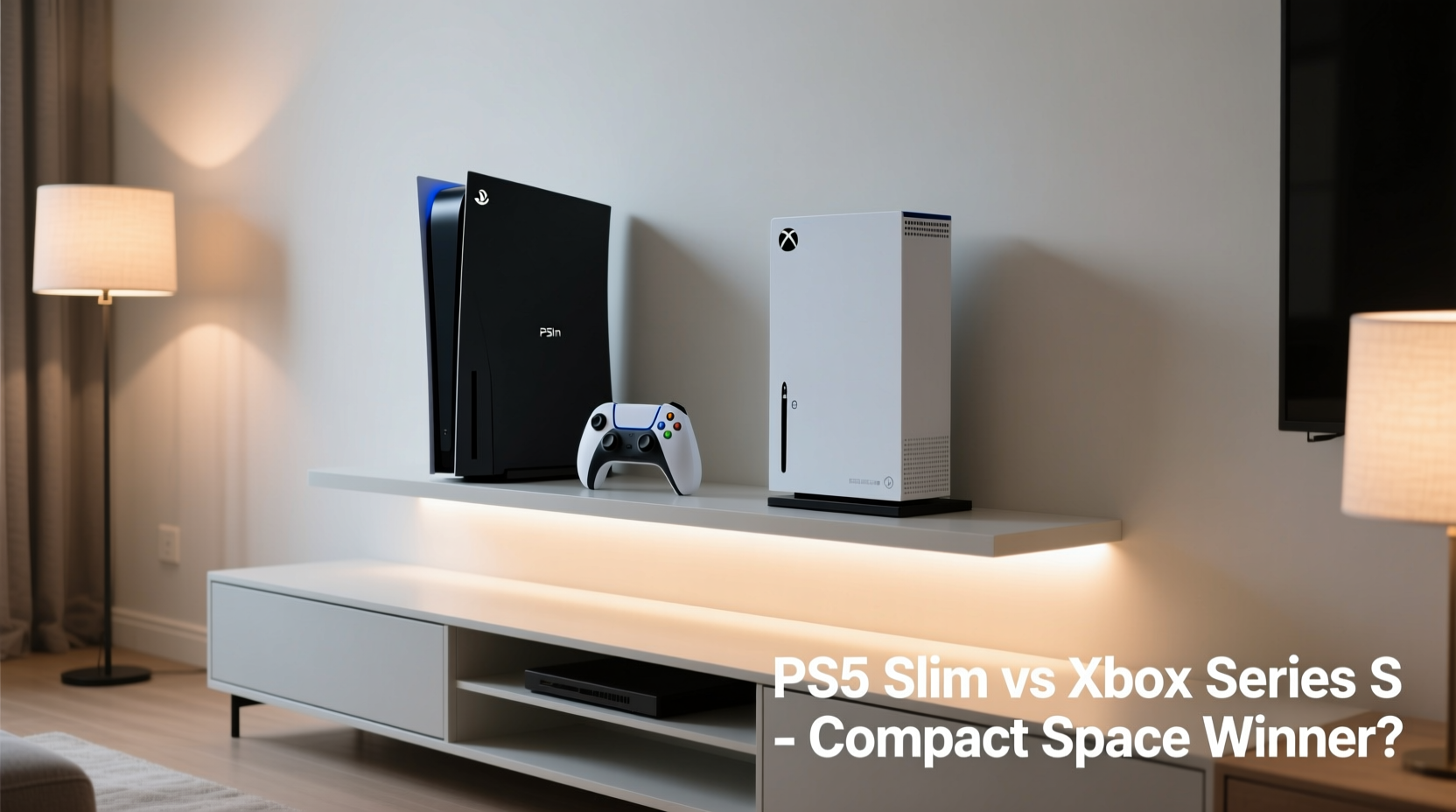
The first and most obvious factor in determining space efficiency is the actual size of the console. Both Sony and Microsoft have designed smaller revisions of their original models, but they take different approaches to miniaturization.
| Console | Width (cm) | Height (cm) | Depth (cm) | Volume (approx. L) |
|---|---|---|---|---|
| PS5 Slim (horizontal) | 35.8 | 9.6 | 21.6 | 7.4 |
| Xbox Series S (vertical) | 15.1 | 27.5 | 15.1 | 6.3 |
| Xbox Series S (horizontal) | 27.5 | 15.1 | 15.1 | 6.3 |
The Xbox Series S is significantly smaller in width and depth when placed vertically—its cube-like shape allows it to occupy less surface area than the PS5 Slim, even though it’s taller. The PS5 Slim, while thinner in height, stretches wider and deeper, especially when laid flat. For side tables, floating shelves, or narrow entertainment centers, the Series S often integrates more seamlessly due to its square footprint.
Ventilation and Clearance Requirements
A compact console isn’t useful if it overheats due to poor airflow. Both systems require clearance around vents, but their designs dictate different spatial needs.
The PS5 Slim retains the same general airflow architecture as the original model: intake vents along the base and exhaust at the rear. Even in its slimmer form, it demands at least 10 cm of clearance on all sides, especially behind and beneath, to maintain optimal thermal performance. Placing it flush against a wall or wedging it between other devices risks throttling and long-term wear.
In contrast, the Xbox Series S uses a centralized fan and vent ring around the power button, allowing for more flexible airflow patterns. It can operate efficiently with just 5–7 cm of breathing room on each side. This makes it better suited for enclosed cabinets or tight clusters of AV equipment, provided there’s some passive ventilation in the enclosure.
“Smaller consoles like the Series S are engineered with constrained environments in mind—they’re not just reduced in size, but rethought for thermal efficiency.” — Marcus Tran, Hardware Engineer at GameTech Labs
Orientation Flexibility and Mounting Options
How you place a console can dramatically affect how much space it appears to consume. The PS5 Slim supports both horizontal and vertical orientations out of the box, thanks to an integrated stand that snaps into either position. However, its asymmetrical design means it still projects outward significantly in both configurations.
The Xbox Series S is designed as a near-perfect cube, making transitions between horizontal and vertical positioning effortless. Its included stand is minimal and doesn’t add bulk. Additionally, third-party wall mounts and magnetic brackets are widely available for the Series S, enabling users to mount it behind a display or under a shelf—solutions rarely practical with the longer profile of the PS5 Slim.
- PS5 Slim: Best for open shelves where aesthetics matter; requires stable surface due to top-heaviness when vertical.
- Xbox Series S: Ideal for vertical stacking, wall mounting, or integration into modular furniture.
Real-World Scenario: Apartment Living Room Setup
Jess, a graphic designer living in a 450-square-foot studio in downtown Seattle, needed to maximize her limited entertainment space. Her TV sits on a narrow credenza just 40 cm deep, shared with a soundbar, streaming stick, and cable box. She initially considered the PS5 Slim but found that even with careful arrangement, the console extended past the edge of the furniture, creating a cluttered look and posing a tripping hazard.
After switching to the Xbox Series S, she mounted it vertically using a magnetic bracket attached to the back of her TV. This freed up surface space entirely. “It’s invisible now,” she said. “I didn’t realize how much visual weight the PS5 added until I removed it.”
This case illustrates a growing trend: compact consoles aren’t just about fitting physically—they also contribute to cleaner, more intentional interior design.
Noise Levels and Heat Output in Confined Spaces
In tight enclosures, noise and heat become amplified concerns. The PS5 Slim, despite improvements in cooling efficiency, runs noticeably louder during intensive gameplay sessions. Its larger internal components generate more heat, requiring sustained fan activity. In a closed cabinet or crowded shelf, this can lead to both audible disruption and elevated ambient temperature.
The Xbox Series S, built on lower-power hardware, produces less heat overall. Its fan cycles are quieter and less frequent, even during extended play. Independent testing by Digital Foundry showed average noise levels of 38 dB for the Series S versus 43 dB for the PS5 Slim under load—making the Series S a better choice for bedrooms, home offices, or quiet environments.
Performance Trade-Offs: What You Gain and Lose
While space efficiency favors the Xbox Series S, it’s essential to acknowledge the performance gap. The Series S targets 1440p resolution with dynamic scaling, whereas the PS5 Slim supports native 4K gaming and higher frame rates. It also includes an Ultra HD Blu-ray drive (on the standard version), which the Series S lacks entirely.
For gamers prioritizing cinematic experiences, physical media, or high-fidelity visuals, the PS5 Slim remains the superior option—even if it demands more room. However, for those who stream games via Xbox Cloud Gaming or prioritize portability and footprint over graphical prowess, the Series S delivers remarkable value in a tiny package.
“The future of gaming hardware is moving toward density, not dominance. Consoles don’t need to be bigger to be better—they need to be smarter.” — Leena Patel, Tech Analyst at FuturePlay Insights
Checklist: Choosing the Right Console for Small Spaces
Use this checklist to determine which console aligns best with your spatial and lifestyle needs:
- Measure your available shelf or cabinet space (depth, width, height).
- Determine whether vertical or horizontal placement works best.
- Assess ventilation options—will the console be enclosed or exposed?
- Evaluate your gaming preferences: Do you prioritize 4K, disc playback, or portability?
- Consider audio setup—will fan noise disrupt nearby activities?
- Check for mounting possibilities (wall, underside of shelf, behind TV).
- Determine internet reliability—if cloud gaming is viable, the Series S becomes more appealing.
Frequently Asked Questions
Can the PS5 Slim fit in a standard DVD rack?
Most standard DVD storage units have compartments around 19–20 cm deep. The PS5 Slim measures 21.6 cm in depth when horizontal, so it will not fit flush and may overhang dangerously. Vertical placement reduces depth but increases height, which may exceed shelf spacing. It's generally incompatible with traditional media racks.
Is the Xbox Series S powerful enough for serious gaming?
Yes, but with caveats. The Series S excels at 1080p to 1440p gaming and supports features like Quick Resume and ray tracing. While it can't match the graphical fidelity of the PS5 Slim or Xbox Series X, it runs all Xbox Game Pass titles and cross-gen games smoothly. For casual and mid-core players, it’s more than sufficient.
Does the PS5 Slim run cooler than the original PS5?
Slightly. The PS5 Slim features minor internal refinements that improve power efficiency and reduce heat output by approximately 10% compared to the launch model. However, due to its large chassis and high-performance components, it still generates more heat than the Series S and requires greater airflow management.
Final Recommendation: Matching Console to Lifestyle
If minimizing physical presence is your top priority, the Xbox Series S is the clear winner. Its symmetrical design, low heat output, and compatibility with alternative mounting solutions make it uniquely adaptable to compact environments. It’s the ideal companion for city dwellers, students, or anyone integrating gaming into a multipurpose living space.
The PS5 Slim, while more powerful and visually impressive, demands respect for its spatial needs. It performs best in open, well-ventilated areas where its design can be appreciated. If you own physical games or demand 4K performance, the trade-off in size may be worth it—but only if your setup can accommodate it.
Ultimately, choosing between these consoles isn’t just about specs—it’s about harmony with your environment. A gaming system should enhance your space, not dominate it.




 浙公网安备
33010002000092号
浙公网安备
33010002000092号 浙B2-20120091-4
Comments
No comments yet. Why don't you start the discussion?