
In compact urban living spaces, every inch counts. For gamers who share a studio apartment or live in a micro-unit, choosing the right gaming console isn’t just about graphics or exclusives—it’s about practicality. The PS5 Slim and Xbox Series S represent two distinct philosophies in next-gen console design: one prioritizes balance and upgradeability, the other embraces minimalism and affordability. But when space is limited and budgets are tight, which system truly delivers better value?
This comparison dives deep into physical footprint, performance trade-offs, media integration, and long-term usability to help city dwellers make an informed decision. Whether you're setting up a corner entertainment center or integrating your console into a multi-functional workspace, understanding how these systems fit into constrained environments is crucial.
Size and Physical Design: Measuring What Matters
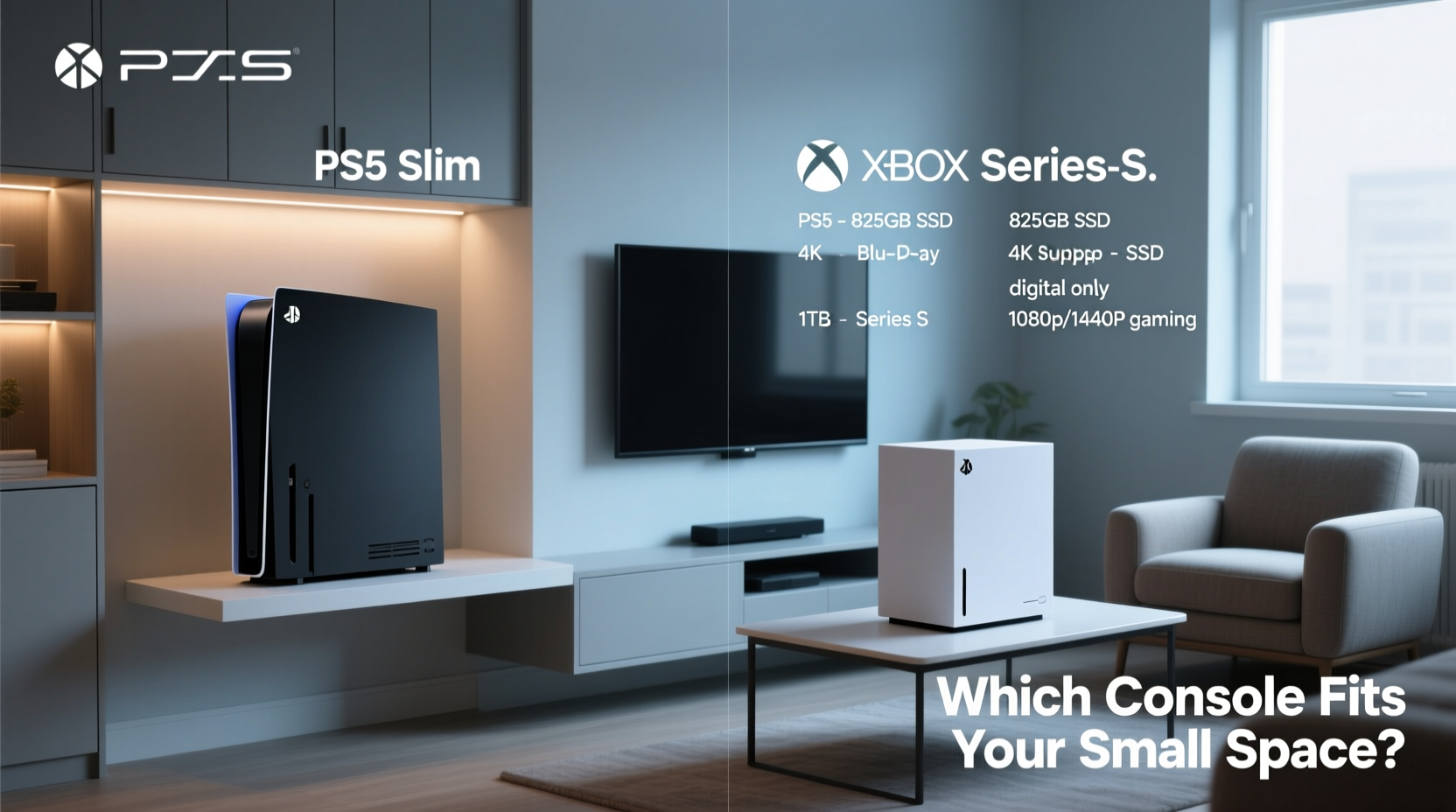
The most immediate difference between the PS5 Slim and the Xbox Series S is their size. While both are significantly smaller than their original counterparts, they take different approaches to miniaturization.
The PS5 Slim measures approximately 360mm x 214mm x 98mm (L x H x D), making it roughly 30% smaller than the original PS5. It features a modular disc drive that can be added or removed, allowing users to choose between digital-only and physical media configurations. Despite its reduced volume, it still commands noticeable shelf space—especially when placed horizontally.
In contrast, the Xbox Series S is dramatically smaller at just 275mm x 151mm x 64mm. Its compact form factor is closer in size to a hardcover book than a traditional console. It fits easily behind a monitor, tucked beside a soundbar, or even stored inside a drawer when not in use. This makes it ideal for minimalist setups where visual clutter must be minimized.
Space Efficiency Comparison
| Feature | PS5 Slim | Xbox Series S |
|---|---|---|
| Dimensions (H x W x D) | 98mm x 360mm x 214mm | 64mm x 275mm x 151mm |
| Volume (approx.) | ~7.5 liters | ~2.6 liters |
| Weight | 3.2 kg (disc version) | 1.9 kg |
| Vertical Stand Required? | Yes (sold separately) | No (included) |
| Port Accessibility | Rear-facing ports require clearance | All ports accessible from back/side |
The Xbox Series S clearly wins on sheer compactness. However, the PS5 Slim compensates with better airflow design and easier internal access for upgrades. For renters who frequently move or rotate furniture, the lighter weight and simpler setup of the Series S offer tangible advantages.
Performance and Gaming Experience
Raw power isn't always the deciding factor in small-space living—but it does affect what kind of experience you can expect from your setup. The PS5 Slim maintains full next-gen capabilities: true 4K output, ray tracing, 120Hz support, and ultra-fast SSD loading. Even in its slimmer form, it retains the same custom AMD Zen 2 CPU and RDNA 2 GPU architecture as the original model.
The Xbox Series S, while impressive for its size, operates at a lower tier. It targets 1440p resolution with dynamic scaling up to 1800p, and uses a less powerful GPU with only 4GB of shared memory allocated to games. While it supports ray tracing and quick resume functionality, many titles run at reduced textures and frame rates compared to higher-end consoles.
“Downsized hardware doesn’t mean downgraded fun—but it does require smarter optimization.” — Raj Patel, Senior Console Analyst at GameTech Insights
For players using smaller TVs or secondary monitors common in studio apartments, the visual gap between the two systems may be less noticeable. On a 32-inch 1080p display, the Series S often performs admirably, especially with well-optimized titles like *Hi-Fi Rush* or *Forza Horizon 5*. However, those investing in larger 4K screens—even modest ones—will feel the limitations of the Series S more acutely.
Storage and Expandability
Both consoles come with custom NVMe SSDs, but differ significantly in base capacity and upgrade flexibility.
- PS5 Slim: 1TB internal storage, expandable via M.2 NVMe slot (requires heatsink-compatible drive).
- Xbox Series S: 512GB total, with only ~364GB available to users; expandable via proprietary Seagate Expansion Card or external USB drive.
The proprietary expansion card for Xbox (while seamless) is expensive—512GB costs nearly $220. Alternatively, users can connect an external HDD for cheaper, slower cold storage. The PS5 Slim allows standard PCIe Gen 4 NVMe drives, offering far greater value per gigabyte. A 2TB third-party SSD can be added for under $150, effectively quadrupling usable space.
Media and Living Space Integration
Beyond gaming, modern consoles serve as multimedia hubs. How well they integrate into a small apartment’s daily life matters just as much as their technical specs.
The PS5 Slim includes a 4K UHD Blu-ray player (in disc version), supporting DVDs, CDs, and streaming apps like Netflix, Disney+, and YouTube. Its interface is clean and media-focused, with dedicated buttons for switching between game and movie modes. For audiophiles using external DACs or high-res audio gear, the PS5 supports lossless audio passthrough—a rare feature in consoles.
The Xbox Series S lacks any optical drive, meaning all media must be streamed or played from external sources. While this aligns with cloud-first trends, it creates friction for collectors or those without reliable broadband. However, its seamless integration with Microsoft’s ecosystem—such as linking to a Windows PC for game streaming or using OneDrive for screenshots—is unmatched.
In a dual-purpose living room-bedroom setup, the ability to quickly switch from gaming to watching a film without buffering delays is essential. Here, the PS5 Slim’s disc option provides reliability during internet outages or data caps. Conversely, the Series S excels in smart-home environments where voice control (via Alexa or Cortana) and app continuity matter more.
Mini Case Study: Urban Gamer in a Studio Apartment
Alex Chen lives in a 450-square-foot Brooklyn studio. His entertainment center doubles as a work desk by day, with a 32-inch 1080p monitor mounted on a swing arm. He wanted a console that wouldn’t dominate his limited surface area.
After testing both systems, Alex chose the Xbox Series S. “It disappeared behind my monitor,” he said. “I don’t own discs anymore—I stream everything. And with Game Pass, I can try new games without worrying about shelf space.”
However, he noted compromises: some games load slightly slower, and he occasionally deletes titles to free up space. Still, for his lifestyle—frequent moves, reliance on subscriptions, and preference for indie and retro titles—the trade-off was worth it.
Value Proposition: Cost Over Time
Pricing shapes long-term value, especially for budget-conscious renters.
- PS5 Slim (Disc Version): $499.99
- PS5 Slim (Digital): $449.99
- Xbox Series S: $299.99
The Series S starts $150–$200 cheaper, a significant saving. But ongoing costs influence total ownership value:
- Game Library Costs: Physical PS5 games can be resold or borrowed. Digital purchases on either platform are non-transferable.
- Subscription Services: Both require PlayStation Plus or Xbox Game Pass for online multiplayer. Game Pass Ultimate ($17/month) includes cloud gaming and PC access, enhancing versatility.
- Expandability: Adding storage to the Series S via official expansion is costly. PS5 M.2 upgrades offer better ROI.
If you plan to keep your console for five years or more, initial savings on the Series S could be offset by higher media and storage expenses. Meanwhile, the PS5 Slim’s longevity, resale market strength, and broader compatibility give it an edge in long-term investment.
Checklist: Choosing Based on Your Lifestyle
- ☐ Do you have less than 1 square foot of open shelf space? → Lean toward Xbox Series S.
- ☐ Do you prefer physical game collections or Blu-ray movies? → Choose PS5 Slim (disc version).
- ☐ Is your internet capped or unreliable? → Avoid full dependence on downloads; consider PS5 Slim.
- ☐ Are you already invested in Microsoft ecosystem (PC, Office, etc.)? → Series S integrates better.
- ☐ Do you play competitive or AAA titles expecting max settings? → PS5 Slim handles demanding games more consistently.
- ☐ Is upfront cost your biggest concern? → Xbox Series S offers lowest entry point.
Frequently Asked Questions
Can the Xbox Series S output 4K video?
Yes, but not natively in most games. The Series S upscales to 4K for select titles and supports 4K streaming via apps like Netflix and YouTube. However, gameplay resolution typically maxes out around 1440p–1800p depending on the title.
Is the PS5 Slim quieter than the original PS5?
Yes. Sony redesigned the cooling system with a longer heat pipe and improved fan curve. Users report noticeably lower noise levels during extended sessions, making it more suitable for quiet apartments.
Which console uses less power?
The Xbox Series S is more energy-efficient, averaging 60–80 watts under load versus 120–150W for the PS5 Slim. Over time, this translates to lower electricity bills—another subtle benefit for renters paying utility surcharges.
Final Verdict: Matching Console to Context
There is no universal \"best\" choice between the PS5 Slim and Xbox Series S for small apartments. Instead, the answer depends on your priorities.
The Xbox Series S is the ultimate space-saver. It’s lightweight, whisper-quiet, and perfectly suited for digital-first gamers who value portability and subscription access over raw fidelity. If you’re renting short-term, live in a dorm, or prioritize minimalism, it’s hard to beat the combination of price and footprint.
The PS5 Slim, while bulkier, offers a more complete next-gen experience. With superior performance, flexible storage, and physical media support, it serves as a lasting centerpiece for those treating gaming as a core hobby. If you plan to stay put for several years and want future-proofing, the extra cost and size are justified.
Ultimately, value isn’t just about price tags or teraflops—it’s about how well a device fits into your life. In a small apartment, efficiency, adaptability, and peace of mind matter as much as graphical prowess.




 浙公网安备
33010002000092号
浙公网安备
33010002000092号 浙B2-20120091-4
Comments
No comments yet. Why don't you start the discussion?