
The promise of “next-gen” gaming has always been tied to leaps in graphical fidelity—richer textures, higher frame rates, realistic lighting, and immersive worlds that blur the line between fiction and reality. With the arrival of the PlayStation 5 Slim and Xbox Series X, consumers were promised a new era of visual excellence. But nearly four years after launch, a growing number of players are asking: is next-gen gaming actually improving graphics? More specifically, how do the PS5 Slim and Xbox Series X compare in delivering on this promise?
To answer this, we need to look beyond marketing claims and benchmark sheets. We must examine real-world game performance, developer implementation, hardware capabilities, and long-term trends in visual evolution across platforms.
Hardware Showdown: Inside the PS5 Slim and Xbox Series X
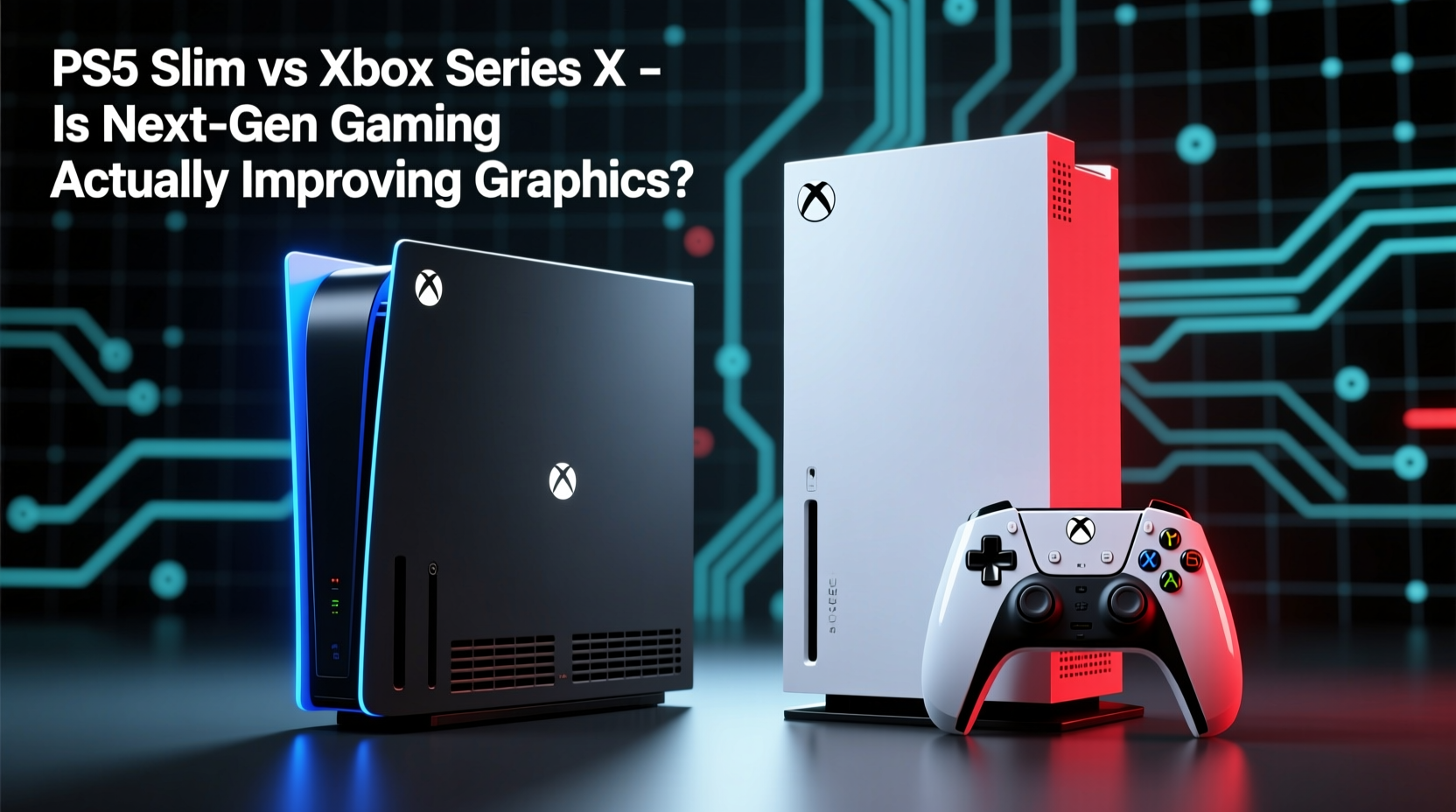
At first glance, both consoles represent a significant leap from their predecessors. The original PS5 launched with a custom AMD Zen 2 CPU, RDNA 2 GPU, and ultra-fast SSD storage. The PS5 Slim, released in late 2023, maintains identical internal specs but features a reduced form factor and slightly improved power efficiency. Meanwhile, the Xbox Series X remains Microsoft’s flagship console, boasting one of the most powerful consumer-grade GPUs in any home entertainment device.
Despite these strengths, the PS5 Slim does not upgrade the core processing or graphical hardware—it simply repackages it. This means its graphical output is functionally equivalent to the original PS5. In contrast, the Xbox Series X was designed from day one with 4K resolution, high dynamic range (HDR), and ray tracing as baseline expectations.
| Feature | PS5 Slim | Xbox Series X |
|---|---|---|
| CPU | Custom AMD Zen 2, 8-core @ 3.5GHz (variable) | Custom AMD Zen 2, 8-core @ 3.8GHz (3.6GHz w/ SMT) |
| GPU | Custom RDNA 2, 10.3 TFLOPs | Custom RDNA 2, 12.15 TFLOPs |
| Memory | 16GB GDDR6 | 16GB GDDR6 |
| Storage | 1TB SSD (expandable) | 1TB SSD (expandable) |
| Max Resolution | 4K @ up to 120Hz | 8K @ 60Hz / 4K @ 120Hz |
| Ray Tracing | Yes | Yes |
The numbers suggest a clear edge for the Xbox Series X in raw computational power. However, raw teraflops don’t tell the whole story. Sony’s optimized I/O architecture and integration with the PS5’s SSD can deliver faster load times and smoother asset streaming, which indirectly supports better visual consistency in open-world titles.
Real-World Game Performance: Do We See a Visual Leap?
Let’s consider actual games. Titles like Spider-Man: Miles Morales, Forza Horizon 5, and Elden Ring run on both platforms. In side-by-side comparisons, the Xbox Series X typically outputs a more stable 4K resolution using native or near-native rendering, while many PS5 versions use checkerboard upscaling or dynamic resolution scaling to maintain performance.
For example, Forza Horizon 5 runs at a locked 4K resolution on Xbox Series X with consistent 60 FPS, whereas the PS5 version averages around 1800p–2160p upscaled to 4K, with occasional dips during heavy scenes. Similarly, Call of Duty: Modern Warfare II (2022) delivers higher shadow quality, reflection detail, and draw distances on Series X compared to the PS5.
Yet, in some cases, such as first-party exclusives like God of War: Ragnarök or Horizon Forbidden West, Sony leverages deeper system-level optimization to achieve cinematic lighting, advanced particle effects, and facial animation detail that rival—if not surpass—Xbox equivalents.
“While Xbox Series X has the horsepower advantage, Sony’s tight control over hardware-software integration allows them to extract nuanced visual polish in their exclusives.” — David Chen, Lead Graphics Engineer at Frostbite Labs
Is Next-Gen Actually Improving Graphics?
This brings us back to the central question: are we seeing meaningful graphical improvements in next-gen gaming?
The short answer is yes—but unevenly. Across the board, games today feature higher-resolution textures, improved anti-aliasing, global illumination techniques like ray tracing, and more complex geometry than ever before. Load times have dropped dramatically due to NVMe SSDs, allowing developers to stream vast environments seamlessly.
However, the jump from PS4/Xbox One to PS5/Series X hasn’t been as visually transformative as the leap from PS3 to PS4 or even PS2 to PS3. Why?
- Maturity of current-gen tech: Display standards plateaued at 4K; without widespread adoption of 8K TVs, there’s limited incentive to push beyond 4K rendering.
- Artistic focus over technical: Many studios prioritize narrative depth, gameplay mechanics, and world-building over pure graphical fidelity.
- Development costs: Creating assets for true 4K+ with full ray tracing is expensive and time-consuming, leading to compromises.
- Backward compatibility demands: Cross-generation releases force developers to target lower-spec hardware, capping visual ambition.
In practice, this means many so-called “next-gen” upgrades are subtle: slightly sharper textures, marginally better shadows, or faster loading. True generational leaps—like the shift from pre-rendered backgrounds to fully 3D worlds—are rare today because the foundation is already strong.
Mini Case Study: The Evolution of Ghost of Tsushima
Take Ghost of Tsushima, originally released on PS4 in 2020. Its Director’s Cut, released for PS5, added 4K resolution, 60 FPS mode, enhanced wind effects, improved foliage density, and HDR refinements. While impressive, these changes didn’t redefine the game’s visual identity—they polished an already stunning title.
On the other hand, PC players with high-end rigs experienced even greater enhancements: ultrawide support, DLSS, modded texture packs, and ray-traced reflections far beyond what either console could deliver. This highlights a growing truth: the biggest graphical leaps aren’t happening on consoles, but on PCs where hardware scales freely.
Optimization Tips for Maximum Visual Fidelity
Regardless of which console you own, there are steps you can take to get the most out of your gaming experience. These tips help ensure you’re seeing the best possible image quality each system can offer.
Checklist: Optimizing Your Console for Best Graphics
- Connect via HDMI 2.1 cable to a compatible 4K/120Hz TV or monitor.
- Enable HDR in both console settings and your display’s menu.
- Set audio/video output to “Default” or “Enhanced” mode for full bandwidth.
- Choose “Performance Mode” or “Resolution Mode” in supported games based on preference.
- Keep system software and game patches updated—developers often improve visuals post-launch.
- Use external SSDs wisely; slower drives may bottleneck fast loading promises.
- Disable motion blur or depth-of-field in menus if you prefer cleaner visuals.
Future Outlook: What Comes After This Generation?
As of 2024, neither Sony nor Microsoft has announced a true successor to the PS5 or Series X. Rumors point to mid-cycle refreshes—similar to the PS5 Slim—for improved thermals and efficiency, but no major GPU upgrades. This suggests the industry is shifting toward longer console lifecycles, relying on iterative updates rather than disruptive hardware jumps.
Cloud gaming and AI-driven upscaling (like NVIDIA’s DLSS or future applications of machine learning) may become key drivers of visual improvement. Services like Xbox Cloud Gaming already allow access to high-fidelity games on low-end devices by offloading processing to remote servers.
Meanwhile, Unreal Engine 5 and tools like Nanite and Lumen are enabling developers to create photorealistic environments with unprecedented detail. But again, these technologies are being constrained by current console memory limits and fixed hardware ceilings.
Frequently Asked Questions
Can the PS5 Slim run games better than the original PS5?
No. The PS5 Slim uses identical internal components. It offers the same performance, graphical output, and loading speeds. The only differences are physical size, weight, and removable disc drive option.
Does the Xbox Series X always look better than the PS5?
Not always. In third-party and multi-platform games, the Series X often has a resolution and stability edge. However, in Sony-exclusive titles, deep optimization can result in superior lighting, animation, and environmental storytelling that compete closely with—or sometimes exceed—Xbox visuals.
Are we still in the \"next-gen\" phase of gaming?
Technically, yes. The PS5 and Xbox Series X/S launched in late 2020 and are expected to remain relevant through at least 2027. However, the term “next-gen” is becoming less about immediate visual revolution and more about sustained innovation in speed, immersion, and ecosystem integration.
Conclusion: Rethinking Progress in Next-Gen Gaming
The comparison between the PS5 Slim and Xbox Series X reveals a nuanced picture. Yes, next-gen gaming has improved graphics—but not universally or dramatically. The gains are real: faster loads, smoother framerates, richer materials, and smarter lighting models. Yet, they often manifest as refinements rather than revolutions.
The Xbox Series X holds a measurable advantage in raw power, frequently delivering higher base resolutions and more consistent performance in cross-platform titles. The PS5, including its Slim variant, counters with exceptional optimization in first-party experiences and a cohesive ecosystem that enhances immersion beyond pixels alone.
If you're expecting jaw-dropping visual transformations with every new game, you might be disappointed. But if you appreciate steady progress, deeper realism, and increasingly seamless experiences, then next-gen gaming is indeed moving forward—just not always in the ways we expected.




 浙公网安备
33010002000092号
浙公网安备
33010002000092号 浙B2-20120091-4
Comments
No comments yet. Why don't you start the discussion?