
The battle between the PlayStation 5 and Xbox Series X isn't just about processing power or controller design—it's about access to the games you love, both past and present. As players invest hundreds into next-gen consoles, backward compatibility and game libraries are increasingly critical. These features determine not only how much of your existing collection you can bring forward but also the breadth of experiences available over time. While both Sony and Microsoft have made significant strides in bridging generations, their approaches differ dramatically in philosophy, execution, and long-term player benefit.
Backward Compatibility: Philosophy and Execution
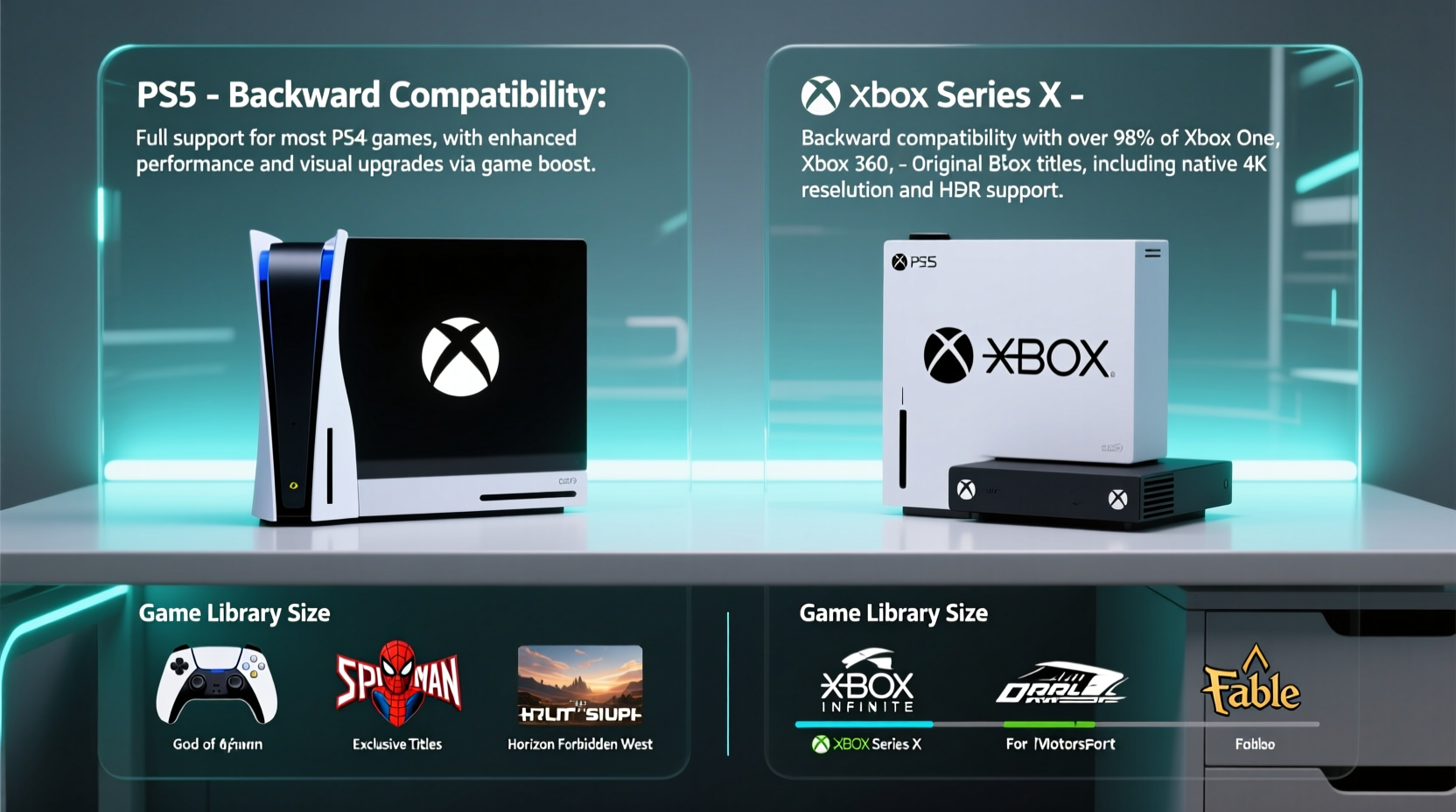
Microsoft has long championed backward compatibility as a core part of its gaming identity. The Xbox Series X supports thousands of titles from the Xbox One, Xbox 360, and even the original Xbox—many enhanced with faster load times, higher frame rates, and improved resolutions through Auto HDR and FPS Boost technologies. This means older games like Red Dead Redemption (2010) or BioShock run more smoothly than ever, often surpassing their original performance.
Sony’s approach with the PS5 is more selective. The console supports nearly all PlayStation 4 games—over 4,000 titles—but does not extend support to PS3, PS2, or PS1 discs. Instead, legacy PlayStation content is accessible only through PlayStation Plus Premium, a subscription service that streams select older titles. This creates a fragmented experience: physical collectors cannot use their old discs, while digital purchases from earlier generations may still be playable if properly migrated.
Game Library Comparison: Quantity vs. Quality
When evaluating game libraries, two factors dominate: exclusives and third-party support. Microsoft has aggressively expanded its first-party studios, acquiring Bethesda, Activision Blizzard, and others, giving Xbox an unprecedented pipeline of future content. Franchises like Halo, Fable, Starfield, and Diablo are now under one roof. However, many of these titles are either unreleased or remain cross-platform.
Sony, by contrast, continues to deliver polished, narrative-driven exclusives annually. Titles like God of War Ragnarök, Spider-Man 2, Horizon Forbidden West, and Ghost of Tsushima Director’s Cut showcase technical excellence and deep storytelling. These games are often system sellers and are rarely ported to competing platforms. While Sony lacks the sheer volume of Microsoft’s upcoming portfolio, its track record for high-quality, must-play experiences remains unmatched.
Third-party support is relatively balanced. Major releases like Elden Ring, Call of Duty, and Assassin’s Creed appear on both systems with similar performance. However, some PC-first developers have delayed or skipped PlayStation ports—a trend that could affect long-term parity.
A Detailed Look at Backward Compatibility Features
| Feature | Xbox Series X | PS5 |
|---|---|---|
| Supported Generations | Xbox, Xbox 360, Xbox One | PS4 only |
| Number of Compatible Games | Over 600 enhanced titles; thousands playable | All PS4 games (approx. 4,000+) |
| Disc Support for Legacy Titles | Yes (select titles) | No (PS3 and earlier) |
| Enhancement Technologies | FPS Boost, Auto HDR, Quick Resume | Game Boost (dynamic resolution/framerate) |
| Streaming Required for Old Games? | No – native playback | Yes – PS3/PS2/PS1 via PS Plus Premium |
| Saves Transfer Method | Cloud sync, USB, network transfer | Cloud (PS+, if subscribed), USB, direct transfer |
The table illustrates a key divergence: Xbox prioritizes accessibility and preservation, allowing physical media and offline play for older titles. Sony limits full legacy access to subscribers, effectively monetizing nostalgia. For users without a PS Plus Premium subscription, decades of PlayStation history remain locked behind a paywall.
“Backward compatibility isn’t just a feature—it’s a promise to players that their time and money still matter.” — Jason Schreier, Bloomberg News, video game journalist
Real-World Example: The Collector’s Dilemma
Consider Mark, a long-time gamer with shelves full of Xbox 360 and PS3 discs. When upgrading to next-gen hardware, he wanted to preserve his collection. On Xbox Series X, he simply inserted his copy of Mass Effect: Trilogy—the console recognized it, downloaded the updated version, and ran it with 4K upscaling and 60 FPS. His save files synced automatically via cloud.
With his PS3 copy of The Last of Us, however, the process was different. He couldn’t insert the disc into the PS5. Instead, he had to subscribe to PS Plus Premium, stream the game, and hope for stable internet. Even then, input lag and compression artifacts detracted from the experience. While a remastered version is available for purchase, he had to buy it again despite owning the original.
This scenario reflects a broader trend: Xbox treats backward compatibility as seamless continuity; PlayStation treats it as optional convenience.
Exclusive Roadmaps and Long-Term Value
Looking ahead, Microsoft’s strategy centers on ecosystem integration. With Game Pass offering hundreds of titles—including day-one exclusives—the value proposition shifts from individual games to ongoing access. Future releases like Indiana Jones and the Great Circle and Crash Team Rumble are already confirmed for Game Pass, reinforcing the idea that ownership matters less than access.
Sony maintains a traditional model: premium-priced exclusives released months before potential PC ports. While this rewards early adopters, it also delays broader availability. Additionally, Sony has begun releasing some exclusives on PC (e.g., Horizon Zero Dawn, God of War), suggesting a shift toward maximizing revenue across platforms rather than locking content to hardware.
For players focused on long-term library growth, Xbox offers more flexibility. Game Pass subscribers gain instant access to a vast catalog, including backward-compatible titles, indie darlings, and new releases. PlayStation Plus tiers offer similar functionality but at higher cost and with fewer enhancements for legacy content.
Actionable Checklist: Choosing Based on Your Library Needs
Use this checklist to determine which console aligns best with your gaming habits and collection:
- ✅ Do you own multiple Xbox 360 or original Xbox games? → Xbox Series X
- ✅ Are most of your older games from the PS4 era? → PS5 is sufficient
- ✅ Do you want to play classic PS1, PS2, or PS3 games without repurchasing? → Xbox wins unless you’re willing to subscribe to PS Plus Premium
- ✅ Are you interested in day-one access to new releases without buying each title? → Xbox Game Pass offers better value
- ✅ Do you prioritize cinematic, story-rich exclusives? → PS5 currently leads
- ✅ Do you play mostly multiplayer or live-service games? → Both platforms are comparable (Fortnite, Warzone, Destiny 2)
- ✅ Is preserving physical media important to you? → Xbox Series X supports legacy discs
Frequently Asked Questions
Can I play PS2 games on PS5?
Only through streaming via the PlayStation Plus Premium subscription. There is no native support for PS2 discs on the PS5. Some remastered versions of PS2-era games (like Shadow of the Colossus) are available for purchase digitally.
Does Xbox Series X enhance old games automatically?
Yes. Many backward-compatible titles receive automatic improvements such as higher resolutions, smoother framerates (via FPS Boost), and HDR support (Auto HDR). Microsoft continuously updates its compatibility list with enhancements.
Are all PS4 games compatible with PS5?
Virtually all PS4 games work on PS5, with the exception of a few titles that require peripherals not supported on the new console (e.g., PlayStation Camera games need an adapter). Most benefit from Game Boost, which improves performance.
Conclusion: Which Console Offers Better Value for Gamers?
The answer depends on what you value most. If you cherish your gaming history and want to revisit classics without barriers, the Xbox Series X delivers superior backward compatibility. Its broad generational support, enhancement tools, and lack of subscription requirements make it the definitive choice for preservation-minded players.
However, if you prioritize cutting-edge exclusive experiences and played heavily during the PS4 era, the PS5 offers a seamless transition and a consistently strong lineup of first-party titles. Its backward compatibility is excellent within its generation, though limited beyond it.
Ultimately, Microsoft is building a unified gaming future where your library travels with you. Sony focuses on delivering premium, self-contained experiences—excellent in quality but narrower in scope. For players who see games as art worth preserving, Xbox’s open-access model sets a new standard. For those chasing narrative depth and visual polish, PlayStation remains compelling.




 浙公网安备
33010002000092号
浙公网安备
33010002000092号 浙B2-20120091-4
Comments
No comments yet. Why don't you start the discussion?