
Change doesn’t have to be dramatic to be powerful. In fact, some of the most enduring transformations begin with actions so small they almost seem insignificant. The secret lies not in motivation or willpower, but in a simple yet profound behavioral strategy: habit stacking. Rooted in cognitive science and behavioral psychology, habit stacking leverages the brain’s natural tendency to form associations, allowing new behaviors to take root by attaching them to existing ones. Over time, these micro-routines accumulate, creating a foundation for long-term growth in health, productivity, and emotional well-being.
The Science Behind Habit Formation
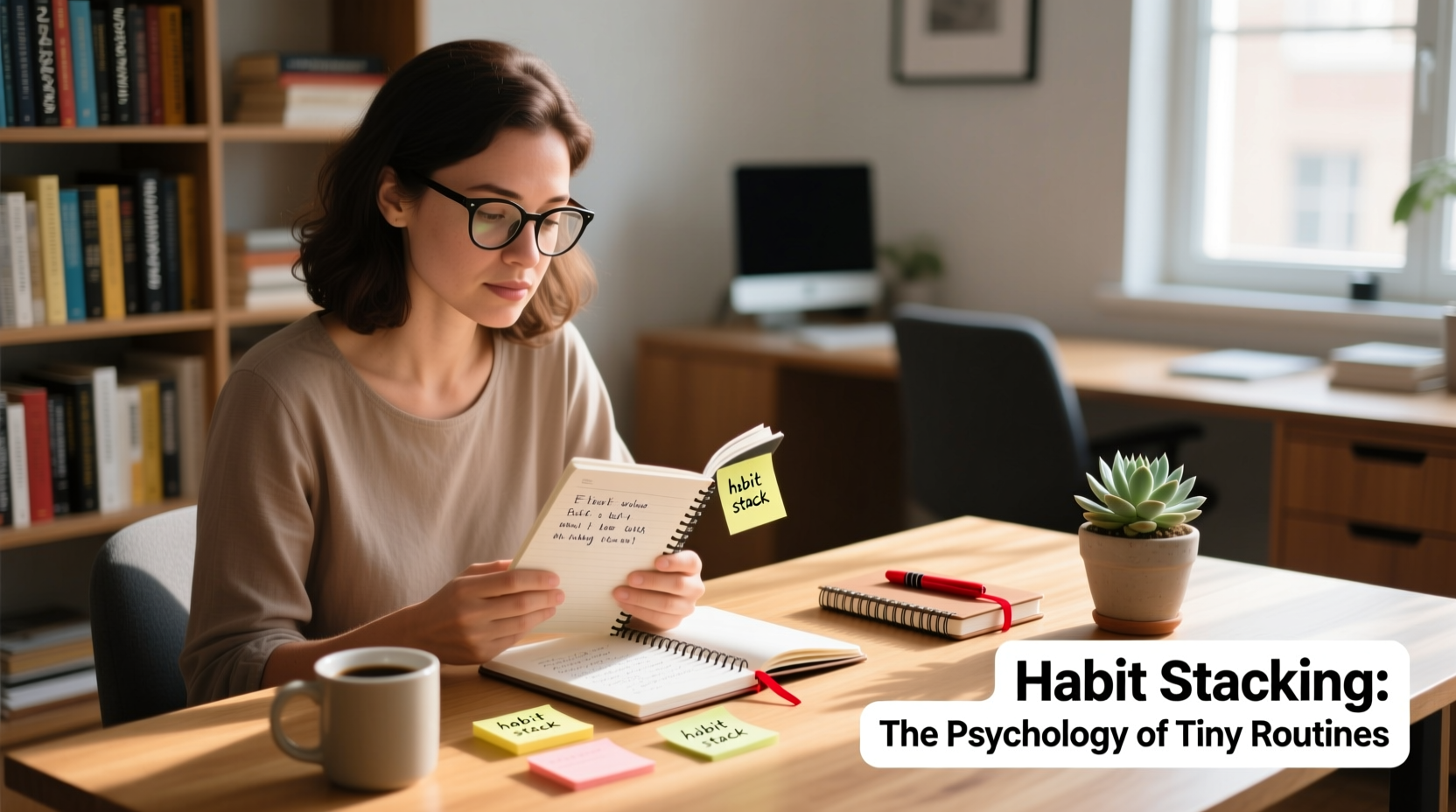
Habits are automatic behaviors triggered by contextual cues—repeated actions that the brain learns to perform with minimal conscious effort. According to research from MIT neuroscientists, habits operate within a neurological loop consisting of three components: cue, routine, and reward. This cycle, known as the \"habit loop,\" is the cornerstone of automatic behavior.
When a cue is recognized (e.g., finishing your morning coffee), the brain anticipates a reward (alertness, comfort) and triggers a routine (checking email, stretching). With repetition, this loop becomes more efficient, reducing cognitive load. This efficiency is why habits feel effortless—they free up mental bandwidth for more complex tasks.
However, forming new habits often fails because people rely on motivation, which fluctuates. What doesn’t fail is structure. That’s where habit stacking comes in. By anchoring a new behavior to an already-automatic one, you bypass the need for constant decision-making.
“Habits are the invisible architecture of daily life. We rise each day to the scaffolding of our previous choices.” — James Clear, author of *Atomic Habits*
What Is Habit Stacking?
Habit stacking is the practice of linking a new habit to an established one using a simple formula: “After [CURRENT HABIT], I will [NEW HABIT].” The method was popularized by James Clear but has roots in behavioral chaining, a technique used in cognitive-behavioral therapy and operant conditioning.
For example:
- After I pour my morning coffee, I will meditate for one minute.
- After I brush my teeth at night, I will floss one tooth.
- After I sit down at my desk, I will write one sentence of my report.
The power isn’t in the action itself, but in the consistency of the sequence. Over time, the existing habit acts as a reliable trigger, making the new behavior easier to initiate—even when motivation is low.
Why Tiny Routines Lead to Lasting Change
Traditional self-improvement advice often emphasizes big goals: lose 30 pounds, write a novel, learn a language. But such targets create pressure and often lead to burnout. Tiny routines work differently. They focus on process over outcome, relying on compound effects.
Neuroplasticity—the brain’s ability to reorganize itself—responds best to repeated, consistent stimuli. Each time you perform a small habit, you strengthen neural pathways associated with that behavior. The more you repeat it, the stronger the connection becomes. Eventually, the behavior feels less like effort and more like instinct.
This principle applies across domains:
- Health: Two minutes of stretching after brushing your teeth can evolve into a full mobility routine.
- Productivity: Writing one sentence after opening your laptop builds momentum toward completing major projects.
- Mental wellness: Naming one thing you’re grateful for after locking the front door reinforces positive thinking patterns.
The key is compounding. Just as compound interest grows wealth slowly but exponentially, small habits generate disproportionate results over time. Missing one day doesn’t derail progress; consistency over weeks and months does the heavy lifting.
A Step-by-Step Guide to Building Your Habit Stack
Creating effective habit stacks requires intentionality. Follow this timeline to design and implement routines that stick:
- Identify Keystone Habits (Day 1–2): List daily behaviors you already do without fail—morning coffee, brushing teeth, sitting in your car, logging into your computer. These are potential anchors.
- Define Micro-Habits (Day 3): Choose tiny actions aligned with your goals. Want to read more? “Read one paragraph.” Need to move more? “Stand up and stretch.”
- Pair Them (Day 4): Use the formula: “After [existing habit], I will [new habit].” Write it down. Example: “After I close my laptop at night, I will jot down one idea in my journal.”
- Test and Adjust (Week 1): Practice the stack daily. If it feels forced, make the new habit smaller or shift the anchor point.
- Expand Gradually (Week 4+): Once the habit feels automatic, increase the difficulty slightly—two paragraphs, five push-ups—but only after mastery.
Track your streaks using a calendar or habit tracker app. Visual progress reinforces commitment, even when results aren’t immediately visible.
Common Pitfalls and How to Avoid Them
Even with the right framework, people stumble. Here are frequent mistakes and evidence-based solutions:
| Problem | Why It Happens | Solution |
|---|---|---|
| New habit feels forced | Poor cue alignment or too large an action | Shrink the habit further or choose a more reliable anchor |
| Skipped days disrupt momentum | Perfectionism leads to all-or-nothing thinking | Focus on consistency, not perfection. Miss a day? Resume immediately. |
| Lose interest after a few weeks | Reward isn’t satisfying or immediate enough | Add a small pleasure—a favorite song, a checkmark, a text to a friend |
| Too many stacks at once | Cognitive overload weakens execution | Limit to 1–2 stacks per week. Master before adding more. |
Real-World Example: From Burnout to Balance
Sarah, a 34-year-old project manager, struggled with chronic stress and evening fatigue. She wanted to exercise but never had energy after work. Instead of committing to an hour at the gym, she started small.
She identified her strongest existing habit: hanging up her coat when she got home. Her micro-habit? Putting on her workout shoes immediately after.
“After I hang up my coat, I will put on my workout shoes.”
That was it. No obligation to exercise—just shoes on. Some days, she’d sit on the couch afterward. But often, just wearing the shoes made her more likely to walk around the block. Within six weeks, she was walking 20 minutes most evenings. Three months later, she joined a weekend hiking group.
The transformation wasn’t due to discipline—it was design. The habit stack reduced friction and leveraged behavioral momentum. One tiny action opened the door to sustained change.
Checklist: Build Your First Habit Stack
Use this actionable checklist to create your first effective habit stack:
- ☐ Identify 3 existing daily habits that happen at consistent times
- ☐ Choose a micro-habit related to a goal you care about
- ☐ Phrase it using “After [current habit], I will [new habit]”
- ☐ Make the new habit so easy you can’t say no (e.g., “floss one tooth”)
- ☐ Perform the stack daily for 7 days without increasing difficulty
- ☐ Track completion with a checkmark or app
- ☐ After 21 days, evaluate: does it feel automatic? If yes, consider expanding.
Expert Insight: The Role of Identity in Habit Success
Behavioral change isn’t just about doing—it’s about becoming. As Clear emphasizes, lasting habits emerge when we shift our identity. Instead of “I’m trying to be healthy,” we adopt “I am someone who takes care of myself.”
Habit stacking supports this shift by providing proof of identity through action. Each time you complete a stack, you reinforce a new self-narrative. You don’t just do the habit—you become the type of person who does it.
“We don’t rise to the level of our goals. We fall to the level of our systems.” — James Clear
This mindset reframes failure. Missing a day doesn’t mean you’ve failed; it means your system needs tweaking. Identity-based habits reduce reliance on motivation because you’re no longer chasing outcomes—you’re living out who you already are.
Frequently Asked Questions
How long does it take for a habit stack to become automatic?
Research varies, but studies suggest between 18 and 254 days, with an average of 66 days for a behavior to become automatic in real-world settings. Consistency matters more than speed. Focus on showing up, not timing.
Can I stack multiple new habits onto one existing one?
Yes, but cautiously. Chaining too many behaviors can overwhelm working memory. Start with one new habit per anchor. Once it’s solid, you can add another—but only if the sequence feels natural.
What if my routine changes—will the stack break?
Life changes are inevitable. If your anchor habit shifts (e.g., switching jobs), simply re-pair the new habit with a different reliable cue. Flexibility strengthens resilience. The method matters more than the specific trigger.
Conclusion: Small Actions, Lasting Transformation
The psychology of habit stacking reveals a quiet truth: meaningful change doesn’t require grand gestures. It begins with intention, structure, and repetition. By anchoring tiny routines to what you already do, you harness the brain’s natural wiring to build behaviors that endure.
Forget overhauling your life overnight. Start where you are. Use what you have. Do what you can. One minute of meditation after coffee. One sentence written after logging in. One deep breath after closing your eyes at night. These moments may seem trivial, but compounded over weeks and months, they reshape your days—and ultimately, your life.




 浙公网安备
33010002000092号
浙公网安备
33010002000092号 浙B2-20120091-4
Comments
No comments yet. Why don't you start the discussion?