
When temperatures drop below freezing, staying warm isn't just about comfort—it's a matter of safety. Choosing the right outerwear becomes critical, especially in regions with harsh winters. Two of the most popular cold-weather staples are puffer jackets and wool coats. While both offer protection from the elements, they function very differently and excel under distinct conditions. Understanding their thermal properties, construction, and real-world performance can make all the difference between enduring winter and thriving in it.
The debate isn’t simply about fashion or tradition; it’s rooted in physics, material science, and practical experience. Puffer jackets rely on trapped air within synthetic or down insulation, while wool coats use the natural heat-retaining structure of tightly woven animal fibers. Each has strengths and limitations that affect warmth, breathability, weight, and durability—especially when exposed to extreme cold, wind, or moisture.
How Warmth Works: The Science Behind Insulation
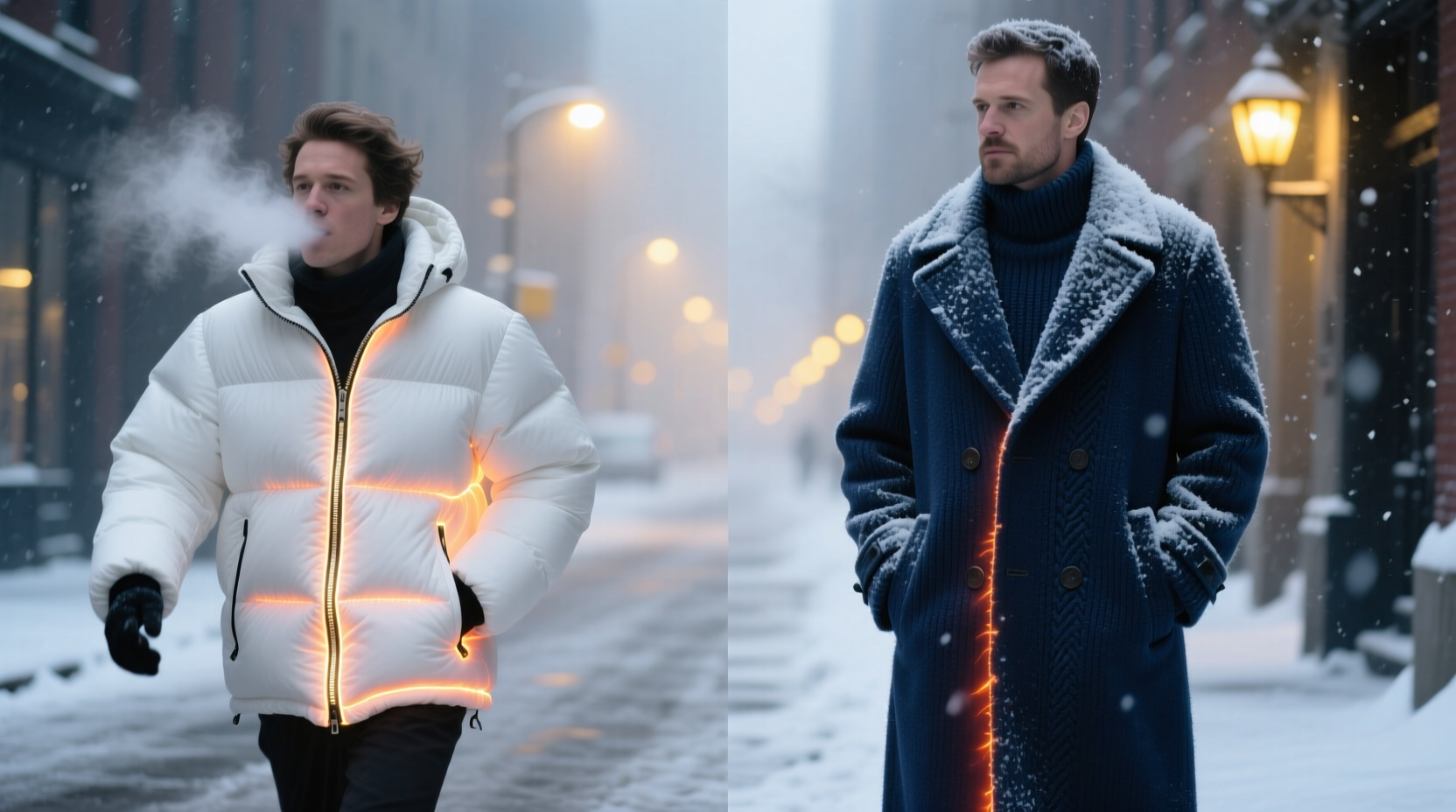
Heat retention in clothing depends on one key principle: minimizing heat loss through conduction, convection, radiation, and evaporation. Effective insulation creates a barrier that traps body heat by slowing these processes. The best cold-weather garments do this efficiently without adding excessive bulk or compromising mobility.
Insulating materials work by trapping still air—the less movement within the fabric layers, the better the heat retention. Down feathers and synthetic fills used in puffer jackets create thousands of tiny air pockets. Wool, on the other hand, insulates through its crimped fiber structure, which naturally holds air while also wicking moisture away from the skin.
“Air is the true insulator. Whether it’s locked in goose down clusters or nestled between wool fibers, still air is what keeps humans warm in subzero environments.” — Dr. Lena Torres, Textile Scientist at Cold Climate Research Lab
The effectiveness of an insulating layer is often measured by its ability to maintain warmth relative to thickness and weight. This is where modern materials have made significant advances—but not always in ways that favor one type of coat over another across all scenarios.
Puffer Jackets: Lightweight Warmth with High Efficiency
Puffer jackets, named for their quilted, balloon-like appearance, are engineered primarily for maximum warmth-to-weight ratio. They typically use either goose down or synthetic insulation (like PrimaLoft or Thinsulate) encased in tightly woven nylon or polyester shells.
Down-filled puffers are renowned for their superior warmth-to-weight performance. High-fill-power down (measured in cubic inches per ounce) indicates larger, loftier clusters that trap more air. A 800+ fill power jacket provides exceptional warmth with minimal weight—ideal for static activities like commuting or standing outdoors.
However, down loses much of its insulating capability when wet. Even light snow or perspiration can compress the clusters and reduce loft. That’s why many premium puffers now feature water-resistant coatings or hydrophobic down treatments.
Synthetic puffers, meanwhile, retain warmth even when damp and dry faster than down. Though slightly heavier and less compressible, they perform reliably in humid or rainy conditions. For those frequently exposed to mixed weather, synthetic options offer consistent thermal protection.
Wool Coats: Natural Insulation with Timeless Performance
Wool coats, particularly those made from high-quality merino, Shetland, or boiled wool, have been trusted winter wear for centuries. Unlike puffers, they derive warmth from dense, interlocking fibers that resist compression and continue insulating even when damp—a trait honed through evolution in sheep adapted to cold climates.
One of wool’s greatest advantages is its hygroscopic nature: it can absorb up to 30% of its weight in moisture without feeling wet. As wool absorbs vapor from sweat, it actually releases a small amount of heat—a process known as heat of sorption. This makes wool uniquely suited for active wear in cold environments, where managing moisture is crucial.
Additionally, wool resists odors, flame, and UV degradation, making it a durable long-term investment. Traditional wool coats often feature heavy weaves or felted finishes that add wind resistance, though they may lack the full waterproofing of modern technical shells.
While wool excels in breathability and moisture management, it generally offers less insulation per inch than high-loft down. A thick wool coat may feel warmer than a thin puffer, but in deep freeze conditions (-15°C/5°F or lower), it may fall short unless layered heavily underneath.
Comparative Analysis: Key Factors in Freezing Conditions
To determine which garment performs better in freezing temperatures, several factors must be weighed beyond basic warmth. Real-world usability often hinges on environmental conditions, activity level, and personal physiology.
| Factor | Puffer Jacket | Wool Coat |
|---|---|---|
| Warmth-to-Weight Ratio | Excellent – especially with high-fill down | Moderate – requires greater thickness for equivalent warmth |
| Moisture Resistance | Fair (down); Good (synthetic) | Very Good – retains warmth when damp |
| Breathability | Moderate – prone to condensation buildup | Excellent – manages sweat effectively |
| Wind Resistance | High – with tightly woven shell | Good – depends on weave density |
| Durability | Good – but down can degrade if compressed long-term | Excellent – wool resists abrasion and aging |
| Ease of Layering | Easy – lightweight allows multiple layers | Limited – bulky coats restrict layering options |
This comparison shows that neither option dominates across all categories. Puffer jackets win in lightweight warmth and packability, while wool coats lead in breathability, moisture handling, and longevity.
Real-World Scenario: Urban Commuter vs. Outdoor Adventurer
Consider two individuals facing the same -20°C (-4°F) winter morning:
- Alex, a city worker, walks 15 minutes to the subway, stands on an uncovered platform, then sits in a heated office all day.
- Jamal, a ski patrol volunteer, spends six hours outside performing rescues, walking uphill, and waiting in wind-exposed zones.
Alex benefits most from a **high-fill down puffer** worn over a sweater. The jacket provides intense warmth during brief exposure, is easy to remove indoors, and doesn’t overheat during mild exertion. Its low bulk fits well under a stylish overcoat if desired.
Jamal, however, needs breathable insulation that won’t fail when he sweats climbing a slope or gets caught in blowing snow. Here, a **wool-blend parka with a wind-resistant outer layer** proves more effective. Despite being slightly heavier, it regulates temperature better and continues insulating after getting wet from snow contact.
“In dynamic outdoor roles, I see more overheating and dampness issues with puffers than with wool. Breathability saves lives in prolonged exposure.” — Mark Renner, Mountain Safety Instructor and Guide
When to Choose Which: A Practical Decision Framework
Selecting between a puffer jacket and a wool coat should align with your environment, lifestyle, and expected conditions. Use the following checklist to guide your decision:
- Will you be mostly stationary in extreme cold? → Prioritize puffer jackets with high-fill down (800+).
- Do you move frequently or generate body heat through activity? → Opt for wool or hybrid wool-puffer designs.
- Is precipitation or humidity common? → Choose synthetic puffers or water-resistant wool blends.
- Do you value packability and travel convenience? → Puffers win—most compress into small stuff sacks.
- Are you investing for long-term wear and sustainability? → Wool coats typically last longer with proper care.
- Do you layer extensively? → Puffers allow more flexibility; wool coats work best as mid or outer layers.
Optimizing Warmth: Layering Strategies for Both Types
No single coat guarantees warmth in freezing temperatures without proper layering. Both puffers and wool coats function best as part of a system:
- Base Layer: Moisture-wicking fabric (merino wool or synthetic) to keep skin dry.
- Middle Layer: Fleece or lightweight wool sweater for additional insulation.
- Outer Layer: Windproof shell (if needed) over the puffer or wool coat to block gusts and light snow.
In extremely cold conditions (-25°C / -13°F or lower), wearing a wool sweater beneath a down puffer combines the best of both worlds: high loft and excellent moisture control. Some manufacturers now produce hybrid jackets integrating wool panels in high-sweat zones (underarms, back) with down elsewhere—a smart fusion of technologies.
Frequently Asked Questions
Can a wool coat be as warm as a puffer jacket?
Yes, but only if it’s exceptionally thick or layered. A standard wool trench may match a light puffer, but few wool coats equal the thermal efficiency of a high-fill down jacket in extreme cold. However, wool maintains warmth better during physical activity due to superior breathability.
Which lasts longer: a puffer or a wool coat?
Wool coats generally last longer. With proper care, a well-made wool coat can remain functional for decades. Puffer jackets, especially down ones, lose loft over time if stored compressed or exposed to moisture. Synthetic puffers degrade faster under UV exposure.
Are there eco-friendly options in both categories?
Absolutely. Recycled polyester puffers and responsibly sourced down (certified by RDS – Responsible Down Standard) are increasingly common. Wool is naturally renewable and biodegradable, especially when untreated and sourced from ethical farms. Look for certifications like ZQ Merino or Oeko-Tex for sustainable choices.
Final Recommendation: Match the Garment to the Environment
So, which keeps you warmer in freezing temperatures? The answer depends on context.
In static, dry, and extremely cold conditions—such as waiting at a bus stop in Arctic weather or attending an outdoor event—a **high-quality down puffer jacket** will likely provide more immediate and intense warmth due to its superior loft and air-trapping capacity.
But in active, variable, or damp settings—like hiking, shoveling snow, or working outdoors—a **well-constructed wool coat** often performs better by regulating temperature, resisting moisture, and maintaining consistent insulation without overheating.
For optimal preparedness, consider owning both. Use the puffer for urban commutes and quick trips in deep cold. Reserve the wool coat for extended outdoor exposure or transitional seasons when breathability matters most.




 浙公网安备
33010002000092号
浙公网安备
33010002000092号 浙B2-20120091-4
Comments
No comments yet. Why don't you start the discussion?