
When the temperature drops, staying warm without sacrificing mobility or style becomes a priority. Two of the most popular insulated outerwear options—quilted jackets and puffer coats—both promise protection from cold weather, but they achieve it in fundamentally different ways. While both are designed to trap heat, their construction, materials, and insulation methods lead to distinct outcomes in warmth, weight, and overall bulk. For those seeking maximum thermal efficiency with minimal volume, understanding the differences between these two styles is essential.
The choice isn’t just about aesthetics; it’s about function. Whether you're layering for urban commutes, braving winter hikes, or traveling through variable climates, knowing which jacket delivers superior insulation without unnecessary thickness can make all the difference. This article breaks down the science, design, and real-world performance of quilted jackets and puffer coats to answer one critical question: which keeps you warmer, lighter, and less encumbered by bulk?
How Insulation Works: The Science Behind Warmth
At its core, insulation works by trapping air. Heat generated by the body warms the air near the skin, and effective insulation prevents that warm air from escaping while blocking cold external air from entering. The more efficiently a garment traps and retains this warm air, the better it insulates.
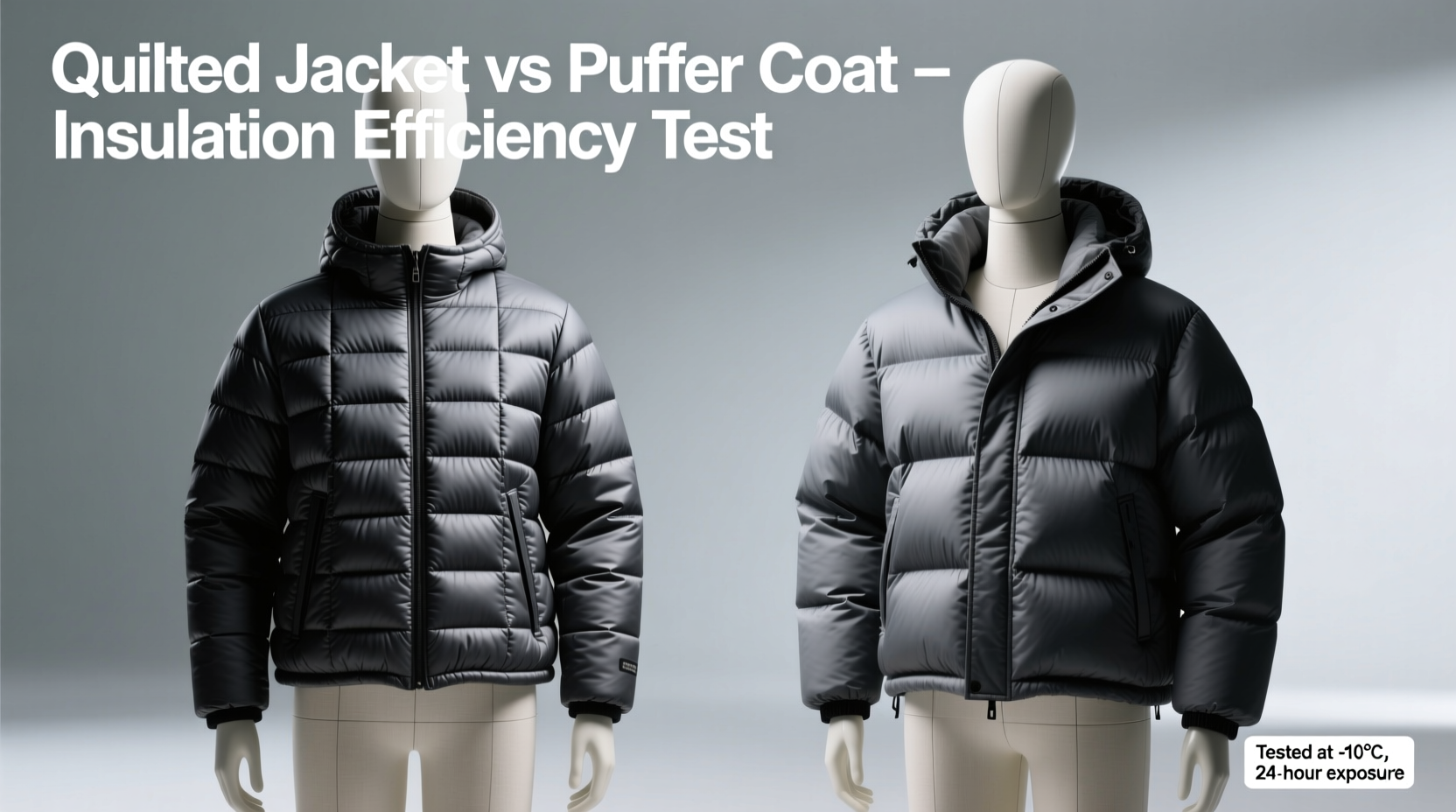
Both quilted jackets and puffer coats rely on this principle, but they use different strategies. Quilted jackets typically feature a tightly stitched pattern that creates small, flat compartments filled with synthetic fibers or light down blends. These compartments prevent insulation from shifting and maintain consistent coverage across the torso and arms.
Puffer coats, on the other hand, are characterized by larger, raised baffles that allow insulation—usually high-fill-power down or thick synthetic clusters—to expand fully. This expansion increases loft, which directly correlates to higher heat retention. The puffiness isn't just visual; it's functional, creating larger pockets of trapped air.
“Loft is king when it comes to insulation. More loft means more still air, which means better thermal resistance.” — Dr. Lena Torres, Textile Engineer, Outdoor Gear Lab
However, greater loft often equates to increased bulk. So while puffers may offer superior warmth per ounce, they also tend to be more voluminous. Quilted jackets trade some of that peak insulation capacity for a sleeker, more tailored profile.
Construction Differences: Design That Defines Performance
The structural design of each jacket type plays a major role in how it performs under cold conditions.
Quilted Jackets: These are typically constructed with a continuous layer of insulation sandwiched between fabric panels stitched together in a repeating geometric pattern—often diamond or grid shapes. The stitching lines serve as both aesthetic detail and functional barriers that keep insulation evenly distributed. Because the quilting is tight and shallow, the resulting jacket lies close to the body, minimizing wind resistance and making it easier to layer under or over other garments.
Materials used in quilted jackets range from polyester batting to lightweight duck down (typically 550–650 fill power). Many are designed for mild to moderately cold conditions, offering moderate warmth with excellent breathability. They’re commonly found in field coats, chore jackets, and fashion-forward outerwear where a clean silhouette matters.
Puffer Coats: Built for extreme conditions, puffer coats use baffle-box construction—larger, three-dimensional chambers that allow insulation to expand vertically. This maximizes loft and minimizes cold spots. High-end models use premium goose down (700–900 fill power), capable of providing exceptional warmth-to-weight ratios. Even synthetic puffers now mimic this structure using advanced hollow-core fibers that retain heat even when damp.
Because of their 3D structure, puffers naturally create more volume. But modern engineering has reduced excess bulk through techniques like differential cut (where the inner shell is slightly smaller than the outer, reducing sagging) and strategic insulation mapping (placing high-loft fill only in core areas like the chest and back).
Warmth vs. Bulk: A Direct Comparison
To determine which option provides better insulation without excessive bulk, we must evaluate several key factors: warmth-to-weight ratio, compressibility, fit, and real-world usability.
| Feature | Quilted Jacket | Puffer Coat |
|---|---|---|
| Insulation Type | Synthetic batting or low-mid down fill (550–650) | High-fill down (700+) or advanced synthetic clusters |
| Warmth Level | Moderate (suitable for 20°F to 40°F / -7°C to 4°C) | High to extreme (down to -20°F / -29°C with proper layering) |
| Bulk | Low – lies flat against body | High – puffy, expansive silhouette |
| Weight | Light to medium | Very light (down) to medium (synthetic) |
| Compressibility | Good – folds compactly | Excellent – stuffs into own pocket or small sack |
| Layering Ease | Excellent – easy to wear under shells or over sweaters | Fair to poor – adds volume that can restrict movement |
| Wind Resistance | High – tighter weave and fit reduce airflow | Moderate – gaps between baffles can allow wind penetration unless windproof shell used |
From this comparison, it’s clear that puffer coats win decisively in raw insulation performance. A 900-fill-power down puffer can provide the same warmth as a much heavier quilted jacket while weighing significantly less. However, that warmth comes with increased visual and physical volume.
Quilted jackets, while not matching the thermal output of top-tier puffers, excel in situations where low profile and freedom of movement matter. They integrate seamlessly into layered wardrobes, slide easily under rain shells, and maintain a polished appearance suitable for city wear.
Real-World Use Case: Urban Commuter vs. Winter Explorer
Consider two individuals facing cold weather but with different needs.
Case Study: Sarah, the City Professional
Sarah lives in Chicago and walks 20 minutes to work each day. Her route includes heated train stations and office buildings, but she’s exposed during transitions. She values looking put-together and dislikes feeling restricted. She opts for a mid-length quilted jacket with 600-fill down and a water-resistant shell. It keeps her warm enough during short exposures, layers well over blazers, and doesn’t crumple her professional look. On extremely cold days (-10°F), she pairs it with a heavy wool coat, using the quilted layer as a warm mid-shell rather than an outer layer.
Case Study: James, the Backcountry Skier
James spends weekends ski touring in the Rockies, where temperatures regularly dip below 0°F. He needs maximum warmth with minimal weight, especially since he’s active and generating sweat. He chooses a 850-fill-power goose down puffer with Pertex® Quantum shell. Though bulky when worn alone, it packs into a small sack when he heats up on climbs. When stopped, he throws it on over his base and softshell layers, instantly regaining core warmth. The bulk is accepted as a necessary trade-off for survival-level insulation.
These examples illustrate that “better insulation without bulk” depends on context. For Sarah, the quilted jacket offers optimal balance. For James, the puffer’s bulk is justified by unmatched warmth per gram.
Choosing Based on Climate and Activity
Your environment and daily routine should guide your decision more than marketing claims.
- Mild Winters (above 30°F / -1°C): Quilted jackets are ideal. Their streamlined design works well with layering systems and avoids overheating during activity.
- Severe Cold (below 20°F / -7°C): Puffer coats dominate. Their ability to trap heat far exceeds quilted alternatives, especially when sedentary.
- Active Use (hiking, cycling, commuting): Consider a hybrid approach—wear a quilted jacket as a mid-layer under a shell, or choose a slim-profile puffer designed for mobility.
- Wet Conditions: Synthetic insulation (in either style) outperforms down when damp. Many modern quilted jackets use hydrophobic fibers that retain warmth even when wet.
Step-by-Step: How to Choose the Right Insulated Jacket
- Assess Your Climate: Track average winter temperatures and precipitation levels in your area.
- Determine Primary Use: Will you be stationary (e.g., waiting for transit) or active (e.g., walking, skiing)?
- Evaluate Layering Needs: Do you need something thin enough to wear under a coat, or will this be your outermost layer?
- Check Fill Power (for down): Aim for 600+ for general use, 750+ for high-performance insulation.
- Test Fit and Mobility: Try on the jacket with typical winter layers. Raise your arms, bend forward—ensure no restriction.
- Compare Weight and Packability: If portability matters, prioritize garments that compress small and weigh less than 1 lb (0.45 kg).
- Verify Care Requirements: Down requires special washing; some synthetics can go straight into the machine.
Expert Insight: What Industry Leaders Recommend
Outdoor gear designers emphasize that insulation effectiveness isn’t just about material—it’s about system integration.
“The best ‘low-bulk, high-warmth’ solution isn’t always a single jacket. It’s a system: a quilted mid-layer for everyday warmth, paired with a packable puffer for sudden cold snaps.” — Marcus Reed, Product Lead at Alpine Threads
This modular approach allows users to adapt to changing conditions without carrying unnecessary weight. Many mountaineers and urban travelers alike now adopt this strategy, treating insulation as interchangeable components rather than fixed outerwear.
Frequently Asked Questions
Can a quilted jacket be as warm as a puffer coat?
Not typically. While high-density synthetic quilting can approach the warmth of lower-fill puffers, it does so at the cost of added weight and thickness. True equivalence in warmth would require a quilted jacket so densely packed it loses its defining advantage: low bulk.
Are puffer coats outdated for city wear?
No. Modern puffers come in sleek, tailored cuts with matte finishes and minimalist designs. Brands like Arc’teryx, Uniqlo, and Canada Goose offer urban-friendly models that balance function and fashion. The key is choosing a trim-fit version with clean lines.
Do quilted jackets lose warmth over time?
Over years of use, yes—especially if compressed frequently or washed improperly. Synthetic batting can clump or flatten, reducing trapped air. Down-filled quilted jackets fare better if cared for correctly, but still benefit from occasional fluffing and proper storage.
Final Recommendation: Match Form to Function
If your priority is **maximum insulation with minimal weight**, and you can accept some visual and physical bulk, a high-fill-power puffer coat is the superior choice. Its ability to trap heat efficiently makes it indispensable in freezing environments.
If you value **a streamlined silhouette, ease of layering, and versatility in milder cold**, a well-insulated quilted jacket offers excellent performance without overwhelming your wardrobe or restricting movement.
For many people, the smartest solution is owning both. Use the quilted jacket daily for comfort and style. Keep a lightweight puffer in your bag or car for emergencies or extended exposure. Together, they form a flexible, future-proof insulation strategy.




 浙公网安备
33010002000092号
浙公网安备
33010002000092号 浙B2-20120091-4
Comments
No comments yet. Why don't you start the discussion?