
The point-of-view (POV) camera market is evolving at breakneck speed. As we approach 2025, two devices stand out in the race for dominance: Ray-Ban Meta, the stylish smart glasses developed with Meta, and Insta360 Go 3S, the ultra-compact action cam favored by vloggers and adventurers. Both promise seamless hands-free recording, but they serve different needs and audiences. One blends into daily life as fashionable eyewear; the other excels in rugged performance and stabilization. So, which one will truly dominate in 2025?
Design & Wearability: Fashion Meets Function
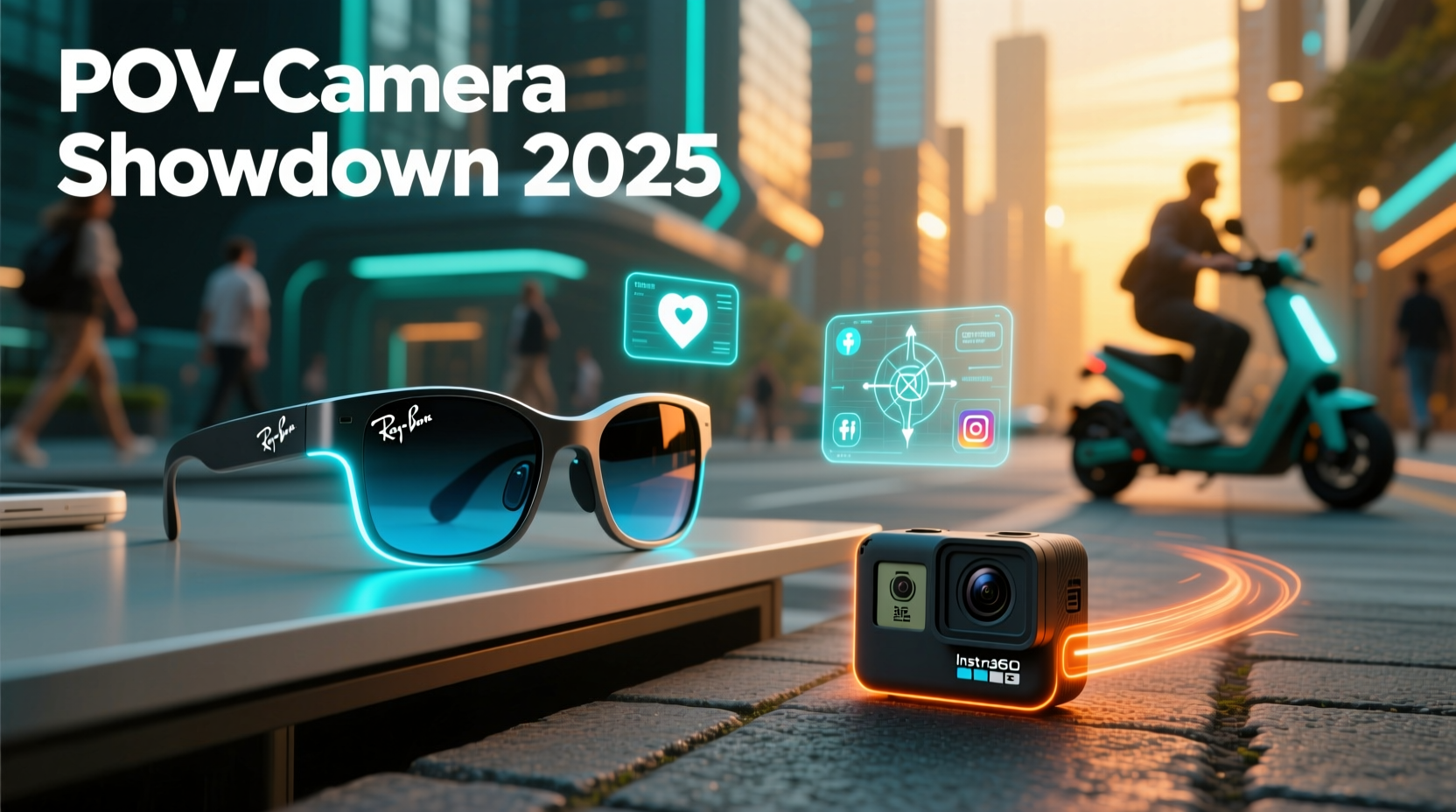
Ray-Ban Meta redefines what smart glasses can be. Built on classic Ray-Ban frames—Wayfarer and Round styles—they look like regular sunglasses. The subtle placement of a tiny camera near the hinge, along with embedded speakers and touch controls, ensures minimal visual disruption. They’re ideal for urban professionals, social media creators, or anyone who wants discreet, all-day capture.
In contrast, the Insta360 Go 3S is designed for utility. Weighing just 34 grams and measuring smaller than a golf ball, it’s magnetically attachable to helmets, clothing, bikes, or even pets. It doesn’t pretend to be fashion-forward—it’s built to survive drops, water exposure, and high-speed motion.
Image Quality & Stabilization: Who Captures Reality Better?
The Insta360 Go 3S shoots 3K video at 60fps and supports 4K timelapse mode. Its standout feature is FlowState 3.0 stabilization, which uses dual-axis gyro and advanced algorithms to deliver buttery-smooth footage—even during parkour or mountain biking. HDR support enhances dynamic range, preserving details in shadows and highlights.
Ray-Ban Meta records 12MP photos and 1080p HD video at 30fps. While adequate for casual sharing, its lower resolution and lack of optical image stabilization make it less suitable for fast-paced environments. Footage can appear shaky when walking briskly or cycling. However, its wide 120° field of view captures more of your natural line of sight, making clips feel more immersive from a first-person perspective.
“Stabilization isn’t just about smoothness—it’s about authenticity. When viewers don’t get motion sickness, they stay engaged longer.” — Lena Torres, Vlogging Tech Analyst at Creators Weekly
AI Integration & Smart Features
This is where Ray-Ban Meta pulls ahead. Powered by Meta AI, these glasses allow voice commands such as “Hey Meta, take a photo” or “Record a 30-second video.” You can also ask contextual questions: “What’s that building?” or “Translate this sign,” with responses delivered through open-ear audio. Paired with the Meta app, clips sync instantly to your phone for editing and sharing across Instagram or Facebook.
The Go 3S offers AI too, but focused on content creation. Its AI-powered editing suite, “Ace,” automatically selects best moments, adds music, transitions, and effects. Horizon Lock keeps the horizon level even if the camera rotates 360° mid-shot—a game-changer for drone-like movement without extra gear.
| Feature | Ray-Ban Meta | Insta360 Go 3S |
|---|---|---|
| Video Resolution | 1080p @ 30fps | 3K @ 60fps, 4K timelapse |
| Photo Resolution | 12MP | 12.8MP |
| Stabilization | Digital (basic) | FlowState 3.0 (advanced) |
| Battery Life | Up to 4 hours (recording: ~2 hours) | 30 mins active recording, extends with Mod Creator or Battery Draw) |
| Water Resistance | Sweat-resistant (IPX2) | Fully waterproof (IPX8 up to 16ft) |
| AI Capabilities | Voice assistant, real-time queries | Auto-editing, Horizon Lock, Motionlapse |
| Wear Style | Eyewear (on-face POV) | Clip-on/mountable (flexible POV) |
Real-World Use Case: Urban Explorer vs Adventure Filmmaker
Consider Maya, a travel content creator based in Tokyo. During weekdays, she walks through bustling markets, interviews locals, and documents street fashion. She uses Ray-Ban Meta because people don’t notice she’s filming, enabling candid interactions. Voice-triggered capture lets her keep her hands free while navigating crowds. Her audience loves the authentic, human视角 (point of view).
On weekends, Maya hikes Mount Takao. There, she switches to the Insta360 Go 3S. Clipped to her backpack strap, it films her ascent with flawless stability. Afterward, Ace generates a cinematic recap in under two minutes. Without it, she’d spend hours editing shaky clips.
Both cameras serve her—but in completely different contexts. This duality reflects a broader trend: the future of POV isn’t one-size-fits-all. It’s about choosing the right tool for the moment.
Battery, Storage, and Expandability
Ray-Ban Meta includes a charging case that provides multiple full recharges, totaling around 12 hours of standby use. However, continuous video recording drains power quickly—approximately two hours per charge. Internal storage holds up to 4GB (about 70 videos), requiring frequent offloading via Bluetooth or Wi-Fi sync.
The Go 3S has limited onboard battery but compensates with modular accessories. The Mod Creator adds extra battery, tripod mount, and wireless mic input. With it, recording time jumps to over an hour. Plus, it supports quick transfer via NFC tap-to-pair and direct USB-C download.
- Ramification: Ray-Ban Meta suits intermittent, lifestyle capture.
- Implication: Go 3S is better for extended shoots with add-ons.
Privacy, Social Acceptance, and Public Perception
One major hurdle for Ray-Ban Meta is social optics. Recording in cafes, stores, or private spaces raises eyebrows. Some venues have banned smart glasses outright due to privacy concerns. Though Meta includes LED indicators when recording, awareness remains low among the general public.
The Go 3S avoids this issue by being visibly a camera. When mounted on a helmet or chest rig, there’s no ambiguity—you’re filming. This transparency fosters trust, especially in public events or collaborative shoots.
Who Will Dominate in 2025?
By 2025, market leadership won’t come from specs alone—it will hinge on ecosystem integration, user behavior trends, and AI maturity.
Ray-Ban Meta could dominate daily life capture if Meta successfully integrates its AI deeper into messaging, navigation, and AR overlays. Imagine receiving turn-by-turn directions whispered in your ear or having Meta AI summarize your day’s conversations. These features would transform the glasses from novelty to necessity.
Meanwhile, Insta360 continues refining autonomous storytelling. With rumors of Go 4 models featuring AI scene recognition and live streaming, the brand is positioning itself as the go-to for creators who value quality and speed. Their partnership with YouTube Shorts and TikTok editors gives them an edge in virality.
Ultimately, neither device will fully \"dominate\" across all categories. Instead, **Ray-Ban Meta will lead in social, conversational, and lifestyle documentation**, while **Insta360 Go 3S will dominate action, adventure, and professional short-form content**.
FAQ
Can I wear Ray-Ban Meta indoors for video calls?
Yes, but currently they don’t function as webcams. You can record yourself and share later, but not stream live from the glasses directly into Zoom or Teams.
Is the Insta360 Go 3S safe to use while driving?
While technically possible, most jurisdictions prohibit mounting cameras in ways that obstruct vision. Always check local laws. Additionally, focus should remain on the road, not on managing devices.
Do both devices work without a smartphone?
Partially. Ray-Ban Meta requires initial pairing and relies on the app for playback and AI. The Go 3S can record standalone, but editing and sharing require the mobile app.
Final Verdict: Choose Based on Your Lifestyle
The question isn’t which POV camera will dominate 2025—but which one aligns with your life. If you move through cities, engage in conversations, and value subtlety, Ray-Ban Meta offers a glimpse into the future of wearable intelligence. If you climb, run, ride, or create visually intense content, the Insta360 Go 3S delivers unmatched agility and polish.
Looking ahead, convergence may come. Future iterations might see Insta360 developing smart glasses or Meta adopting advanced stabilization. Until then, the divide between fashion-integrated AI and performance-driven capture defines the landscape.




 浙公网安备
33010002000092号
浙公网安备
33010002000092号 浙B2-20120091-4
Comments
No comments yet. Why don't you start the discussion?