
Every December, millions of households face the same quiet dilemma: Should they bring home a freshly cut Fraser fir or unbox a plastic tree that’s been stored in the attic for seven years? Behind this seasonal choice lies a complex environmental calculus—one that extends far beyond “natural” versus “synthetic.” The carbon footprint of a Christmas tree isn’t determined solely by whether it’s grown in soil or molded in a factory. It hinges on how long it’s used, how it’s transported, how it’s disposed of—and crucially, how many years an artificial tree must be reused to offset its manufacturing emissions. This isn’t about virtue signaling or nostalgia. It’s about lifecycle analysis grounded in peer-reviewed research from environmental scientists, forestry engineers, and industrial ecologists.
How Carbon Footprint Is Measured: The Lifecycle Perspective
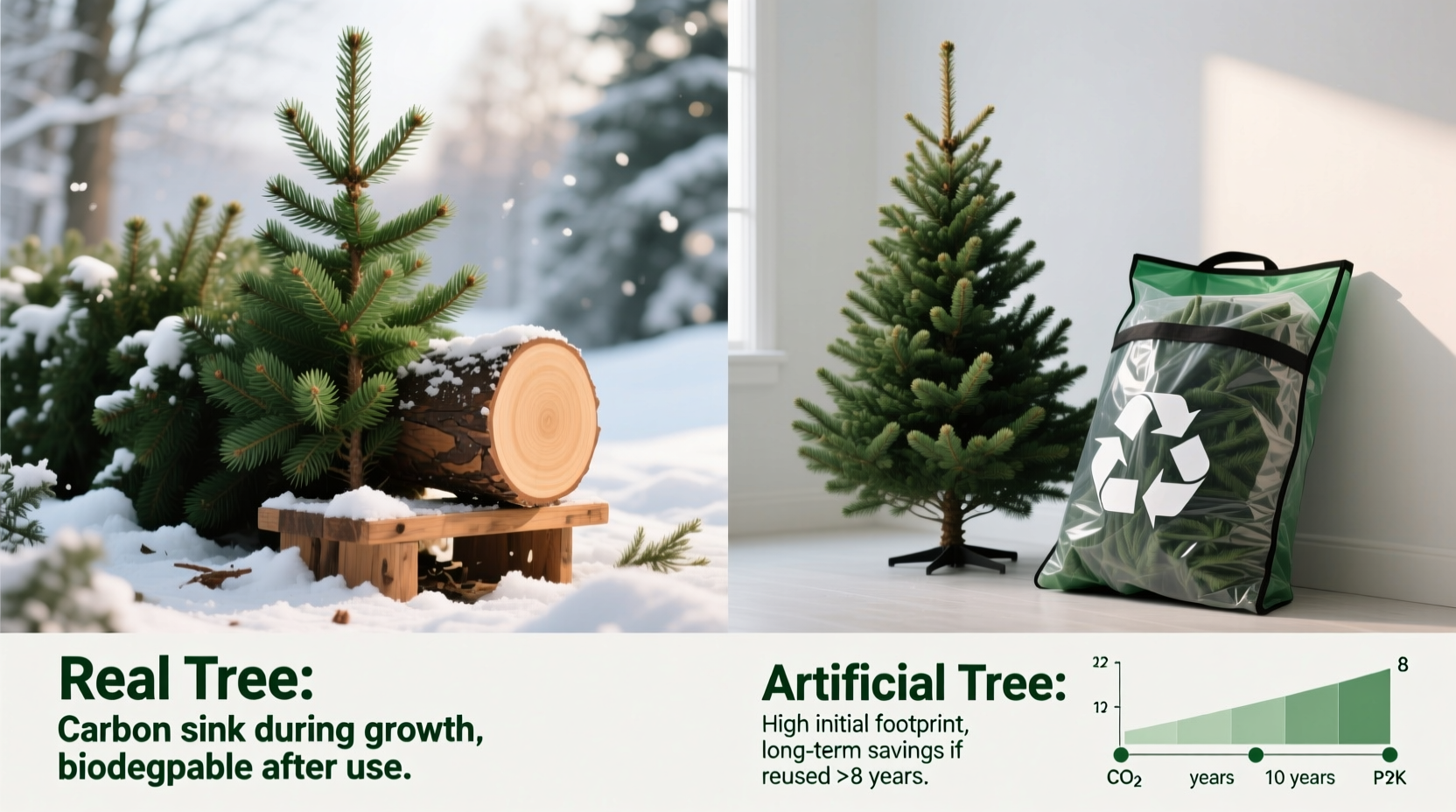
To compare real and artificial trees meaningfully, we apply a cradle-to-grave lifecycle assessment (LCA)—a standardized method used by the International Organization for Standardization (ISO 14040). This framework quantifies greenhouse gas (GHG) emissions across five key phases:
- Cultivation/Manufacturing: For real trees, this includes land use change, fertilizer production, diesel-powered harvesting, and on-farm irrigation. For artificial trees, it covers petroleum extraction, PVC and PE polymer synthesis, injection molding, and assembly—mostly in factories across China and Vietnam.
- Transportation: Emissions from moving seedlings to nurseries, harvested trees to distribution centers (often cross-country), and final delivery to homes—or shipping artificial trees from Asia to North America/Europe (typically via container ship and truck).
- Use Phase: Often overlooked, but critical: real trees require no energy during display; artificial trees do not—but their repeated reuse is what determines long-term efficiency.
- End-of-Life: Real trees are biodegradable—if composted or mulched properly. If landfilled, they generate methane (25× more potent than CO₂ over 100 years). Artificial trees rarely get recycled; most end up in landfills where PVC persists for centuries and may leach heavy metals.
- Carbon Sequestration (Real Trees Only): While growing, live Christmas trees absorb atmospheric CO₂. A mature 6–7 ft. tree sequesters approximately 1 kg of CO₂ per year. Over its 7–12-year growth cycle, that adds up—but only if the tree is part of a sustainably managed rotation where new seedlings replace harvested ones.
This holistic view dismantles common myths. A “natural” label doesn’t automatically mean low-carbon. And a reusable artificial tree isn’t inherently green—it only becomes climate-beneficial after crossing a critical reuse threshold.
The Real Tree Reality: Not All Are Created Equal
A real Christmas tree’s carbon footprint varies dramatically depending on origin, species, and post-harvest handling. According to a landmark 2021 study published in Environmental Research Letters, the median GHG emissions for a locally sourced, farm-grown tree in the U.S. range from 3.1 to 6.8 kg CO₂-equivalent (CO₂e) when composted—rising to 16.4 kg CO₂e if landfilled due to methane generation.
But location matters profoundly. A tree grown in Oregon and shipped by refrigerated truck to New York City generates nearly 3× the transport emissions of one grown and sold within 50 miles of the consumer. Similarly, pesticide-heavy monoculture farms increase embedded energy through synthetic nitrogen fertilizer production—a process responsible for ~1.4% of global CO₂ emissions.
“Most consumers don’t realize that the biggest carbon win for real trees isn’t ‘buying local’—it’s ensuring the tree goes to municipal composting, not the landfill. That single decision can reduce its footprint by over 60%.” — Dr. Lena Torres, Environmental Scientist, Yale School of Forestry
Yet sustainability extends beyond emissions. Well-managed Christmas tree farms provide wildlife habitat, prevent soil erosion, and often occupy marginal land unsuitable for food crops. In Canada, over 95% of Christmas trees are grown on dedicated farms—not clear-cut from forests—making them an agricultural product, not a timber harvest.
The Artificial Tree Equation: Reuse Is Non-Negotiable
An average 6.5 ft. artificial tree emits roughly 40 kg CO₂e during manufacturing and global shipping—equivalent to driving a gasoline car 100 miles. That’s before it ever enters your living room. Its environmental value accrues only through repeated use. A 2018 LCA by the Ellipsos consulting firm, commissioned by Natural Resources Canada, modeled scenarios across 1–20 years of reuse:
| Years of Use | Average Annualized CO₂e | Climate Break-Even Point vs. Real Tree (Composted) |
|---|---|---|
| 1 year | 40.0 kg | Not reached |
| 3 years | 13.3 kg | Still higher than real tree (avg. 5.2 kg) |
| 5 years | 8.0 kg | Approaching parity |
| 8 years | 5.0 kg | Below composted real tree average |
| 12 years | 3.3 kg | Significantly lower |
| 20 years | 2.0 kg | Less than half the annualized impact |
Note: This assumes the artificial tree is *not* recycled at end-of-life—because functional recycling infrastructure for PVC/PE Christmas trees remains virtually nonexistent in North America and Europe. Less than 0.1% of artificial trees sold annually are recovered for material reprocessing. Most are shredded into filler or buried intact.
Also critical: durability. Many budget artificial trees degrade visibly after 4–6 seasons—bent branches, faded color, brittle tips. High-end models with steel hinges and UV-stabilized PE tips last longer but cost 3–5× more. The climate math only holds if the tree survives intact for at least 8 years.
A Real-World Comparison: The Anderson Family Case Study
In Portland, Oregon, the Andersons switched from real to artificial trees in 2012 after their toddler pulled over a water stand. They purchased a $189 7.5 ft. tree with “lifetime warranty” labeling. By 2019, three branches had snapped, the flocking had yellowed, and the central pole bent under weight. They replaced it—keeping the old one in storage “just in case.” In 2023, they donated both trees to a thrift store. Neither was accepted for resale; both were discarded.
Over 11 years, the Andersons used two artificial trees totaling ~7 years of active display (with gaps), generating an estimated 72 kg CO₂e—more than double the 32 kg CO₂e they’d have produced buying a locally composted real tree each year.
Contrast this with the Dubois family in Quebec City. Since 2008, they’ve bought a balsam fir from the same 4th-generation farm 12 km from their home. Each year, they drop the tree at the city’s free chipping program. Over 16 years, their cumulative footprint: ~72 kg CO₂e—identical to the Andersons’ total—but achieved without plastic, heavy metals, or overseas shipping.
Practical Decision Framework: What Should You Choose?
Forget absolutes. Your lowest-carbon choice depends entirely on behavior—not biology or chemistry alone. Use this step-by-step guide to determine the optimal path for your household:
- Assess your realistic reuse horizon. Be brutally honest: Will you keep the same artificial tree for 8+ years? If you move frequently, dislike assembly, or anticipate lifestyle changes (e.g., young children, pets), the odds drop sharply.
- Evaluate local real-tree logistics. Can you walk or bike to a farm or lot? Does your municipality offer curbside compost pickup for trees (available in 74% of Canadian cities and 41% of U.S. metro areas)? If yes, real trees gain a decisive advantage.
- Calculate transport distance. If your nearest real-tree source is >200 miles away—and you drive alone to fetch it—the emissions may rival those of an artificial tree shipped via container vessel (which emits just 10–15 g CO₂e per ton-mile).
- Inspect artificial tree quality. Look for welded steel hinges (not plastic clips), PE (polyethylene) over PVC needles (lower toxicity, better UV resistance), and a 10+ year manufacturer warranty. Avoid “instant setup” models—they sacrifice longevity for convenience.
- Commit to end-of-life responsibility. If choosing artificial, pledge to use it for ≥12 years and donate it to a community center or theater group at retirement—not the curb. If choosing real, write “COMPOST” on your calendar for January 7th.
Frequently Asked Questions
Do real Christmas trees contribute to deforestation?
No. Less than 0.001% of U.S. forestland is dedicated to Christmas tree farming—about 350,000 acres total, mostly on land unsuitable for agriculture. Trees are grown as a rotational crop: for every tree harvested, 1–3 seedlings are planted. Wild forest clearing for Christmas trees is illegal under the U.S. National Forest Management Act and equivalent laws in Canada and the EU.
Are “eco-friendly” artificial trees made from recycled plastic actually better?
Marginally—but misleadingly marketed. Recycled PET (rPET) trees still require virgin plastic for structural components (hinges, poles, stands) and emit similar CO₂e during molding and shipping. A 2022 study in Journal of Industrial Ecology found rPET trees reduce manufacturing emissions by just 7–12% versus conventional PVC/PE—far less than the 80% reduction achieved by extending reuse from 5 to 12 years.
What’s the lowest-carbon option for renters or apartment dwellers?
A potted, living Christmas tree (e.g., dwarf Alberta spruce or Norfolk Island pine). When cared for properly, it can be planted outdoors after the holidays—or kept as a perennial houseplant for 5–10 years. Its net carbon impact is negative: it absorbs CO₂ year after year while avoiding disposal emissions entirely. Just ensure it receives adequate light and avoid overwatering.
Conclusion: Climate-Conscious Choices Start With Honesty, Not Labels
There is no universal “green” Christmas tree. There is only your tree—shaped by your habits, your geography, and your commitment. Choosing a real tree means accepting responsibility for its end-of-life journey. Choosing artificial demands discipline: resisting novelty, honoring longevity, and refusing disposability disguised as convenience. The data is unequivocal—reusing an artificial tree for 12 years cuts annual emissions below even the most sustainably grown and composted real tree. But if your household replaces it every 4 years, you’re amplifying rather than reducing your climate impact.
This holiday season, let your tree reflect intention—not inertia. Visit a local farm and ask how they manage soil health and waste. Measure your attic space and commit to using that artificial tree until its hinges outlive your coffee maker. Or go further: adopt a potted tree and watch it grow alongside your family. Small, consistent choices—rooted in evidence, not emotion—compound into meaningful climate action. Because sustainability isn’t found in the perfect product. It’s built in the decisions we repeat, year after year, branch after branch.




 浙公网安备
33010002000092号
浙公网安备
33010002000092号 浙B2-20120091-4
Comments
No comments yet. Why don't you start the discussion?