
Choosing between a red agate and a carnelian bracelet might seem like a simple aesthetic decision at first glance. Both stones boast warm, earthy reds and oranges, often appearing so similar that even experienced crystal enthusiasts can pause to tell them apart. Yet beneath their surface-level resemblance lie distinct geological origins, energetic properties, and symbolic meanings that influence how they serve the wearer. Whether you're drawn to these stones for spiritual alignment, emotional balance, or fashion, understanding the nuances between red agate and carnelian is essential to making a meaningful choice.
Understanding the Origins: What Are Red Agate and Carnelian?
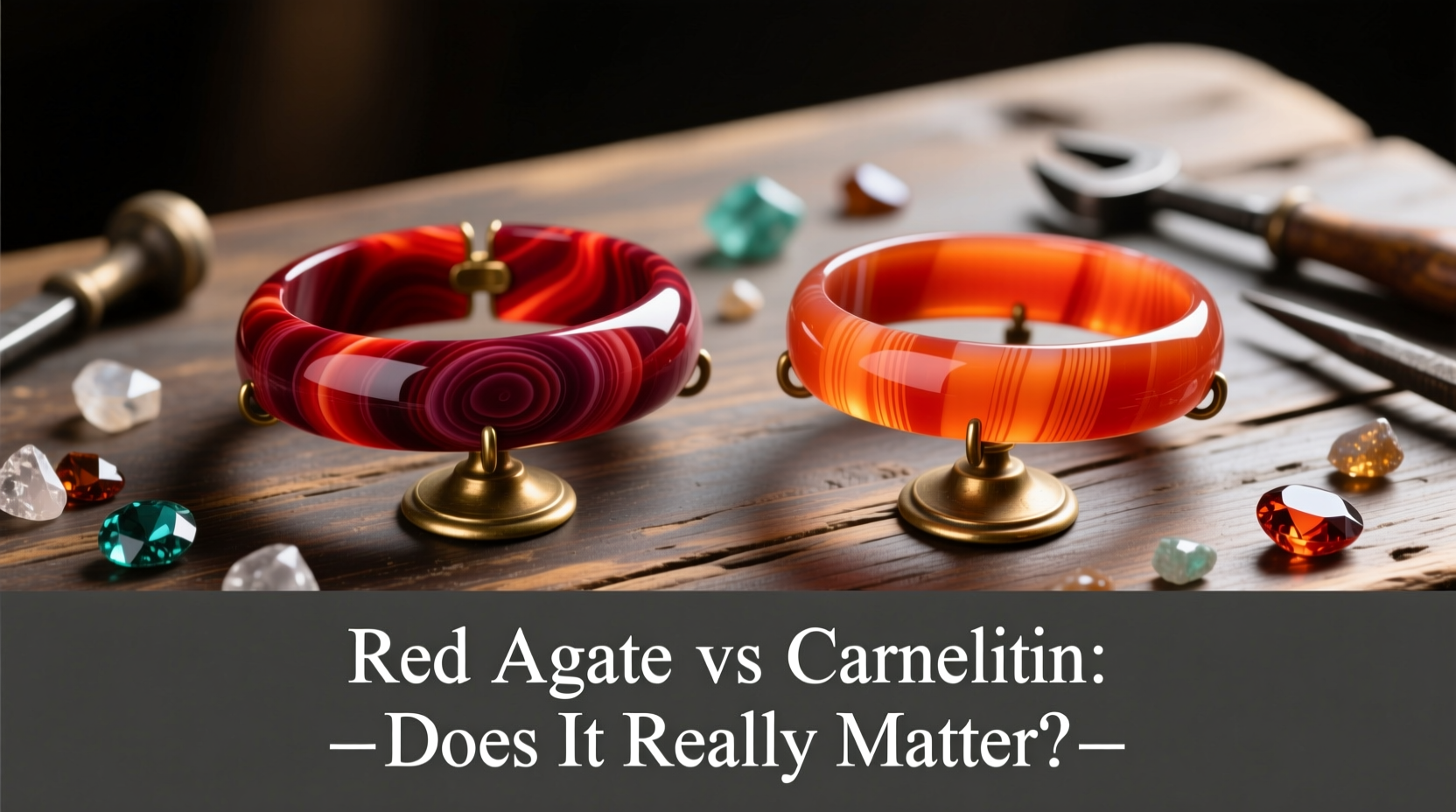
Red agate and carnelian are both forms of chalcedony, a microcrystalline variety of quartz. However, their formation processes and mineral compositions differ subtly but significantly.
Red agate is a banded variety of chalcedony, characterized by its fine layers of color—often red, white, gray, or brown—that form in concentric patterns. These bands develop over millions of years as silica-rich water deposits layer within volcanic rock cavities. The iron oxide impurities in the stone give it its signature red hues. Agates are found globally, with major sources in Brazil, Uruguay, India, and the United States.
Carnelian, on the other hand, is a solid-colored translucent chalcedony, typically ranging from pale orange to deep blood red. Unlike agate, it lacks banding and has a more uniform appearance. Its color comes from iron oxide as well, but the distribution is even, resulting in a smoother visual texture. Historically prized by ancient Egyptians and Romans, carnelian was used in signet rings and amulets for protection and vitality.
Energy and Metaphysical Properties Compared
In holistic and crystal healing practices, both stones are associated with the sacral and root chakras, grounding energy and enhancing motivation. However, their vibrational qualities differ in tone and intensity.
Red agate is considered a stabilizing stone. It promotes emotional balance, inner security, and resilience. Often recommended during times of stress or transition, red agate acts as an anchor—helping individuals remain centered without becoming overwhelmed. It’s said to strengthen confidence in one’s own truth and support long-term perseverance.
Carnelian is more dynamic. Revered as a stone of action and courage, it stimulates creativity, passion, and ambition. Unlike the calming presence of agate, carnelian energizes. It's frequently used to overcome procrastination, reignite desire, and enhance physical vitality. Some practitioners recommend wearing carnelian before public speaking or creative work due to its ability to boost self-expression and assertiveness.
“Carnelian awakens the fire within—it doesn’t just ground you; it moves you forward.” — Dr. Lena Patel, Holistic Energy Therapist
Visual and Physical Differences: How to Tell Them Apart
Because red agate and carnelian can look nearly identical in bracelet form, especially when polished and strung, it helps to know what distinguishing features to examine.
| Feature | Red Agate | Carnelian |
|---|---|---|
| Color Pattern | Banded, layered, often multi-tonal | Uniform, solid red-orange |
| Transparency | Usually opaque to semi-translucent | Semi-transparent, glassy glow |
| Texture | Visible internal lines or waves | Smooth, even grain |
| Hardness (Mohs) | 6.5–7 | 6.5–7 |
| Energetic Vibe | Calming, protective, steady | Vibrant, motivating, passionate |
While both stones score similarly on the Mohs hardness scale, meaning they’re durable enough for daily wear, their visual cues remain the most reliable way to differentiate them. A close inspection under natural light often reveals the subtle banding in red agate that carnelian lacks.
Real-Life Use Case: Choosing Based on Lifestyle Needs
Consider Sarah, a freelance graphic designer working from home. Lately, she’s felt emotionally drained and indecisive about her career path. She purchased a red agate bracelet after reading about its grounding effects. Within two weeks of wearing it daily, she reported feeling “more anchored” and better able to manage client feedback without emotional spikes. The stone, she said, helped her maintain consistency in her routine.
In contrast, her friend Marcus, a sales manager preparing for a high-stakes promotion, chose a carnelian bracelet. He described himself as “stuck in a rut,” lacking the drive to pursue leadership opportunities. After wearing carnelian for ten days, he noticed a shift: “I walked into meetings with more confidence. I actually wanted to speak up.” For Marcus, carnelian acted as a catalyst for action rather than calm.
Their experiences illustrate a key principle: the right stone depends not on popularity or appearance, but on personal intention.
How to Choose: A Practical Checklist
Still unsure whether red agate or carnelian is right for you? Ask yourself the following questions before deciding:
- Am I seeking stability, emotional healing, or protection?
- Do I need help staying grounded during life changes?
- Am I feeling lethargic, unmotivated, or creatively blocked?
- Do I want to enhance my courage and take bold steps?
- Is my goal more about inner peace or outward expression?
If your answers lean toward emotional regulation and safety, red agate is likely the better fit. If you're aiming to ignite passion, boost confidence, or break through stagnation, carnelian may be the superior choice.
Common Misconceptions and Care Tips
One widespread myth is that all red stones function the same energetically. This couldn't be further from the truth. While both red agate and carnelian connect to the lower chakras, their roles diverge—one sustains, the other sparks.
Another misconception is that these bracelets require no maintenance. In reality, like all crystals, they absorb energy from their environment and benefit from regular cleansing. Carnelian, in particular, should never be cleansed with salt water, as prolonged exposure can dull its surface. Instead, use sound (like a singing bowl), moonlight, or smudging with sage.
Store both stones away from harder minerals to prevent scratching, and remove bracelets during intense physical activity or exposure to chemicals like lotions and chlorine.
Frequently Asked Questions
Can I wear red agate and carnelian together?
Yes. Wearing both stones combines grounding stability with motivational energy. Many users report that this pairing creates a balanced flow—secure enough to act, inspired enough to move forward. Try stacking them on the same wrist or alternating based on your daily needs.
Which stone is rarer or more valuable?
Carnelian is generally more sought after due to its historical significance and uniform color, especially in deep red varieties. High-quality banded red agate can also be valuable, particularly if the patterns are intricate. However, both are relatively affordable compared to precious gemstones.
Do scientific studies support their benefits?
There is limited clinical research on the metaphysical effects of crystals. However, studies in psychophysiology suggest that belief and ritual—such as wearing a meaningful stone—can influence mood and perception through the placebo effect and somatic awareness. The psychological comfort derived from these stones is real, even if the mechanisms are not fully understood by science.
Making the Right Choice for You
Does it really matter which you choose? Yes—if you’re intentional about your wellness journey. While both red agate and carnelian offer beauty and positive associations, they serve different roles. Selecting based solely on color or trend may lead to a mismatch between your needs and the stone’s properties.
Your bracelet should be more than an accessory. It can be a tool—a quiet reminder of your goals, a touchstone for focus, or a symbol of personal growth. When chosen with awareness, either red agate or carnelian becomes more than a piece of jewelry; it becomes part of your daily rhythm.




 浙公网安备
33010002000092号
浙公网安备
33010002000092号 浙B2-20120091-4
Comments
No comments yet. Why don't you start the discussion?