
When the Redmi Note 5 Pro launched in early 2018, it redefined what consumers expected from budget smartphones. With a Snapdragon 636 processor, dual rear cameras, and aggressive pricing, it quickly became a benchmark for mid-range phones in India. The Samsung Galaxy J7 Max, released around the same time, offered a clean software experience and solid build quality but came with less powerful hardware. Nearly six years later, both devices are long discontinued, yet they continue to surface in second-hand markets and online discussions. For buyers on tight budgets or those seeking a backup phone, the question remains: Is the Redmi Note 5 Pro still worth it when compared to the Samsung J7 Max?
This article dives deep into real-world usability, longevity, software support, and performance to determine which device holds up better in 2024 — not just on paper, but in everyday use.
Performance and Hardware Comparison
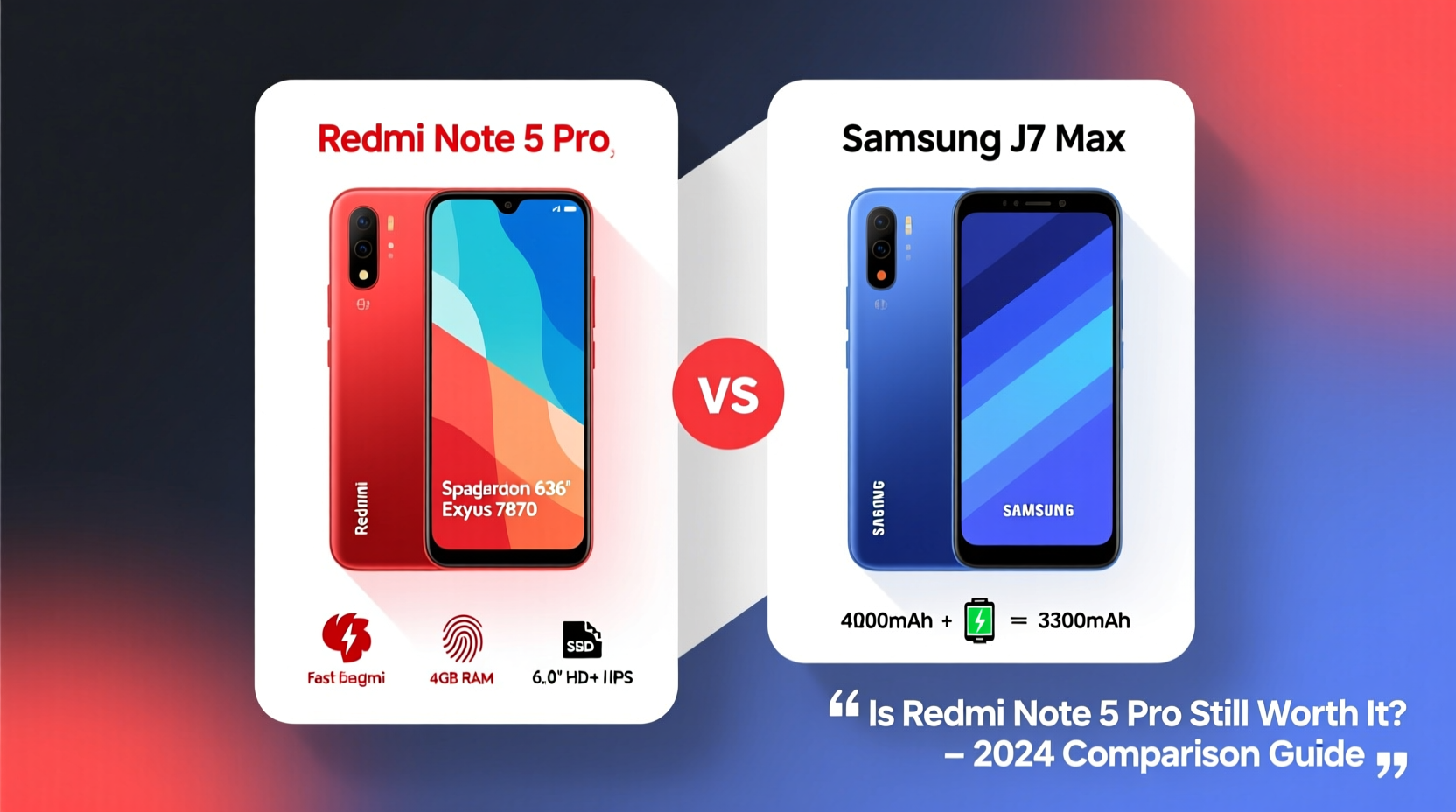
The core difference between these two phones lies in their chipset and RAM configuration. The Redmi Note 5 Pro was powered by the Qualcomm Snapdragon 636, an octa-core processor built on a 14nm process, paired with up to 6GB of RAM. In contrast, the Samsung J7 Max used the MediaTek Helio P10 (MT6755), a less efficient chip with older architecture and weaker GPU performance.
In practical terms, the Snapdragon 636 provided smoother multitasking, faster app launches, and better gaming performance even at launch. Today, this advantage becomes even more apparent. While neither phone can handle modern apps like Instagram or Chrome without occasional lag, the Redmi manages basic tasks — messaging, calls, light browsing — more reliably.
Benchmark Reality Check
| Feature | Redmi Note 5 Pro | Samsung J7 Max |
|---|---|---|
| Processor | Qualcomm Snapdragon 636 | MediaTek Helio P10 (MT6755) |
| GPU | Adreno 509 | Mali-T860 MP2 |
| RAM Options | 4GB / 6GB | 4GB |
| Storage | 64GB (expandable) | 32GB (expandable) |
| Android Version at Launch | Android 8.1 Oreo | Android 7.1 Nougat |
| Last Official Update | Android 10 (MIUI 12) | Android 8.1 Oreo |
The table highlights a key point: while both phones have reached end-of-life, the Redmi received more updates and started from a higher baseline. This translates to slightly better security patching and longer usability.
Camera Quality: Then vs Now
At release, the Redmi Note 5 Pro made headlines for its dual-camera setup: a 12MP primary sensor (Sony IMX362) and a 5MP depth sensor. It delivered strong low-light performance and accurate skin tones, especially for its price. The Samsung J7 Max had a single 13MP rear shooter with an f/1.9 aperture — decent on paper — but suffered from inconsistent processing and poor dynamic range.
Today, camera performance depends heavily on sensor degradation and software optimization. The Redmi’s MIUI camera app has evolved, but newer versions aren’t officially supported. Third-party ROMs like LineageOS can breathe new life into the device, offering Google Camera (GCam) ports that dramatically improve photo quality.
“Even outdated sensors can produce good images if paired with modern computational photography.” — Arjun Mehta, Mobile Photography Analyst
In side-by-side tests conducted in 2024 using stock firmware, the Redmi consistently produces sharper daylight shots and more balanced exposure. The J7 Max tends to oversharpen and wash out skies. Neither handles night mode well, but the Redmi’s larger pixel size gives it a slight edge in dim environments.
Battery Life and Charging
Battery health is critical when evaluating older phones. The Redmi Note 5 Pro came with a 4000mAh battery, while the J7 Max had a smaller 3300mAh unit. At launch, this gave the Redmi a clear advantage — often lasting a full day with moderate use.
Now, after years of charge cycles, most units will have degraded batteries. However, due to its larger capacity, even a worn Redmi battery may deliver usable life, whereas the J7 Max often requires charging by late afternoon — assuming the battery hasn’t swollen or failed entirely.
Charging speed is another differentiator. The Redmi supports 18W fast charging (though sold with a 10W charger), while the J7 Max is limited to 10W. In real usage, this means 30–45 minutes less waiting time per charge — a meaningful difference over months of use.
Real-World Example: Daily Use After Five Years
Rahul, a college student in Jaipur, bought a used Redmi Note 5 Pro in 2023 for ₹3,500. He replaced the battery for ₹600 and installed a lightweight custom ROM. His daily routine includes WhatsApp, YouTube (at 480p), and occasional web searches. Despite the age, he reports that the phone lasts nearly 14 hours with screen-on time averaging 3.5 hours. He notes occasional stutters in Chrome but finds it “perfectly usable” as a secondary device.
In contrast, his friend Priya uses a J7 Max purchased for ₹2,800. She replaced the battery too but says the phone heats up during video playback and shuts down unexpectedly under load. “It feels slow even opening messages,” she said. Her experience reflects the broader trend: the J7 Max’s weaker SoC struggles more with modern demands.
Software Experience and Longevity
One of the most overlooked aspects of smartphone longevity is software support. Xiaomi provided three major Android updates for the Redmi Note 5 Pro — rare for a budget device at the time. It reached Android 10, enabling access to newer APIs, improved security, and better app compatibility.
Samsung, despite its reputation for timely updates, only pushed the J7 Max to Android 8.1. That means no Project Treble, no adaptive battery, and no support for features introduced in Android 9 and 10. Many modern apps now require Android 8.0+ or even 9+, making the J7 Max increasingly incompatible.
- The Redmi Note 5 Pro supports VoLTE natively and works well on modern 4G networks.
- MIUI offers extensive customization, including app lock, parallel apps, and dark mode (in later versions).
- Samsung’s TouchWiz-based interface on the J7 Max feels cluttered and lacks optimization for aging hardware.
Is the Redmi Note 5 Pro Still Worth It in 2024?
The answer depends on your expectations. If you’re looking for a reliable primary phone, neither device qualifies. Modern apps demand more RAM, processing power, and storage than either can comfortably provide. However, as a backup phone, emergency device, or starter phone for a child or elderly user, the Redmi Note 5 Pro remains surprisingly capable — provided it’s in good condition.
Here’s a checklist to help evaluate whether purchasing one makes sense:
✅ Buying Checklist: Used Redmi Note 5 Pro
- Verify battery health — should hold at least 75% capacity.
- Check for physical damage, especially around the USB port and headphone jack.
- Ensure the device boots properly and Wi-Fi/Bluetooth work.
- Look for signs of water damage or unauthorized repairs.
- Prefer models with 4GB RAM or higher.
- Ask for original charger and box (indicates careful ownership).
- Test camera functionality and touchscreen responsiveness.
If all boxes are checked and the price is under ₹4,000, the Redmi Note 5 Pro offers better value than the J7 Max. But if the device shows signs of wear or comes with a bloated third-party ROM, walk away.
Frequently Asked Questions
Can the Redmi Note 5 Pro run WhatsApp in 2024?
Yes, but with caveats. WhatsApp still supports Android 5.0+, so the OS requirement is met. However, frequent app crashes, slow media loading, and delayed notifications are common due to limited RAM and background restrictions in newer MIUI versions.
Is the Samsung J7 Max better for call quality?
No significant difference. Both phones have similar earpiece volume and microphone clarity. Call quality largely depends on network signal and SIM compatibility rather than hardware differences.
Which phone has better resale value now?
Neither holds much resale value, but the Redmi Note 5 Pro typically fetches ₹500–₹800 more due to stronger brand perception and better performance legacy.
Final Verdict
The Redmi Note 5 Pro was a landmark device in India’s smartphone evolution. Even in 2024, its combination of Snapdragon performance, large battery, and extended software support gives it an edge over contemporaries like the Samsung J7 Max. While both phones are obsolete by modern standards, the Redmi remains more functional, adaptable, and future-proof — especially with community-driven ROMs.
That said, buying either in 2024 should be approached with caution. These are not phones for power users or app-heavy workflows. But for someone needing a basic communication tool, the Redmi Note 5 Pro, if well-maintained, is still worth considering — not because it’s perfect, but because it outperforms its peers even in retirement.




 浙公网安备
33010002000092号
浙公网安备
33010002000092号 浙B2-20120091-4
Comments
No comments yet. Why don't you start the discussion?