
For budget-conscious smartphone users, the decision between upgrading to a newer model or sticking with a reliable older device often comes down to real-world value. The Redmi Note 9S and Samsung Galaxy A20 represent two popular choices in the sub-$200 market—each offering a different balance of features, design, and performance. But if you're currently using the A20 and considering a jump to the Redmi Note 9S, the key question remains: is the upgrade actually worth it?
The answer isn't just about specs on paper. It's about how those improvements translate into daily use—whether you’ll notice faster app launches, better photo quality in low light, or longer battery life that lasts through heavy usage. Let’s break down both phones across critical categories to help you make an informed decision.
Design and Build Quality
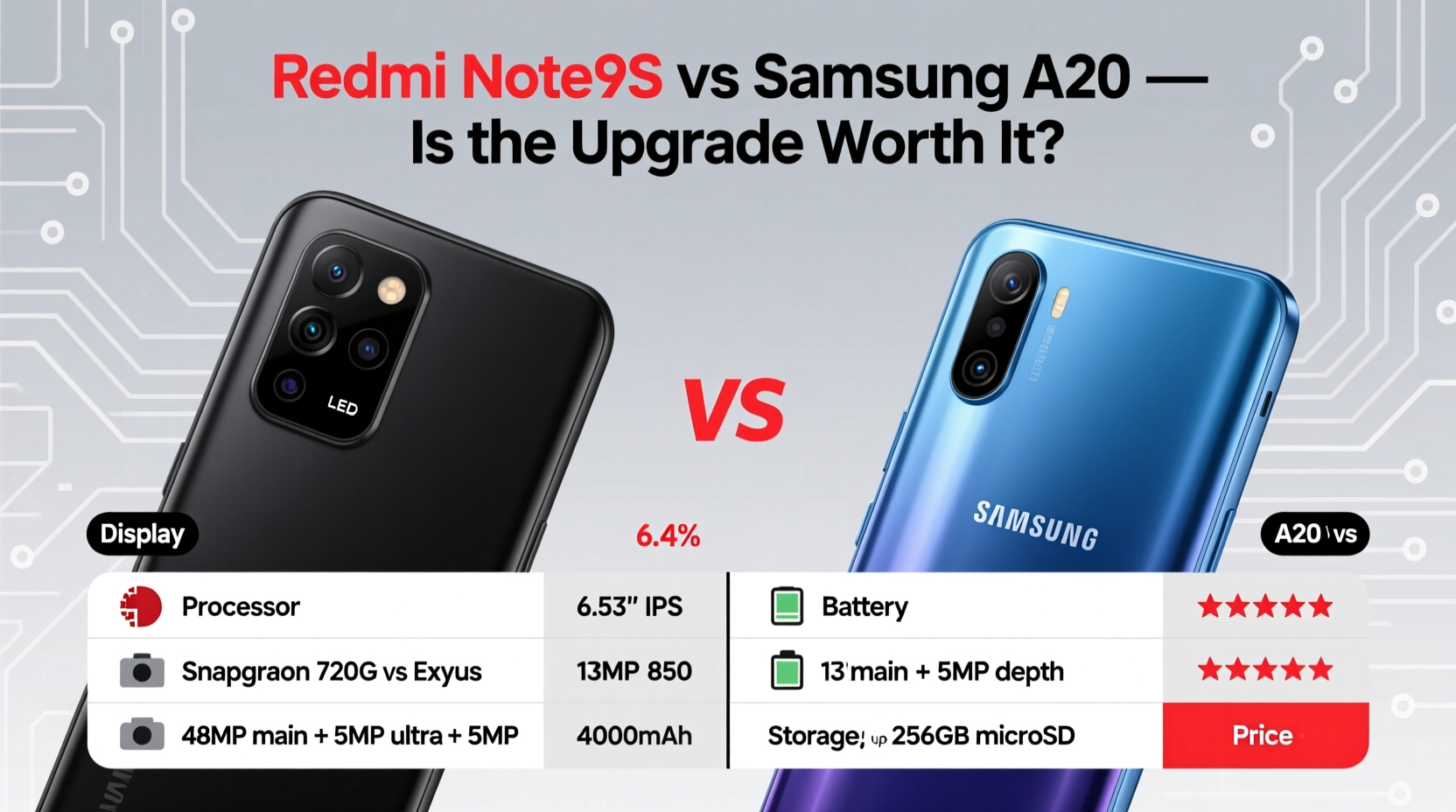
The Samsung Galaxy A20, released in 2019, features a minimalist plastic body with a glossy back that attracts fingerprints easily. It has a 6.4-inch HD+ Super AMOLED display—a standout feature at its price point—with slim bezels and a teardrop notch. While the screen looks vibrant, the overall build feels lightweight and somewhat fragile.
In contrast, the Redmi Note 9S (released in early 2020) adopts a more modern aesthetic with a matte-finish polycarbonate back and slightly curved edges. It also uses a 6.67-inch Full HD+ IPS LCD panel with a punch-hole front camera centered at the top. Though the display type isn’t as premium as AMOLED, the higher resolution delivers sharper text and crisper image detail. The Redmi feels sturdier in hand, partly due to its slightly heavier frame and improved structural rigidity.
Performance and Software Experience
This is where the Redmi Note 9S pulls significantly ahead. Under the hood, it runs on Qualcomm’s Snapdragon 720G—a mid-tier chipset built on an 8nm process, paired with up to 6GB of RAM. This combination enables smooth multitasking, faster app loading, and better gaming performance even with graphically demanding titles like PUBG Mobile on medium settings.
The Samsung A20, by comparison, relies on Samsung’s Exynos 7884B—an older octa-core processor manufactured on a less efficient 14nm process, typically paired with only 3GB of RAM. Users frequently report lag when switching between apps or during prolonged use. Android updates are also limited; the A20 launched with Android 9 and received only one major OS upgrade.
The Redmi Note 9S shipped with Android 10 and MIUI 11, supporting multiple software updates and additional security patches over time. Its superior processing power translates directly into responsiveness: animations are smoother, background tasks handle better, and the system recovers from hibernation without stuttering.
“Upgrading from a 3GB RAM device to 4GB or more can dramatically improve perceived speed—even with similar UI designs.” — Arjun Patel, Mobile Systems Analyst
Camera Comparison: Real-World Photo Performance
Both phones feature multi-lens setups, but their execution varies widely. The Samsung A20 includes a basic dual-camera system: 13MP main + 5MP ultra-wide. However, the ultra-wide sensor lacks autofocus and performs poorly in anything less than ideal lighting. Low-light photos tend to be grainy, with washed-out colors and soft details.
The Redmi Note 9S steps up with a quad-camera array: 48MP main (f/1.8), 8MP ultra-wide, 5MP macro, and 2MP depth sensor. The higher-resolution primary sensor captures significantly more detail, especially noticeable when zooming or cropping. More importantly, the f/1.8 aperture allows more light intake, resulting in cleaner night shots and better dynamic range.
In daylight, both phones produce acceptable results, but the Redmi consistently delivers richer color reproduction and sharper edge definition. Its AI scene detection works reasonably well, automatically enhancing landscapes or portraits. Video recording maxes out at 1080p@30fps on both devices, though the Redmi offers better stabilization and microphone filtering.
Front Camera and Selfies
The A20’s 8MP front camera produces average selfies—fine in bright conditions but overly processed and noisy indoors. The Redmi Note 9S counters with a 16MP sensor that supports portrait mode and AI beautification. Skin tones remain natural, and fine details like eyelashes or hair strands are preserved rather than blurred away.
Battery Life and Charging Speed
Battery capacity is another area where the Redmi clearly wins. It packs a 5020mAh cell—over 1,000mAh larger than the A20’s 4000mAh unit. In practical terms, this means the Redmi can comfortably last a full day and a half under moderate use, including streaming, social media, and messaging.
Charging speed further widens the gap. The Redmi supports 18W fast charging (charger included in-box), allowing a 0–50% charge in about 40 minutes. The A20 charges at a sluggish 15W and does not include a fast charger in the box—meaning many users stick with slower 5W bricks unless upgraded separately.
| Feature | Redmi Note 9S | Samsung A20 |
|---|---|---|
| Battery Capacity | 5020 mAh | 4000 mAh |
| Charging Speed | 18W (included) | 15W (adapter sold separately) |
| Estimated Daily Use | 1.5 days | 1 day |
| Standby Drain (72 hrs) | ~12% | ~25% |
Real-World Upgrade Impact: A Mini Case Study
Rahul, a college student in Chennai, used his Samsung A20 for nearly two years. Initially satisfied, he began experiencing slowdowns—apps closing unexpectedly, delays in WhatsApp message delivery, and frequent need to restart the phone. After upgrading to a second-hand Redmi Note 9S for ₹10,500, his experience transformed.
He noticed immediate improvements: Google Maps loaded instantly, YouTube videos buffered faster, and group video calls via Zoom remained stable. His photography hobby benefited too—he started capturing clearer campus event photos and sharing them directly to Instagram without editing. Most importantly, the larger battery meant he no longer scrambled for power banks between classes.
For Rahul, the upgrade wasn’t just about new features—it was about regaining reliability and usability without spending excessively.
Value-for-Money Verdict: Is the Redmi Note 9S Worth It?
If you’re still using the Samsung A20 and haven’t faced hardware failure, consider these factors before upgrading:
- You prioritize performance: Apps open faster, multitasking is smoother, and games run better.
- You take photos regularly: The Redmi’s 48MP sensor and dedicated depth/macro lenses offer creative flexibility.
- You hate charging anxiety: The 5020mAh battery provides extended endurance, ideal for travel or long workdays.
- You want future-proofing: Better software support and longer update cycles enhance longevity.
However, if your usage is minimal—calls, texts, occasional browsing—and your A20 still functions well, the upgrade may feel unnecessary. You’d be paying more for capabilities you won’t fully utilize.
Checklist: Should You Upgrade?
- Is your current phone lagging during everyday tasks?
- Do you frequently run out of battery before evening?
- Are you frustrated with poor photo quality?
- Have you maxed out storage and can’t expand further?
- Is repair cost approaching half the price of a Redmi Note 9S?
If three or more apply, upgrading makes financial and functional sense.
Frequently Asked Questions
Can the Redmi Note 9S run modern games smoothly?
Yes. Thanks to the Snapdragon 720G and at least 4GB RAM, it handles games like Call of Duty: Mobile, Genshin Impact (on low settings), and Asphalt 9 with stable frame rates and minimal overheating.
Does the Samsung A20 support fast charging?
Technically yes, up to 15W, but Samsung doesn’t include a fast charger in the box. Most users end up charging at 5W unless they purchase an adapter separately.
Is MIUI on the Redmi Note 9S bloated?
MIUI does come with pre-installed apps and occasional ads in certain regions, but these can be disabled manually. Despite this, the interface remains fluid and offers useful customization options not found on stock Android or One UI Go.
Final Thoughts: Making the Smart Move
The Redmi Note 9S isn’t just a minor iteration over the Samsung A20—it represents a meaningful leap in processing power, camera capability, battery life, and overall user experience. For someone stuck with an aging A20 showing signs of wear, this upgrade restores confidence in daily device reliability.
It’s not merely about having more megapixels or a bigger number next to “RAM.” It’s about how seamlessly your phone integrates into your routine—answering messages instantly, capturing memories clearly, and lasting from sunrise to well past sunset without needing a recharge.
If you’ve been hesitating, weigh the long-term benefits against the short-term cost. In most cases, moving from the A20 to the Redmi Note 9S isn’t just justified—it’s a smart investment in better digital living.




 浙公网安备
33010002000092号
浙公网安备
33010002000092号 浙B2-20120091-4
Comments
No comments yet. Why don't you start the discussion?