
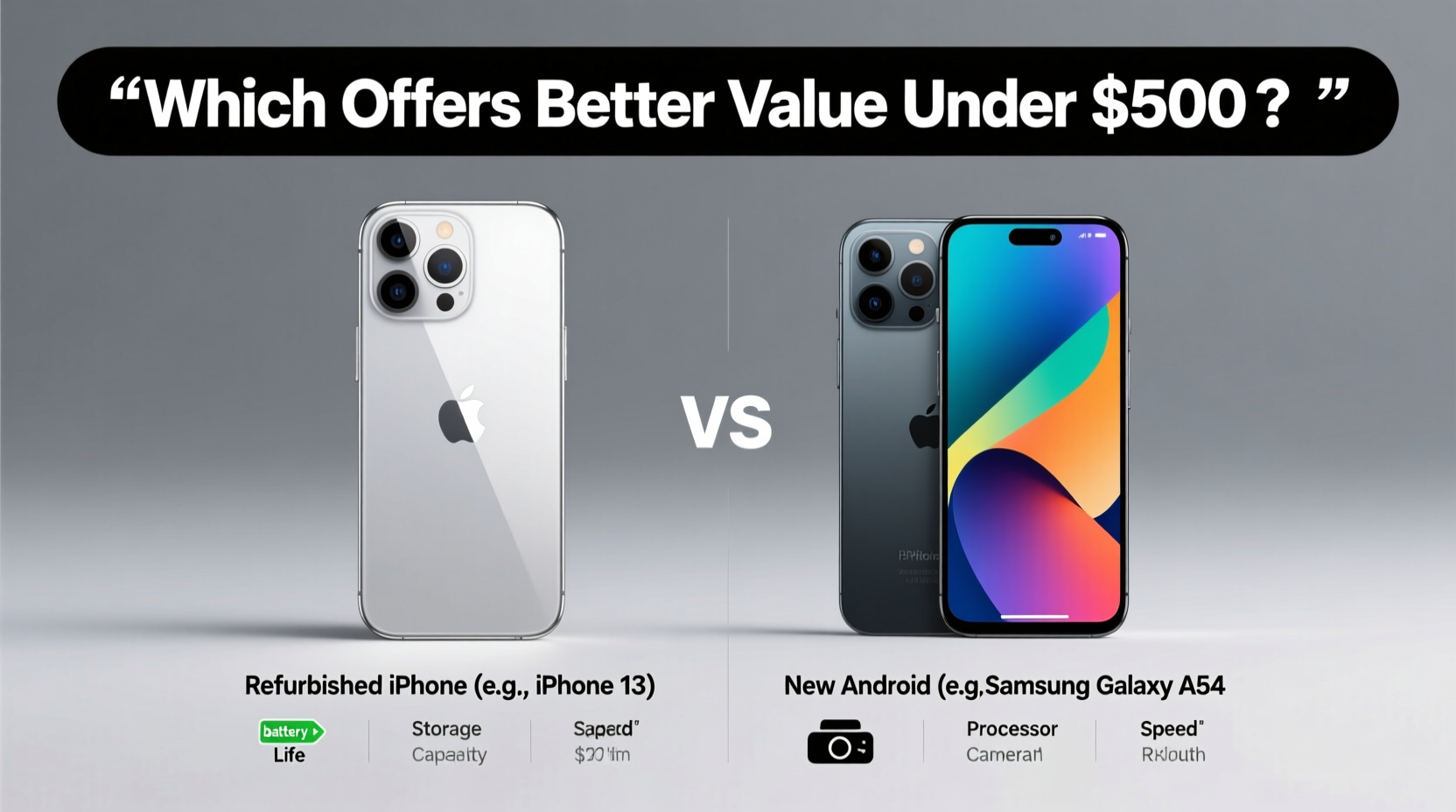
When shopping for a smartphone under $500, the decision isn’t just about price—it’s about long-term value. Two compelling options emerge: a refurbished iPhone from Apple or a brand-new Android phone from brands like Google, Samsung, or OnePlus. Each path offers distinct advantages in performance, ecosystem integration, longevity, and user experience. But which truly gives you more for your money?
This isn’t a debate of brand loyalty. It’s a practical comparison grounded in real-world usage, resale value, update support, and total cost of ownership. Whether you're upgrading on a budget, replacing a lost device, or buying your first premium-tier phone, understanding the trade-offs between a certified pre-owned iPhone and a fresh Android model can save you hundreds over time.
Performance and Longevity: The iPhone Advantage
One of the strongest arguments for choosing a refurbished iPhone under $500 is longevity. Apple devices consistently receive iOS updates for five to seven years after release. For example, an iPhone XR (released in 2018) still runs the latest iOS versions in 2024, a testament to Apple’s long-term software commitment.
Under $500, you can often secure a refurbished iPhone 13 or even an iPhone 14 through Apple’s Certified Refurbished program or trusted retailers like Back Market and Amazon Renewed. These models feature the A15 Bionic chip—one of the most powerful mobile processors ever made—capable of handling gaming, multitasking, and photo editing with ease.
In contrast, most new Android phones in this price range use mid-tier chips such as the Snapdragon 7 Gen 3 or Dimensity 7000 series. While competent for everyday tasks, they fall short in raw power and thermal efficiency compared to Apple’s silicon. More importantly, their long-term performance degrades faster due to less aggressive memory management and slower software optimization.
Software Updates and Security: Who Supports You Longer?
Software support is where the gap widens significantly. Apple provides major iOS updates for six to seven years, along with regular security patches. This means your refurbished iPhone 13 bought today will likely remain supported until at least 2029.
Android manufacturers vary widely. Google Pixel phones offer seven years of updates—a rare exception—but they start above $400 and may exceed your budget when taxes are added. Samsung’s Galaxy A-series and Motorola’s Moto G lineup typically receive only three years of OS upgrades and four years of security patches. After that, you’re left exposed to vulnerabilities and missing key features.
“Long-term software support is the single biggest factor in smartphone value. Devices that stop receiving updates become digital liabilities.” — David Kim, Mobile Security Analyst at TechShield Labs
If you plan to keep your phone beyond two years, the iPhone’s extended update cycle dramatically improves its value proposition. Even if you resell it later, buyers prefer devices still under active software support.
Total Cost of Ownership: Beyond the Initial Price
The sticker price is only part of the equation. Total cost of ownership includes repair costs, accessory compatibility, cloud services, and how long the device remains usable before needing replacement.
iPhones generally have higher repair costs, especially for screens and batteries outside warranty. However, because they last longer and retain functionality better, you replace them less frequently. Over a five-year period, owning one iPhone may be cheaper than cycling through two lower-end Android devices.
Androids, particularly budget models, often suffer from early battery degradation, bloatware, and inconsistent performance tuning. Many users report slowdowns within 18–24 months, prompting earlier upgrades. Additionally, accessories like cases and chargers for older Android models become harder to find as OEMs discontinue support.
Apple’s ecosystem also adds hidden value. If you own other Apple devices—an iPad, Mac, or AirPods—seamless integration via Handoff, AirDrop, Universal Clipboard, and iCloud enhances productivity and convenience. These synergies reduce friction across devices, indirectly increasing the utility of your phone.
Comparison Table: Key Factors at a Glance
| Factor | Refurbished iPhone (e.g., iPhone 13) | New Android (e.g., Galaxy A54 or Pixel 7a) |
|---|---|---|
| Price (approx.) | $450–$500 | $350–$500 |
| Processor | A15 Bionic (top-tier) | Exynos 1380 / Snapdragon 778G (mid-range) |
| OS Update Support | 6–7 years | 3–4 years (except Pixel: 7 years) |
| Security Patches | Regular, up to 7 years | Varies; usually 4–5 years |
| Ecosystem Integration | Excellent (iCloud, AirPods, Mac) | Limited (Google services only) |
| Resale Value After 2 Years | ~60% of original value | ~30–40% of original value |
| Battery Health Guarantee | 100% (replaced in refurb process) | 100% (new device) |
| Warranty | 1 year (Apple-certified) | 1 year (manufacturer) |
Real-World Example: Sarah’s Decision
Sarah, a freelance graphic designer, needed a reliable phone under $500. She considered the newly released Pixel 7a ($499) and a refurbished iPhone 13 from Apple’s store ($479). Both had strong cameras and met her basic needs.
She ultimately chose the iPhone 13. Her reasoning was simple: she already owned a MacBook and used iCloud for file sync. The ability to quickly transfer designs between devices using AirDrop saved her hours each week. Moreover, knowing her phone would receive updates until 2028 gave her peace of mind.
Two years later, Sarah’s iPhone still performs smoothly, while a colleague who bought a Galaxy A54 reported lag during video editing and stopped receiving updates in late 2024. Sarah estimates she’ll keep her iPhone for at least another two years—effectively halving her annual cost.
When a New Android Makes More Sense
Despite the iPhone’s strengths, there are scenarios where a new Android phone is the smarter choice.
- You want customization: Android allows deeper personalization—launchers, default apps, sideloading, automation tools like Tasker. Power users thrive here.
- Need expandable storage: Most Android phones support microSD cards; iPhones do not.
- Preferring larger screens or unique form factors: Foldables like the Samsung Z Flip 5 start near $500 refurbished but offer novelty and versatility unmatched by iPhones.
- Better camera flexibility: Some Androids offer superior night modes, periscope zoom, or RAW capture out of the box.
The Google Pixel 7a stands out in this category. At $499, it includes five years of guaranteed updates (extended to seven in 2023), excellent computational photography, and clean Android with minimal bloat. For someone prioritizing camera quality and stock Android purity, it's a compelling alternative—even if raw performance lags behind the iPhone 13.
Action Checklist: How to Choose Wisely Under $500
- ✅ Determine your primary use case: work, photography, media, or general browsing.
- ✅ Check software support timelines for both options.
- ✅ Evaluate existing tech ecosystem—are you invested in Apple or Google services?
- ✅ Research seller reputation if buying refurbished (stick to Apple, Best Buy, or Back Market).
- ✅ Compare actual performance benchmarks, not just specs.
- ✅ Consider future resale value and upgrade cycles.
- ✅ Test the device in person if possible—especially screen quality and ergonomics.
Frequently Asked Questions
Is a refurbished iPhone safe to buy?
Yes—provided it’s from a reputable source like Apple’s Certified Refurbished program. These devices undergo rigorous testing, include new batteries and housings, and come with a full one-year warranty, identical to new units.
Do refurbished iPhones come with the original box and charger?
Apple-certified refurbished iPhones include all original accessories, including charging cable (though no wall adapter since iPhone 12). Third-party sellers may vary, so always verify what’s included.
Can I expect the same performance from a refurbished iPhone as a new one?
Yes. Since Apple replaces internal components like the battery and外壳 (housing), a refurbished unit performs identically to a new one. In some cases, the battery health is actually better than a new phone that has sat in storage for months.
Final Verdict: Where Does True Value Lie?
For most consumers seeking long-term value, reliability, and ecosystem cohesion, a **refurbished iPhone** under $500 is the superior investment. You gain access to flagship-tier hardware, industry-leading software support, and seamless integration with other Apple products—all at a price point competitive with mid-range Androids.
That said, a **new Android phone** makes sense if you prioritize customization, specific hardware features (like foldable screens or expandable storage), or are deeply embedded in Google’s ecosystem. The Pixel 7a and select Samsung models narrow the gap significantly, especially with improved update policies.
The key is aligning your purchase with your lifestyle, not just specs or brand preference. A refurbished iPhone isn’t “used” in the traditional sense—it’s renewed, tested, and backed like new. And when longevity, security, and resale value are factored in, it often proves to be the more economical choice over time.




 浙公网安备
33010002000092号
浙公网安备
33010002000092号 浙B2-20120091-4
Comments
No comments yet. Why don't you start the discussion?