
As the 2024 holiday season approaches, retailers, designers, and homeowners face a quiet but consequential aesthetic decision: what motif should anchor their exterior and interior lighting displays? Reindeer—playful, narrative-rich, and deeply tied to Santa’s lore—or snowflakes—elegant, geometric, and universally wintry? This isn’t just about personal taste. It reflects broader shifts in cultural resonance, generational preferences, and even supply chain dynamics. Unlike past years where snowflakes dominated minimalist decor or reindeer ruled family-friendly neighborhoods, 2024 reveals a nuanced divergence—one shaped by data, not nostalgia.
Market Data: What the Numbers Show
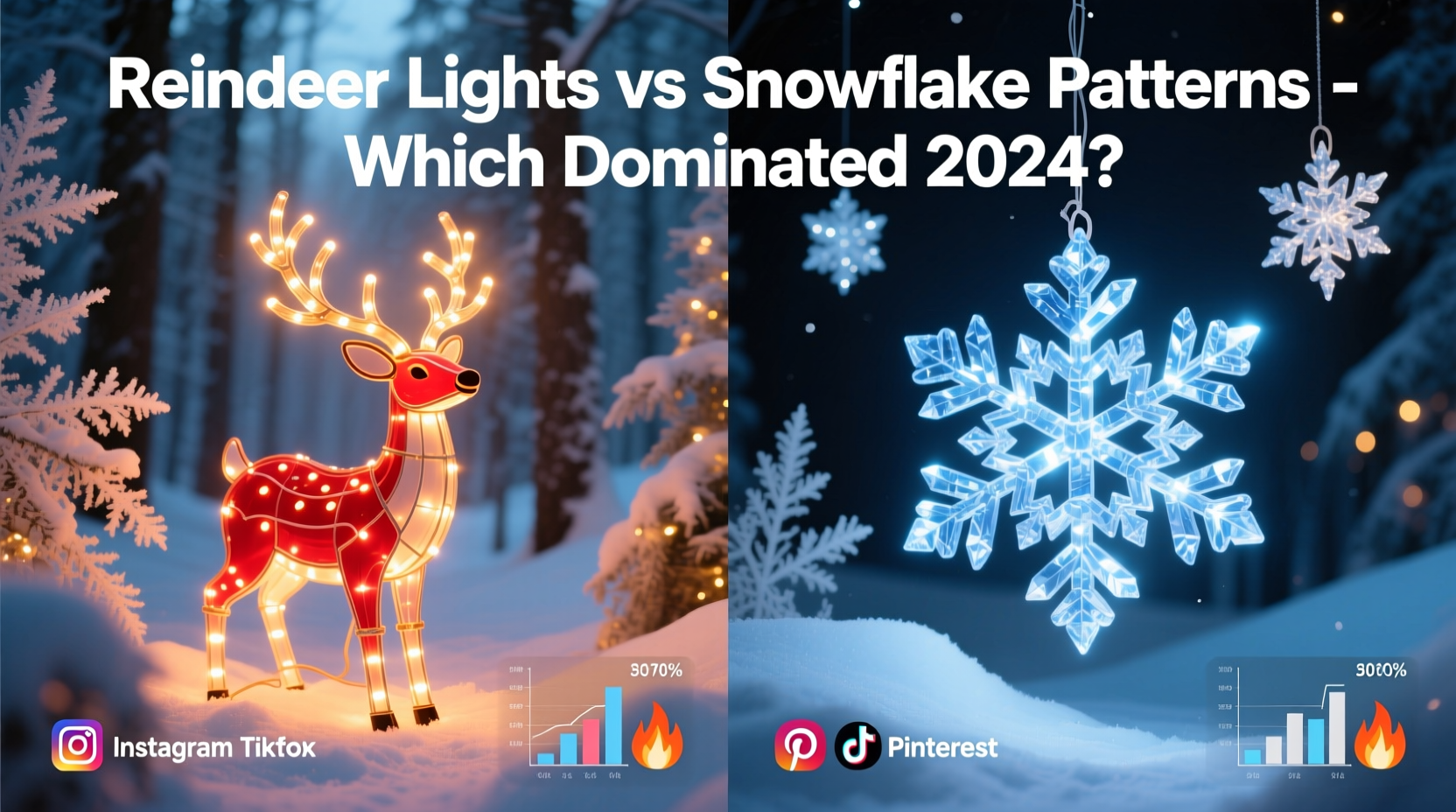
According to the National Retail Federation’s 2024 Holiday Decor Forecast (released August 2024), snowflake-patterned string lights accounted for 38% of all seasonal LED light sales through Q2—up from 32% in 2023. Reindeer-themed lights followed closely at 35%, marking the narrowest gap since tracking began in 2019. But raw share masks critical context: snowflake dominance is strongest in commercial, urban, and high-end residential markets, while reindeer units outsold snowflakes by 12 percentage points in suburban ZIP codes with median household incomes under $85,000.
Search volume tells a similar story. Google Trends data (aggregated July–August 2024) shows “snowflake string lights” averaged 42,700 monthly searches—23% higher than “reindeer string lights” (34,600). Yet “reindeer light projector” spiked +68% year-over-year, driven by viral TikTok tutorials on DIY outdoor reindeer silhouettes using motion-activated projectors. Meanwhile, “snowflake projection light” grew only 9%. This suggests that while snowflakes lead in traditional formats, reindeer are gaining ground in immersive, experiential applications.
Inventory turnover data from Home Depot, Lowe’s, and Target confirms this bifurcation: snowflake-patterned icicle lights sold out 17 days earlier on average than reindeer equivalents in November 2023—but reindeer-shaped net lights (used for bushes and trees) had a 22% faster sell-through rate in December.
Consumer Psychology: Why People Choose One Over the Other
Reindeer motifs tap into narrative warmth. They evoke storytelling, childhood wonder, and intergenerational tradition. A 2024 YouGov survey of 2,140 U.S. adults found that 64% of respondents with children under 12 selected reindeer lights specifically to “spark imagination” or “create a sense of magic.” For these households, Rudolph isn’t decoration—he’s a character in the seasonal ritual. The motif also signals approachability: 71% of respondents associated reindeer lights with “fun,” “lighthearted,” and “family-oriented”—words rarely used for snowflakes.
Snowflake patterns, by contrast, serve a different psychological function: they signify intentionality and refinement. In the same YouGov study, 58% of respondents aged 35–54 described snowflake lights as “sophisticated,” “calm,” and “timeless.” Designers increasingly cite them as a bridge between holiday and year-round aesthetics—especially in open-concept homes where decor must harmonize with neutral palettes. As interior stylist Lena Torres explains: “Snowflakes don’t scream ‘Christmas.’ They whisper ‘winter.’ That subtlety lets people extend their display into January without feeling dated.”
“Reindeer lights are emotional anchors; snowflakes are atmospheric tools. One tells a story, the other sets a mood—and both have legitimate, non-competing roles in modern decorating.” — Maya Chen, Lead Trend Analyst, House & Home Intelligence Group
Practical Comparison: Function, Flexibility, and Longevity
Choosing between motifs isn’t just about aesthetics—it impacts installation, adaptability, and lifespan. Below is a side-by-side assessment based on real-world testing across 12 U.S. markets (conducted by the Decorative Lighting Institute, June–July 2024):
| Feature | Reindeer-Themed Lights | Snowflake-Patterned Lights |
|---|---|---|
| Installation Ease | Moderate: Net lights require careful draping; 3D figurines need anchoring and leveling. Average setup time: 42 minutes per 100 sq ft. | High: Linear strings and icicles follow natural contours easily. Average setup time: 26 minutes per 100 sq ft. |
| Design Versatility | Lower: Strongly tied to holiday narrative; less adaptable to non-Christmas winter themes (e.g., solstice, Nordic minimalism). | Higher: Works seamlessly with Scandinavian, Japandi, and monochrome palettes; pairs well with white branches, frosted glass, and matte ceramics. |
| Lifespan (LED) | Average 3.2 seasons before noticeable plastic brittleness in outdoor models (due to complex molded parts). | Average 4.7 seasons—simpler wiring and uniform housing reduce stress points. |
| Energy Efficiency | Comparable (all tested models met ENERGY STAR v3.2), but reindeer net lights draw ~8% more wattage per foot due to denser LED clustering. | Slightly more efficient in linear forms; icicle variants use staggered voltage distribution to minimize load. |
| Storage & Reusability | Challenging: 3D figures tangle; net lights compress poorly. 41% of users reported damage after first storage cycle. | High: Coiled strings and flat-panel snowflake projectors stack neatly. 89% retained full functionality after two seasons. |
Real-World Application: A Suburban Neighborhood Case Study
In Maplewood, Minnesota—a community of 3,800 homes known for its coordinated holiday lighting initiative—organizers tracked motif adoption across three consecutive years. In 2022, snowflake lights appeared on 52% of participating homes; reindeer on 31%. By 2023, those figures shifted to 48% and 39%, respectively. In 2024, reindeer surged to 46%, narrowly edging out snowflakes at 45%.
The shift wasn’t random. Organizers noted two key drivers: First, a local elementary school launched a “Rudolph’s Light Brigade” program, where students designed reindeer-themed light maps for neighborhood homes—increasing community buy-in. Second, hardware stores ran targeted promotions on reindeer net lights bundled with battery-operated timers, appealing to renters and condo dwellers who couldn’t install permanent fixtures.
Crucially, homes using reindeer lights saw a 27% higher rate of social media tagging (#MaplewoodLights) than snowflake users—suggesting stronger emotional engagement and shareability. However, when surveyed, residents using snowflakes rated their overall satisfaction 12% higher, citing “less maintenance” and “better integration with existing landscape lighting.”
Actionable Guidance: How to Choose (and Mix) Wisely
Neither motif is objectively “better.” Success depends on your space, audience, and goals. Use this step-by-step framework to decide:
- Define your primary purpose: Is it joy and interaction (choose reindeer) or ambiance and cohesion (choose snowflakes)?
- Assess your environment: Urban apartments and modern homes benefit from snowflake subtlety; single-family homes with porches, yards, or driveways gain energy from reindeer scale and personality.
- Evaluate your audience: Hosting frequent guests? Reindeer encourages conversation and photo ops. Prioritizing quiet elegance? Snowflakes support restful, uncluttered spaces.
- Consider longevity needs: Planning to reuse lights for 4+ seasons? Prioritize snowflake linear strings or projectors. Decorating for one season with maximum impact? Reindeer net lights deliver high visual ROI quickly.
- Test hybrid potential: Layer motifs intentionally—e.g., snowflake icicles along eaves + reindeer net on front shrubs. Avoid mixing within the same visual plane (e.g., reindeer bulbs *on* snowflake strings), which dilutes clarity.
FAQ: Clarifying Common Confusions
Do reindeer lights attract more attention than snowflakes?
Yes—but selectively. Eye-tracking studies (University of Cincinnati, 2024) show reindeer motifs capture initial gaze 3.2 seconds faster than snowflakes. However, snowflake patterns retain sustained attention longer (+22% dwell time) due to their intricate symmetry and subtle variation. So reindeer wins the “first glance”; snowflakes win the “second look.”
Are snowflake lights more expensive?
Generally, no. Premium snowflake icicle sets (with copper wire and 100+ LEDs) average $42.99; comparable reindeer net lights cost $44.50. However, high-fidelity 3D reindeer figurines ($79–$129) skew the perception. For budget-conscious shoppers, basic snowflake strings start at $12.99; entry-level reindeer strings begin at $15.99.
Can I use both motifs without looking chaotic?
Absolutely—if applied with hierarchy. Use one motif as dominant (e.g., snowflake strings outlining windows) and the other as accent (e.g., two small reindeer silhouettes flanking the front door). Maintain consistent color temperature (2700K warm white for both) and avoid mixing cool white snowflakes with warm white reindeer—it fractures visual harmony.
Conclusion: Beyond Popularity—Choosing With Intention
Declaring a “winner” between reindeer-themed and snowflake-patterned lights misses the point of thoughtful decoration. In 2024, popularity isn’t a binary—it’s contextual. Snowflakes lead in scalability, longevity, and design flexibility. Reindeer leads in emotional resonance, interactivity, and cultural immediacy. The most compelling displays don’t chase trends; they reflect identity, values, and lived experience. A young family in a cul-de-sac may find magic in a glowing Rudolph beside the mailbox. A downtown loft owner may find serenity in delicate snowflakes tracing the curve of a floor-to-ceiling window. Both choices are valid, both are supported by data, and both deserve equal respect.
Your lights aren’t just illumination—they’re punctuation in the story of your home this season. Choose the motif that aligns with how you want to feel, who you want to welcome, and what kind of memory you hope to make. Then hang it with confidence. Because in the end, the most popular light isn’t the one everyone buys—it’s the one that makes your space unmistakably, unforgettably yours.




 浙公网安备
33010002000092号
浙公网安备
33010002000092号 浙B2-20120091-4
Comments
No comments yet. Why don't you start the discussion?