
Every holiday season, millions of households wrestle with the same decision: how to decorate their Christmas tree. For decades, the process has followed a familiar rhythm—unboxing lights, untangling wires, climbing step stools, and testing strands one by one. But now, technology offers an alternative: remote-controlled Christmas trees that promise effortless lighting, synchronized music modes, and app-based scheduling. The question isn't just whether these smart trees work—it's whether they're truly worth replacing tradition with automation.
The answer depends on your priorities: convenience, budget, family dynamics, or sentimental value. While remote-controlled trees deliver undeniable ease, especially for busy or mobility-limited households, they come with trade-offs in cost, customization, and authenticity. Understanding both sides reveals not just which option suits you best—but whether automation enhances or distances us from the spirit of the season.
Understanding the Remote-Controlled Christmas Tree
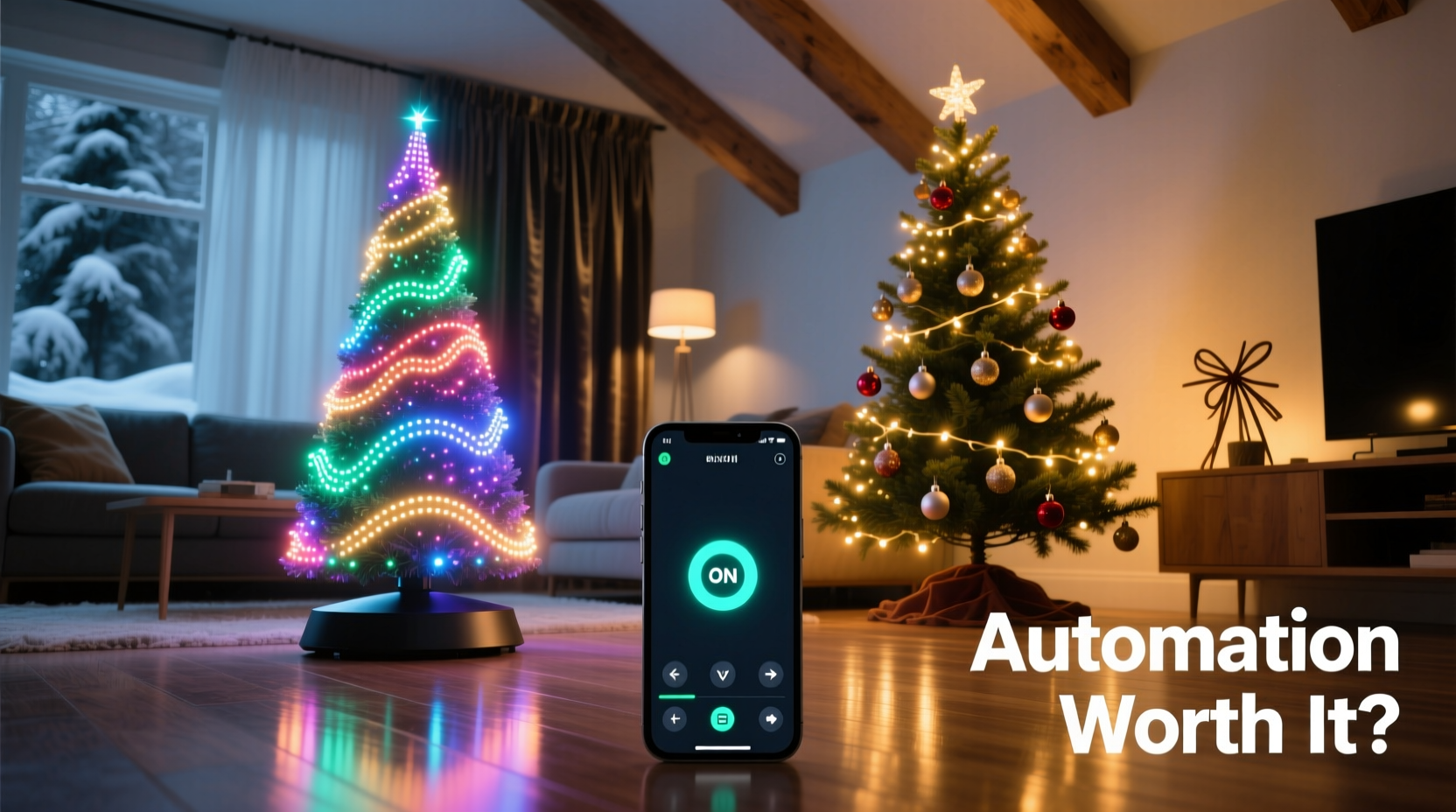
A remote-controlled Christmas tree integrates built-in LED lighting systems managed via handheld remotes, smartphone apps, or voice assistants like Alexa and Google Home. These trees often feature pre-strung, non-removable lights designed to last the life of the tree. Functions typically include brightness adjustment, color cycling (for multicolor models), flashing patterns, timer settings, and even music synchronization.
Manufacturers market these trees as “plug-and-play” solutions—ideal for people who want instant decor without the hassle of stringing hundreds of bulbs. Some high-end models offer Wi-Fi connectivity, enabling users to turn the tree on or off while away from home or schedule daily light routines aligned with sunset times.
Most remote-controlled trees are artificial, though a few specialty live trees with removable smart-light sleeves exist. They range in size from tabletop 3-foot models to towering 9-foot centerpieces. Prices vary widely, starting around $150 for basic versions and reaching over $600 for premium, app-enabled designs with advanced features.
Manual Setup: Tradition, Control, and Customization
The traditional approach involves assembling an artificial or real tree and decorating it piece by piece. This includes selecting individual strands of lights, ornaments, garlands, and a star or angel topper. Many families treat this ritual as a core holiday event—often accompanied by hot cocoa, carols, and shared memories.
Manual setups offer near-total creative freedom. You can mix vintage bulb styles with modern LEDs, layer different types of tinsel, or theme the entire tree around a color scheme or personal story. Lighting choices aren’t limited to what’s pre-wired; you can swap out faulty strings, add spotlights, or incorporate motion-activated elements.
From a financial standpoint, manual decoration is often more budget-friendly upfront. A basic unlit artificial tree starts under $50, and light strands can be purchased incrementally. Over time, families build collections of ornaments and lighting that carry emotional weight—each item tied to a year, a milestone, or a loved one.
However, manual setup demands time and physical effort. Untangling lights remains one of the most frustrating aspects of holiday prep. According to a 2022 consumer survey by HomeDecor Insider, nearly 70% of respondents reported spending at least 45 minutes just managing light cords before decorating could begin. Additionally, older adults or those with mobility issues may find ladder use or repetitive bending difficult or unsafe.
“Lighting a tree manually creates moments of connection. There’s something meaningful in the small struggles—the tangled wires, the missing ornament—that becomes part of the memory.” — Dr. Lydia Monroe, Cultural Anthropologist specializing in holiday rituals
Comparing Key Factors: Automation vs Manual
| Factor | Remote-Controlled Tree | Manual Setup |
|---|---|---|
| Setup Time | 5–15 minutes (plug in and sync) | 60–180 minutes (assembly + lights + decor) |
| Upfront Cost | $150–$600+ | $40–$200 (tree + incremental decor) |
| Long-Term Maintenance | Low (sealed lights; minimal upkeep) | Moderate to high (replace bulbs, store components separately) |
| Customization | Limited (fixed lights; fewer styling options) | High (full control over every element) |
| Safety | Higher (LEDs run cooler; no exposed wiring) | Variable (risk of overloaded circuits or frayed cords) |
| Lifespan | 5–10 years (dependent on tech durability) | 10+ years (with proper storage) |
| Emotional Value | Functional and convenient | High (ritual, nostalgia, personal expression) |
The table highlights a fundamental divide: remote-controlled trees prioritize efficiency and consistency, while manual setups emphasize creativity and tradition. Neither is objectively better—it comes down to what kind of experience you value during the holidays.
Real Example: Two Families, Two Choices
Consider two households preparing for the same December weekend.
The Chen family lives in a downtown apartment. Both parents work full-time jobs, and they have two young children involved in school plays and ice skating lessons. Last year, they spent three hours on a Saturday night trying to fix a flickering light strand while the kids lost interest and went to bed. This year, they invested in a 7-foot remote-controlled tree with app integration. On December 1st, they unpacked the tree, plugged it in, and used their phones to activate a soft white glow that turns on automatically at dusk. They still hang ornaments together, but the lighting stress is gone. “It feels less like a chore,” says Maria Chen. “We get more time for what matters—being together.”
In contrast, the Reynolds family gathers every first weekend of December at their eldest daughter’s home. Ten relatives, including grandparents and toddlers, participate in what they call “Tree Day.” They use the same 8-foot artificial tree from 1998, carefully stored in sections. Each person brings new ornaments or repairs old ones. The lights—hand-strung incandescent bulbs—are checked one by one. It takes all afternoon, but laughter fills the house. “If we switched to a remote tree,” says Grandpa Joe, “we’d lose half the fun. The mess is the memory.”
These stories illustrate that the choice isn’t just logistical—it’s cultural and emotional. Automation saves time, but sometimes the time spent *is* the point.
Step-by-Step: How to Decide Which Option Fits Your Home
Choosing between a remote-controlled and manual Christmas tree doesn’t need to be arbitrary. Follow this practical timeline to evaluate your needs and make an informed decision.
- Assess Your Holiday Schedule (November 1–10)
Track how many free evenings you realistically have for decorating. If you consistently have less than 3 hours total, automation may reduce seasonal stress. - Inventory Current Decor (November 11–15)
Check your existing tree, lights, and ornaments. Are lights failing frequently? Is storage disorganized? High replacement costs may justify upgrading to a long-term solution like a smart tree. - Evaluate Physical Ability (Ongoing)
Consider whether anyone in your household has difficulty lifting, bending, or climbing. Remote trees eliminate ladder use and reduce strain, making them safer for seniors or those with chronic pain. - Determine Budget Range (November 16–20)
Set a firm limit. If staying under $100 is essential, manual setup is likely your only viable path. Those with flexibility may weigh long-term savings (fewer replacements) against higher initial investment. - Test Emotional Priorities (November 21–30)
Ask: Is the decorating process itself important to your family? Do you look forward to it as a bonding event? If yes, preserving manual traditions may outweigh convenience. - Research and Purchase (By December 5)
Compare models. Read reviews focusing on reliability, remote responsiveness, and customer support. For manual decorators, consider investing in cord organizers and labeled bins to streamline future years.
Common Misconceptions About Smart Trees
Despite growing popularity, several myths persist about remote-controlled Christmas trees:
- Myth: They’re prone to hacking.
Reality: Most operate on infrared or short-range RF signals, not internet-connected protocols. Wi-Fi models use encrypted connections, and risks are minimal with standard password hygiene. - Myth: You can’t personalize them.
While lights are fixed, you can still customize with unique ornaments, themed skirts, and creative placement. The tree base and surrounding decor remain fully flexible. - Myth: They break after one season.
Quality varies, but reputable brands offer 3–5 year warranties. Proper handling—especially during assembly and storage—dramatically improves longevity.
The biggest misconception, however, is that choosing automation means abandoning tradition. In reality, many families blend both approaches—using a smart tree for lighting while maintaining handmade ornament exchanges or annual cookie-baking sessions alongside decorating.
Frequently Asked Questions
Can I add extra lights to a remote-controlled tree?
Yes, but cautiously. You can drape additional LED strands over the tree, but avoid connecting them to the built-in circuit. Overloading can trip safety fuses or void warranties. Use battery-powered or plug-into-a-separate-outlet options instead.
What happens if the remote is lost?
Most models include a manual override button at the base. Some allow pairing with universal remotes or smartphone apps. Keep the model number handy for replacement requests. A few brands offer QR-code registration for digital remote backups.
Are remote-controlled trees safe around pets and kids?
Generally, yes. Built-in LEDs produce little heat, reducing burn risk. Cords are enclosed within the trunk or branches, minimizing tripping or chewing hazards. Still, supervise young children and pets during initial setup to prevent tipping.
Final Checklist: Making Your Decision
Before purchasing or committing to a method, go through this checklist:
- ☐ I’ve considered how much time I realistically have for setup
- ☐ I understand the total cost, including potential future repairs
- ☐ I’ve thought about physical limitations in my household
- ☐ I’ve discussed preferences with family members or roommates
- ☐ I’ve researched reliable brands and read recent customer reviews
- ☐ I know how to store the tree properly, regardless of type
- ☐ I’m comfortable with the level of customization available
Conclusion: Is Automation Worth It?
The value of a remote-controlled Christmas tree isn’t measured solely in minutes saved or watts consumed. It’s measured in peace of mind, accessibility, and the ability to focus on joy rather than logistics. For some, flipping a switch and watching the tree glow is enough. For others, the imperfection of tangled lights and mismatched bulbs is precisely what makes the season feel real.
Automation isn’t about replacing tradition—it’s about redefining it for modern lives. If your holiday energy is drained by chores, a smart tree might give you back the space to enjoy what truly matters: presence, warmth, and connection. But if the act of decorating is itself a cherished ritual, no remote can replicate that sentiment.
Ultimately, the best tree—whether controlled by app or by hand—is the one that brings light into your home and heart. Choose not based on trends, but on what aligns with your lifestyle, values, and vision of the holidays.




 浙公网安备
33010002000092号
浙公网安备
33010002000092号 浙B2-20120091-4
Comments
No comments yet. Why don't you start the discussion?