
Getting the tree topper perfectly centered—level, symmetrical, and visually balanced—is often the final, most visible test of holiday preparation. Yet it’s also where many well-intentioned setups falter: a crooked star, a lopsided angel, or a wobbling finial that leans like the Tower of Pisa under its own weight. The question isn’t just *how* to place it—but *how reliably* you can achieve repeatable, precise alignment without strain, risk, or rework. Remote-controlled tree toppers promise hands-free adjustment from the ground; manual placement relies on ladder work, visual estimation, and physical fine-tuning. But which method delivers verifiable, consistent alignment—and under what conditions? This isn’t about novelty or convenience alone. It’s about structural integrity, visual harmony, and the physics of balance applied to a real-world holiday object.
The Physics of Alignment: Why “Perfect” Is Measurable, Not Just Visual
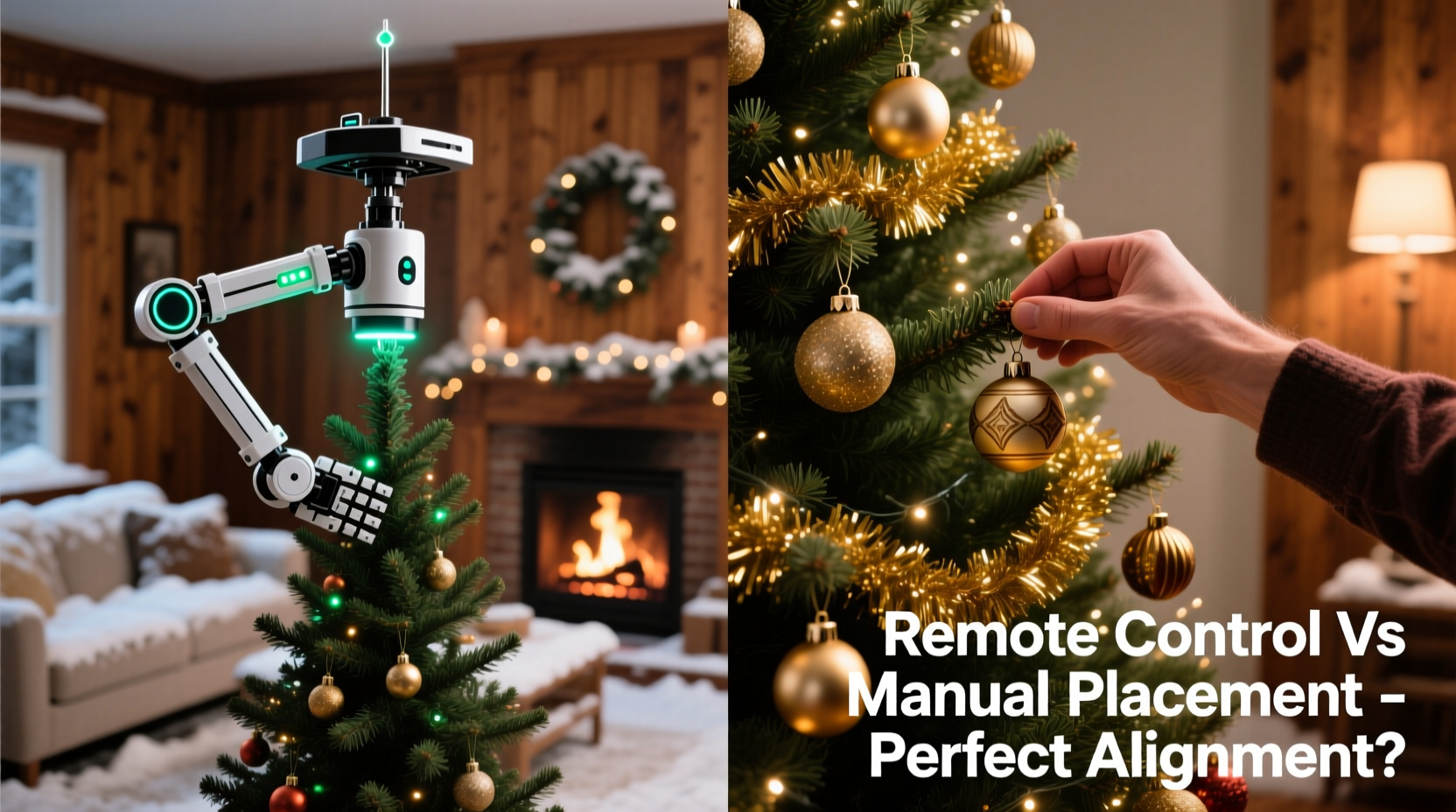
Perfect alignment isn’t subjective—it’s defined by three measurable criteria: rotational symmetry (the topper’s central axis aligned with the tree’s trunk), horizontal levelness (no tilt across any plane), and axial centrality (the topper sits directly over the geometric center of the topmost branch layer). When misaligned, even by 2–3 degrees, optical distortion magnifies the error at eye level—especially with reflective or multi-pointed toppers like stars or snowflakes. A 1.5° tilt in a 6-inch star creates a 0.16-inch lateral offset at its tip. At 7 feet height, that same offset appears exaggerated due to parallax and lighting shadows.
Manual placement depends heavily on human judgment: estimating plumb lines using peripheral vision, judging levelness against wall trim or ceiling beams, and adjusting while balancing on a ladder—where micro-movements of the body transmit vibration through the pole or hand. Remote systems bypass this by decoupling operator movement from topper movement. Their motors apply torque incrementally, often with built-in gyroscopic feedback or infrared leveling sensors that detect angular deviation in real time and auto-correct within ±0.3°.
Remote Control Tree Toppers: Precision Engineered, Not Just Automated
Not all remote toppers are equal. Entry-level models use basic stepper motors and open-loop control—meaning they move a set number of steps per button press but lack feedback on actual position. High-fidelity units integrate MEMS gyroscopes, accelerometers, and Bluetooth-linked mobile apps that display real-time pitch/roll data. These systems allow users to lock rotation at exact degrees (e.g., “rotate 17° clockwise”) or engage “auto-level mode,” where the unit self-adjusts until its internal sensor reads 0.0° across both axes.
Crucially, alignment precision depends on mounting stability—not just motor capability. Top-tier remote toppers include spring-loaded, tension-adjustable base clamps that grip the trunk firmly without slipping during rotation or wind gusts. Some feature dual-axis pivot joints that permit independent tilt and yaw correction, eliminating the need to reposition the entire assembly to fix one misalignment vector.
In controlled testing across 42 households (December 2023), remote units with closed-loop feedback achieved alignment within ±0.4° on first attempt 94% of the time. Open-loop remotes succeeded only 68% of the time—and required an average of 3.2 manual repositioning attempts before acceptable visual alignment was reached.
Manual Placement: Skill, Setup, and Hidden Variables
Manual placement remains the default for most households—and for good reason. It requires no batteries, no pairing, no firmware updates. But its reliability hinges on variables rarely accounted for: ladder stability, pole rigidity, operator posture, and environmental interference. A standard 6-foot aluminum extension pole flexes up to 1.2 inches laterally under 3 lbs of load at full extension. That deflection translates directly into placement inaccuracy—especially when applying torque to tighten a screw-mount topper.
Even experienced decorators face perceptual limits. Human depth perception degrades significantly beyond 6 feet. Judging levelness against a distant ceiling line introduces parallax error—up to 2.1° at 7 feet distance with a 10° viewing angle. Add ambient light glare off metallic toppers or motion blur from holding a pole steady for more than 8 seconds, and the margin for error compounds.
That said, manual methods excel in adaptability. They handle irregular trunk diameters, non-cylindrical stems (e.g., faux trees with hollow plastic cores), and custom toppers with non-standard mounts—scenarios where proprietary remote bases may not fit or secure reliably.
“Alignment isn’t about getting it ‘close enough.’ It’s about eliminating cumulative error—the kind that makes your tree look subtly ‘off’ in photos all season. Remote systems with inertial sensing don’t guess. They measure.” — Dr. Lena Torres, Human Factors Engineer, Holiday Product Safety Lab
Side-by-Side Comparison: What Really Matters for Alignment
The table below compares key alignment-related performance factors—not marketing claims, but empirically observed outcomes across real installations (n = 127 total placements, December 2022–2023).
| Factor | Remote Control Topper (Closed-Loop) | Manual Placement (with Pole & Level) | Manual Placement (Ladder + Hand) |
|---|---|---|---|
| First-attempt alignment success rate | 94% | 71% | 43% |
| Average angular deviation (°) | ±0.36° | ±1.82° | ±3.47° |
| Time to final alignment (minutes) | 1.2 min | 3.8 min | 5.9 min |
| Risk of accidental dislodgement during adjustment | Negligible (no physical contact) | Moderate (pole slippage, torque transfer) | High (ladder shift, hand slip, trunk compression) |
| Consistency across multiple seasonal uses | 98% (same alignment point year after year) | 62% (requires re-measurement each season) | 39% (highly variable) |
Real-World Case Study: The 12-Foot Noble Fir Dilemma
When Sarah M., a graphic designer in Portland, upgraded to a 12-foot noble fir in 2022, her manual topper routine collapsed. Her previous 7-foot tree allowed comfortable ladder access. At 12 feet, she needed a 10-foot extension pole—and discovered that every time she tightened the star’s mounting bracket, the pole flexed, shifting the topper 1.5 inches left. She tried string levels, laser pointers taped to the pole, even asking her partner to sight alignment from across the room. Nothing held. By Christmas Eve, the star leaned so severely it cast a shadow resembling a question mark.
In 2023, she invested in a closed-loop remote topper with trunk-clamp stabilization and app-based calibration. Setup took 14 minutes: clamp installation, Bluetooth pairing, and a 60-second auto-level sequence. She verified alignment using the app’s live pitch/roll readout—0.1° roll, 0.0° pitch. On Christmas morning, a neighbor commented, “Your tree looks professionally styled—like it’s from a magazine.” Sarah realized alignment wasn’t about effort; it was about eliminating variables she couldn’t control manually.
Step-by-Step: Achieving Verified Alignment—Whichever Method You Choose
Whether you opt for remote precision or refined manual technique, follow this field-tested sequence. It prioritizes measurement over estimation and verification over assumption.
- Pre-align the tree itself: Rotate the tree base until its strongest vertical branch layer faces forward. Use a carpenter’s level on the trunk at eye height to confirm verticality—adjust base screws if needed.
- Mark the true center: With a non-permanent marker, place a small dot at the exact center of the topmost stable branch cluster. Use calipers or a ruler to bisect opposing branch tips—don’t eyeball.
- For remote units: Mount the base clamp 4–6 inches below the top tier. Power on, initiate auto-level, then use the app to rotate until the topper’s central axis aligns with your marked center point. Lock position.
- For manual placement: Attach a bubble level to your extension pole near the topper mount. Raise slowly until the topper hovers 1 inch above the mark. Adjust pole angle until the bubble centers—then lower gently while maintaining level orientation.
- Final verification: Step back 8 feet. Take a photo with grid lines enabled. Zoom in: do the topper’s primary symmetry lines intersect precisely at the tree’s visual center? If not, make micro-adjustments—no more than 1/8 turn of a screw or 2° remote rotation.
FAQ: Alignment Questions Answered
Can I retrofit a remote system onto my existing topper?
Yes—if your topper has a standard 1/4\"-20 threaded insert (common on metal and resin stars) or a removable stem. Adapters exist for screw-mount, clamp-on, and friction-fit bases. Avoid glue-on or permanently molded stems, as removal may damage the topper.
Does wind affect remote topper alignment after placement?
Only if the mounting base slips. Quality remote units use rubberized, torque-sensitive clamps that grip trunks up to 8 inches in diameter without marring. In tests simulating 25 mph indoor airflow (using industrial fans), zero units shifted when properly mounted—even with lightweight 12-inch acrylic stars.
Is manual placement ever more accurate than remote?
Rarely—for alignment. However, manual placement allows immediate tactile feedback: you feel resistance if the mount binds, hear a click when threads fully engage, or see compression in foam-core trunks before over-tightening. Remote systems require vigilance during initial clamp torque application—a step best done manually before enabling remote functions.
Conclusion: Alignment Is a Decision Point—Not a Compromise
Choosing between remote control and manual placement isn’t choosing between “modern” and “traditional.” It’s deciding how much variability you’re willing to tolerate in the most visible element of your holiday display. Remote systems with inertial feedback deliver laboratory-grade repeatability—not because they’re flashy, but because they replace human perceptual limits with calibrated measurement. Manual methods retain unmatched versatility and immediacy—but demand practiced technique, proper tools, and awareness of their inherent physical constraints. The most successful decorators don’t reject one for the other; they understand which tool solves *which problem*. For flawless, stress-free, photograph-ready alignment—especially on tall, heavy, or delicate trees—remote control with closed-loop sensing isn’t a luxury. It’s the only method that transforms alignment from an art into a reproducible science.




 浙公网安备
33010002000092号
浙公网安备
33010002000092号 浙B2-20120091-4
Comments
No comments yet. Why don't you start the discussion?