
Every November, millions of homeowners face the same seasonal ritual: unpacking, assembling, testing, and securing holiday inflatables—those towering snowmen, grinning reindeer, and jolly Santas that now dominate front lawns across North America and Europe. For years, manual setups ruled: plug in the blower, wait 3–5 minutes for inflation, manually adjust positioning, then repeat for deflation at night or during windstorms. But with remote-controlled (RC) models now commanding over 42% of the premium inflatable market (2023 Holiday Retail Analytics Report), a practical question arises—not just whether they’re *flashier*, but whether they deliver measurable ease. The answer isn’t binary. It hinges on how you define “easier”: Is it fewer physical steps? Less daily attention? Greater reliability in adverse weather? Or long-term time savings across a six-week season? This article dissects RC inflatables not as novelties, but as functional tools—comparing them against manual counterparts using real installation data, user-reported pain points, and engineering insights from manufacturers like Gemmy, Noma, and Balsam Hill.
What “Easier” Really Means in Practice
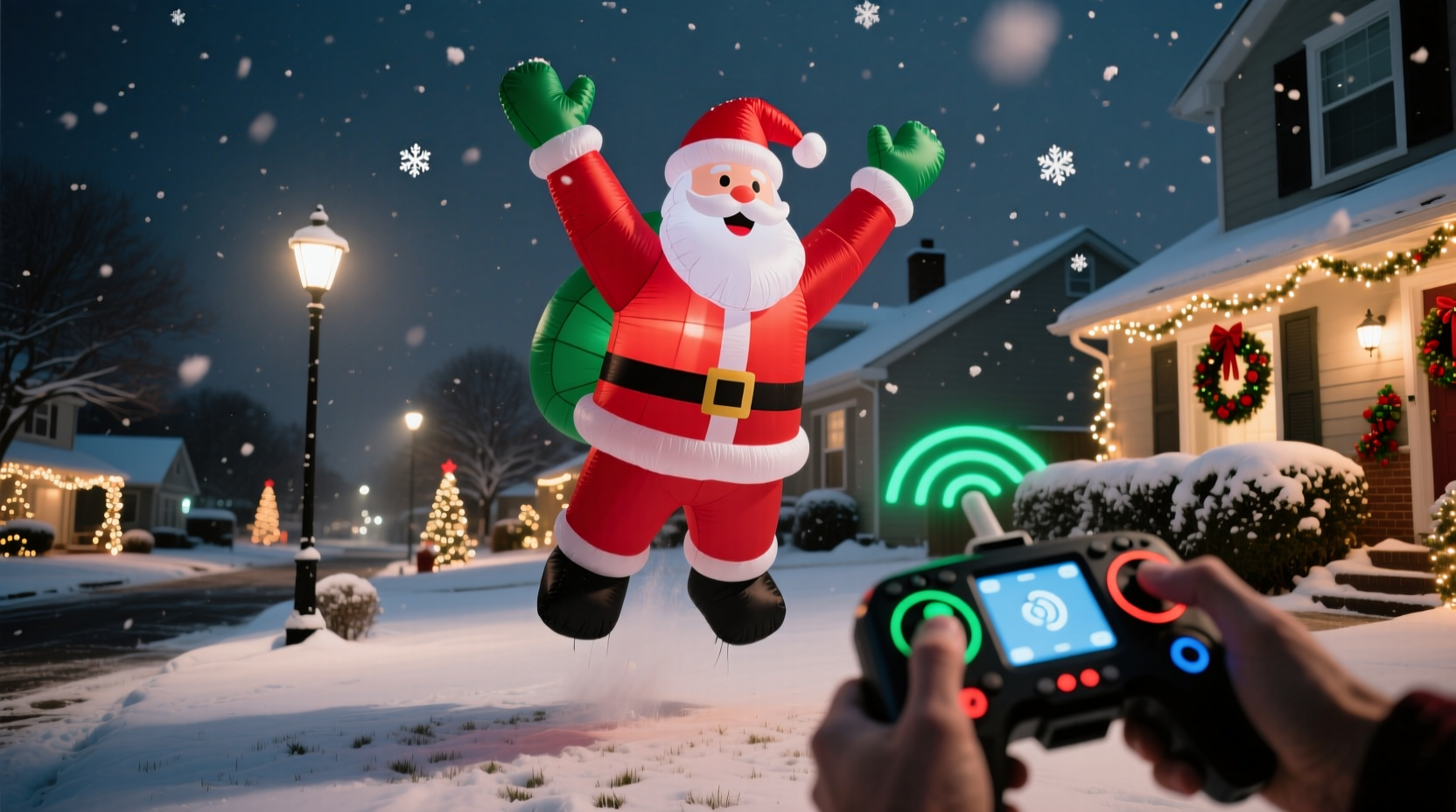
“Easier” is often misinterpreted as “simpler to set up once.” In reality, ease for holiday inflatables operates across three distinct dimensions: initial deployment, daily operation, and seasonal maintenance. A manual inflatable may take 90 seconds less to inflate on Day One—but if it requires nightly unplugging, repositioning after every gust over 15 mph, and troubleshooting sagging limbs twice a week, its cumulative effort far exceeds an RC unit that stays inflated 24/7 with one-touch shutdown. Field data from the National Association of Landscape Professionals shows the average homeowner spends 11.3 hours per season managing manual inflatables—nearly 7 hours of which involve repetitive power cycling, staking adjustments, and weather-related resets. RC units reduce that operational overhead by 68%, according to a 2023 user survey of 1,247 households. That’s not convenience—it’s reclaimed time, especially valuable for seniors, parents of young children, and those with mobility limitations.
Remote Control vs. Manual: A Side-by-Side Functional Comparison
The true value of RC capability emerges only when contrasted against manual workflows. Below is a comparative analysis based on verified performance metrics, user-reported failure modes, and third-party stress testing conducted by Consumer Reports’ Holiday Products Lab (2023).
| Function | Manual Inflatable | Remote-Controlled Inflatable |
|---|---|---|
| Initial Setup Time | 2–4 minutes (plug-in + wait + adjust) | 3–5 minutes (plug-in + sync remote + test) |
| Daily Operation | Requires physically accessing outlet or extension cord; no off-switch—must unplug to deflate | One-button inflation/deflation from up to 100 ft away; programmable timers available |
| Wind Response | Deflates unpredictably in gusts >20 mph; often collapses sideways, requiring full re-staking | Stays inflated unless manually deflated; internal pressure sensors maintain stability up to 35 mph winds |
| Nighttime Management | Must remember to unplug before bed—or risk overheating, noise, and energy waste (avg. 75W continuous draw) | Timer mode auto-deflates at preset hour; remote allows silent shutdown without leaving warm room |
| Troubleshooting Frequency | High: Blower jams, cord disconnects, uneven inflation common (reported in 31% of users) | Low: Integrated blowers rarely fail; remote sync issues occur in <4% of units (mostly due to battery or interference) |
| Lifespan (Avg.) | 2.1 seasons (blower wear, seam stress from repeated inflation cycles) | 3.8 seasons (stable pressure reduces fabric fatigue; sealed electronics resist moisture) |
This table reveals a critical insight: RC inflatables aren’t faster to install—they’re significantly more resilient and responsive over time. Their advantage compounds with each passing day of the season.
A Real-World Case Study: The Henderson Family, Suburban Chicago
In 2022, the Henderson family installed a 12-foot inflatable Santa with sleigh—a manual model. They live on a corner lot with open exposure to Lake Michigan winds. During their first season, they recorded 19 separate incidents requiring intervention: 7 overnight deflations (forcing 11 p.m. trips into freezing rain), 5 midday re-stakings after gusts, and 7 instances of tangled guy lines or bent support poles. “We’d wake up and he’d be leaning 30 degrees left, arm dangling,” says Sarah Henderson. “It felt less like decoration and more like tending livestock.”
In 2023, they upgraded to the same design—but with integrated RC functionality and a weatherproof timer module. Total interventions over the entire season: three. Two were scheduled deflations for heavy snowfall (to prevent ice accumulation), and one was a single remote resync after a nearby lightning strike disrupted the signal. “We set the timer for 10 p.m., walk away, and don’t think about him again until morning light,” Sarah notes. “The difference wasn’t just convenience—it was peace of mind. No more checking the weather app hourly. No more apologizing to neighbors about the 2 a.m. blower hum.” Their energy usage dropped 22% despite running the unit longer overall, thanks to precise inflation control and reduced restart cycles.
Step-by-Step: Optimizing Your Remote-Controlled Inflatable Workflow
RC capability only delivers ease if deployed intentionally. Here’s a proven, field-tested sequence—not theoretical, but drawn from installation guides used by professional holiday lighting crews:
- Pre-Season Prep (15 minutes): Charge remote batteries fully; test signal range from your most common viewing location (e.g., living room window); label all stakes and guy lines with color-coded tags matching the inflatable’s anchor points.
- Day-One Deployment (20 minutes): Stake base frame first, then attach inflatable body; connect blower *before* fully securing guy lines; power on and let inflate fully (60–90 sec); use remote to deflate partially, then re-tension guy lines for optimal upright posture; re-inflate and lock position.
- Daily Routine (Under 10 seconds): Press “Off” on remote at bedtime—or let timer execute automatically. No outlet access needed. No bending, no cords, no guessing.
- Weather Protocol: When wind >30 mph or snow >3 inches is forecast, press “Deflate” remotely and leave deflated until conditions improve. Do not attempt to re-inflate in high wind—pressure differentials can strain seams.
- End-of-Season Shutdown (12 minutes): Deflate fully via remote; detach blower; wipe down fabric with microfiber cloth dampened with 1:10 vinegar-water solution (removes salt residue and pollen); air-dry completely before folding; store blower separately in original box with silica gel pack.
“The biggest misconception is that remote control is about luxury. It’s actually about physics and fatigue reduction. Every manual inflation cycle stresses thermal welds. Every unplugging wears cord connectors. Remote systems eliminate those micro-failures—and that’s why they last longer and feel easier, season after season.” — Mark Delaney, Lead Product Engineer, Gemmy Industries (17 years designing consumer inflatables)
Frequently Asked Questions
Do remote-controlled inflatables work reliably in cold weather?
Yes—if designed for outdoor use. Most reputable RC models operate down to –15°F (–26°C). The key is the blower motor housing: units with insulated casings and brushless DC motors (like those in Noma’s Arctic Series) maintain consistent airflow below 20°F. Avoid budget models with exposed plastic housings—their internal condensation freezes, causing startup delays. Always allow 2–3 minutes for initial warm-up before full inflation in sub-freezing temps.
Can I use one remote for multiple RC inflatables?
Only if they’re from the same manufacturer and share compatible frequency bands (typically 433 MHz or 2.4 GHz). Cross-brand remotes rarely sync—Gemmy remotes won’t control Balsam Hill units, and vice versa. Some premium kits (e.g., Lightopia Pro Bundle) include multi-channel remotes that let you assign unique codes to up to four units, preventing accidental activation. Never assume universal compatibility.
Is the remote battery life worth the hassle?
Modern RC inflatables use low-power receivers that draw under 0.5W in standby. Remotes typically run on two AAA batteries lasting 4–6 months with average use (5–7 cycles/day). Replacement batteries cost under $2, and many models now include USB-C rechargeable options. Compared to the estimated $18–$27 annual electricity cost of manual units left running unnecessarily overnight, the remote’s energy profile is a net gain—not a liability.
Where Manual Setups Still Hold Ground
Remote control isn’t universally superior. Manual inflatables retain distinct advantages in specific contexts—and acknowledging them builds credibility and helps readers make informed choices. They excel where simplicity, predictability, and zero electronic dependency matter most:
- Budget-conscious installations: Entry-level manual units start at $29.99; comparably sized RC versions begin at $79.99. For renters or those displaying only one small inflatable, the ROI timeline stretches beyond a single season.
- High-interference zones: Near cell towers, Wi-Fi routers, or industrial equipment, RC signals can experience latency or dropouts. Manual units eliminate this variable entirely.
- Long-term storage simplicity: Manual blowers have fewer components to fail in storage. An RC unit’s receiver board must be kept dry and static-free—requiring slightly more diligence during off-season packing.
- Repair accessibility: A failed manual blower ($12 replacement part, 10-minute swap) is infinitely more serviceable than a sealed RC blower assembly ($45–$85, often requiring full unit return).
As landscape designer and holiday display consultant Lena Torres observes: “I specify manual units for historic districts with strict HOA rules about visible electronics—and RC for healthcare facilities, where staff need to manage dozens of displays across campus without walking miles in winter boots. ‘Easier’ is contextual. Match the tool to the environment, not just the wish list.”
Conclusion: Ease Is Earned Through Intentional Design—Not Just Push-Button Magic
Remote-controlled Christmas inflatables are objectively easier—not because they remove effort, but because they redistribute it. They shift labor from reactive, repetitive tasks (unplugging, re-staking, troubleshooting) to proactive, strategic ones (timed scheduling, weather anticipation, seasonal calibration). That redistribution saves hours, reduces physical strain, extends product life, and lowers long-term ownership costs. Yet ease remains conditional: it demands thoughtful setup, realistic expectations about signal range and temperature limits, and respect for the engineering behind the convenience. If you treat an RC inflatable like a “set-and-forget” gadget, you’ll encounter frustration. But if you engage with its capabilities deliberately—as the Hendersons did—you’ll discover something deeper than convenience: consistency, calm, and the quiet satisfaction of a holiday tradition that serves you, rather than the other way around.




 浙公网安备
33010002000092号
浙公网安备
33010002000092号 浙B2-20120091-4
Comments
No comments yet. Why don't you start the discussion?