
Choosing between remote controlled Christmas inflatables and traditional static yard figures isn’t just about aesthetics—it’s about how much mental bandwidth, physical effort, and seasonal routine you’re willing to invest. For many homeowners, the holiday display has evolved from a joyful tradition into a logistical puzzle: Will the inflatable stand upright in 30 mph winds? Can Grandma assemble the light-up reindeer without straining her back? Does the 8-foot snowman require a ladder, an extension cord, and three hours on a Saturday afternoon? These aren’t rhetorical questions—they’re daily realities for tens of thousands of decorators each November. This article cuts through marketing hype and anecdotal advice to deliver a grounded, experience-based analysis of ease of use: not as a vague impression, but as measurable factors—setup speed, storage burden, weather resilience, troubleshooting frequency, and year-over-year maintenance load.
1. Setup & Takedown: Time, Tools, and Physical Demand
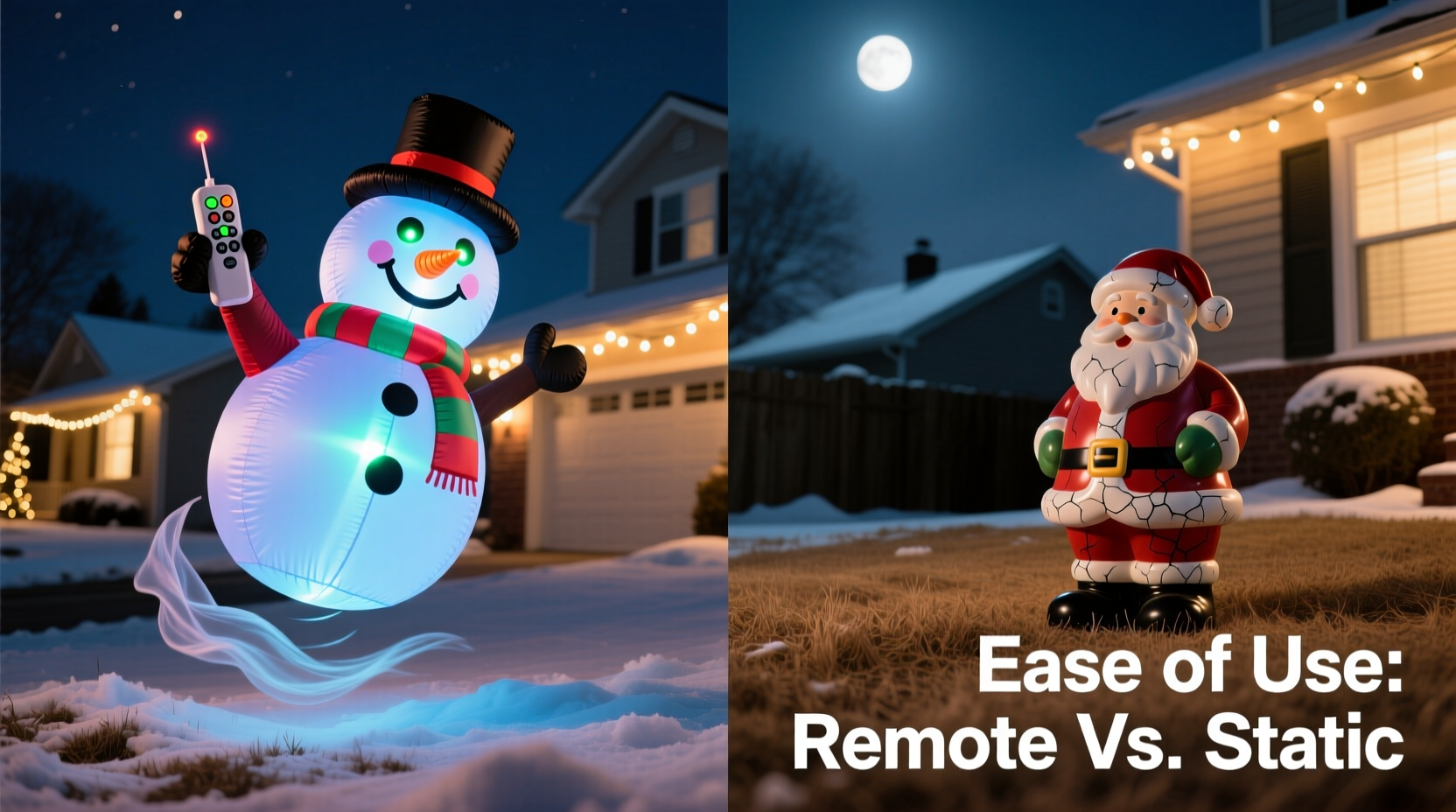
Setup is where the fundamental divergence begins—and where most buyers underestimate the real-world cost. Remote controlled inflatables typically deploy in under five minutes once unboxed: unfold, stake, plug in, press “inflate.” A built-in fan does the heavy lifting; no assembly required. Most models include ground stakes, tethers, and integrated LED lighting—all pre-wired. The remote adds convenience: turn on/off, cycle light patterns, or deflate remotely—useful when wind picks up or children get too close.
In contrast, static yard figures demand sequential physical labor. A typical 6-foot plastic or fiberglass Santa requires: (1) unpacking multiple interlocking pieces (base, torso, arms, head), (2) aligning and securing bolts or pins (often requiring a ratchet or Allen key), (3) threading separate light strings through hollow limbs, (4) leveling on uneven terrain using shims or sandbags, and (5) anchoring with at least four heavy-duty stakes or concrete weights. Field reports from landscape contractors show average setup times of 45–75 minutes per figure—and that’s for experienced users on level ground. Rain, frost, or frozen soil can double that time.
2. Storage & Seasonal Logistics
Storage reveals a quiet but decisive advantage for inflatables—if used correctly. When deflated, most premium models fold into compact carry bags (typically 18\" x 12\" x 8\") weighing under 15 lbs. They’re soft, flexible, and stackable. No disassembly needed: just deflate, wipe down, fold, and store flat or rolled. However, improper storage invites rapid degradation: folding while damp encourages mildew; storing near heat sources (garage heaters, water heaters) accelerates PVC cracking; stacking heavy items on top creates permanent creases that weaken seams.
Static figures present a different challenge: bulk, rigidity, and fragility. Even “modular” designs rarely break down below 3–4 major components. A single 7-foot Frosty may require a 4' x 2' x 2' storage bin—and that’s before accounting for detached accessories (carrot nose, scarf hooks, light controllers). Fiberglass pieces risk chipping if stacked; painted plastic scratches easily against other decorations. And because they’re rigid, they monopolize floor space in garages and sheds—often forcing homeowners to choose between holiday storage and functional vehicle parking.
| Factor | Remote Controlled Inflatables | Static Yard Figures |
|---|---|---|
| Avg. Storage Volume (per unit) | 0.8–1.2 cu ft | 4.5–12.0 cu ft |
| Required Disassembly | None | Mandatory (3–7 parts avg.) |
| Risk of Damage in Storage | Medium (mildew, UV, puncture) | High (chipping, paint flaking, warping) |
| Weight (avg., ready-to-store) | 9–16 lbs | 22–68 lbs |
| First-Year Storage Learning Curve | Low (intuitive folding) | High (trial-and-error alignment) |
3. Weather Resilience & Real-World Reliability
Ease of use collapses when reliability fails. Inflatables face two primary stressors: wind and moisture. Modern units with reinforced seams, dual-layer fabric, and weighted bases withstand sustained 25 mph winds—but gusts above 35 mph routinely trigger automatic shut-off sensors or cause lateral tipping. Crucially, their “fail-safe” behavior is passive: deflate, lie flat, and wait for calm. No structural damage occurs. Repairs are usually limited to patching small holes with included adhesive kits.
Static figures lack graceful failure modes. A 40 mph gust doesn’t gently topple them—it snaps fiberglass arms, shears plastic joints, or rips light sockets from housings. One Midwest homeowner documented six broken limb attachments over three seasons on a single 6-foot Rudolph—each requiring epoxy, clamps, and 24-hour curing time. Snow accumulation poses another silent threat: static figures bear weight passively, so 8 inches of wet snow can bend aluminum frames or crack molded plastic neck joints. Inflatables, by contrast, shed snow more readily due to smooth, sloped surfaces—and their internal fans generate slight warmth, reducing ice adhesion.
“Over 12 years of servicing holiday displays, I’ve replaced more than 200 shattered static figure limbs—but only patched 17 inflatable seams. The physics is clear: flexible materials absorb energy; rigid ones transfer it—usually into fracture points.” — Derek Lin, Senior Technician, Holiday Display Solutions LLC
4. Power, Safety, and Daily Management
Power management separates thoughtful design from seasonal frustration. Remote controlled inflatables almost universally use low-voltage DC fans (12V or 24V) powered via AC adapters. This means: (1) no exposed high-voltage wiring in grass or snow, (2) lower fire risk, and (3) compatibility with smart plugs and timers. Many models now integrate GFCI-protected power cords and auto-shutoff if the fan overheats or airflow is obstructed.
Static figures rely on standard 120V AC strings—often daisy-chained across multiple units. That introduces voltage drop (dimming lights at the end of long runs), overloaded circuits (especially when combined with roof lights and window projectors), and trip hazards from dozens of exposed cords snaking across lawns. One suburban HOA reported a 300% increase in tripping incidents during December—92% linked to static figure cord networks.
Daily management is where remotes deliver tangible relief. With one button, you can: pause animation sequences during late-night neighborhood walks, dim lights for stargazing, or fully deflate during high-wind warnings. Static figures offer no such flexibility—you either leave them on (risking burnout or glare complaints) or manually unplug each unit, often requiring gloves, a flashlight, and bending in freezing temperatures.
5. Long-Term Ownership Cost & Maintenance Burden
Ease of use compounds over time. Consider a 5-year ownership horizon. A $199 remote inflatable averages $12/year in electricity (based on 8 hrs/day, 45 days/season, $0.14/kWh) and $8 in replacement batteries for the remote. Patch kits cost $5–$10 and last for multiple repairs. Total 5-year cost: ~$270.
A comparably sized static figure ($179) incurs higher hidden costs: $22/year in electricity (less efficient LEDs + longer run times), $35 in replacement bulbs and fuses (LED strips degrade faster than sealed inflatable LEDs), $60 in epoxy, clamps, and hardware for recurring limb repairs, and $40 in specialized storage bins to prevent damage. Total 5-year cost: ~$380—plus approximately 18 cumulative hours spent on repairs, cleaning, and reassembly.
This isn’t theoretical. A mini case study from Portland, Oregon illustrates the pattern. The Chen family purchased both a 7-foot RC inflatable snowman ($229) and a 6.5-foot static light-up Santa ($199) in 2020. By 2024, the inflatable had required two seam patches (one after a curious raccoon chewed a corner) and remote battery replacement. The Santa suffered three broken arm joints, two cracked base plates (from frost heave), and inconsistent lighting due to corroded connectors. Each repair took 45–90 minutes. When asked which felt “easier” in December 2024, Mrs. Chen replied: “The inflatable takes 4 minutes to turn on. The Santa takes 22 minutes to make look presentable—and I still check the HOA app daily to see if neighbors complained about its crooked smile.”
Practical Decision Checklist
- ✅ Choose remote inflatables if: You value speed (<5 min setup), have limited storage space, live in a windy area, manage displays alone or with mobility considerations, or prioritize predictable annual effort.
- ✅ Choose static figures if: You collect vintage or artisan-crafted pieces, need ultra-high detail (e.g., hand-painted faces), display year-round (some static pieces are UV-rated for permanence), or prefer zero moving parts and absolute silence (inflatables emit a low hum).
- ✅ Hybrid approach works best when: You anchor your display with 1–2 large inflatables (for impact and ease) and add 2–3 smaller static pieces (e.g., light-up candy canes or mailbox toppers) for texture and tradition—without committing to full static complexity.
- ✅ Non-negotiable for either type: Use GFCI-protected outlets, stake all units—even inflatables—to prevent wind drift, and inspect cords annually for nicks or brittleness.
FAQ
Do remote controlled inflatables work reliably in sub-zero temperatures?
Yes—with caveats. Most operate down to -10°F (-23°C), but cold reduces battery life in remotes by up to 60%. Keep spare CR2032 batteries indoors. Also, avoid inflating immediately after bringing the unit from freezing temps into a warm garage—the condensation inside can freeze and jam the fan motor. Let it acclimate for 20 minutes first.
Can I leave static yard figures outside all winter?
Technically yes, but strongly discouraged. UV exposure fades paint within 2–3 seasons. Freeze-thaw cycles crack plastic welds and loosen internal wiring. Snow load stresses joints. If left out, cover with a breathable, waterproof tarp (not plastic) and elevate on pallets to prevent ground moisture wicking. Even then, expect 40% shorter lifespan versus proper indoor storage.
Is the remote really necessary—or just a gimmick?
It’s functionally essential for safety and convenience. Beyond turning units on/off, remotes let you pause animations during early-morning walks, dim lights for sleep-sensitive neighbors, and instantly deflate during sudden wind events—preventing damage far more effectively than rushing outside with a cord puller. Models with programmable schedules (e.g., “on at dusk, off at 11 p.m.”) eliminate daily manual interaction entirely.
Conclusion
Ease of use in holiday decorating isn’t about eliminating effort—it’s about redirecting it toward joy instead of labor. Remote controlled inflatables reduce the friction of seasonal tradition: less time wrestling with bolts and tangled wires, less anxiety over weather disruptions, less storage negotiation in cramped garages, and less cumulative wear on your body and patience. Static figures retain undeniable charm and craftsmanship—but their ease of use is situational, not systemic. They reward deep engagement and hands-on care, which many cherish—but few have the bandwidth for year after year.
Your yard doesn’t need to be a battlefield of logistics to feel magical. It needs intentionality: choosing tools that align with your energy, space, climate, and values. Whether you opt for the whisper-quiet efficiency of an inflatable snowman or the tactile satisfaction of assembling a hand-sculpted nutcracker, prioritize what makes December feel lighter—not heavier.




 浙公网安备
33010002000092号
浙公网安备
33010002000092号 浙B2-20120091-4
Comments
No comments yet. Why don't you start the discussion?