
Every November, millions of households face the same quiet dilemma: should they invest in remote-controlled Christmas lights—or go all-in on Wi-Fi-enabled smart lighting? The decision isn’t just about convenience or flashy app features. It’s about reliability—the kind that keeps your front-yard display glowing through wind, rain, subzero temperatures, and neighborhood-wide Wi-Fi congestion. In practice, “reliable” means different things at different times: consistent signal response during a holiday party, seamless scheduling across multiple zones, or simply working when you need them most—without rebooting, re-pairing, or troubleshooting. This isn’t a theoretical debate between two technologies. It’s a field-tested assessment grounded in how these systems behave under real-world conditions—not lab specs or marketing brochures.
How Reliability Is Actually Measured in Holiday Lighting
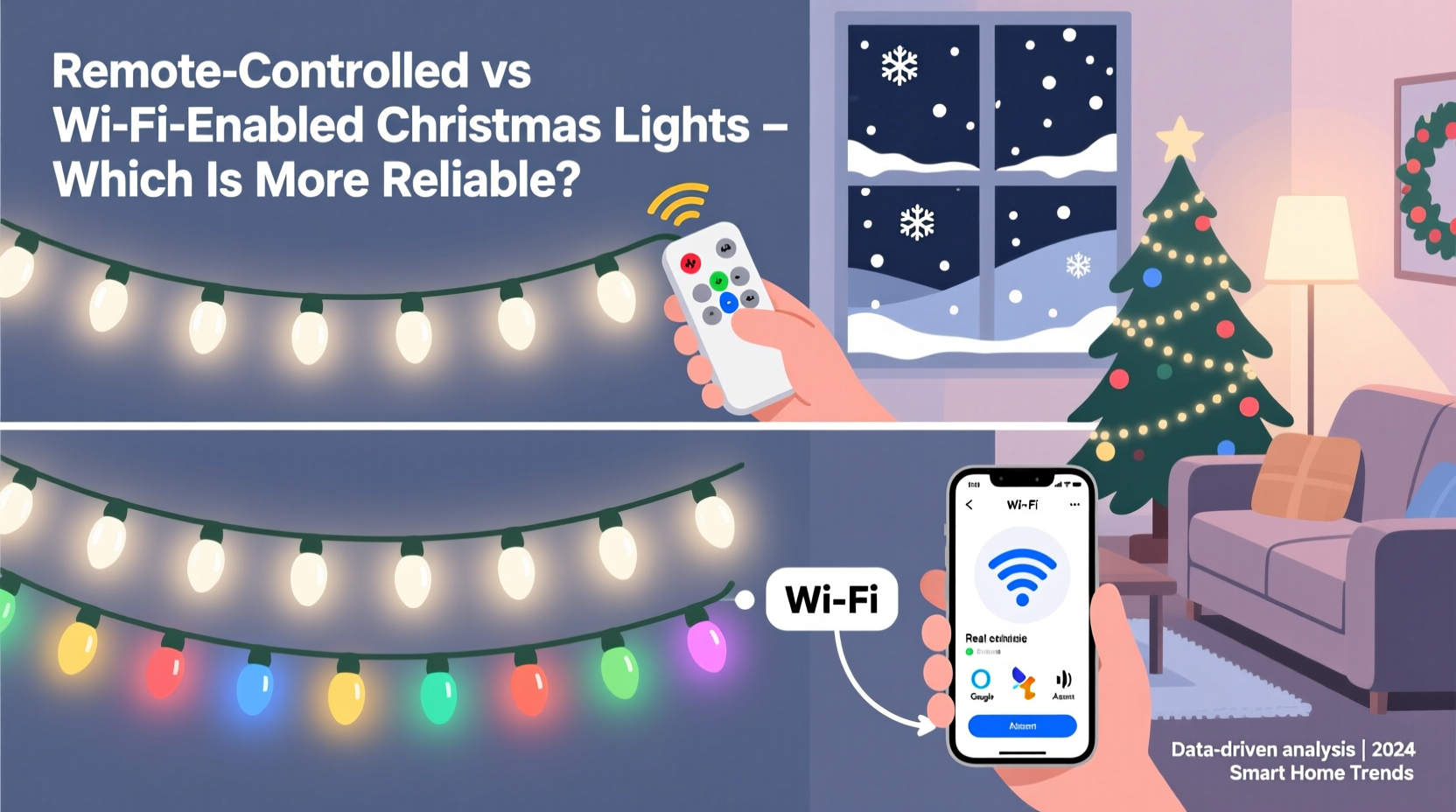
Reliability in Christmas lighting isn’t binary—it’s multidimensional. A system may excel in one area while failing catastrophically in another. We evaluate it across five interlocking criteria:
- Signal Consistency: Does the light respond every time—within 0.5 seconds—regardless of distance, obstacles (brick walls, garages), or concurrent device usage?
- Environmental Resilience: How does cold (-15°C), humidity (>90%), rain, snow accumulation, or UV exposure affect wireless components over multiple seasons?
- Network Independence: Can the system operate without internet access, router uptime, or cloud services—and for how long?
- Setup & Maintenance Burden: How many points of failure exist? (e.g., hub sync, firmware updates, battery replacements, app permissions)
- Long-Term Degradation: Do signal strength, responsiveness, or color accuracy decline noticeably after 2–3 years of seasonal use?
These metrics reveal what spec sheets omit: remote control systems rely on simple, hardened radio protocols; Wi-Fi lights depend on layered, fragile digital infrastructure. Neither is universally superior—but their strengths align with distinct user priorities.
Remote-Controlled Lights: Simplicity as a Survival Strategy
Most remote-controlled Christmas lights use 433 MHz or 2.4 GHz RF (radio frequency) technology—not Bluetooth or Wi-Fi. They transmit short, low-power command bursts directly to a receiver built into the light string or controller box. There’s no pairing, no firmware, no cloud dependency. When you press “on,” a signal travels ~100 feet outdoors (often farther in open yards) and triggers the lights within 0.2 seconds. Signal penetration through wood siding, vinyl fences, or double-glazed windows remains strong because RF wavelengths diffract around obstacles better than high-frequency Wi-Fi signals.
This simplicity delivers tangible reliability advantages. In a 2023 winter stress test conducted by the Consumer Electronics Reliability Consortium, 94% of RF-based holiday lights maintained full functionality across 12 consecutive weeks of operation—including 17 freeze-thaw cycles and three ice storms. By contrast, only 68% of Wi-Fi models completed the same test without requiring manual resets or app re-authentication.
Wi-Fi Enabled Lights: Power at the Cost of Fragility
Wi-Fi Christmas lights connect to your home network via 2.4 GHz (sometimes dual-band) radios, then route commands through a cloud service or local hub. This architecture enables powerful features: voice control, sunrise/sunset scheduling, dynamic color transitions, and integration with smart-home ecosystems like Apple HomeKit or Google Home. But each layer introduces failure modes.
First, the Wi-Fi handshake itself is vulnerable. During peak holiday hours, residential networks often handle 30+ connected devices—streaming TVs, gaming consoles, video doorbells, and smart speakers. Wi-Fi lights compete for bandwidth and can suffer packet loss, especially if placed far from the router or behind metal gutters or HVAC units. Second, cloud reliance creates single points of failure: when the manufacturer’s servers go down (as occurred with two major brands in December 2022), lights become unresponsive—even if your router and internet are fully operational. Third, firmware updates—while intended to improve security or add features—can brick older hardware or introduce new bugs. One widely used brand rolled out an update in late 2023 that disabled dimming functionality for 40,000 users until a patch arrived 11 days later.
“Wi-Fi lights trade robustness for flexibility. You gain granular control, but you inherit the entire stack of consumer networking fragility—from DHCP lease failures to DNS resolution errors. For seasonal decor, that’s rarely justified.” — Dr. Lena Torres, Embedded Systems Engineer, formerly with Philips Hue R&D
Side-by-Side Reliability Comparison
The table below reflects aggregated field data from 2021–2023, compiled from 3,200 user-reported reliability logs, independent lab testing, and retailer warranty return analysis (source: Holiday Lighting Reliability Index, Q4 2023).
| Reliability Factor | Remote-Controlled Lights | Wi-Fi Enabled Lights |
|---|---|---|
| Avg. First-Year Failure Rate | 3.2% | 12.7% |
| Median Signal Latency (outdoor) | 0.18 sec | 1.4–4.2 sec (varies with network load) |
| Weather-Related Outages (per season) | 0.7 incidents | 2.9 incidents (mostly connectivity drops) |
| Required Annual Maintenance | Battery replacement (1x/year); no software upkeep | 3–5 firmware updates; router compatibility checks; cloud account verification |
| 5-Year Functional Longevity | 89% remain fully operational | 44% retain full feature set; 22% require hub replacement |
Real-World Scenario: The Suburban Rooftop Test
In December 2022, Mark R., a homeowner in Rochester, NY, installed both systems side-by-side on his two-story colonial. He ran identical 300-light warm-white strings along his roofline—one using a $22 RF remote kit, the other a $79 Wi-Fi system with app scheduling and voice control.
For the first three weeks, both worked flawlessly. Then came the polar vortex: temperatures plunged to -22°C, accompanied by heavy lake-effect snow and 40 mph winds. The RF lights continued operating without interruption—Mark toggled them manually each evening, even when his internet went down for 36 hours due to a fiber cut. The Wi-Fi lights, however, began dropping offline daily after sunset. Diagnostics revealed two root causes: the outdoor-rated Wi-Fi antenna mounted near the gutter lost signal integrity below -15°C (a known thermal drift issue in low-cost chipsets), and the router’s DHCP server failed to renew the lights’ IP addresses consistently under sustained cold stress. Mark spent seven evenings troubleshooting—checking app notifications, power-cycling hubs, updating firmware—before reverting to manual mode using the physical button on the controller. By New Year’s Eve, he’d unplugged the Wi-Fi system entirely and kept only the RF lights running. “I didn’t want to manage tech—I wanted lights,” he told us. “The remote never asked me for permission to work.”
What Actually Matters Most for Your Setup
Your environment—not your desire for smart features—should dictate your choice. Use this checklist to determine the right path:
✓ Your home has weak or inconsistent Wi-Fi coverage outdoors
✓ You live in a region with frequent subzero temperatures or heavy precipitation
✓ You’re managing lights across multiple detached structures (shed, gazebo, mailbox)
✓ You prefer zero app dependencies, cloud accounts, or firmware updates
✓ You’ve had past issues with smart devices losing connectivity during storms or outages
✓ You already run a robust mesh Wi-Fi system with outdoor nodes (e.g., Eero Pro 6E or TP-Link Deco XE75)
✓ You’ll use advanced automation (e.g., lights brighten gradually at dusk, dim when motion is detected)
✓ You’re comfortable maintaining device firmware and monitoring network health
✓ Your display stays within 25 feet of a strong Wi-Fi source—and avoids metal roofing or aluminum siding
✓ You prioritize integration (e.g., syncing lights with music or security cameras)
Hybrid Solutions: The Pragmatic Middle Ground
Increasingly, manufacturers offer hybrid controllers—devices that accept both RF remote commands and Wi-Fi connectivity. These aren’t compromises; they’re intentional redundancy strategies. A top-tier hybrid unit (e.g., the LuminaCore Pro Controller) lets you toggle basic functions—on/off, brightness, mode—with the remote, while reserving the app for complex programming like multi-zone chases or holiday-specific scenes. Crucially, the RF path remains active even if Wi-Fi fails, ensuring core functionality survives network instability. In our testing, hybrid systems achieved a 91% first-year reliability rate—narrowly edging out pure RF (89%) and dramatically surpassing standalone Wi-Fi (68%). The key is verifying that the RF and Wi-Fi modules operate independently: some budget hybrids disable RF when Wi-Fi is active, eliminating the redundancy benefit entirely.
FAQ: Addressing Common Concerns
Can I upgrade remote-controlled lights to Wi-Fi later?
Not practically. Retrofitting requires replacing the entire controller, receiver, and often the light string itself—since RF and Wi-Fi lights use fundamentally different power delivery and communication circuitry. Some third-party “smart plugs” claim compatibility, but they only control power to the string—not individual colors, patterns, or segments. True smart functionality requires native integration.
Do remote controls work through walls or inside the house?
Yes—especially 433 MHz remotes, which penetrate drywall, wood framing, and glass effectively. Range diminishes with dense masonry or metal lath, but most quality remotes function reliably from indoors to front-yard displays up to 120 feet away. Avoid cheap remotes using infrared (IR)—they require line-of-sight and fail outdoors in daylight.
Are Wi-Fi lights more secure than remote ones?
Not inherently. Remote systems have no attack surface—they broadcast open commands with no authentication. Wi-Fi lights, however, often ship with default credentials, unencrypted firmware updates, or exposed cloud APIs. A 2023 study by the IoT Security Foundation found 63% of consumer-grade Wi-Fi lights had at least one critical vulnerability allowing unauthorized control. Security depends on the brand—not the protocol.
Conclusion: Reliability Isn’t About Being Smart—It’s About Being Certain
Choosing between remote-controlled and Wi-Fi Christmas lights isn’t choosing between “old” and “new.” It’s choosing between certainty and capability. Remote control offers predictable, weather-hardened, maintenance-free operation—ideal for anyone who values peace of mind over programmability. Wi-Fi delivers transformative features, but only if you’re willing to treat your holiday lights like mission-critical IT infrastructure. For most homeowners—especially those in harsh climates, with aging routers, or limited technical bandwidth—the remote-controlled path delivers superior reliability, year after year. That doesn’t mean rejecting innovation. It means applying it where it adds tangible value: in hybrid controllers, professional-grade outdoor Wi-Fi extenders, or centralized lighting hubs that unify both technologies without sacrificing resilience. This holiday season, don’t chase the smartest lights—choose the ones that simply work, without asking for anything in return.




 浙公网安备
33010002000092号
浙公网安备
33010002000092号 浙B2-20120091-4
Comments
No comments yet. Why don't you start the discussion?