
For many gamers, revisiting classic titles isn’t just about nostalgia—it’s about reliving a moment in time. The pixelated sprites, chiptune soundtracks, and tactile feel of old controllers evoke memories that modern remasters often fail to replicate. But when it comes to playing retro games today, two paths dominate: using original retro gaming consoles or turning to an emulation box. Each offers access to beloved classics, but only one truly captures the essence of authenticity. Understanding the differences between them is crucial for collectors, purists, and casual players alike.
The Heart of Authenticity: What Defines a True Retro Experience?
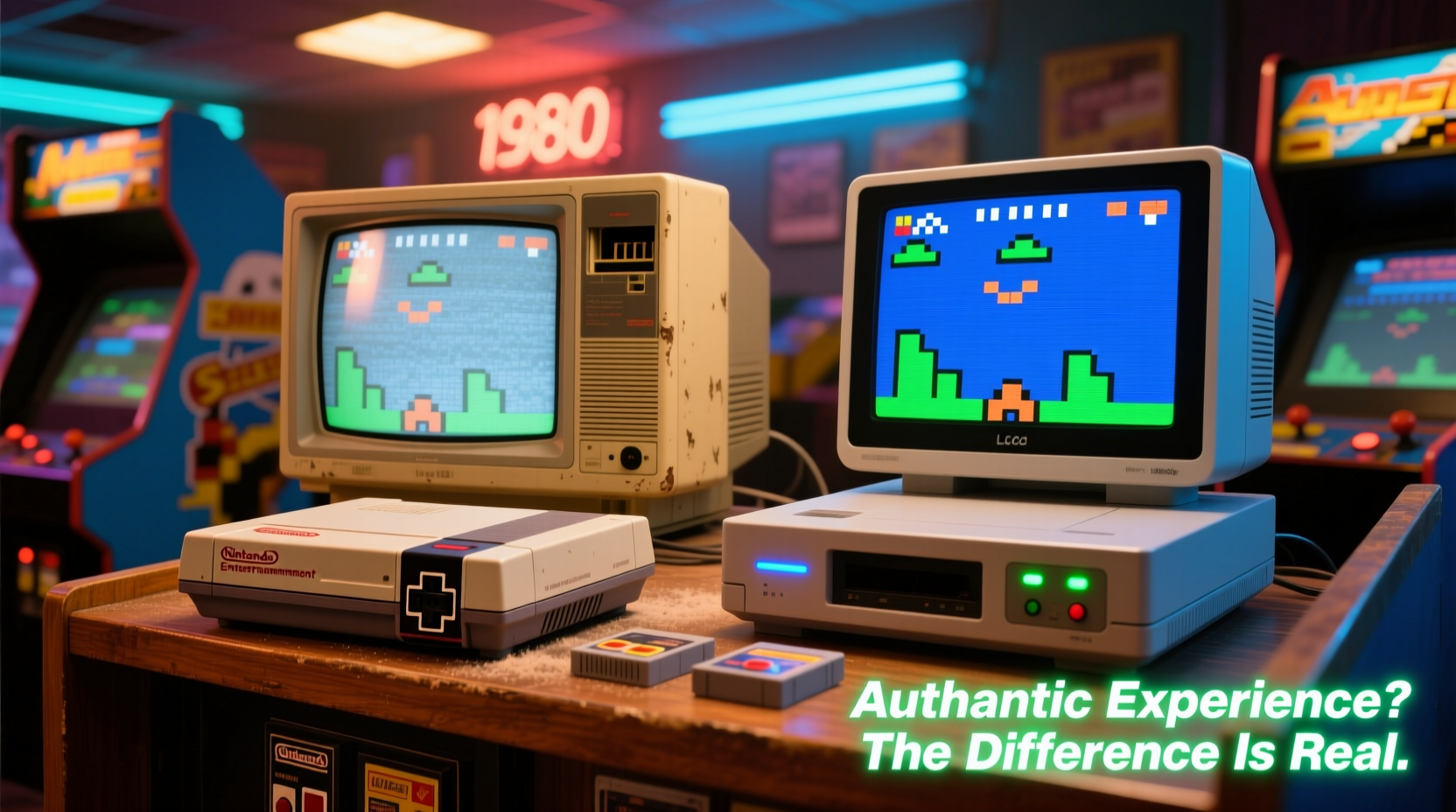
Authenticity in retro gaming goes beyond visual fidelity. It encompasses timing, input lag, audio processing, screen scanlines, controller responsiveness, and even the physical interaction with hardware. True enthusiasts argue that only original hardware can deliver the complete sensory package—the slight hum of a CRT television syncing with a Super Nintendo, the resistance of an NES controller’s D-pad, or the warmth radiating from a Sega Genesis after hours of play.
Modern emulation has made incredible strides, replicating not just game logic but also aspects of hardware behavior down to the transistor level. Yet, even the most accurate emulators operate within layers of abstraction. They simulate, rather than embody, the original system’s architecture. This distinction may seem minor, but for those seeking purity, simulation is not equivalent to reality.
“Emulation gets us close, but there's a soul in original hardware—the imperfections, the quirks—that code alone can't perfectly reproduce.” — David Haynes, Vintage Console Restoration Specialist
Hardware Realism: Original Consoles as Time Capsules
Using a genuine retro console means engaging with technology as it existed in its era. From boot-up sequences to reset glitches, every aspect reflects the engineering limitations and design philosophies of the time. Playing on original hardware requires specific peripherals: RF switches, composite cables, and CRT televisions—all contributing to the characteristic blur, scanlines, and color bleed that defined 80s and 90s gaming aesthetics.
Consider the Nintendo Entertainment System (NES). When powered on, it displays the iconic “flashing light” indicator while the 10NES lockout chip negotiates authentication with the cartridge. That delay, once considered a flaw, is now part of the ritual. Similarly, blowing into cartridges—a practice now known to be ineffective and potentially damaging—was a widespread habit ingrained in player behavior. These micro-interactions form part of the cultural memory of gaming.
Emulation Boxes: Convenience Meets Fidelity
An emulation box—often a small PC or single-board computer like a Raspberry Pi running software such as RetroArch or Batocera—offers unparalleled convenience. These devices can host thousands of ROMs across dozens of systems, support save states, rewind functionality, and output crisp HDMI signals compatible with modern HDTVs.
High-end emulators like bsnes/higan prioritize cycle-accurate emulation, meaning they mimic the exact timing of CPU and PPU operations found in original hardware. For practical purposes, this results in near-perfect gameplay replication. Some setups even integrate original controllers via USB adapters, bridging the gap between old-school input and modern display tech.
However, compromises remain. Audio resampling introduces subtle pitch shifts. Input polling rates differ slightly between emulated environments and real hardware. And while shaders can simulate CRT effects, they are approximations—not the actual interlaced electron beam scanning of vintage televisions.
When Emulation Excels: Accessibility and Preservation
Emulation shines where original hardware fails: availability and longevity. Many retro consoles suffer from capacitor leakage, aging ribbon cables, and decaying cartridge connectors. Finding working units in good condition grows harder each year. Emulation ensures that games remain playable long after their original platforms have failed.
Museums, researchers, and preservationists rely heavily on emulation to archive titles at risk of being lost forever. The Video Game History Foundation uses verified ROM dumps and precise emulator configurations to document how games behaved at release, ensuring future generations can study them accurately.
Side-by-Side Comparison: Key Factors Evaluated
| Factor | Retro Gaming Console | Emulation Box |
|---|---|---|
| Hardware Accuracy | Perfect—uses original components | Near-perfect with high-end emulators; varies by platform |
| Input Lag | Natural lag inherent to CRT + console (~1-2 frames) | Depends on display and configuration; can be lower or higher |
| Visual Authenticity | True scanlines, bloom, and phosphor glow on CRT | Simulated via shaders; lacks physical depth |
| Audio Quality | Analog signal path with natural filtering | Digital resampling may alter tone and timing |
| Game Library Access | Limited to physical cartridges/discs owned | Thousands of titles accessible instantly |
| Maintenance & Reliability | Requires cleaning, repairs, component replacement | Minimal upkeep; stable with proper cooling |
| Cost Over Time | High (console, CRT, controllers, repairs) | Low to moderate (one-time build cost) |
A Real-World Example: The SNES Collector’s Dilemma
Mark, a lifelong SNES enthusiast from Portland, spent years collecting sealed games and refurbishing consoles. He eventually built a dedicated retro setup: a modded PAL SNES with RGB output connected to a Sony PVM-2040 monitor. Every weekend, he plays through classics like *Super Metroid* and *Chrono Trigger*, savoring the responsive controls and warm picture quality.
But when his daughter expressed interest in *Donkey Kong Country*, he hesitated. The cartridge was worth over $300 in mint condition. Risking wear on a rare item felt irresponsible. Instead, he loaded a verified ROM onto a RetroArch setup using a Raspberry Pi 4, configured with bsnes-core and an original-style USB controller. While visually similar, he noticed the music lacked the slight reverb present on his CRT setup. The jump arcs felt identical, but the immersion wasn’t quite the same.
He concluded: “I’ll keep both. My original rig is for personal enjoyment and respect for the medium. The emulator is for sharing, experimenting, and protecting my collection.”
Expert Tips for Maximizing Authenticity
- Use verified ROM dumps: If opting for emulation, ensure your ROMs come from No-Intro or Redump databases to avoid corrupted or modified versions.
- Prioritize cycle-accurate cores: In RetroArch, select bsnes for SNES, Mesen for NES, and PCSX2 (with accurate settings) for PS1.
- Match original aspect ratios: Many retro games were designed for 4:3 screens. Stretching them to 16:9 distorts sprite proportions.
- Minimize post-processing: Excessive sharpening or anti-aliasing removes the softness inherent in analog video signals.
- Invest in original controllers: Even when using emulators, connecting real pads via USB adapters enhances muscle-memory authenticity.
Step-by-Step Guide: Building an Authentic Setup
- Choose your primary platform: Decide whether you want original hardware, emulation, or both. Budget and space will influence this decision.
- Gather necessary components: For original consoles: console unit, power supply, AV cables (preferably RGB or S-Video), CRT or compatible display. For emulation: mini PC/Raspberry Pi, microSD card, USB hub, original-style controllers.
- Source verified game data: Dump your own cartridges or use legally obtained ROMs from authorized re-releases. <4> Install and configure software: Use Batocera, Lakka, or RetroArch with high-accuracy cores. Disable rewind and save states if aiming for purist play.
- Optimize display settings: Enable CRT shaders if desired, set correct refresh rates (e.g., 60Hz NTSC, 50Hz PAL), and disable overscan.
- Test and refine: Compare side-by-side with original hardware footage or community benchmarks. Adjust audio latency, input polling, and shader intensity.
Frequently Asked Questions
Can emulation ever be 100% accurate?
While some emulators achieve cycle accuracy for certain systems (like bsnes for SNES), full system reproduction—including peripheral behavior, thermal drift, and analog circuit variance—is still incomplete. True 100% accuracy remains theoretical, especially for complex systems like the Nintendo 64 or PlayStation.
Is playing on original hardware worth the extra effort?
For collectors, historians, and purists, yes. There's intangible value in interacting with the actual machine—seeing the startup logo flicker, hearing the drive spin, feeling the controller vibrate during a level transition. However, for casual players or families, emulation offers a more sustainable and user-friendly alternative.
Are emulation boxes legal?
The hardware itself is legal. Emulator software is generally considered legal under fair-use rulings, provided it’s not distributed with copyrighted BIOS files or games. However, downloading commercial ROMs without owning the original cartridge constitutes copyright infringement in most jurisdictions.
Final Verdict: Which Delivers the Most Authentic Experience?
If authenticity is defined by technical precision and emotional resonance, original retro gaming consoles win. They offer unmediated access to the past—not through approximation, but through direct engagement. Every quirk, limitation, and artifact is preserved exactly as intended.
That said, modern emulation boxes have closed the gap dramatically. With careful configuration, they can deliver experiences indistinguishable to most players. For educators, archivists, and those introducing younger generations to retro gaming, emulation is not just acceptable—it’s essential.
The ideal approach may lie in integration. Use original hardware for curated, immersive sessions. Rely on emulation for exploration, backup, and accessibility. Both honor gaming history, albeit through different lenses.




 浙公网安备
33010002000092号
浙公网安备
33010002000092号 浙B2-20120091-4
Comments
No comments yet. Why don't you start the discussion?