
For many gamers, revisiting classic titles isn’t just about entertainment—it’s a journey through memory. The pixelated graphics, chiptune soundtracks, and tactile feel of an old controller can instantly transport someone back to their childhood. But when it comes to reliving that experience today, two primary options dominate: original retro gaming consoles and modern emulation boxes. Each offers access to beloved games from the past, but they deliver vastly different experiences. One prioritizes authenticity; the other, convenience. So which truly captures the essence of nostalgia?
The Heart of Nostalgia: What Makes Retro Gaming Special
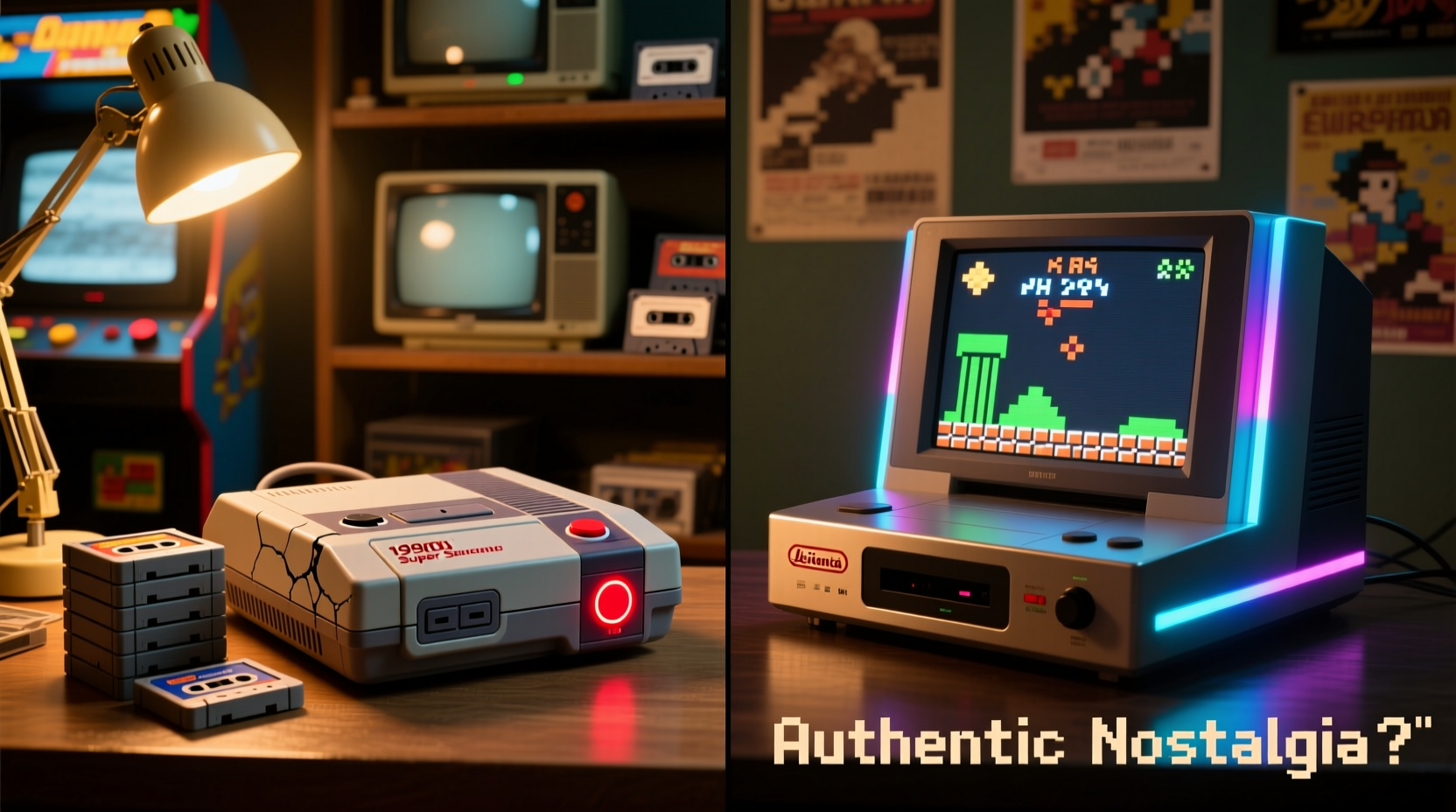
Nostalgia in gaming isn’t just about playing old games—it’s about context. It’s the CRT TV flicker, the hum of a cartridge slotting into place, the weight of a bulky controller in your hands. These sensory details form an emotional tapestry that shaped how we experienced games decades ago.
When people talk about “authentic” retro gaming, they often refer not only to the software but also to the hardware ecosystem. A Nintendo Entertainment System (NES) connected to a tube television via RF cable, for instance, produces visual artifacts—scanlines, input lag, color bleed—that were part of the original experience. Removing those elements changes more than just aesthetics; it alters the rhythm and feel of gameplay.
“Nostalgia is as much about imperfection as it is about memory. The flaws are what make it real.” — Jason Rule, Vintage Game Archivist at the Digital Preservation Society
Retro Gaming Consoles: Hardware with History
Using original hardware means sourcing actual consoles like the Sega Genesis, Super Nintendo, or PlayStation 1, along with their accompanying accessories—controllers, AV cables, power supplies, and cartridges or discs. This approach offers unparalleled authenticity but comes with logistical challenges.
Original systems degrade over time. Capacitors fail, laser lenses get dusty, and cartridges suffer from corrosion on their contact points. Even if a console powers on, there’s no guarantee it will output stable video or read media reliably without restoration work.
Yet, for purists, this is part of the charm. Restoring a system, cleaning a cartridge, and troubleshooting sync issues are rituals that deepen the connection to the era. There’s a satisfaction in getting a 30-year-old machine to run *Sonic the Hedgehog* flawlessly—not because it was easy, but because it required effort.
Pros and Cons of Original Retro Consoles
| Aspect | Advantages | Disadvantages |
|---|---|---|
| Authenticity | True-to-original visuals, audio, and input response | Hardware degradation affects reliability |
| Setup | Tactile interaction with real controllers and cartridges | Requires space, multiple cables, and compatible display |
| Maintenance | Satisfying DIY repair and modding opportunities | Costly repairs; parts scarcity increases over time |
| Game Library | Physical collection adds sentimental value | Limited by availability and price inflation |
Emulation Boxes: Convenience Meets Modern Tech
An emulation box is a dedicated device—often built on single-board computers like Raspberry Pi or preconfigured units such as Retroid Pocket or Anbernic devices—that runs software mimicking the behavior of vintage consoles. These systems allow users to play thousands of ROMs across dozens of platforms from one compact unit.
Modern emulation has reached impressive levels of accuracy. Projects like bsnes/higan offer cycle-perfect emulation, meaning every processor instruction is replicated precisely as it would occur on original hardware. When paired with accurate shaders to simulate CRT effects, the visual fidelity can be astonishingly close to the real thing.
But even perfect emulation doesn't replicate everything. Input lag—even if measured in milliseconds—can disrupt timing-sensitive games. Controller vibration, button resistance, and ergonomic design differ significantly between original pads and modern replicas. And perhaps most importantly, the ritual of inserting a cartridge or flipping a disc case simply doesn’t exist.
How Emulation Enhances Accessibility
- Save states: Pause at any moment, even mid-level, reducing frustration in notoriously difficult games.
- Fast-forwarding: Speed through cutscenes or grinding sections.
- Upscaling: Play NES games in 1080p with scanline filters that mimic CRT displays.
- Portability: Carry hundreds of games in a handheld device.
These features make emulation ideal for casual players or those reintroducing classics to younger audiences. However, they also distance the user from the constraints that defined the original experience—limited lives, no save functionality, and long replay sessions needed to master a game.
Case Study: Reintroducing Final Fantasy VI After 25 Years
Mark, a 42-year-old teacher, recently wanted to revisit Final Fantasy VI, a game he played obsessively in high school. He had two choices: track down his old SNES and test whether the cartridge still worked, or load a ROM onto his Analogue Pocket with SD card support.
He tried both. On the original SNES setup—with a repaired console, cleaned cartridge, and CRT monitor—the experience felt familiar yet frustrating. The lack of a save battery meant starting over from scratch. The dialogue moved slowly, and battles took longer than he remembered. But something about the music coming through slightly distorted speakers triggered vivid memories of staying up past midnight during summer break.
On the Analogue Pocket, the same game ran flawlessly. Text advanced quickly, save states allowed him to jump back after mistakes, and the screen rendered crisp, colorful pixels. Technically superior? Undoubtedly. Emotionally resonant? Less so. “It felt like watching a remastered concert,” he said. “Same songs, better sound—but missing the crowd noise, the sweat, the imperfections that made it alive.”
Which Delivers More Authentic Nostalgia?
This question ultimately depends on how one defines “authentic.” If authenticity means technical precision and faithful reproduction of code execution, then high-end emulation wins. Cycle-accurate emulators reproduce CPU timings, audio processing, and graphical rendering with laboratory-grade fidelity.
However, if authenticity includes the full sensory and emotional context—the creak of a cartridge drawer, the anxiety of blowing into a connector, the shared excitement of passing a controller to a sibling—then original hardware holds an irreplaceable edge.
Consider the role of limitation. Old consoles had strict memory caps, forcing developers to innovate within tight boundaries. Players adapted to these limitations too—memorizing level layouts, mastering glitches, enduring punishing difficulty. Emulation removes many of these barriers, making games easier to enjoy but potentially less impactful.
Checklist: Choosing Your Retro Experience
- Determine your goal: Are you seeking emotional connection or convenient gameplay?
- Assess budget: Original consoles in working condition can cost hundreds; emulation setups range from $50–$200.
- Test display compatibility: Can you access a CRT, or do you need HDMI output?
- Evaluate maintenance willingness: Are you prepared to clean cartridges, replace capacitors, or troubleshoot AV issues?
- Consider portability: Do you want to play on a couch or during commute?
- Verify legal compliance: Only use ROMs for games you own physically.
Expert Insight: The Role of Imperfection
Dr. Lena Torres, a media historian specializing in interactive entertainment, argues that nostalgia thrives on selective memory. “We remember the joy of beating Bowser, not the hours lost due to dead batteries,” she explains. “But those frustrations were part of the texture of play. When we eliminate them entirely, we risk sanitizing history.”
“The most powerful nostalgic experiences aren’t flawless—they’re layered with struggle, surprise, and personal triumph.” — Dr. Lena Torres, Media Historian, University of California, Santa Cruz
She notes that while emulation democratizes access to retro games, it also flattens experiential diversity. Two players using the same emulator may have identical runs. In contrast, two people playing on original hardware might face different challenges based on regional versions, TV calibration, or worn controllers—creating unique, personal narratives.
FAQ
Is emulation legal?
Emulating console software is generally considered legal under fair use principles, provided you own the original game. However, downloading copyrighted ROMs you don’t physically possess violates copyright law in most jurisdictions.
Can I use original controllers with emulation boxes?
Yes, many modern emulation devices support USB or Bluetooth connections, allowing you to pair original controllers via adapters. Some enthusiasts even build custom interfaces to connect vintage pads directly.
Do FPGA consoles count as emulation?
FPGA (Field-Programmable Gate Array) systems like the Analogue Super Nt are not traditional emulators. Instead of running software simulations, they reprogram hardware circuits to behave like original processors. This results in near-exact timing and signal output, offering a middle ground between original hardware and software emulation.
Conclusion: Honoring the Past, One Pixel at a Time
The debate between retro gaming consoles and emulation boxes isn’t about which is objectively better—it’s about what kind of memory you’re trying to reclaim. For those who crave the raw, unfiltered past, dusting off an old console and hearing that startup chime remains unmatched. For others, the ability to explore classic games without hunting down rare hardware opens doors that nostalgia alone couldn’t unlock.
Perhaps the best path forward lies in balance. Keep a restored SNES for weekend marathons of *Super Metroid*. Use an emulation box to discover obscure Japanese imports never released in your region. Let both coexist—one honoring tradition, the other expanding access.




 浙公网安备
33010002000092号
浙公网安备
33010002000092号 浙B2-20120091-4
Comments
No comments yet. Why don't you start the discussion?