
For decades, retro gaming has held a special place in the hearts of players who grew up with pixelated sprites, chiptune soundtracks, and controllers that required real thumb strength. Today, fans have two primary ways to revisit these classics: by purchasing original retro consoles or using software emulators on modern devices. While both offer access to beloved games, they differ dramatically in experience, authenticity, cost, and technical demands. As vintage hardware prices soar and emulator technology improves, many are asking: is buying original hardware still worth it?
The Appeal of Original Retro Consoles
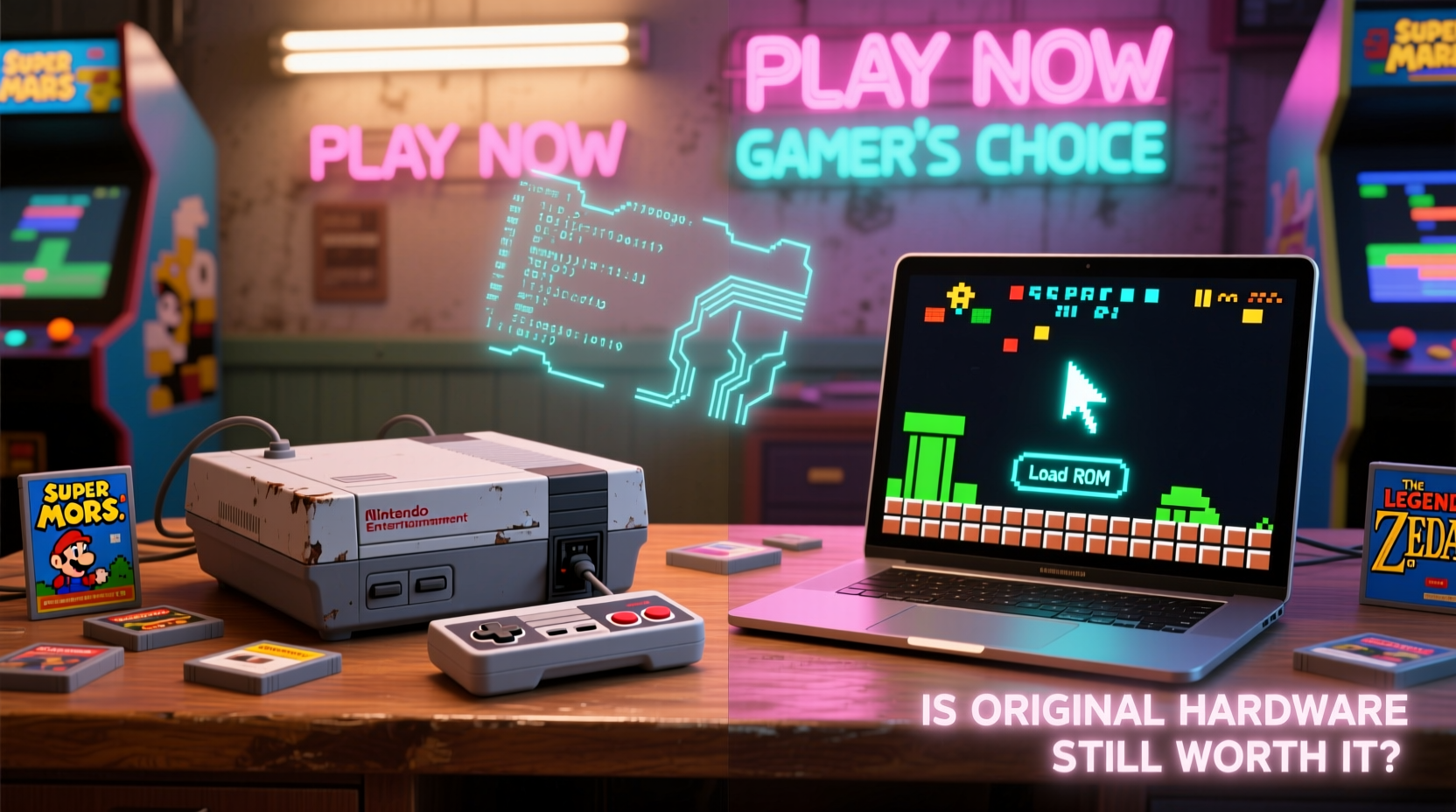
There’s an undeniable magic in powering up a genuine Nintendo Entertainment System, Sega Genesis, or PlayStation 1. The tactile feedback of inserting a cartridge, the whir of a disc spinning up, and the glow of CRT scanlines evoke a sensory experience that transcends gameplay. For purists, this authenticity is irreplaceable.
Original hardware delivers the game exactly as it was intended—right down to timing quirks, audio latency, and graphical rendering. Some titles, especially those relying on precise input lag or analog components (like light gun games), simply don’t translate perfectly through emulation. Games like *Duck Hunt* or *Time Crisis* lose their essence when played on a monitor with even slight delay.
Moreover, owning physical hardware connects you to gaming history. Holding a Game Boy from 1989 or seeing the original Xbox boot screen offers a tangible link to technological evolution. Collectors often value packaging, manuals, and condition, turning retro gaming into both a hobby and an investment.
Emulators: Power, Convenience, and Customization
Emulation has come a long way since early experiments in the late '90s. Modern emulators like Dolphin (GameCube/Wii), PCSX2 (PS2), and RetroArch can not only replicate console behavior but enhance it—offering higher resolutions, texture filtering, save states, and rewind functions.
One of the strongest arguments for emulation is accessibility. Instead of hunting down a working SNES and paying hundreds for a complete-in-box unit, you can install an emulator on a $50 Raspberry Pi or your existing PC and play hundreds of games instantly. Emulators also eliminate region locking, allowing you to play Japanese imports without modifying hardware.
Performance-wise, emulators often surpass original systems. You can run *The Legend of Zelda: Ocarina of Time* at 1440p with anti-aliasing, or use widescreen patches to modernize older titles. Save states let you pause mid-boss fight; rewind functionality helps correct mistakes without restarting. These quality-of-life improvements make emulation ideal for casual players or those revisiting difficult classics.
“Emulation isn’t about replacing consoles—it’s about preserving them. Without emulators, many forgotten games would be lost to hardware decay.” — Andrew B., Digital Preservation Researcher at the Video Game History Foundation
A Practical Comparison: Hardware vs Emulation
| Factor | Original Hardware | Emulators |
|---|---|---|
| Cost | High (especially for rare or well-preserved units) | Low (often free software, minimal hardware needed) |
| Authenticity | Full original experience (audio, visuals, input lag) | Accurate, but may vary; some imperfections replicated intentionally |
| Convenience | Requires physical space, AV setup, maintenance | Portable, searchable libraries, instant load times |
| Upgrades | Limited (modchips, HDMI upscalers possible but costly) | Highly customizable (resolution, shaders, mods) |
| Legality | Fully legal to own and use | Legal only if ROMs are self-ripped from owned copies |
| Preservation | Hardware degrades; discs rot, cartridges fail | Digital backups prevent loss, but require active management |
Real Example: Sarah’s Journey Through Retro Gaming
Sarah, a 32-year-old graphic designer, grew up playing her brother’s PlayStation 1. When she decided to revisit *Final Fantasy VII*, she faced a choice: buy a used PS1 or emulate it. She first tried a $120 refurbished console from an online seller, but after two weeks, the disc drive failed. Frustrated, she turned to PCSX2.
Using her gaming laptop, she installed the emulator, dumped her original disc (a process taking less than 10 minutes), and was amazed at the results. She played in 1080p, applied texture enhancements, and used save states during long boss fights. While she missed the nostalgia of the boot screen and CD loading sounds, the convenience won out.
Still, Sarah later purchased a modded NES Classic Edition with added homebrew support. “It’s not original hardware,” she admits, “but it gives me that living-room feel without the hassle of RF adapters and failing power supplies.” Her story reflects a growing trend: hybrid approaches that balance authenticity with practicality.
When Original Hardware Makes Sense
Despite the advantages of emulation, there are clear scenarios where investing in original retro consoles remains worthwhile.
- You’re a collector or preservationist. Owning mint-condition systems with boxes and manuals preserves gaming history and can appreciate in value.
- You prioritize authenticity. Certain games rely on hardware-specific features—like the Super Famicom’s SA-1 chip in *Super Mario RPG*—that emulators struggle to replicate perfectly.
- You enjoy tinkering. Modding consoles with HDMI outputs, fan replacements, or region-free firmware can be a rewarding technical hobby.
- You play multiplayer locally. There’s no substitute for passing around original controllers during a *Mario Kart 64* session on a CRT TV.
Additionally, some arcade-perfect experiences—such as playing *Street Fighter II* on a real CPS-2 board—are nearly impossible to emulate flawlessly due to timing precision. Enthusiasts argue that even a few milliseconds of input lag break immersion.
Step-by-Step: Choosing Your Retro Gaming Path
- Define your goal: Are you playing for nostalgia, competition, collection, or convenience?
- Assess your budget: Willing to spend $300+ on a sealed N64, or prefer under $50 for a Raspberry Pi setup?
- Check game availability: Are the titles you want well-supported by emulators? (e.g., PS2 emulation is excellent; Dreamcast is spotty.)
- Evaluate your tech skills: Can you safely rip ROMs from your own games? Are you comfortable installing BIOS files and configuring settings?
- Test both options: Try an emulator first. If you miss the feel of real hardware, start small—buy one classic console and expand slowly.
FAQ
Is emulation legal?
Emulator software itself is generally legal, as it’s reverse-engineered code. However, downloading copyrighted ROMs you don’t own is illegal. It’s acceptable to create digital backups of games you physically possess, though enforcement varies by country.
Can emulators damage my computer?
Reputable emulators from trusted sources pose no risk. Avoid shady websites offering “pre-loaded” ROM bundles, which often contain malware. Always scan downloaded files and stick to open-source projects with active communities.
Do original consoles last forever?
No. Capacitors dry out, lasers wear down, and plastics yellow. Even stored properly, most retro consoles will eventually fail without maintenance. Regular cleaning and occasional capacitor replacement (recapping) can extend lifespan significantly.
Conclusion: Balance Passion with Practicality
The debate between retro consoles and emulators isn’t about declaring one superior—it’s about aligning your approach with your values and lifestyle. If you crave authenticity, collectibility, and the tactile joy of vintage tech, original hardware is absolutely worth it. But if you want reliable, enhanced, and accessible gameplay, emulation offers unmatched flexibility.
Many enthusiasts now blend both worlds: using emulators for daily play while keeping a curated selection of original consoles for special occasions. Flash carts bridge the gap further, letting you run homebrew or backup ROMs on real hardware without degradation.
Retro gaming isn’t just about reliving the past—it’s about how we choose to honor it. Whether you power up a dusty NES or launch a ROM on your phone, what matters most is the joy these games continue to bring.




 浙公网安备
33010002000092号
浙公网安备
33010002000092号 浙B2-20120091-4
Comments
No comments yet. Why don't you start the discussion?