
Nostalgia is a powerful force. For many gamers, the late '80s through early 2000s were formative years defined by pixelated sprites, chiptune soundtracks, and the tactile joy of pressing physical buttons on a dedicated gaming device. Today, those memories can be relived in two primary ways: through original retro handheld consoles like the Game Boy, or via emulator apps running classic games on smartphones and modern devices. But when it comes to capturing the true essence of that era, which approach offers a more authentic nostalgic experience?
The debate isn’t just about functionality—it’s about emotion, authenticity, accessibility, and how we connect with our past. While emulators offer convenience and enhanced features, original hardware provides sensory fidelity that software alone can’t replicate. This article examines both sides with depth, offering insights into what each medium gets right—and where they fall short.
The Emotional Weight of Physical Hardware
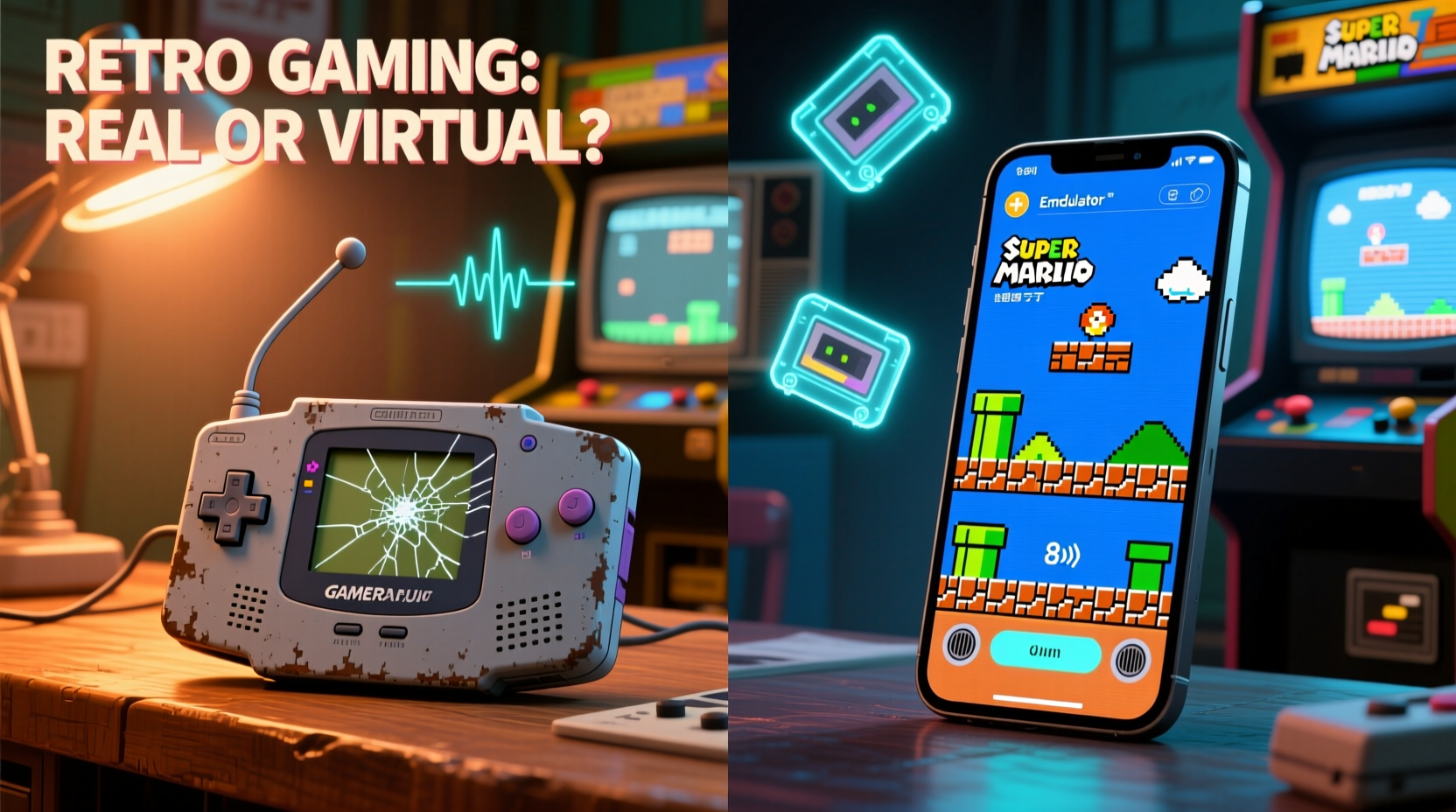
There's an undeniable emotional resonance tied to holding an actual Game Boy Advance, Game Gear, or Neo Geo Pocket Color. These devices are artifacts of a specific time—when portable gaming was novel, batteries drained quickly, and screen glare was a constant battle. The weight, the button resistance, the way the cartridge clicks into place—all contribute to a multisensory experience that goes beyond gameplay.
For many, nostalgia isn’t just about playing old games; it’s about re-experiencing childhood rituals. Turning on the console, blowing into cartridges (despite its questionable effectiveness), adjusting the contrast wheel, and even dealing with flickering screens—all these quirks become part of the memory. Emulator apps streamline the process but often strip away the imperfections that made the original experience memorable.
“Nostalgia lives in the details—the hum of the speaker, the feel of worn D-pads, the smell of aged plastic. You can emulate code, but not chemistry.” — Dr. Lena Torres, Digital Media Psychologist
Emulation: Power, Precision, and Practicality
On the other side of the spectrum, emulator apps provide unmatched flexibility. Platforms like RetroArch, My Boy!, or Delta allow users to run ROMs from dozens of systems on a single device. Features such as save states, rewind functionality, customizable controls, and high-resolution filters make gaming more accessible than ever before.
Modern enhancements also address longstanding hardware limitations. Want to play Pokémon Red without squinting at a green-tinted screen? Apply a CRT filter and upscale the resolution. Need a break mid-battle? Save your progress instantly—even if the original game didn’t support saving outside designated points. These tools transform retro gaming from a period-specific challenge into a curated, user-friendly experience.
However, this convenience comes at a cost: detachment. When every flaw is smoothed over, the result may be technically superior—but emotionally hollow. As one long-time collector put it, “It’s like watching a remastered vinyl recording through noise-canceling headphones. It sounds better, but something’s missing.”
A Side-by-Side Comparison: Key Differences
| Feature | Retro Handheld Consoles | Emulator Apps |
|---|---|---|
| Authenticity | High – Original hardware, sound, and input response | Variable – Depends on configuration; often too clean |
| Portability | Moderate – Limited battery life, fragile components | High – Runs on phones/tablets already carried daily |
| Game Library Access | Limited – Requires purchasing physical cartridges | Extensive – Thousands of ROMs available digitally |
| Visual & Audio Fidelity | Original specs only – Low-res screens, mono audio | Enhanced – HD upscaling, stereo remixes, filters |
| User Experience | Tactile, ritualistic, sometimes frustrating | Streamlined, efficient, customizable |
| Persistence & Longevity | Declining – Aging hardware, screen rot, component failure | Future-proof – Backups, cloud sync, updates |
When Authenticity Matters Most
Certain experiences are deeply rooted in context. Playing *Tetris* on a brick-like Game Boy while riding a school bus, struggling to see the screen in daylight, is fundamentally different from tapping a perfectly rendered version on an iPhone during a coffee break. The former carries emotional texture—the anticipation, the limitations, the triumph of overcoming hardware constraints.
Similarly, multiplayer sessions using link cables between two Game Boys created social bonds that app-based emulation struggles to replicate. There was a shared physicality in passing consoles around, comparing progress, and feeling the same controller vibrations. Modern solutions like online netplay exist, but they lack the immediacy and intimacy of sitting across from a friend, shoulder-to-shoulder, battling in *Pokémon Silver*.
This doesn’t mean emulation fails entirely. For rediscovering forgotten titles or exploring regional exclusives never officially released outside Japan, emulators open doors that physical ownership simply cannot. But for reliving personal history, nothing beats the real thing—warts and all.
Mini Case Study: Reconnecting with Childhood Through Hardware
Mark Rivera, a 34-year-old graphic designer from Austin, recently purchased a used Game Boy Color after seeing a viral TikTok video of someone playing *The Legend of Zelda: Oracle of Seasons*. He hadn’t touched a handheld console since middle school.
“I bought it mostly as a joke,” he admitted. “But when I turned it on and heard that startup chime… I froze. I remembered lying on my bedroom floor, trying to beat Ganon with my little brother cheering beside me.”
He found himself replaying *Mario Tennis*, not for mastery, but to recapture the rhythm of play—the slight delay between button press and character movement, the way the music looped endlessly. He tried the same game on an emulator later that night but turned it off after ten minutes. “It felt too smooth. Too easy. Like I was watching a documentary about my childhood instead of living it.”
The Role of Preservation and Accessibility
While original hardware holds sentimental value, preservation remains a growing concern. Many retro handhelds suffer from screen degradation, capacitor leakage, and broken buttons due to age. Finding working units with intact displays is increasingly difficult—and expensive.
Emulators, despite legal gray areas surrounding ROM distribution, serve as vital archival tools. They ensure that games remain playable long after manufacturers stop supporting them. Projects like the Internet Archive’s Console Living Room have begun legally hosting abandonware titles, recognizing that digital preservation is essential for cultural continuity.
Moreover, emulator apps democratize access. Not everyone can afford rare cartridges or collectors’ editions. A student in India might never own a TurboExpress, but they can still experience *Bonk’s Adventure* through emulation. In this sense, emulators expand nostalgia beyond privileged circles, allowing new generations to appreciate classics they never lived through.
Checklist: Choosing the Right Nostalgia Path
- ✅ Determine your goal: Are you seeking emotional connection or functional gameplay?
- ✅ Assess budget: Original hardware + cartridges can exceed $200+ for complete sets.
- ✅ Consider portability: Do you want a standalone device or something integrated into your phone?
- ✅ Evaluate technical skill: Emulators often require setup (BIOS files, core selection, controller mapping).
- ✅ Reflect on ethics: Only use ROMs for games you legally own.
- ✅ Test both: Try an emulator first, then seek out original hardware if the experience feels incomplete.
Hybrid Approaches: Best of Both Worlds?
An emerging trend blends authenticity with modern convenience: flash carts and FPGA-based clones. Devices like the EverDrive GB X5 let users load multiple ROMs onto a cartridge that runs natively on original Game Boy systems. This preserves the original screen, sound chip, and button layout while eliminating reliance on scarce physical media.
Similarly, FPGA consoles like the Analogue Pocket offer pixel-perfect reproduction of Game Boy, Game Gear, and even Atari Lynx libraries using field-programmable gate arrays—hardware that mimics original chips rather than software emulation. Paired with optional adapters, these devices deliver near-original performance with modern durability and display clarity.
These hybrids satisfy purists who demand hardware accuracy while addressing longevity concerns. However, they come at a premium price—often exceeding $200—and still require technical know-how to fully utilize.
Frequently Asked Questions
Is using emulator apps legal?
Emulator software itself is generally legal. However, downloading copyrighted ROMs without owning the original game constitutes piracy. To stay compliant, create backups from games you physically own or use public domain/abandonware titles where permitted.
Can emulators truly replicate the original sound and timing?
High-quality emulators like mGBA or SameBoy achieve cycle-accurate emulation, meaning they simulate CPU timing precisely enough to reproduce correct audio pitch, frame pacing, and even glitches present in original hardware. With proper settings, the difference becomes nearly imperceptible.
Why do some people prefer original handhelds even with poor screens?
Beyond sentimentality, original screens introduce visual artifacts—ghosting, motion blur, low contrast—that affect gameplay rhythm. Some players develop muscle memory based on these quirks. Removing them changes timing perception, making fast-paced games like *Super Mario Land 2* feel unnaturally responsive.
Conclusion: Nostalgia Is Personal, But Integrity Has Standards
Ultimately, whether retro handheld consoles or emulator apps deliver “better” nostalgia depends on what you’re trying to reclaim. If your aim is emotional authenticity—the creak of a hinge, the click of a button, the patience required to finish a level without save states—then original hardware wins by immersion.
But if your priority is accessibility, variety, and the ability to explore forgotten gems without breaking the bank, emulators offer a compelling alternative. And for those unwilling to choose, hybrid solutions now bridge the gap with impressive fidelity.
Nostalgia isn’t just about reliving the past—it’s about understanding why certain moments mattered. Sometimes, that truth lies in a blurry green screen. Other times, it’s revealed through perfect pixel replication on a bright OLED display. The best approach? Honor both paths, respect the legacy of the games, and keep the spirit of retro gaming alive—however you choose to play.




 浙公网安备
33010002000092号
浙公网安备
33010002000092号 浙B2-20120091-4
Comments
No comments yet. Why don't you start the discussion?