
In an age where digital theft is as common as pickpocketing, many consumers are turning to RFID blocking wallets for protection. These wallets claim to shield your credit cards and IDs from unauthorized scanning—preventing what’s known as “electronic pickpocketing.” But they often come with a trade-off: increased thickness and stiffness compared to traditional, sleeker models. So, is the added security truly worth the bulkier design? To answer that, we need to examine how RFID works, the actual risk of skimming, and whether modern payment habits make this feature essential or overkill.
Understanding RFID and How It Works
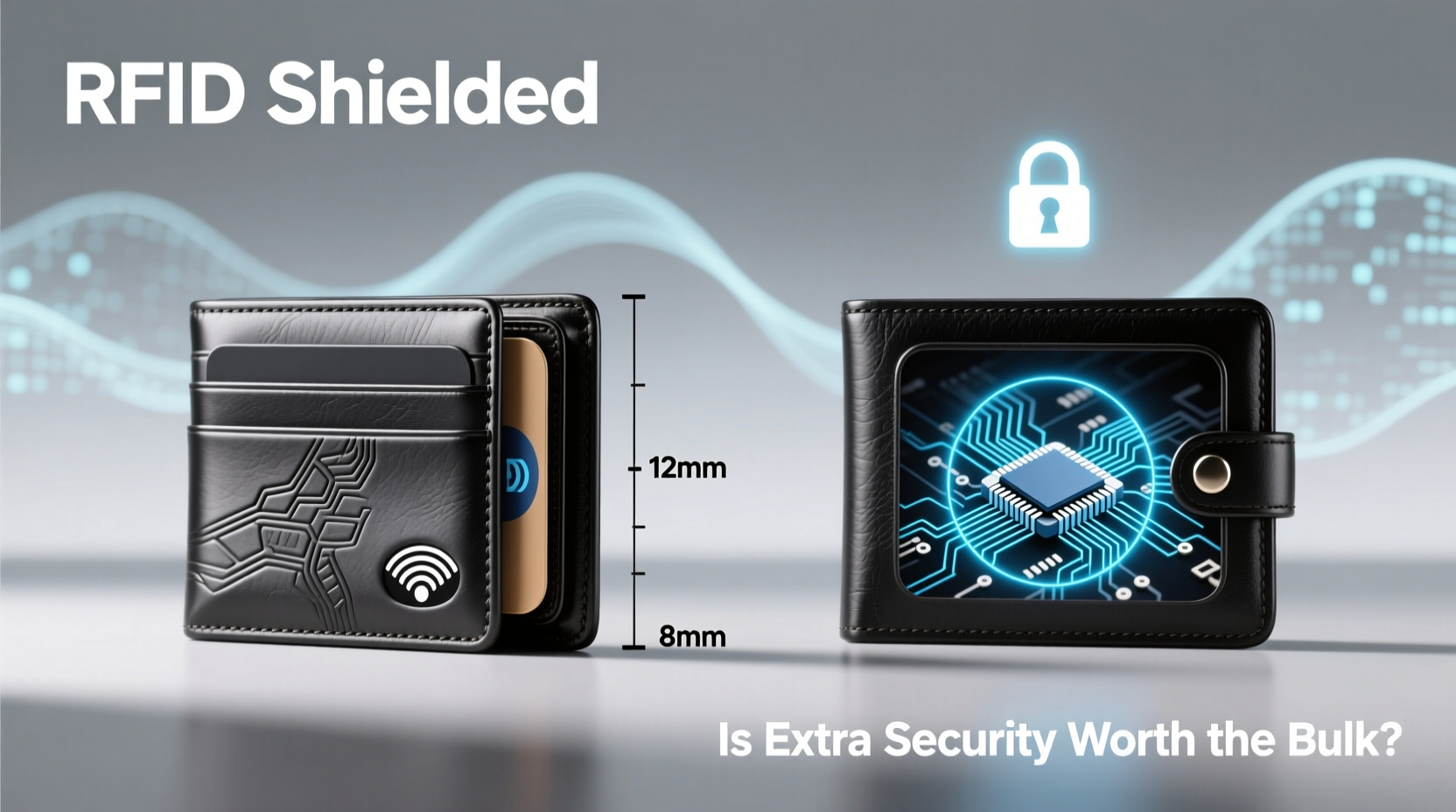
Radio Frequency Identification (RFID) is a technology that uses electromagnetic fields to automatically identify and track tags attached to objects. In everyday life, this includes contactless credit cards, passports with e-chips, key fobs, and access badges. These cards contain small microchips and antennas that transmit data when near a compatible reader—no physical contact required.
For example, tapping your card at a subway turnstile or paying for coffee with a wave of your wallet relies on RFID or its close cousin, Near Field Communication (NFC). The convenience is undeniable, but it also raises concerns: if a device can read your card during a legitimate transaction, could someone else use a concealed reader to steal your information without your knowledge?
The Real Risk of RFID Skimming
The idea of someone silently scanning your wallet in a crowded subway or airport lounge sounds like something out of a spy movie—and in reality, it's largely still confined to fiction. While RFID skimming is technically possible, documented cases of large-scale fraud via this method remain extremely rare.
Security researchers have demonstrated proof-of-concept attacks using handheld readers, but these require proximity (usually within a few inches), sustained signal time, and specialized equipment. Moreover, even if a criminal captures card details, most contactless systems use tokenization—meaning the transmitted number isn’t your actual credit card number, but a one-time-use code that’s useless after the transaction.
“While RFID skimming is theoretically possible, we’ve seen no widespread incidents in consumer environments. The fear often outweighs the factual risk.” — Dr. Lena Patel, Cybersecurity Researcher at MIT Lincoln Lab
That said, low-probability doesn’t mean zero risk. In high-theft urban areas or densely packed events, opportunistic criminals may experiment with new tools. And for individuals who carry multiple sensitive cards—such as government IDs, corporate badges, or premium credit cards—the potential fallout from a breach justifies precaution.
RFID Blocking Wallets: How They Work and Their Trade-offs
RFID blocking wallets incorporate a thin layer of conductive material—often metal mesh, aluminum, or carbon fiber—into their lining. This creates a Faraday cage effect, which blocks electromagnetic signals from reaching the cards inside. When properly designed, these materials prevent unauthorized scanners from communicating with your cards.
However, this shielding comes at a cost. The added layers make the wallet stiffer and thicker than minimalist designs. Over time, repeated bending can compromise the integrity of the blocking material, especially in bi-fold or trifold styles. Additionally, some users report difficulty tapping their cards at payment terminals because the shielding interferes with intended transactions—requiring them to remove the card entirely, defeating the purpose of contactless convenience.
Pros and Cons at a Glance
| Feature | RFID Blocking Wallet | Regular Wallet |
|---|---|---|
| Security Against Scanning | High – blocks unauthorized RFID/NFC reads | None – cards exposed to potential skimming |
| Thickness & Profile | Thicker and stiffer due to shielding layer | Thinner, more flexible options available |
| Durability | Shielding may degrade with wear and folding | Generally durable; depends on material |
| Contactless Payment Ease | Sometimes requires removing card | Smooth tap-to-pay functionality |
| Cost | Typically $5–$20 more than regular wallets | Wider range, including budget options |
Real-World Example: Traveler’s Dilemma in Tokyo
Consider Mark, a frequent business traveler based in San Francisco. On a recent trip to Tokyo, he carried his passport (which has an RFID chip), two contactless credit cards, and a transit pass—all in a slim leather wallet. During rush hour on the Yamanote Line, he stood shoulder-to-shoulder with commuters for nearly 20 minutes. Unbeknownst to him, a nearby individual had a modified smartphone running an NFC detection app.
Luckily, Mark experienced no fraudulent charges afterward. But a post-trip conversation with a cybersecurity colleague raised concerns: while no evidence suggested a breach occurred, the environment was ideal for proximity-based scanning. Since then, Mark switched to an RFID-blocking sleeve for his passport and now keeps his cards in a compact blocking wallet—even though it adds noticeable bulk to his front pocket.
His reasoning? “I don’t think I’ll ever be skimmed, but knowing my data is shielded gives me peace of mind, especially abroad.”
When an RFID Blocking Wallet Makes Sense
Not every user needs RFID protection. However, certain lifestyles and circumstances tip the balance in favor of the extra security:
- Frequent international travelers – Many countries use RFID in passports and transit cards, increasing exposure.
- Professionals with high-value cards – Executives with premium credit lines or corporate charge cards may face higher stakes.
- People in high-density urban areas – Crowded subways, festivals, and airports increase opportunities for close contact.
- Those carrying sensitive IDs – Government employees, military personnel, or individuals with enhanced driver’s licenses.
If you fall into any of these categories, the slightly thicker profile may be a small price to pay for reduced anxiety and enhanced digital safety.
Checklist: Choosing the Right Wallet for Your Needs
- Verify which of your cards actually use RFID/NFC (look for the contactless symbol).
- Assess your daily environments—do you often navigate crowded spaces?
- Determine your tolerance for thickness and rigidity in a wallet.
- Test wallet designs in person if possible, especially regarding ease of card access.
- Check independent reviews for durability of the RFID shielding over time.
- Consider hybrid solutions—like RFID sleeves for specific cards instead of a full blocking wallet.
FAQ
Can someone really steal my credit card info just by walking past me?
Technically yes, but practically it’s unlikely. Successful skimming requires very close proximity (inches), sustained contact, and custom equipment. No widespread cases of such theft have been confirmed in real-world settings.
Do all contactless cards need RFID protection?
No. Most modern contactless cards use dynamic encryption and tokenization, meaning stolen data can't be reused. The risk is low, but not zero—especially for older or poorly secured cards.
Will an RFID blocking wallet interfere with Apple Pay or Google Pay?
No. These services rely on your phone’s secure element and authentication (face, fingerprint, PIN), not passive card transmission. The wallet won’t block your phone’s NFC signals unless fully enclosed in shielding.
Final Thoughts: Security vs. Convenience
The choice between an RFID blocking wallet and a regular one ultimately hinges on personal risk assessment and lifestyle. For most people in everyday scenarios, the threat of electronic pickpocketing is minimal—making the added thickness and reduced flexibility hard to justify. However, for those who value proactive security, travel frequently, or simply prefer minimizing digital vulnerabilities, the modest trade-off in profile is a reasonable compromise.
Technology evolves, and so do threats. Today’s low-risk scenario could change tomorrow as scanning tools become cheaper and more accessible. By staying informed and choosing solutions aligned with your habits, you strike the right balance between convenience and protection.




 浙公网安备
33010002000092号
浙公网安备
33010002000092号 浙B2-20120091-4
Comments
No comments yet. Why don't you start the discussion?