
When holiday season arrives—or when you simply want to transform your yard into a dynamic canvas—speed matters. Not just in how quickly you can hang strings of light, but in how fast you achieve *impact*: that “wow” moment when neighbors pause mid-walk, when guests gasp at the front door, when your yard stops being background and becomes the centerpiece. Two dominant tools dominate modern yard art: RGB laser projectors and static net lights. One promises cinematic motion and infinite color; the other offers simplicity, reliability, and broad coverage. But “better” isn’t universal—and “faster” means different things depending on your goals, skill level, timeline, and tolerance for troubleshooting. This isn’t about declaring a winner. It’s about matching technology to intention.
What “Faster Yard Art” Really Means
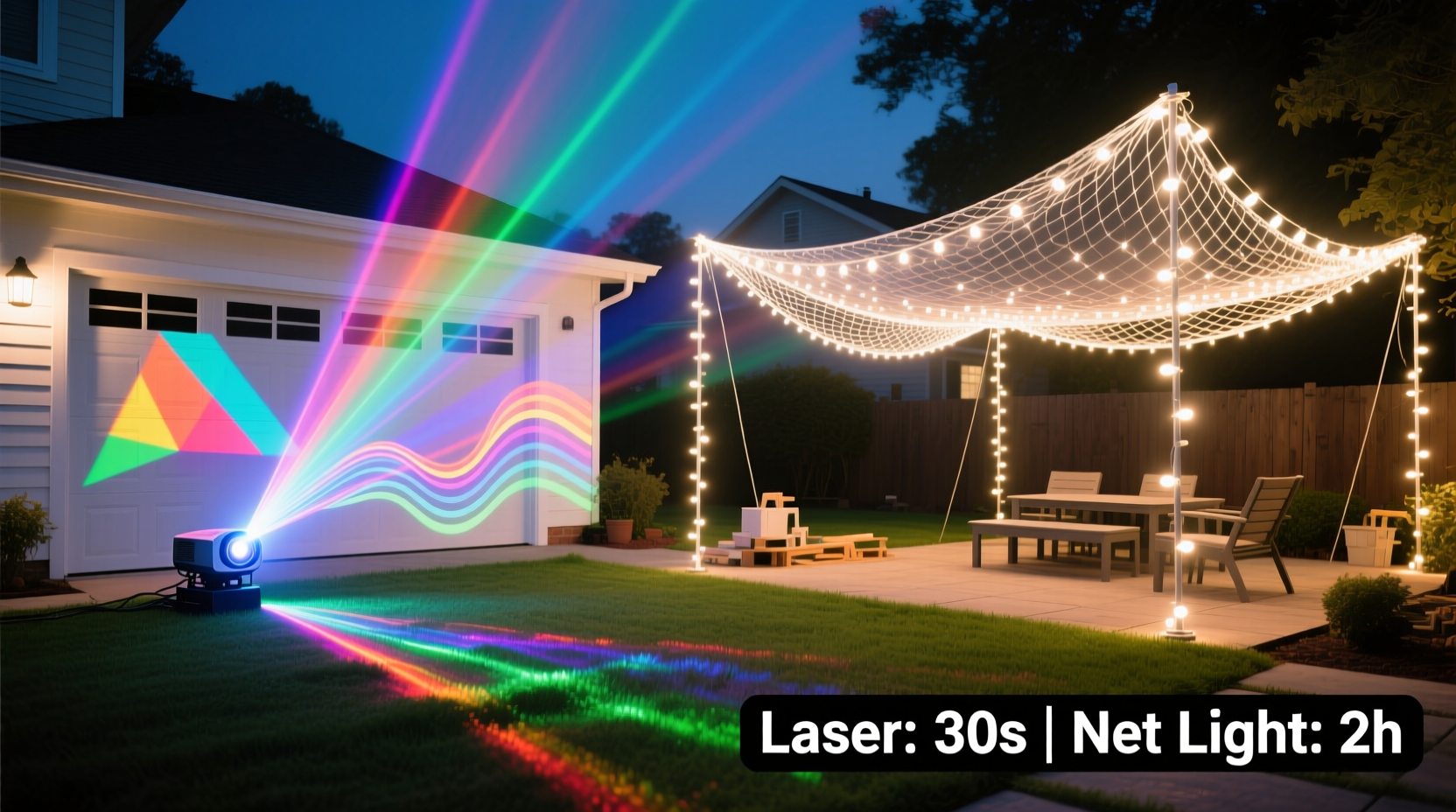
“Faster” isn’t just minutes saved during installation. It encompasses four interlocking dimensions:
- Setup speed: Time from box opening to fully powered, aligned, and visible effect.
- Design iteration speed: How quickly you can test, adjust, or swap effects—especially critical if you’re refining a look for photos, events, or social sharing.
- Troubleshooting & recovery speed: How long it takes to diagnose and fix flickering, misalignment, dead zones, or weather-related failure.
- Visual payoff speed: The immediacy of perceived transformation—how fast the yard feels *changed*, not just lit.
A tool might install in 90 seconds but take 20 minutes to calibrate brightness, focus, and angle to avoid blinding drivers or washing out detail. Another might require 45 minutes to drape and secure—but deliver full, balanced coverage the moment it powers on. Speed without control is spectacle without substance. Speed with repeatability builds confidence for next year.
RGB Laser Projectors: Precision Light, High Learning Curve
RGB laser projectors emit tightly focused beams that scan across surfaces—walls, fences, trees, driveways—to create animated patterns, logos, text, and fluid color washes. They don’t illuminate space; they *paint* it with light. Modern units (like those from brands such as LightShow Pro, Laserworld, or Pangolin) offer DMX control, smartphone apps, built-in animations, and IP65 weather resistance.
Installation is deceptively simple: mount the unit (often on a tripod or eave bracket), aim, power on, and select an effect. But aiming is where nuance lives. A 3° beam spread may cover only a 6-foot section of fence at 100 feet—so achieving full-yard coverage often requires multiple units or strategic repositioning. Ambient light drastically affects visibility: lasers shine brightest against dark, matte surfaces and fade noticeably under moonlight or near streetlights.
Laser projectors excel in design iteration speed. With an app or controller, you can cycle through dozens of animations, shift hues in real time, slow motion, or trigger strobes—all without touching hardware. That makes them ideal for short-term displays (e.g., Halloween parties, graduation celebrations) or evolving themes (e.g., shifting from red/green to purple/teal for Pride week). But their fragility is real: optics fog in humidity, lenses scratch easily, and misalignment from wind or vibration can turn a crisp snowflake pattern into a smeared green streak. Recovery isn’t plug-and-play—it’s recalibration, refocusing, and sometimes firmware resets.
Static Net Lights: Coverage First, Consistency Guaranteed
Static net lights are pre-wired grids of LEDs—typically 3’x5’, 4’x6’, or 6’x10’—designed to drape over bushes, hedges, pergolas, or walls. Each node contains an individual RGB LED, and all nodes display the same color or pattern simultaneously (hence “static,” though many support basic chase, fade, and twinkle modes via remote or app). Unlike lasers, they emit diffused, omnidirectional light—no projection surface required.
Setup speed is where nets truly shine. Unroll, drape, tuck branches through the mesh, secure corners with clips or zip ties, plug in. A 6’x10’ net covering a large evergreen takes under 5 minutes for one person—even on uneven terrain. No aiming, no focus, no ambient-light dependency. Visual payoff is instantaneous and uniform: the entire shape glows, defining form rather than overlaying it. There’s no “finding the sweet spot.” What you see is what you get.
But iteration speed suffers. Changing colors or patterns usually requires a remote or app—but switching from “warm white pulse” to “blue fade” doesn’t alter composition. You can’t project a custom monogram or animate falling snow across a roofline. Nets deliver consistency, not customization. And while durable, they’re not indestructible: heavy snow load can bend frames, aggressive pruning can sever wires, and low-quality units suffer from node failures that create dark patches—hard to diagnose and impossible to repair without splicing.
Side-by-Side Comparison: Real Metrics, Not Marketing Claims
| Factor | RGB Laser Projector | Static Net Light |
|---|---|---|
| Initial Setup Time (Single Unit / Net) | 3–12 minutes (mounting + aiming + testing) | 2–5 minutes (draping + securing) |
| Full-Yard Coverage Time (1,200 sq ft yard) | 25–60+ minutes (multiple units + alignment per zone) | 15–35 minutes (3–5 nets + strategic placement) |
| Design Iteration Time (e.g., change effect/color) | 5–15 seconds (app or remote) | 10–30 seconds (remote/app; limited pattern variety) |
| Troubleshooting Time (common issue) | 8–25 minutes (focus drift, beam clipping, WiFi disconnect) | 2–7 minutes (loose plug, dead segment, reset remote) |
| Weather Resilience (rain/fog/wind) | Moderate (optics vulnerable; wind shifts aim) | High (IP65+ common; mesh sheds water; no moving parts) |
| Visual Impact at Night (vs. ambient light) | High on dark surfaces; fades near streetlights/moonlight | Consistent; works equally well in urban or rural settings |
| Long-Term Durability (3+ seasons) | Medium (laser diodes degrade; optics need cleaning) | High (solid-state LEDs; robust wiring; no calibration drift) |
Mini Case Study: The November Wedding Backyard
Maya needed to transform her modest suburban backyard for her sister’s outdoor November wedding—just 11 days before the event. She wanted “romantic, warm, and cohesive,” not “festive” or “busy.” Her yard featured two mature arborvitae, a stone patio, and a wooden pergola.
She first tried a $299 RGB laser projector. Within 90 seconds, she had a soft amber gradient washing over the pergola beams. It looked elegant. But when she added a second projector for the arborvitae, alignment took 40 minutes—and the cool evening air caused condensation on the lens by dusk, blurring the pattern. She spent three evenings troubleshooting brightness settings and mounting stability. On Day 7, a gust knocked the unit sideways, projecting a distorted stripe across the neighbor’s garage.
On Day 8, she swapped to two 4’x6’ static net lights: one draped over each arborvitae, wired in series. She secured them with landscape staples and patio clips. Total setup: 6 minutes. The warm white twinkle mode created gentle depth without glare. Guests didn’t notice “lights”—they noticed how the trees seemed to glow from within, how the stone patio felt intimate, how the pergola’s silhouette was softly framed. Maya didn’t touch them again until cleanup. As she told us: “The laser made me feel like a technician. The nets made me feel like a host.”
Expert Insight: Beyond Brightness, It’s About Intention
“The fastest yard art isn’t the one installed quickest—it’s the one that achieves its emotional goal without distraction. Lasers demand attention; nets invite presence. Choose the tool that serves the feeling you want people to carry away—not the one with the most specs.” — Derek Lin, Lighting Designer & Founder of Lumina Grounds, specializing in residential experiential lighting since 2012
Lin’s point cuts to the core: technology should recede behind experience. A laser’s shimmering aurora may stun for 10 seconds—but if it distracts from conversation or casts harsh shadows on faces, its speed is functionally wasted. A net’s even, gentle radiance may not “pop” on Instagram—but it sustains warmth, encourages lingering, and requires zero audience interpretation. Speed isn’t velocity. It’s velocity toward meaning.
Step-by-Step: Choosing & Deploying Based on Your Timeline
- Assess your deadline: Less than 48 hours? Prioritize static nets. More than 5 days? Test both—but allocate 60% of setup time to laser calibration.
- Map your focal points: Identify 2–3 key surfaces (e.g., front door, main tree, garage wall). If they’re varied in texture, distance, or orientation, nets simplify coverage. If they share a flat plane (e.g., side of house + fence), lasers unify them elegantly.
- Check ambient conditions: Use a light meter app at dusk. If readings exceed 15 lux near your target surface, lasers will struggle. Nets thrive here.
- Test connectivity & controls: Before committing, verify your phone connects to the laser’s app or the net’s remote. If pairing fails twice, switch tools—don’t waste hours debugging.
- Do a “walk-around test” at night: Stand at the street, then the patio, then the neighbor’s sidewalk. Does the effect read clearly from all vantage points? Lasers often dazzle up close but vanish down the block. Nets maintain legibility across distances.
FAQ
Can I combine lasers and net lights in one display?
Yes—and it’s increasingly common. Use nets to establish base coverage and form (e.g., glowing hedges), then add a laser to highlight a specific feature (e.g., monogram on the garage, animated snow on the roof). Just ensure laser brightness doesn’t overwhelm net colors; dim lasers to 60–70% output when layered.
Do static net lights work on irregular shapes like sculptures or trellises?
They adapt surprisingly well. The flexible mesh conforms to curves, and excess wire can be tucked or coiled. For complex geometry (e.g., metal garden art), use zip ties every 6–8 inches to prevent sagging. Avoid stretching nets taut—they’re designed to drape, not stretch.
Are RGB laser projectors safe for pets and children?
Class IIIa lasers (≤5mW output) used in consumer-grade projectors are generally eye-safe for incidental exposure—but never point directly at faces, eyes, or reflective surfaces. Pets may be startled by sudden motion patterns. Nets pose no ocular risk and emit negligible heat—making them safer around curious hands and paws.
Conclusion: Speed Is a Choice, Not a Spec
There is no universal “faster” tool—only faster paths to your specific vision. RGB laser projectors reward patience with precision, drama, and creative flexibility. They’re the choice when your yard art must tell a story, shift moods, or serve as a dynamic backdrop for events. Static net lights reward decisiveness with reliability, speed, and serene impact. They’re the choice when your yard art must simply *be*—calm, cohesive, and effortlessly beautiful.
Your timeline, your yard’s architecture, your tolerance for tinkering, and your definition of “better” all converge in this decision. Don’t choose based on what’s trending. Choose based on what lets you step back, breathe, and say, “Yes—that’s exactly how I imagined it.”




 浙公网安备
33010002000092号
浙公网安备
33010002000092号 浙B2-20120091-4
Comments
No comments yet. Why don't you start the discussion?