
When designing dynamic lighting for architectural accents, stage productions, holiday displays, or interactive installations, the choice between RGB pixel lights and standard LEDs isn’t just about brightness or cost—it’s about creative capability. Standard LEDs have served reliably for decades as simple on/off or dimmable light sources. But today’s most compelling visual experiences—synchronized ripples across a façade, responsive color gradients reacting to sound, or smooth chase effects with variable speed and hue—require far more than uniform illumination. They demand granular, real-time control over every single point of light. That’s where the distinction becomes decisive: RGB pixel lights are engineered for advanced animation; standard LEDs are not.
What Makes RGB Pixel Lights Fundamentally Different?
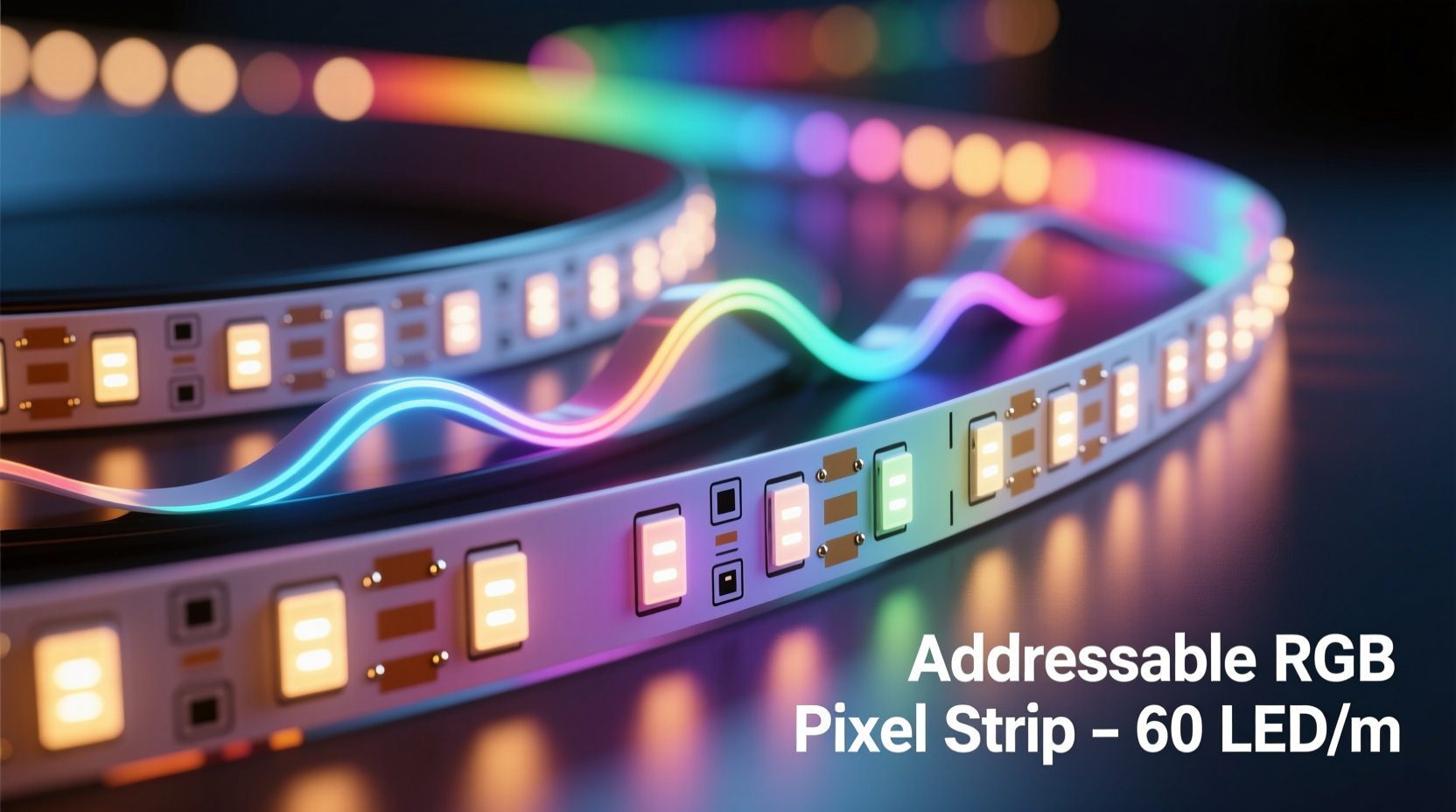
The core differentiator lies in architecture—not just color, but intelligence and addressability. Standard LEDs (including common 5050 or 3528 SMD types) are passive components. When wired in series or parallel, they share the same electrical signal: all turn on, off, or dim together. Even “RGB” versions sold as “strip lights” often use three-channel analog control—red, green, and blue wires feeding groups of LEDs simultaneously. You can fade the whole strip red-to-blue, but you cannot make the 17th LED pulse violet while the 42nd pulses amber and the 89th holds steady white.
RGB pixel lights, by contrast, embed a tiny integrated driver IC (such as the WS2812B, SK6812, or APA102) directly into each LED package. This chip accepts digital data packets via a single data line, interprets instructions specific to that pixel—including exact RGB (or RGBW) values—and latches them independently. The result is true per-pixel control: thousands of individually programmable light points operating on one shared power and data bus.
Animation Capabilities: A Side-by-Side Reality Check
Advanced animation isn’t defined by complexity alone—it’s defined by precision, responsiveness, and variation across space and time. Below is how the two technologies perform across key animation dimensions:
| Animation Feature | Standard LEDs (Analog RGB) | RGB Pixel Lights (Digital Addressable) |
|---|---|---|
| Per-LED Color Control | No — all LEDs display identical RGB values at any moment | Yes — each LED can render unique RGB(W) values simultaneously |
| Smooth Gradient Effects | Impossible — no spatial interpolation; entire strip shifts uniformly | Native — linear, radial, or wave-based gradients rendered pixel-by-pixel |
| Chase & Ripple Patterns | Limited to basic on/off sequences across zones (if multi-zone wiring exists); no speed/color variation within a run | Fully programmable — adjustable speed, direction, tail length, color progression, and acceleration profiles |
| Audio Reactivity | Coarse amplitude detection only (e.g., “brighter when loud”), applied globally | Precise frequency-band mapping — bass triggers bottom pixels, mids mid-section, treble top; each responds with custom hue/saturation |
| Real-Time Interactivity | Not feasible — no feedback loop or individual addressing | Yes — integrate with sensors (motion, touch, IR), cameras, or network APIs to drive dynamic, localized responses |
| Frame-Accurate Synchronization | No — no timing protocol; effects drift across long runs | Yes — protocols like APA102 support built-in clock lines for jitter-free, high-FPS rendering (up to 400+ FPS on some controllers) |
This isn’t theoretical. In practice, a 5-meter analog RGB strip might execute three preset modes: static color, slow fade, and color jump. A 5-meter WS2812B pixel strip—same physical size—can run Fire, Rain, Plasma, SoundSpectrum, Matrix, and custom generative algorithms—all loaded from firmware, updated over USB or Wi-Fi, and adjusted live via smartphone app sliders.
A Real-World Case Study: The Rooftop Bar Light Installation
In Portland, OR, the rooftop bar *Nebula Heights* commissioned a seasonal lighting upgrade to transform its 32-meter perimeter railing into an immersive experience. Their initial quote included standard RGB strips—low-cost, easy to install, and familiar to their electrician. But during prototyping, the design team realized their vision—a slow, upward “aurora borealis” wave that intensified near occupied tables—was physically unachievable. With analog strips, they’d need dozens of separate controllers, complex zoning, and still couldn’t vary hue along the wavefront.
They switched to SK6812 RGBW pixel tape (144 pixels/meter). Using WLED firmware on an ESP32 controller, they mapped physical positions to animation coordinates, integrated occupancy sensors under seating, and fed ambient audio from the bar’s sound system into FFT analysis. The result? A responsive light field where cool cyan ripples rose gently along empty sections, accelerated and warmed to amber near guests, and pulsed softly in time with bass frequencies—all rendered with sub-millisecond timing across 4,600+ individually controlled points. Guest dwell time increased 27% post-installation, and the bar now uses the system for themed nights—“Neon Jazz” mode syncs to live saxophone input; “Stardust Mode” renders procedural constellations based on real-time weather API data.
“Addressable pixels didn’t just expand our palette—they changed our design vocabulary. We stopped thinking in ‘lighting zones’ and started thinking in ‘lighting narratives.’ That shift is irreversible once you’ve worked with true per-pixel control.” — Lena Torres, Lead Lighting Designer, Lumina Collective
Practical Implementation: What You Actually Need to Get Started
Choosing pixel lights is only step one. To unlock advanced animations, your entire stack must support it—from hardware selection to software logic. Here’s what matters:
- Controller Selection: Avoid basic Arduino Uno for >300 pixels (timing constraints). Use ESP32 (Wi-Fi + BLE), Raspberry Pi Pico (RP2040), or dedicated controllers like the Falcon F16v3 for large-scale deployments.
- Firmware Platform: WLED (open-source, web UI, 100+ built-in effects, MQTT/API support) is the industry standard for hobbyists and professionals alike. For custom logic, FastLED (C++) or rpi_ws281x (Python) offer low-level control.
- Power Architecture: Pixel strips draw significant current—especially at full white. Calculate peak draw (e.g., 144 pixels × 60mA = 8.64A @ 5V), then supply power every 1–2 meters via parallel injection to prevent voltage drop and color shift at the end of the run.
- Data Line Integrity: Keep data lines short (<1m from controller to first pixel), shielded if running near AC sources, and terminated with a 100Ω resistor at the final pixel to prevent signal reflection artifacts.
- Software Workflow: Design animations in tools like xLights (for sequencing) or Vixen Lights, then export frame data—or write code that generates effects procedurally using noise functions (Perlin, Simplex), HSV color space math, and temporal smoothing.
When Standard LEDs Still Make Sense (And When They Don’t)
It’s critical to acknowledge that RGB pixel lights aren’t universally superior—they’re purpose-built. Their advantages come with trade-offs: higher cost per lumen, greater complexity in setup and troubleshooting, stricter power requirements, and reduced maximum run lengths before signal degradation.
Standard LEDs remain the optimal choice when the application prioritizes simplicity, reliability, and economy over animation fidelity:
- General ambient lighting (under-cabinet, cove, or path lighting)
- Architectural accenting where uniform color wash is sufficient (e.g., backlighting a logo wall)
- Emergency or task lighting requiring high CRI and consistent output
- Budget-constrained projects with fixed, non-interactive effects
Conversely, avoid standard LEDs entirely for:
- Any installation requiring motion, depth, or directionality in light movement
- Interactive environments (museums, retail, stages)
- Projects needing future-proofing—pixel systems accept firmware updates and new effect libraries years after deployment
- Situations where maintenance access is limited; a single failed pixel on a WS2812B strip doesn’t kill the rest (data passes through), whereas a broken connection in analog wiring kills the downstream chain
FAQ
Can I mix RGB pixel lights and standard LEDs in the same project?
Technically yes—but not on the same controller channel without additional hardware. Pixel lights require digital data signals; standard LEDs need constant-voltage PWM or analog dimming. You’d need separate drivers (e.g., a WLED controller for pixels + a PWM dimmer module for standard strips) and coordinate timing manually or via external triggers. For cohesive animation, keep subsystems separate and synchronize via network commands (MQTT) or hardware sync pulses.
Do all “addressable” LED strips support the same animation quality?
No. Performance varies significantly by IC type. WS2812B is affordable and widely supported but has strict timing requirements and no clock line—making long runs (>5m) or high frame rates (>40 FPS) unreliable. APA102 and SK6812 use separate clock/data lines, enabling stable 100+ FPS operation and easier signal integrity management. SK6812 also adds a dedicated white die (RGBW), enabling truer whites and higher lumen output without RGB color mixing compromise.
Is programming pixel lights prohibitively difficult for beginners?
Not anymore. WLED’s intuitive web interface requires zero coding—just select an effect, adjust sliders for speed, intensity, and color, and apply. Prebuilt effect packs (like “Fire,” “Ocean,” or “Cyberpunk”) are ready to deploy in minutes. For deeper customization, platforms like xLights provide drag-and-drop sequencing with visual waveform syncing—no syntax knowledge needed. True coding (FastLED, Python) remains optional, reserved for those building bespoke interactions or integrating with sensors and APIs.
Conclusion: Choose Based on Your Creative Intent, Not Just Specs
RGB pixel lights versus standard LEDs isn’t a battle of “better” versus “worse.” It’s a question of alignment: does your project demand light that behaves like a canvas—or like a spotlight? If your goal is to evoke emotion through motion, respond intelligently to environment, or tell stories with luminous detail, then pixel lights aren’t an upgrade—they’re the foundation. Their ability to animate with cinematic nuance, spatial intelligence, and real-time adaptability transforms static infrastructure into living media. Standard LEDs will continue to shine brightly in roles where consistency, simplicity, and value reign supreme. But for anyone serious about advanced animation—whether you’re lighting a home theater, designing a concert rig, or engineering an urban art installation—the answer is unequivocal: true per-pixel control isn’t optional. It’s essential.




 浙公网安备
33010002000092号
浙公网安备
33010002000092号 浙B2-20120091-4
Comments
No comments yet. Why don't you start the discussion?