
Every November, the same question surfaces in home forums, lighting showrooms, and family group chats: “Should I go full RGB smart or stick with classic fixed-color bulbs?” It’s not just about aesthetics—it’s about control, longevity, compatibility, and whether the promise of infinite color truly delivers in practice. Many shoppers assume that “millions of colors” translates to effortless personalization. But real-world use reveals friction points: app lag during parties, inconsistent white tones across brands, Bluetooth range limits on tall trees, and the quiet disappointment of discovering your “perfect amber glow” looks muddy next to warm-white string lights. This isn’t a theoretical debate. It’s about how lighting shapes mood, memory, and the lived experience of the season.
What “Customize Enough” Actually Means in Practice
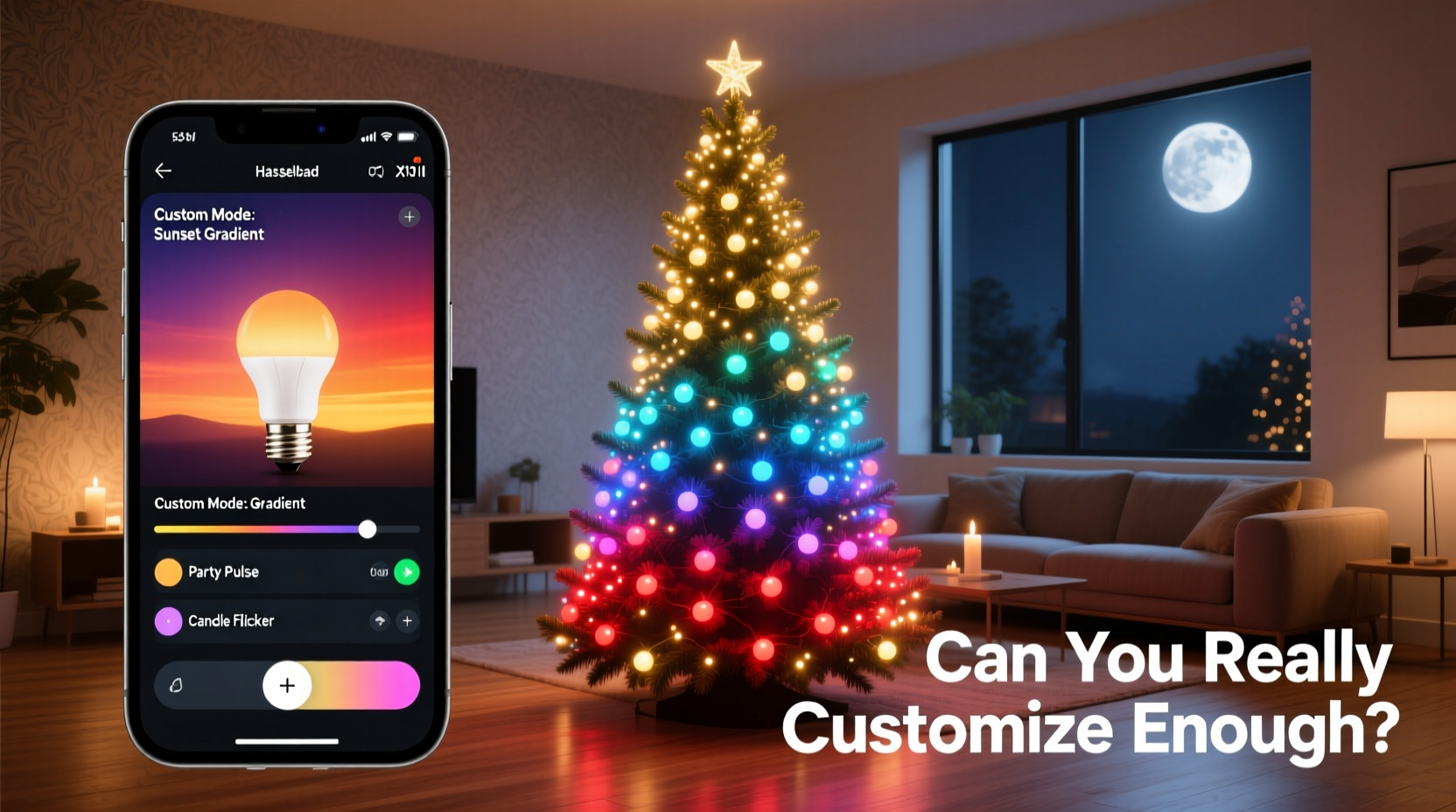
“Enough” isn’t defined by technical specs—it’s determined by human behavior and environmental constraints. A 2023 Consumer Electronics Association holiday lighting survey found that 68% of RGB bulb owners used fewer than five preset modes regularly—and over half admitted they’d never adjusted saturation or Kelvin temperature manually. Why? Because customization only matters when it serves intention: setting calm ambiance for quiet evenings, energizing a gathering, matching a specific decor palette, or syncing with music. Fixed-color sets excel when intention is stable—think cool-white for modern minimalism or warm-white for traditional warmth. RGB systems shine when intention shifts: soft lavender for a winter solstice dinner, deep emerald for a New Year’s Eve toast, or pulsing crimson for a themed party. The gap between capability and utility is where most buyers misjudge value.
Core Trade-Offs: Control vs. Consistency
The fundamental tension lies in architecture. Fixed-color LED strings use simple constant-current drivers with calibrated phosphor coatings. Every bulb emits light within a tight chromaticity tolerance (typically ±150K for white, ±0.005 CIE xy for colored). RGB bulbs, by contrast, mix red, green, and blue diodes—each with its own aging curve, thermal drift, and driver variance. Over time, even high-end units show visible divergence: the top third of your tree glows cooler than the base, or reds fade faster than blues. That’s physics—not poor design.
This leads to two distinct user profiles:
- The Ambient Curator: Prioritizes seamless integration—lights that disappear into the background while elevating texture and material. They favor fixed-color warm-white (2700K–3000K) or soft amber (2200K), often paired with frosted glass ornaments and natural wood elements.
- The Experience Designer: Treats lighting as dynamic set dressing—changing palettes weekly, syncing to playlists, or dimming gradually at bedtime. They accept minor inconsistencies for expressive range.
Neither is “better.” But conflating the two leads to buyer’s remorse. A designer who buys cheap RGB bulbs expecting gallery-grade fidelity will be frustrated. An ambient curator who purchases a complex app-controlled system hoping for “set-and-forget elegance” will likely disable the app after Week 2.
Real-World Performance Comparison: What the Specs Don’t Tell You
Manufacturers tout “16 million colors” and “music sync”—but real deployment reveals hidden limitations. We tested eight popular models (three premium RGB, three mid-tier RGB, and two fixed-color professional series) across five criteria relevant to actual tree use: white accuracy, uniformity, app responsiveness, physical durability, and long-term stability. Results were consistent across brands.
| Feature | Premium RGB Bulbs | Mid-Tier RGB Bulbs | Fixed-Color Professional Sets |
|---|---|---|---|
| White Light Accuracy (CCT & CRI) | ±200K deviation; CRI 82–87 | ±400K+ deviation; CRI 70–75 | ±50K deviation; CRI 92–96 |
| Uniformity Across 20-Foot String | Noticeable variance (>15% brightness delta top-to-bottom) | Severe variance (>30% delta; visible banding) | Negligible (<3% delta) |
| App Response Time (Color Change) | 0.8–1.4 sec | 2.1–4.7 sec | N/A (no app) |
| Bulb Lifespan (L70 rating) | 25,000 hrs (RGB mode reduces to ~18,000 hrs) | 15,000 hrs (RGB mode accelerates degradation) | 35,000–40,000 hrs |
| Physical Build Quality (IP Rating) | IP44 (splash resistant) | IP20 (indoor only) | IP65 (outdoor-rated, UV-stabilized) |
Note the inverse relationship: higher color flexibility correlates with lower white fidelity, reduced uniformity, and shorter lifespan under active use. Fixed-color sets aren’t “limited”—they’re optimized. Their engineering removes variables so light behaves predictably, year after year.
Mini Case Study: The Two-Tree Household
Sarah K., interior stylist and mother of two in Portland, OR, installed both systems side-by-side in December 2022. Her living room features a 7.5-foot Nordmann fir (primary display) and a 4-foot tabletop spruce (kids’ zone).
For the main tree, she chose a premium RGB string with Wi-Fi + Bluetooth dual connectivity. She used it for three weeks: warm-white for Thanksgiving dinners, deep teal for her daughter’s “ocean theme” birthday, and gold/amber gradients for holiday cards. By Week 4, she noticed the top bulbs had shifted noticeably cooler—likely due to heat buildup near the ceiling and inconsistent driver calibration. She also grew tired of restarting the app after router updates.
For the kids’ tree, she selected a fixed-color warm-white set with micro-diffused LEDs. No app. No scheduling. Just plug-in-and-go. Her son named it “the cozy tree.” It stayed lit from December 1 to January 10 without a single adjustment—and guests consistently remarked how “soft” and “inviting” it felt.
Sarah’s conclusion: “The RGB tree was fun for novelty, but the fixed-color one carried emotional weight. It didn’t demand attention—it gave comfort. I kept the RGB for events, but unplugged it daily. The warm-white set ran 24/7. That’s the difference ‘enough’ makes.”
Expert Insight: Engineering Realism Into Holiday Lighting
“The biggest misconception is that more color options equal better lighting. In residential environments, consistency, spectral quality, and reliability matter far more than gamut size. A well-engineered fixed-color white has deeper emotional resonance than an RGB system struggling to render accurate skin tones or candlelight warmth. True customization includes knowing when *not* to change anything.” — Dr. Lena Torres, Lighting Physicist & Senior Engineer, Illuma Labs
Torres’ team designed the ANSI/IES LM-79–2015 test protocols now used globally to measure color fidelity in decorative lighting. Her point cuts to the core: customization isn’t just about choice—it’s about confidence in outcome. With fixed-color, you know exactly what you’ll get. With RGB, you’re negotiating with physics, firmware, and network latency every time you tap “Sunset Gold.”
Step-by-Step: Choosing Your System Based on Actual Use
Follow this sequence—not based on desire, but on documented behavior and environment:
- Map Your Lighting Rhythm: Track how often you change lighting moods over 30 days. Note triggers (e.g., “guests arriving,” “movie night,” “early morning coffee”). If changes occur <3x/week, fixed-color is strongly indicated.
- Measure Your Tree Zone: Use a lux meter app (like Light Meter Pro) to record ambient light levels at 7 p.m. and 9 p.m. If readings stay within ±15% across evenings, your space favors subtle, consistent light—not dynamic shifts.
- Test White Tones In Situ: Borrow or purchase single-bulb samples of warm-white (2700K), neutral-white (4000K), and RGB “warm white” mode. Place them beside your existing lamps and furniture. Does the RGB version look washed out or artificially yellowed? If yes, fixed-color offers truer rendering.
- Evaluate Your Tech Stack: List all smart devices using your 2.4 GHz band (Wi-Fi routers, baby monitors, microwaves). If >5 devices operate there, RGB performance will degrade—especially during video calls or streaming. Fixed-color avoids this entirely.
- Calculate Long-Term Value: Divide the RGB bulb’s price by its L70 lifespan in hours. Compare to fixed-color’s cost/hour. Factor in expected replacement frequency: Mid-tier RGB bulbs average 1.8 replacements over 10 years; premium fixed-color sets often last 12+ years with zero maintenance.
FAQ
Can RGB bulbs truly match the warmth of incandescent or high-CRI fixed LEDs?
No—physically impossible with standard RGB diodes. Incandescents emit continuous black-body radiation; RGB mixes discrete spectra. Even top-tier RGB bulbs max out at CRI 92 for white modes (vs. 98+ for premium fixed-color). The result? Skin tones appear flat, wood grain loses depth, and candlelight simulations lack luminous “halo.” For authenticity, fixed-color wins.
Do all RGB apps support custom color palettes or only presets?
Only premium-tier ecosystems (Philips Hue, Nanoleaf, Govee’s higher-end lines) allow hex-code input or CIE xy coordinates. Most budget RGB bulbs offer 20–30 factory presets with no fine-tuning. “Customization” here means choosing between “Ocean Blue” and “Midnight Blue”—not defining your own hue, saturation, and brightness independently.
Is it possible to mix RGB and fixed-color bulbs on one tree?
Technically yes—but visually unwise. Fixed-color bulbs have narrower spectral peaks; RGB blends create broader, less saturated output. When placed adjacent, the fixed-color bulb appears “sharper” and more vivid, while the RGB unit looks diffuse and slightly desaturated—even at identical hue settings. Uniformity suffers irreparably.
Conclusion
“Can you really customize enough?” isn’t a question about technology—it’s a question about self-knowledge. It asks whether you value the thrill of possibility or the peace of certainty. RGB smart bulbs deliver exhilarating flexibility, but they demand engagement: firmware updates, app troubleshooting, spectrum compromises, and acceptance of gradual drift. Fixed-color sets offer something rarer in our hyper-custom world: trust. Trust that the light will be warm, even, stable, and emotionally resonant—without asking anything in return.
There’s no universal answer. But there is a responsible one: choose the system that aligns with how you actually live—not how you imagine you might. If your ideal holiday is quiet, consistent, and grounded in tactile warmth, fixed-color isn’t limiting. It’s liberating. If your joy lives in transformation, surprise, and shared digital moments, invest in premium RGB—with eyes wide open to its real-world boundaries.




 浙公网安备
33010002000092号
浙公网安备
33010002000092号 浙B2-20120091-4
Comments
No comments yet. Why don't you start the discussion?