
Modern holiday lighting has evolved from simple plug-and-play strings to ecosystems of controllable, networked devices. Yet many homeowners face the same frustrating reality: they own both vibrant, app-driven RGB smart bulbs *and* classic static-color LED Christmas lights—but struggle to unify them under a single interface. The question isn’t just theoretical; it’s logistical, technical, and deeply practical. Can one app truly orchestrate both? The answer depends less on marketing claims and more on underlying communication protocols, hub architecture, and how “static” is defined in today’s smart-home landscape.
Understanding the Fundamental Divide: Protocol, Not Just Color
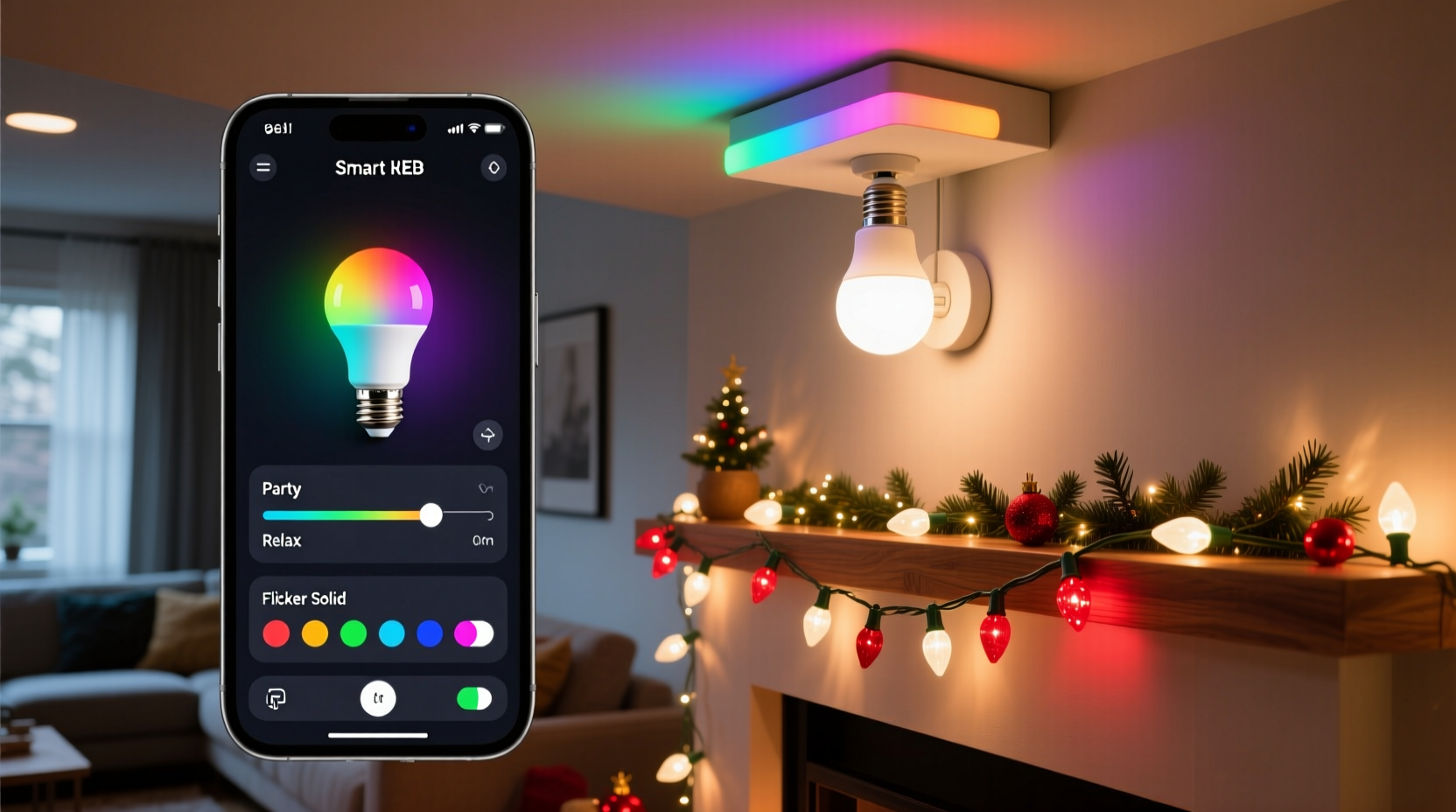
The core distinction between RGB smart bulbs and traditional static-color Christmas lights lies not in their appearance—but in how they receive and interpret commands. RGB smart bulbs (like Philips Hue, Nanoleaf, or Govee Mesh bulbs) use standardized wireless protocols—primarily Zigbee, Matter over Thread, or Wi-Fi—to accept dynamic instructions: hue shifts, brightness ramps, scene triggers, and scheduling. They’re designed as endpoints in a two-way communication loop.
Static-color Christmas lights, by contrast, fall into three categories:
- Non-smart, passive strings: Basic plug-in LEDs with no electronics beyond a simple rectifier. These have zero connectivity and cannot be controlled remotely—ever.
- “Smart-adjacent” plug-in controllers: Strings with built-in RF remotes or Bluetooth modules (e.g., Twinkly Mini, Luminara Smart Lights). These often run proprietary firmware and require vendor-specific apps.
- True smart static lights: Devices like GE Cync Static White or Wyze Warm White Bulbs—Wi-Fi or Matter-enabled bulbs that emit only white light but support full smart-home integration, including voice and app control.
This taxonomy matters because interoperability hinges on protocol alignment—not aesthetics. A warm-white GE Cync bulb and a multicolor Philips Hue bulb can coexist in Apple Home or Google Home—not because they’re both “lights,” but because both speak Matter or are certified for the platform’s native ecosystem.
Where One-App Control Actually Works (and Where It Doesn’t)
True unification—where both RGB bulbs and static lights appear in the same app, respond to the same automations, and share scenes—requires shared infrastructure. Below is a realistic assessment of current platforms:
| Platform | RGB Smart Bulbs Supported | Static-Color Lights Supported | Unified Control? | Key Limitation |
|---|---|---|---|---|
| Apple Home | Yes (Matter, Thread, or HomeKit-certified RGB) | Yes (Matter/Thread white bulbs; select certified static LEDs) | ✅ Yes—full scene sync, Siri, automations | Non-Matter static strings (e.g., basic Twinkly, older Lightorama) require third-party bridges or won’t appear at all. |
| Google Home | Yes (Matter, Works with Google) | Yes (Matter white bulbs; some legacy static via Nest Hub) | ✅ Yes—with caveats on naming consistency and grouping logic | Non-Matter Bluetooth-only static lights often show as “unavailable” or lack scheduling. |
| Alexa | Yes (Works with Alexa RGB bulbs) | Limited (only certified white bulbs or Matter-compliant static) | ⚠️ Partial—can group in Routines, but no shared color/brightness sliders | No native scene editor across mixed device types; static lights appear as “on/off only” in most routines. |
| Vendor Apps (e.g., Hue, Nanoleaf) | Yes (native) | No—unless the static lights are from the same brand and model line (e.g., Hue White Ambience + Hue White & Color Ambience) | ❌ No—vendor lock-in prevents cross-brand static integration | Twinkly static strings won’t appear in the Hue app—even if both are on the same Wi-Fi network. |
| Home Assistant (self-hosted) | Yes (via integrations: Zigbee2MQTT, ESPHome, Tuya) | Yes (if static lights expose local API or use compatible controllers like Shelly relays) | ✅ Yes—deep control, custom dashboards, granular automations | Requires technical setup; no official support for closed RF protocols (e.g., many $15 Amazon static strings). |
Crucially, “static color” doesn’t mean “dumb.” Many modern static-white bulbs are fully smart—they simply omit color wheels and RGB drivers. Their intelligence lives in dimming curves, CCT (correlated color temperature) adjustment, and scheduling—not chromatic range. When those bulbs are Matter-certified, they become first-class citizens alongside RGB counterparts.
Real-World Integration: A Suburban Family’s Holiday Setup
In late November 2023, the Chen family upgraded their outdoor lighting. They kept their existing Philips Hue Outdoor RGB Floodlights (Zigbee) and added a new set of GE Cync Static White Pathway Lights—purchased specifically for their Matter-over-Thread certification. Both were added to Apple Home via the Home app: the RGB lights appeared under “Lights,” the static whites under “Outdoor Lighting.” Within minutes, they created a “Front Porch Evening” scene: RGB floods dimmed to 40% and shifted to soft amber (2700K), while the static pathway lights brightened to 85% at the same 2700K tone. No bridging hardware was needed—their HomePod mini acted as the Thread border router.
What didn’t work? Their old 2019 Twinkly Mini string—designed for Bluetooth-only control. It remained in the Twinkly app, unresponsive to Home automations. To include it, they’d need either a Twinkly Bridge (which adds Matter support for newer models) or a Home Assistant add-on to proxy Bluetooth commands—a complexity they chose to avoid this season.
This case illustrates a key principle: unified control is achievable *when devices share a common language and infrastructure*. It’s not about replacing all static lights—it’s about upgrading strategically where interoperability matters most.
Step-by-Step: Building a Unified Lighting System in Under 45 Minutes
- Evaluate your current lights: Identify which static strings are truly “dumb” (no app, no remote) versus those with Bluetooth/Wi-Fi controllers. Discard or repurpose non-controllable strings.
- Choose your ecosystem hub: For simplicity, pick Apple Home (if you own an iPhone and HomePod), Google Home (with Nest Hub), or Home Assistant (if you value open-source control). Avoid starting with Alexa if you plan heavy automation—its scene engine lags behind.
- Purchase only Matter-certified devices going forward: Look for the official Matter logo. Prioritize Thread-capable bulbs—they offer lower latency and better mesh reliability than Wi-Fi-only options.
- Add devices in order: First, pair your static-white bulbs (they usually onboard fastest). Then add RGB bulbs. Use the same account across devices—don’t mix manufacturer accounts unless using Home Assistant.
- Create logical groups and scenes: In Apple Home, group “Porch RGB” and “Porch Static” into a single room. Then build a scene named “Holiday Warm” that sets both groups to matching brightness and correlated color temperature (CCT). Test manually, then schedule it to activate at sunset.
Expert Insight: The Matter Standard Changes Everything
“The shift to Matter isn’t incremental—it’s foundational. For the first time, a static white bulb and an RGB bulb aren’t competing product categories. They’re interoperable nodes in the same network. That means a homeowner can start with warm-white path lights, add RGB accents later, and never re-architect their system.” — Dr. Lena Torres, Director of Interoperability, Connectivity Standards Alliance
Dr. Torres’ point underscores a paradigm shift: static lights are no longer the “legacy option.” They’re now the entry point to smart lighting—especially for users who prioritize reliability, longevity, and energy efficiency over color play. RGB bulbs excel in ambiance and novelty; static bulbs excel in functional illumination and consistent output. A mature smart home leverages both—without forcing trade-offs in control.
FAQ: Your Most Pressing Questions Answered
Can I make my old non-smart Christmas lights “smart” without rewiring?
Yes—but with limits. Plug-in smart plugs (like Kasa KP125 or Wemo Mini) can turn entire static strings on/off and schedule them. However, they cannot dim, change color, or create multi-zone effects. This works well for porch outlines or roof lines where binary control suffices—but not for layered lighting design.
Why do some RGB bulbs claim “works with Alexa” but my static lights don’t show up in the same routine?
Alexa’s routine builder treats devices by capability, not category. If your static lights only report “on/off” status (common with older Wi-Fi bulbs), Alexa classifies them as switches—not lights—and excludes them from lighting-specific actions like “set brightness to 50%.” Upgrading to Matter-certified static bulbs resolves this by exposing standardized lighting attributes.
Do I need a separate hub for RGB and static lights if I use Home Assistant?
Not necessarily. A single Raspberry Pi 4 running Home Assistant with a Sonoff Zigbee 3.0 USB dongle can manage both Zigbee RGB bulbs and static white bulbs—provided they use the same protocol. For Wi-Fi-only static lights, ensure they expose a local API (check docs for Tuya, Meross, or Gosund). Avoid cloud-dependent brands unless you’re comfortable with the security and latency trade-offs.
Conclusion: Control Is a Choice—Not a Compromise
You don’t have to choose between vibrant RGB expression and serene static illumination. Nor must you resign yourself to juggling five different apps. The convergence of Matter, Thread, and open-source platforms has dissolved the artificial wall between “color” and “white” lighting—replacing it with a spectrum of intelligent, addressable endpoints. Whether you’re illuminating a tree with pulsing auroras or guiding guests along a walkway with steady, warm-white light, both belong in the same system—if you prioritize protocol over packaging.
Your next step isn’t to replace everything. It’s to audit what you own, identify one high-impact zone (like your front porch or living room mantle), and upgrade just two devices—one RGB, one static—using Matter certification as your north star. Within an hour, you’ll have a unified scene that breathes with your home, not against it.




 浙公网安备
33010002000092号
浙公网安备
33010002000092号 浙B2-20120091-4
Comments
No comments yet. Why don't you start the discussion?