
Customization isn’t just about aesthetics—it’s about intentionality, adaptability, and personal expression. When it comes to holiday lighting, the choice between RGB smart lights and traditional static-color strings goes far beyond “pretty vs plain.” It reflects how much control you want over mood, timing, rhythm, and seasonal evolution. Static lights deliver reliability and simplicity; RGB smart lights unlock dynamic storytelling with light. But “better customization” isn’t a universal verdict—it depends on your goals, technical comfort, budget, and how deeply you want light to participate in your celebrations. This article cuts through marketing hype to examine real-world customization capabilities across five critical dimensions: color range, sequencing control, integration intelligence, scalability, and long-term creative flexibility.
1. Color Range & Precision: Beyond Red, Green, and White
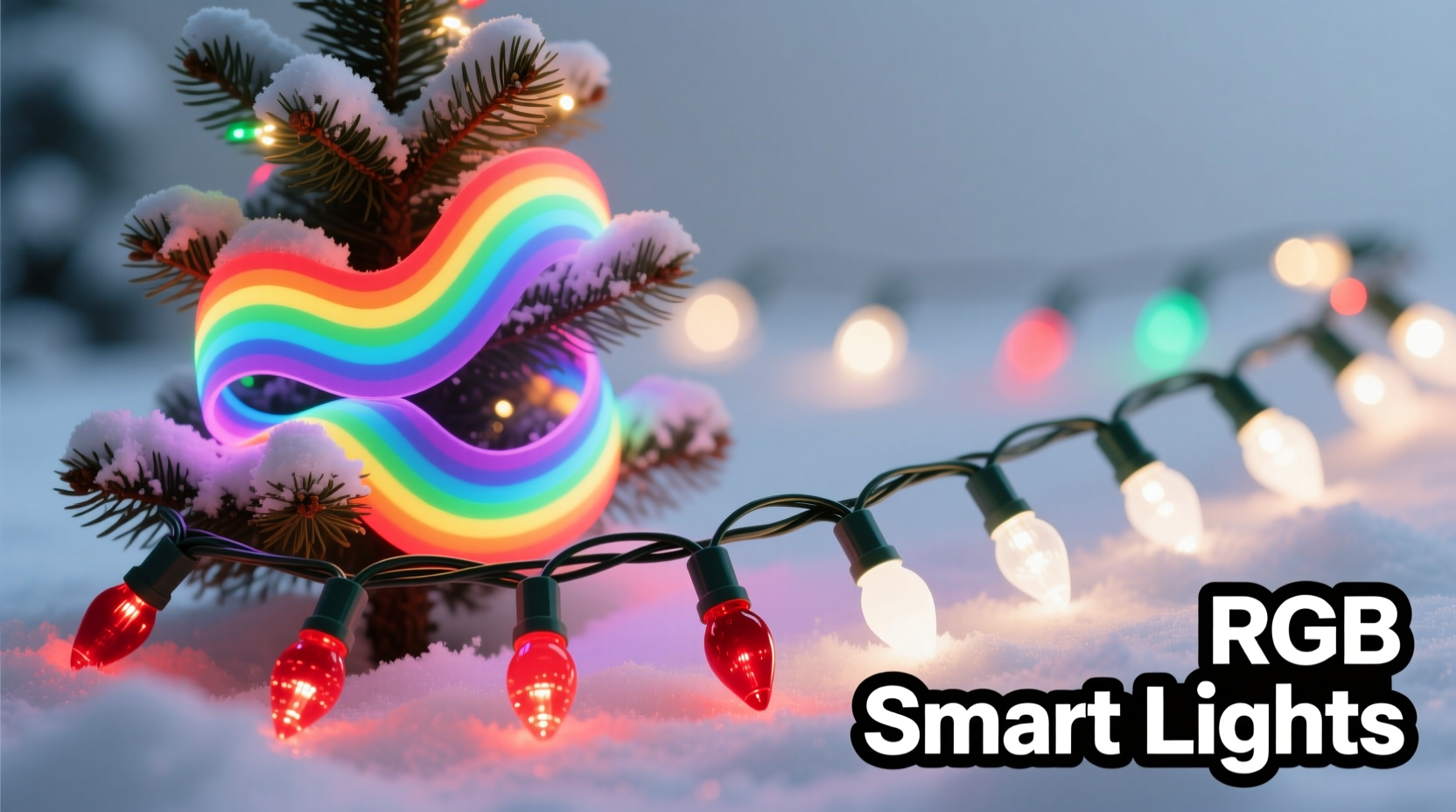
Static-color lights—whether warm white, cool white, red, or blue—are manufactured with fixed LED chips. Each bulb emits one unchangeable hue. Even multi-color static strings (e.g., “5-color mixed”) use pre-wired segments where red, green, blue, yellow, and white bulbs are physically arranged in repeating patterns. You cannot alter that sequence, shift saturation, or dim individual colors independently.
RGB smart lights, by contrast, use tri-chip LEDs (Red + Green + Blue) in every single bulb. By varying the intensity of each sub-pixel, they generate over 16 million distinct colors—including pastels, metallics, deep teals, and muted lavenders impossible with static sets. More importantly, they support color temperature adjustment: shifting from 2700K candlelight warmth to 6500K daylight crispness within the same string. That’s not just more colors—it’s contextual precision. A porch display can warm up at dusk and cool down at midnight; a tree can pulse amber during carols and shift to icy blue for a winter solstice theme—all programmatically, without swapping bulbs.
2. Sequencing, Timing, and Motion Control
Static lights offer zero sequencing control. Their behavior is hardwired: steady-on, twinkle, chase, or fade—fixed modes selected via a physical controller with no memory or scheduling. You cannot set a chase effect to run only from 5–9 p.m., nor slow it down during quiet evening hours, nor pause it when guests arrive.
RGB smart lights operate on programmable firmware—often managed via Bluetooth or Wi-Fi apps (like LampUX, Twinkly, or proprietary platforms). Here, sequencing becomes compositional:
- Per-bulb addressing: Individual control means you can make only the top third of your roofline pulse while the bottom remains steady—ideal for architectural highlighting.
- Beat-syncing: Some systems analyze audio input (via microphone or file upload) and automatically map light pulses, fades, and color shifts to musical tempo and dynamics.
- Scheduled automation: Lights can dim gradually at 10:30 p.m., transition to soft amber at sunrise, or activate only on weekends—without manual intervention.
- Scene layering: Combine a slow color wash with a subtle snowfall effect and a gentle breathing pulse—all running simultaneously but independently adjustable.
This isn’t decoration. It’s choreography.
3. Integration Intelligence: Where Light Meets Ecosystem
Static lights exist in isolation. They don’t speak to other devices. You cannot say, “Alexa, turn on Christmas lights when I get home,” or trigger a color shift when your security camera detects motion. Their intelligence ceiling is a mechanical timer.
RGB smart lights integrate natively into smart home ecosystems. With Matter/Thread or certified HomeKit support, they become first-class citizens in your automation stack:
| Integration Capability | Static Lights | RGB Smart Lights |
|---|---|---|
| Voice control (Alexa/Google/Siri) | No | Yes — with naming, grouping, and scene triggers |
| Geofencing (auto-on/off by location) | No | Yes — via app or hub automation |
| Weather-triggered effects (e.g., blue glow on snow forecast) | No | Yes — using IFTTT or Home Assistant webhooks |
| Sync with doorbell or motion sensor | No | Yes — e.g., front path lights brighten and shift to welcoming gold when entry detected |
| Firmware updates adding new effects | No | Yes — manufacturers regularly release new animations, palettes, and control logic |
This ecosystem fluency transforms lights from seasonal accessories into responsive environmental tools—capable of adapting to routines, weather, safety needs, and even emotional intent.
4. Real-World Customization Case Study: The Urban Apartment Balcony
Maria lives in a 12th-floor downtown apartment with a narrow 4-foot balcony. HOA rules prohibit permanent fixtures and limit wattage. Last year, she used two 35-ft static warm-white incandescent strings—simple, compliant, and unremarkable. This November, she upgraded to a single 50-ft RGB smart LED rope light with built-in Wi-Fi and magnetic mounting clips.
Her customization workflow evolved dramatically:
- Pre-installation: She used the app’s augmented reality preview to simulate how different color schemes would look against her brick wall at night—testing deep burgundy vs. sage green before purchasing.
- Installation: Magnets held the rope securely to her iron railing—no nails, no tape, no drilling. The app auto-detected all 150 bulbs and mapped their physical positions.
- Daily use: She created three core scenes: “Café Glow” (soft amber, 20% brightness, slow fade), “City Pulse” (cool white with rhythmic 3-second pulses synced to ambient street noise), and “Holiday Mode” (rich red/green alternating every 8 seconds, active only Dec 1–26).
- Unexpected flexibility: When hosting a New Year’s Eve party, she loaded a custom countdown animation—white lights dimming to black, then exploding into gold sparks at midnight—triggered automatically by her phone’s calendar alarm.
Maria didn’t just gain more colors. She gained narrative agency—turning a regulatory constraint into a canvas for micro-seasonal expression.
5. Long-Term Creative Flexibility & Upgradability
Static lights depreciate creatively the moment you hang them. Their function is fixed. If you want variety next year, you buy new strings—or layer multiple static sets (increasing cost, clutter, and power draw). There’s no path to evolve the display beyond hardware swaps.
RGB smart lights appreciate in utility over time. Firmware updates routinely introduce new features: improved color calibration, expanded music-sync algorithms, deeper Home Assistant integrations, or even AI-assisted scene generation (“Create a cozy Scandinavian winter scene for my living room”). Third-party developers build plugins and visualizers. Open-source communities share custom code for niche effects—like simulating aurora borealis or mimicking vintage neon signage.
“Smart lighting’s greatest customization advantage isn’t what it does today—it’s what it *can* do tomorrow. We’ve seen users repurpose the same $80 string for Easter egg hunts, Halloween fog effects, and Valentine’s Day heart patterns—all with zero hardware changes.” — Rajiv Mehta, Co-Founder, Lumina Labs (smart lighting R&D group, 2019–present)
Moreover, true customization includes creative ownership. With open API access (available on platforms like WLED or ESPHome), advanced users can write custom animations in C++ or Python, define mathematical waveforms for light movement, or sync lights to live data feeds—stock prices, air quality index, or even local train arrivals. That level of authorship simply doesn’t exist in the static paradigm.
Practical Customization Checklist: Before You Buy
Don’t assume “RGB smart” guarantees seamless customization. Use this checklist to verify real-world flexibility:
- ✅ Bulb-level addressing: Confirmed per-LED control—not just zone-based (e.g., “section 1–10” only).
- ✅ Open protocol support: Compatibility with WLED, ESPHome, or Matter ensures future-proofing beyond vendor apps.
- ✅ Offline operation: Can scenes run without cloud connectivity? (Critical for privacy and reliability.)
- ✅ Power injection points: For runs over 33 ft, does the kit include optional 12V injection connectors to prevent voltage drop and color shift?
- ✅ Mounting versatility: Clips, magnets, or adhesive options compatible with your surfaces (wood, brick, vinyl, glass)?
- ✅ App transparency: Does the interface show actual RGB/HSV values for each color—and allow manual hex entry?
FAQ: Addressing Common Customization Concerns
Do RGB smart lights require constant Wi-Fi to work?
No—most support local Bluetooth control and onboard memory for saved scenes. Wi-Fi enables remote access and cloud automations, but core functionality (color selection, sequencing, scheduling) works offline once configured. Some models even include physical IR remotes as fallbacks.
Is the setup really harder than static lights?
Initial setup takes 10–20 minutes longer: downloading an app, scanning a QR code, naming the device, and calibrating brightness. But after that, daily operation is often simpler—no fumbling with physical controllers or remembering which button does “slow twinkle.” And once integrated into a smart home, controlling dozens of lights becomes one voice command.
Can I mix RGB smart and static lights in one display?
Technically yes—but not meaningfully. You cannot synchronize timing, color, or effects across different protocols. The result is visual dissonance: one section pulsing to music while another blinks steadily. For cohesive customization, uniform technology across your entire display is strongly advised.
Conclusion: Customization Is a Verb, Not a Feature
RGB smart Christmas lights don’t just “offer more options”—they reframe what holiday lighting is for. Static lights fulfill a functional need: illumination with festive connotation. RGB smart lights serve an expressive need: translating intention into atmosphere, memory into motion, and seasonality into story. Better customization isn’t measured in color count alone—it’s found in the quiet confidence of knowing your lights will feel fresh not just this December, but next year’s solstice, the year after’s graduation party, or your first grandchild’s first Christmas. It’s in the ability to shift from reverence to revelry with a tap, to honor tradition while inventing new rituals, and to let light respond—not just shine.
If you value consistency, simplicity, and low upfront investment, static lights remain a thoughtful choice. But if you see your home as a living canvas—and your holidays as evolving narratives—then RGB smart lights aren’t an upgrade. They’re the first line of your next chapter in light.




 浙公网安备
33010002000092号
浙公网安备
33010002000092号 浙B2-20120091-4
Comments
No comments yet. Why don't you start the discussion?