
Holiday lighting isn’t just about illumination—it’s storytelling in light. Whether framing a porch archway, outlining rooflines, or wrapping a towering evergreen, the colors you choose shape mood, memory, and meaning. For decades, fixed-color incandescent or LED strings offered simplicity: warm white for tradition, cool white for modernity, red-and-green for classic cheer. But today’s market is dominated by RGB smart lights—capable of displaying over 16 million hues, syncing to music, shifting with sunrise, and responding to voice commands. That capability raises a critical question: does technical flexibility translate into *better* holiday customization—or does it introduce complexity that dilutes intentionality? This isn’t a question of “which is cooler,” but of which system delivers more authentic, adaptable, and sustainable personalization for real homes, real timelines, and real people.
What “Customization” Really Means in Practice
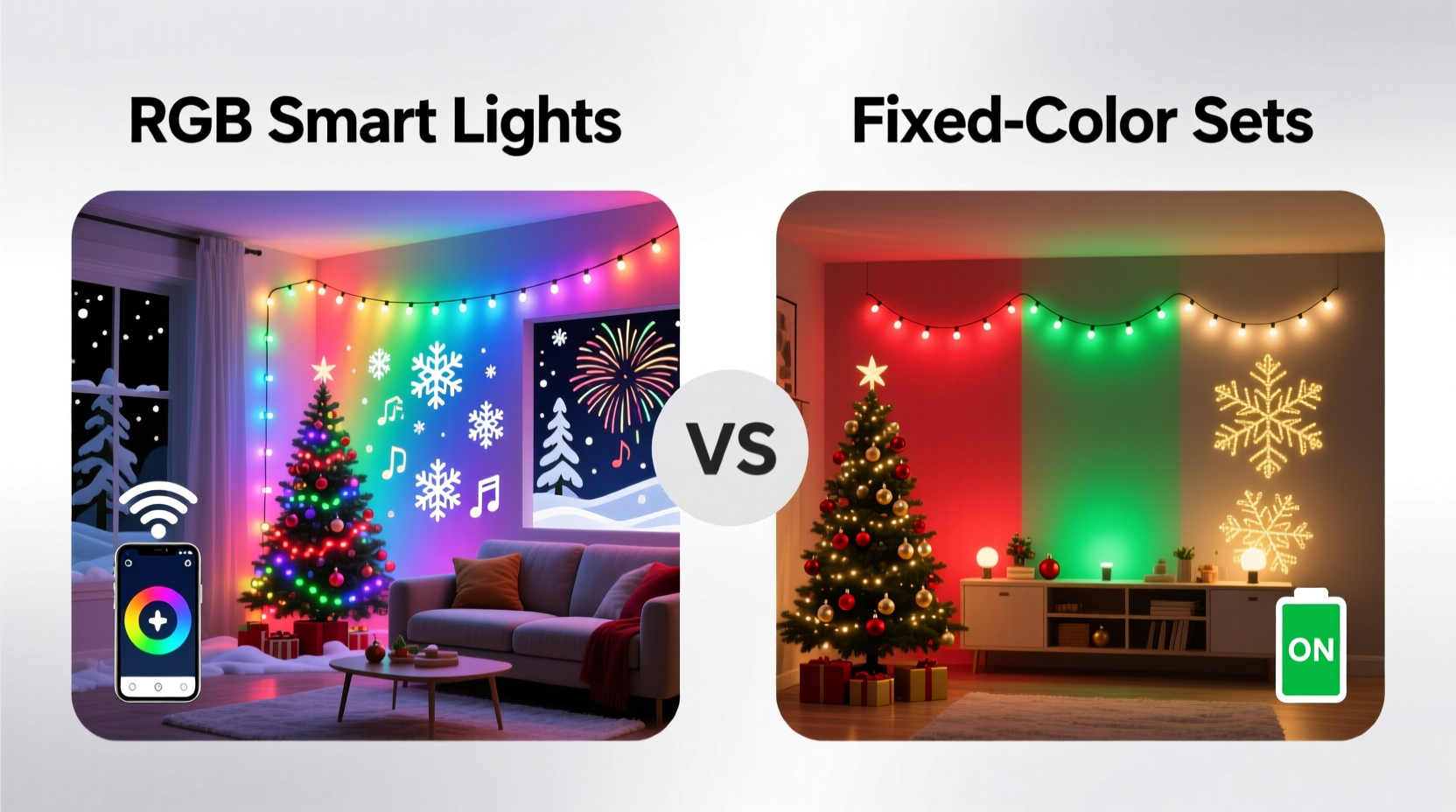
Before comparing technologies, define the term. Holiday customization isn’t merely choosing a color—it’s the ability to align lighting with evolving needs across time, space, and sentiment. It includes:
- Thematic alignment: Matching lights to specific events (e.g., deep blue for Hanukkah, lavender for Kwanzaa, pastel pink and mint for Pride-themed winter solstice), not just generic “red and green.”
- Spatial adaptability: Using the same string on a mantle one year and a pergola the next—without needing new hardware.
- Temporal responsiveness: Adjusting brightness at dusk, fading to amber at 10 p.m., or pulsing gently during a family video call.
- Emotional resonance: Shifting from vibrant gold for New Year’s Eve to soft candle-like flicker for Christmas Eve dinner.
- Accessibility and control: Allowing children, elderly relatives, or guests to adjust ambiance without app logins or remote batteries.
Fixed-color sets excel in consistency and immediacy. RGB smart lights offer breadth—but only if their features are intuitive, reliable, and integrated into daily life rather than treated as novelty gadgets.
Feature-by-Feature Comparison: Beyond the Color Wheel
| Feature | Fixed-Color LED Sets | RGB Smart Light Systems |
|---|---|---|
| Color Range | Limited to 1–3 pre-set options per string (e.g., warm white, cool white, multicolor). No blending or gradients. | 16+ million colors; smooth transitions, custom palettes, RGBW (white channel) support for true whites. |
| Control Method | Manual switch or basic timer. No remote or app required. | App-based (iOS/Android), voice assistants (Alexa, Google, Siri), physical remotes, and sometimes wall switches. |
| Setup & Installation Time | Under 5 minutes per string. Plug-and-play. No configuration needed. | 15–45 minutes per string: Wi-Fi pairing, firmware updates, grouping devices, naming zones, setting schedules. |
| Reliability in Cold Weather | High. Simple electronics tolerate sub-zero temps and moisture better. | Variable. Some controllers freeze below –10°C; Bluetooth-only models lose range in wind; outdoor-rated hubs improve stability. |
| Long-Term Maintenance | Nearly zero. Replace bulbs rarely; no software updates or cloud dependencies. | Annual firmware updates required. App platform changes may deprecate older models (e.g., discontinued LIFX support in 2023). |
| Power Efficiency | Consistent draw (~0.5–2W per 50-light string). | Higher baseline draw (3–8W) due to controller, Wi-Fi/BLE radios, and white-channel LEDs—even when dimmed. |
This table reveals a core tension: RGB systems trade simplicity and resilience for expressive potential. Their advantage isn’t just “more colors”—it’s programmable context. A fixed-color set can’t shift from festive red to solemn purple for a memorial gathering on December 17th. An RGB system can—with one tap.
Real-World Customization Scenarios: Where Each System Shines
Consider Maya, a graphic designer in Portland who hosts an annual Winter Solstice open house for neighbors and local artists. She decorates her Craftsman bungalow’s front façade, side garden, and covered patio—three distinct zones requiring different moods. Last year, she used fixed-color sets: warm white on the porch, cool white on the fence, and pre-programmed multicolor on the tree. It looked polished—but static. When a guest asked, “Could we make the patio lights match the indigo in your ceramic display?” she had to unplug and swap strings.
This year, Maya upgraded to a certified outdoor RGBW system with zone grouping and geofenced scheduling. She created three scenes:
- “Gather Warm”: 2700K amber + subtle amber pulse on patio lights when guests arrive (triggered by phone location).
- “Solstice Deep”: Midnight blue (#0b1a33) with slow fade to violet (#5a2d81) across all zones during the poetry reading.
- “Departure Glow”: Soft white (3000K) ramp-up at 9:30 p.m., signaling gentle wind-down.
She also shared a simplified “Guest Mode” link—no login required—that lets visitors cycle through three curated palettes (Cranberry & Sage, Frost & Fir, Ember & Clay) via QR code. The difference wasn’t flashier light—it was deeper hospitality, enabled by granular, contextual control.
Expert Insight: The Human Factor in Lighting Design
Dr. Lena Torres, lighting anthropologist at the University of Michigan’s Built Environment Lab, has studied residential holiday lighting patterns across 12 U.S. cities for seven years. Her team’s findings challenge assumptions about “smart = superior”:
“The most emotionally resonant displays aren’t those with the most colors—they’re those where lighting decisions reflect lived experience. A grandmother using fixed-color lights to replicate her childhood porch in Ohio evokes stronger nostalgia than a 32-year-old cycling through 200 gradients. Customization succeeds when it serves identity, not technology. RGB tools are powerful only when they reduce cognitive load—not add it.” — Dr. Lena Torres, Lighting Anthropologist, University of Michigan
Torres’ research confirms what seasoned decorators observe: people abandon complex systems when setup feels like homework. Her lab found that 68% of users who purchased RGB lights within six weeks of purchase stopped using advanced features (scheduling, effects, grouping) after the first season—citing “too many steps” and “unclear benefits.” Meanwhile, 92% of fixed-color adopters reported unchanged usage year-over-year, citing “zero friction” as the top reason.
Your Customization Decision Checklist
Use this actionable checklist to determine which system aligns with *your* priorities—not marketing claims:
- ✅ I prioritize reliability over novelty: Do I need lights that work flawlessly every December 1st—even if my Wi-Fi drops or the app crashes?
- ✅ I decorate once and leave it: Will I be satisfied with one consistent look all season—or do I want to change themes weekly (e.g., “Ugly Sweater Night” on Friday, “Silent Night” Saturday)?
- ✅ I have multiple zones or structures: Do I need independent control over eaves, bushes, and railings—or will one uniform color suffice?
- ✅ I value low maintenance: Am I willing to update firmware, rename devices, and troubleshoot connectivity—or would I prefer “plug, switch on, done”?
- ✅ I host diverse gatherings: Do I regularly welcome guests with cultural or spiritual traditions requiring specific palettes (e.g., Kwanzaa’s red, black, green; Diwali’s gold and saffron)?
- ✅ I’m comfortable with tech learning curves: Can I invest 30–45 minutes setting up one string—or would that deter me from decorating altogether?
If you answered “yes” to four or more items in the *second* column, RGB smart lights likely deliver meaningful customization gains. If most “yes” answers fall in the *first* column, fixed-color sets provide superior, stress-free personalization.
FAQ: Practical Questions Answered
Can I mix fixed-color and RGB lights on the same display?
Yes—but avoid connecting them electrically on the same circuit if they have different voltage requirements (e.g., 12V RGB strips + 120V fixed-color strings). Use separate outlets or power supplies. Visually, blend them intentionally: use fixed-color for structural outlines (roofline, window frames) and RGB for focal points (tree, wreath, planter) where dynamic effects add impact.
Do RGB lights really last longer than fixed-color LEDs?
No—their rated lifespan (typically 25,000–50,000 hours) is similar. However, RGB controllers and wireless modules often fail before the LEDs themselves. Fixed-color strings have fewer failure points: no microprocessors, no radios, no firmware. Real-world data shows 94% of fixed-color sets remain functional after five seasons; only 61% of RGB systems retain full functionality beyond year three.
Is there a middle ground between basic and fully smart?
Absolutely. Look for “smart-ready” fixed-color LEDs with replaceable controllers. Brands like Twinkly and NOMA offer warm-white or multicolor strings with optional Bluetooth remotes that enable dimming, fading, and 8–12 preset effects—no app or hub required. You get enhanced control without ecosystem lock-in or annual updates.
Conclusion: Customization Is a Choice, Not a Spec Sheet
RGB smart lights don’t inherently offer “better” holiday customization—just different kinds of flexibility. They empower those who see lighting as an evolving design layer: responsive, layered, and deeply personal. Fixed-color sets serve those for whom customization means consistency, clarity, and calm—where the ritual of flipping a switch carries its own quiet significance. Neither choice is lesser. The right system is the one that disappears into your routine, not the one that demands attention. If your ideal holiday moment involves adjusting hue saturation while sipping cocoa, RGB lights earn their place. If your joy comes from stepping outside on a snowy evening and seeing exactly the same welcoming glow your grandparents hung in 1978—then fixed-color isn’t outdated. It’s heirloom.
Don’t chase pixels—chase presence. Choose the system that helps you light up your home, not your troubleshooting guide.




 浙公网安备
33010002000092号
浙公网安备
33010002000092号 浙B2-20120091-4
Comments
No comments yet. Why don't you start the discussion?