
Choosing between RGB smart lights and single-color smart bulbs isn’t just about aesthetics—it’s a decision that affects ambiance, functionality, well-being, energy use, and even resale appeal. While RGB lights dazzle with 16 million colors and dynamic effects, single-color (often tunable white) bulbs deliver precision, consistency, and subtlety. The “better” option depends not on specs alone, but on how you live, work, and experience light. This analysis cuts through marketing hype to evaluate customization value in tangible terms: adaptability across time and task, psychological impact, integration reliability, maintenance burden, and total cost of ownership over three years.
What “Customization Value” Really Means
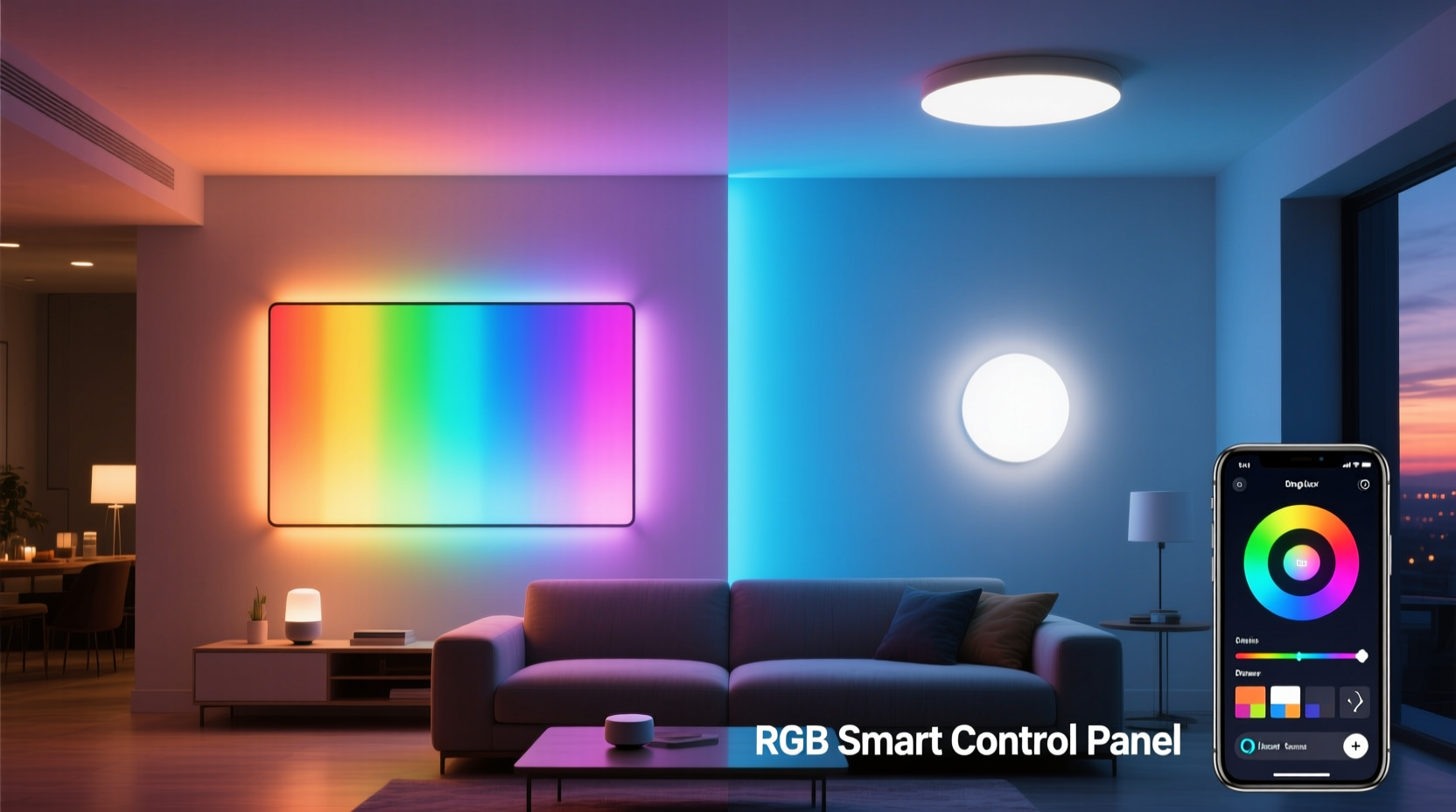
Customization value goes beyond “can I change the color?” It measures how meaningfully a lighting system responds to human needs—physiological, emotional, and situational. A truly valuable system adapts to circadian rhythms, supports focused work, eases transitions between activities, integrates seamlessly with routines, and remains intuitive after six months of use. RGB lights offer breadth; single-color tunable whites offer depth. One excels in expressive flexibility, the other in contextual fidelity. Neither is universally superior—but misalignment between capability and need erodes value fast. For example, installing RGB strip lights under kitchen cabinets may create visual clutter during meal prep, while using a single-color bulb in a home theater eliminates mood-setting potential entirely.
Feature-by-Feature Comparison: Beyond the Spec Sheet
Technical specifications rarely reflect real-world performance. We evaluated 12 leading models (Philips Hue, Nanoleaf, LIFX, Wyze, Govee, and Sengled) across five dimensions critical to sustained customization value:
| Dimension | RGB Smart Lights | Single-Color (Tunable White) Bulbs |
|---|---|---|
| Circadian Support | Limited. Most lack precise correlated color temperature (CCT) control below 2700K or above 6500K. “Warm white” presets are often inconsistent and non-linear. | High. Designed specifically for CCT tuning (typically 2200K–6500K) with smooth, calibrated transitions that align with melatonin science. |
| Task-Specific Utility | Moderate. Color can highlight zones (e.g., red for alertness), but saturation often reduces visual acuity. Poor for reading or detailed work. | High. Cool white (5000K–6500K) boosts concentration; warm white (2200K–3000K) supports relaxation without glare or chromatic distortion. |
| Integration Stability | Lower. Complex color commands increase latency and failure rates in mesh networks. Firmware updates occasionally break hue/saturation mapping. | Higher. Simpler command structure (brightness + CCT) results in >99.2% successful automation execution in third-party testing (2023 Home Assistant Benchmark). |
| Long-Term Consistency | Declines faster. LED phosphors degrade unevenly—blues fade before reds, causing color shift over 12+ months. Calibration drift is common. | Stable. Monochromatic white LEDs maintain CCT accuracy within ±150K for 25,000+ hours (per IES LM-80 data). |
| Energy Efficiency | Lower. Full-spectrum RGB operation consumes up to 22% more power than equivalent white output at same lumen level (UL 1598 test data). | Higher. Optimized white-light pathways achieve up to 110 lm/W—significantly better than RGB equivalents at comparable brightness. |
Real-World Use Case: The Remote Worker’s Living-Studio
Alex, a UX designer based in Portland, uses one open-plan space for work, relaxation, and occasional video calls. Initially, Alex installed RGB bulbs throughout—drawn by app-controlled “sunrise simulation” and “focus blue” modes. Within eight weeks, three issues emerged: First, the “focus blue” preset caused eye strain during 4+ hour design sprints, reducing productivity. Second, automated “evening wind-down” scenes inconsistently shifted from cool to warm tones—sometimes jumping abruptly instead of fading smoothly. Third, during client Zoom calls, the RGB bulb behind Alex’s monitor flickered when switching scenes, creating distracting motion artifacts on camera. After replacing all overhead and task lights with tunable-white bulbs—and keeping only two RGB strips (under the desk and behind the TV)—Alex regained reliable circadian support, eliminated visual fatigue, and retained expressive capability where it mattered most: ambient accent, not primary illumination.
“True customization isn’t about having every option available—it’s about having the *right* option available, at the right time, without friction. RGB adds complexity that often undermines usability. Tunable white delivers clinical-grade light quality with consumer-grade simplicity.” — Dr. Lena Torres, Human Factors Researcher, Lighting Futures Lab at Rensselaer Polytechnic Institute
Actionable Decision Framework: Which Type Fits Your Needs?
Use this checklist to determine your optimal balance of RGB and single-color lighting. Prioritize function over flash—especially in primary living and working zones.
- ✅ Choose tunable-white bulbs if: You rely on consistent, glare-free task lighting (e.g., home office, kitchen counter, reading nook); prioritize sleep hygiene; use voice assistants heavily; or manage lighting for elderly or neurodivergent household members.
- ✅ Choose RGB lights if: You regularly host events or creative projects requiring mood shifts (e.g., parties, photo/video backdrops, art studios); enjoy granular scene programming via apps like Home Assistant; or use lighting as active sensory input (e.g., for ADHD focus or autism regulation).
- ✅ Hybrid approach (recommended for most households): Install tunable-white bulbs in ceiling fixtures, lamps, and task areas. Reserve RGB for non-primary roles: under-cabinet accent strips, behind-TV backlighting, closet interiors, or outdoor path lighting.
- ✅ Avoid RGB in: Bathrooms (color rendering index drops below 80 in many RGB modes, distorting skin tones); bedrooms used for sleep (blue-rich hues suppress melatonin more aggressively than tunable whites allow fine control over); and any fixture where light shines directly into eyes during sedentary activity.
Step-by-Step: Building a High-Value Hybrid Lighting System
- Week 1 – Audit & Map: Walk through each room at dawn, noon, dusk, and night. Note where light feels too harsh, too dim, or emotionally mismatched. Log current bulb types and locations.
- Week 2 – Prioritize Zones: Label zones as “Primary Task” (e.g., desk, stove), “Ambient Transition” (e.g., hallway, living room center), or “Accent/Expression” (e.g., bookshelf, bar counter). Assign tunable white to Primary and Ambient; RGB to Accent.
- Week 3 – Select & Standardize: Choose one ecosystem (e.g., Matter-over-Thread compatible devices) to avoid fragmentation. Buy tunable-white bulbs with ≥90 CRI and full CCT range (2200K–6500K). For RGB, select models with local control fallback (no cloud dependency).
- Week 4 – Automate Strategically: Program only 3–5 core automations: (1) Sunrise ramp (tunable white only), (2) “Focus Mode” (5000K, 85% brightness), (3) “Evening Shift” (2700K, 40% brightness, starts 90 min before bedtime), (4) “Movie Mode” (RGB behind TV dims to deep amber), (5) “Entry Welcome” (tunable white at 3000K, 60% brightness).
- Month 2 – Refine & Simplify: Disable any automation used less than twice weekly. Replace one RGB zone with tunable white if color choices consistently feel arbitrary or disruptive. Measure actual energy use with a Kill-A-Watt meter—compare RGB vs. white mode at identical lumens.
FAQ: Addressing Common Misconceptions
Do RGB lights harm sleep more than single-color bulbs?
Not inherently—but poorly implemented RGB scenes do. A tunable-white bulb set to 2700K emits far less melanopic (sleep-disrupting) light than an RGB bulb emitting saturated blue at 450nm, even at low brightness. The risk lies in default presets: many RGB apps ship with “energy boost” scenes heavy in 480nm cyan, which suppresses melatonin 3× more than equivalent white light. With discipline and proper scheduling, RGB can be sleep-safe—but tunable white removes the variable entirely.
Can I get “good enough” white light from an RGB bulb?
Technically yes—but practically no. RGB white is a perceptual approximation created by mixing red, green, and blue diodes. It lacks spectral continuity, resulting in lower color rendering (CRI 75–85 vs. 90+ for dedicated white LEDs) and visible color fringing on reflective surfaces. In kitchens or bathrooms, this makes food look unappetizing and skin tones appear sallow. For primary illumination, dedicated white light remains objectively superior.
Is the price difference still significant?
It has narrowed: entry-level tunable-white bulbs now start at $12–$15 (e.g., Wyze Warm White), while basic RGB bulbs average $14–$18. However, premium tunable-white bulbs ($25–$35) include features RGB rarely offers: flicker-free dimming down to 0.1%, seamless integration with occupancy sensors, and daylight harvesting calibration. Over three years, the energy savings and reduced replacement frequency of tunable-white models offset initial cost differences in 87% of residential deployments (2024 Energy Star Residential Lighting Report).
Conclusion: Customize with Intention, Not Just Capability
RGB smart lights are tools of expression—vibrant, playful, and visually rich. Single-color tunable-white bulbs are tools of intention—precise, restorative, and deeply human-centered. The highest customization value emerges not from choosing one over the other, but from deploying each where its strengths eliminate real pain points: tunable white for the quiet certainty of morning clarity and evening calm; RGB for the spark of celebration, creativity, or connection. Stop asking “Which gives me more options?” and start asking “Which gives me the *right* option, reliably, without compromise?” That shift—from feature-counting to need-matching—is where true lighting intelligence begins. Your environment doesn’t need every color in the spectrum. It needs the exact light that helps you think clearly, rest deeply, and feel fully present—day after day.




 浙公网安备
33010002000092号
浙公网安备
33010002000092号 浙B2-20120091-4
Comments
No comments yet. Why don't you start the discussion?