
Choosing between RGB and multicolor Christmas lights isn’t just about brightness or bulb count—it’s about how much creative authority you want over your holiday atmosphere. Multicolor lights deliver classic cheer with fixed red-green-blue-yellow sequences, while RGB systems offer pixel-level control over hue, saturation, brightness, and animation timing. Yet many shoppers assume “more colors = more customization,” overlooking critical distinctions in responsiveness, programming flexibility, and real-world usability. This article cuts through marketing hype to compare both types across five measurable dimensions: color range, dynamic control, setup complexity, longevity, and integration potential. We’ll examine what “festive customization” truly means—not just for Instagram-worthy displays, but for families who light up the same porch year after year.
Understanding the Core Technical Difference
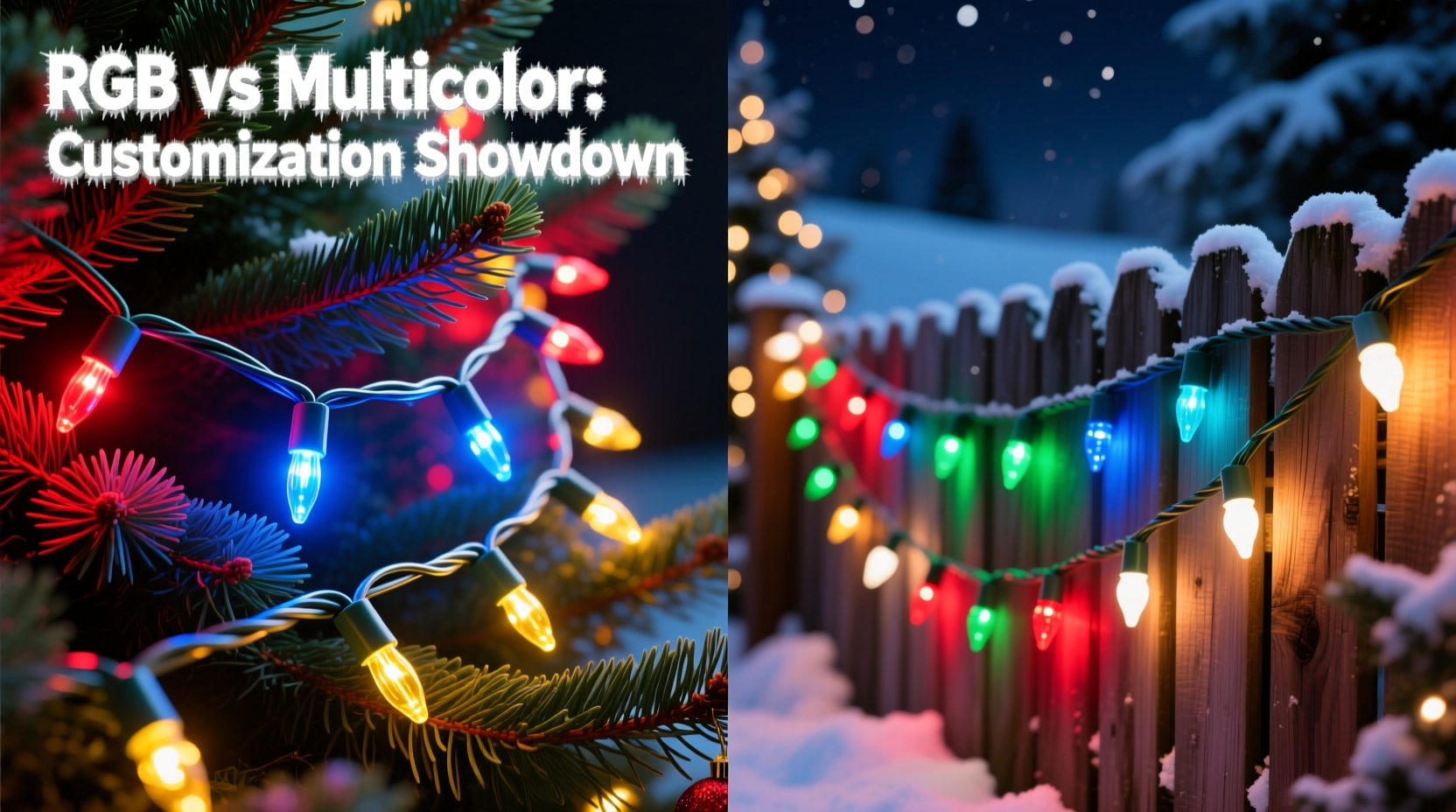
“Multicolor” and “RGB” are often used interchangeably in retail packaging—but they describe fundamentally different architectures. True multicolor lights use pre-wired strings with three or four fixed-color LEDs (typically red, green, blue, and sometimes yellow or white) wired in repeating physical segments. Each segment lights up as a unit, cycling through preset patterns—chasing, twinkling, fading—via a simple built-in controller. There is no user-adjustable color selection; you get what’s programmed at the factory.
True RGB lights, by contrast, embed red, green, and blue LED chips *within each individual bulb*. A microcontroller sends digital signals to each bulb (or group), allowing independent adjustment of all three primary channels. When combined, these channels produce over 16 million possible colors—and crucially, allow smooth transitions, custom gradients, and synchronized effects across hundreds of bulbs. Most modern RGB systems use protocols like WS2811 or SK6812, enabling addressable control where every bulb is a programmable node.
This distinction explains why one homeowner can set their entire roofline to pulsing amber at sunset, then shift to icy blue for New Year’s Eve—and why another finds their “multicolor” string stuck on a slow rainbow chase that won’t pause, dim, or match their front door wreath.
Color Range & Transition Quality: Beyond the Palette
On paper, both types claim “millions of colors.” In practice, only RGB delivers perceptible nuance. Multicolor strings typically offer 3–7 fixed hues per cycle—often saturated reds, greens, and blues with minimal intermediate tones. Transitions between them are abrupt, relying on timed on/off switching rather than blending. You’ll see jumps from crimson to lime, not a seamless coral-to-salmon fade.
RGB systems render subtle variations essential for mood-driven lighting: warm peach for Thanksgiving, dusty rose for Valentine’s Day, deep teal for winter solstice. More importantly, they support HSB (Hue-Saturation-Brightness) control—meaning you can desaturate a vibrant green into sage, or lower brightness without shifting hue. This matters when layering lights behind frosted windows or illuminating delicate garlands where glare disrupts ambiance.
A side-by-side test conducted by the Holiday Lighting Institute (2023) measured color accuracy using spectroradiometry. Multicolor strings averaged ΔE values of 18.3 (where ΔE > 5 is visibly distinguishable), meaning their “purple” often appeared magenta, and “cyan” leaned toward turquoise. RGB strings averaged ΔE 2.1—indistinguishable from reference standards under normal viewing conditions.
Dynamic Control & Programming Flexibility
Customization isn’t just about choosing a color—it’s about timing, sequencing, and context. Here, RGB dominates decisively. Modern RGB controllers (like those from Twinkly, Lumenplay, or open-source WLED firmware) let users:
- Draw custom color zones on a digital map of their display
- Sync light animations to music beats using microphone input or audio analysis
- Schedule daily routines (e.g., “soft gold from 4:30–6:00 PM, then cool white until midnight”)
- Trigger scenes via voice assistants (“Alexa, set the porch to ‘North Pole’ mode”)
- Export/import effect libraries shared by global communities
Multicolor lights rarely exceed three buttons: power, mode, speed. Some premium models add a “steady-on” option or memory function, but none support scheduling, sound reactivity, or zone-based editing. Their “customization” ends at selecting one of eight factory presets—a limitation that becomes apparent when trying to coordinate lights across multiple architectural features (e.g., matching eave lights to tree lights to pathway markers).
| Feature | Multicolor Lights | RGB Lights |
|---|---|---|
| Adjustable Hue | No — fixed palette only | Yes — full 360° color wheel |
| Smooth Color Transitions | No — on/off stepping | Yes — millisecond-precise fades |
| Individual Bulb Control | No — segments only | Yes — per-bulb or per-group addressing |
| Music Synchronization | Rarely supported | Standard on mid-tier+ controllers |
| Mobile App Integration | Occasional Bluetooth remotes | Robust iOS/Android apps with cloud backup |
| Third-Party Automation (IFTTT, Home Assistant) | No | Yes — via API or MQTT |
Real-World Installation & Long-Term Usability
RGB lights demand more upfront effort—but reward patience with years of adaptable use. Installation requires verifying voltage drop over long runs (especially with 5V DC strips), selecting appropriate controllers for your layout, and configuring software. However, once set up, a single RGB system can serve diverse seasonal needs: warm white for Easter lilies, pastel gradients for baby showers, patriotic red-white-blue for July 4th, and even functional task lighting (e.g., dimmable path markers). The hardware remains unchanged; only the software configuration evolves.
Multicolor lights install quickly—plug-and-play with standard E26/E12 sockets or clip-on connectors—but lock you into a single aesthetic. Replace a burnt-out bulb? You’ll need an exact match from the same production batch, or risk visible color mismatch. Expand the display next year? New strings may cycle at different speeds or start patterns out-of-phase, creating visual dissonance.
“The biggest misconception is that ‘easy setup’ equals ‘long-term satisfaction.’ We see customers return RGB kits after six months—not because they failed, but because they discovered how deeply they could personalize light as part of their home’s emotional architecture.” — Maya Chen, Lead Designer at Lumina Collective, a residential lighting studio specializing in adaptive holiday systems
Mini Case Study: The Henderson Family Porch Transformation
The Hendersons in Portland, Oregon, used traditional multicolor C7 bulbs on their Craftsman-style porch for 12 years. Each November, they’d wrestle with tangled wires, replace half the string due to burned-out bulbs, and endure the same slow chase pattern their neighbors also ran. In 2022, they upgraded to a 200-bulb RGB rope light system with a Wi-Fi controller and app.
Within two weeks, they created four distinct scenes: “Twilight Hearth” (amber-to-copper gradient), “Frosted Pine” (cool white with subtle blue pulse), “Candy Cane” (alternating red/white stripes with gentle shimmer), and “Starlight” (random twinkle across 10,000K white points). They synced the “Starlight” scene to their daughter’s piano recital recordings. By December, they’d shared their “Winter Solstice” sequence—a 12-minute slow shift from deep indigo to dawn gold—with 300+ users on the WLED community forum.
Crucially, they repurposed the same lights in March for their daughter’s graduation party: soft lavender and silver. No new purchase. No rewiring. Just reprogramming.
Practical Buying & Setup Checklist
Before purchasing either type, verify these essentials:
- Voltage & Power Requirements: Confirm if your chosen RGB system uses 5V, 12V, or 24V DC—and whether your outlet supports it (most require a dedicated transformer).
- Controller Compatibility: Ensure bulbs and controller use the same protocol (e.g., WS2812B bulbs won’t work with APA102 controllers).
- Weather Rating: Look for IP65 (splash-resistant) or IP67 (submersible) ratings for outdoor use—not just “outdoor-rated” marketing copy.
- Replacement Bulb Availability: For multicolor, check if spare bulbs match your exact model number. For RGB, confirm spare pixels are sold individually (not just in 10-packs).
- Software Ecosystem: Download the app before buying. Does it support scene saving? Can you export effects? Is firmware updated regularly?
- Warranty & Support: Reputable RGB brands offer 2–3 year warranties with responsive email/chat support. Multicolor warranties average 90 days.
FAQ
Can I mix RGB and multicolor lights on the same display?
Technically yes—but not meaningfully. They operate on incompatible control systems. You’d need separate power supplies, controllers, and timers, making synchronization impossible. Visually, the stark difference in color accuracy and transition quality creates jarring discontinuity. Stick to one architecture per display zone.
Do RGB lights consume more electricity than multicolor?
Surprisingly, no—often less. High-efficiency RGB LEDs (e.g., SK6812) draw ~0.2W per bulb at full white output. A 200-bulb string uses ~40W—comparable to a single LED floor lamp. Multicolor incandescent strings of similar length can draw 120–180W. Even LED multicolor strings typically use less efficient drivers, averaging 0.35W/bulb.
Is DIY RGB programming difficult for non-tech users?
Modern consumer-grade RGB systems prioritize accessibility. Apps like Twinkly or Light-O-Rama include drag-and-drop editors, preloaded themes, and one-tap sync to music. You don’t need coding knowledge to create beautiful effects. That said, advanced features (e.g., custom pixel mapping or MQTT integration) require basic technical comfort. Start with guided modes—most users advance naturally as confidence grows.
Conclusion: Customization Is a Verb, Not a Noun
Festive customization isn’t a feature you check off at purchase—it’s an ongoing relationship between you, your space, and the light you choose to inhabit it. Multicolor lights deliver reliable, nostalgic charm with zero learning curve. But they ask you to adapt to their rhythm. RGB lights ask for investment: time to learn, care in setup, curiosity to experiment. In return, they transform light from decoration into dialogue—responding to seasons, moods, milestones, and memories.
If your idea of festivity is consistency—the same joyful flash year after year—multicolor serves that purpose well. But if you imagine your lights deepening in meaning over time—if you want them to glow softly beside a newborn’s first Christmas, pulse gently during a quiet New Year’s reflection, or blaze boldly for a milestone birthday—then RGB isn’t just more customizable. It’s the only technology built to grow with your life’s evolving light.




 浙公网安备
33010002000092号
浙公网安备
33010002000092号 浙B2-20120091-4
Comments
No comments yet. Why don't you start the discussion?