
When it comes to decorating for the holidays, few elements set the tone like Christmas lights. Whether you're wrapping them around trees, draping them over rooftops, or lining your porch railings, the choice between RGB and single-color lights can dramatically influence not only the look of your display but also how much control you have over its appearance. While both types serve their purpose, understanding the differences in customization potential, ease of use, energy efficiency, and long-term value helps you make a decision that aligns with your vision.
The rise of smart lighting technology has made RGB (Red-Green-Blue) LED strings increasingly popular, offering dynamic color shifts and programmable effects. Yet, traditional single-color lights—especially warm white and cool white variants—still dominate many neighborhoods due to their classic appeal and simplicity. But which is truly better when customization is your top priority?
Understanding RGB vs Single Color Lights
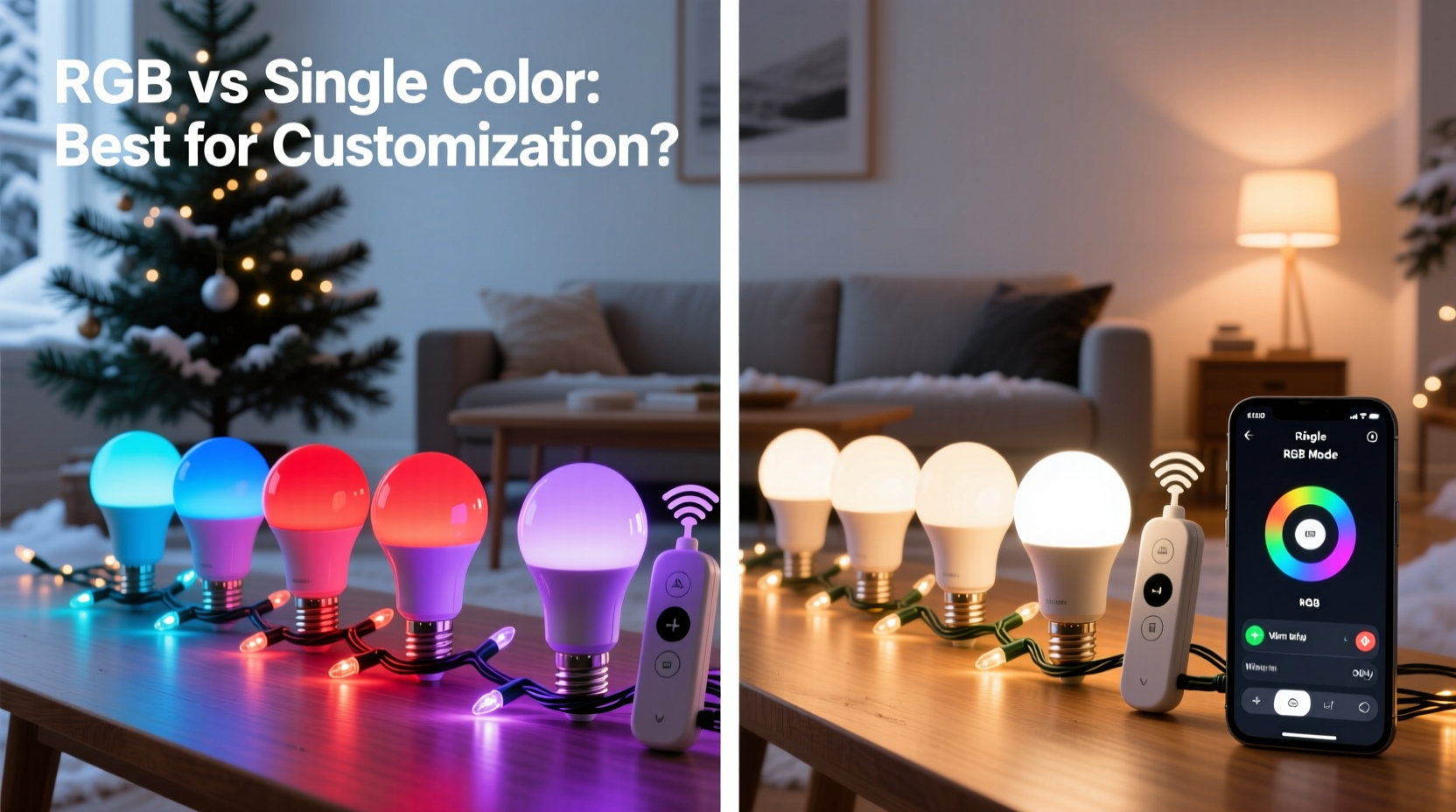
At their core, single-color Christmas lights emit one fixed hue. Most commonly found in warm white, cool white, multi-colored (non-changing), red, blue, green, or amber, these lights are straightforward: plug them in, and they glow consistently. They’re ideal for traditionalists who appreciate timeless elegance without complexity.
In contrast, RGB lights contain tiny LEDs capable of producing millions of colors by mixing varying intensities of red, green, and blue light. Many modern versions are addressable or segment-controllable, meaning individual bulbs or sections along the string can be programmed independently. When paired with controllers or smartphone apps, users can create animated sequences, synchronize lights to music, or change themes based on occasion.
This fundamental difference shapes everything from setup time to seasonal versatility. A homeowner using single-color lights might enjoy a cozy, consistent ambiance year after year. Meanwhile, someone with an RGB setup could switch from festive red-and-green patterns on Christmas Eve to patriotic red-white-and-blue animations on Independence Day—all without changing a single bulb.
Customization Capabilities Compared
Customization isn’t just about aesthetics—it’s about adaptability, personal expression, and creating memorable experiences. Here's where the gap between RGB and single-color lights becomes most apparent.
Color Range and Flexibility
Single-color lights are limited to their built-in shade. You can layer different strings (e.g., warm white and cool white) to achieve subtle contrasts, but each strand remains unchangeable once installed. This makes them predictable but inflexible.
RGB lights, however, provide access to nearly the full visible spectrum. With proper software or remote control, you can dial in pastel pinks, deep purples, ocean blues, or even custom hues like “mistletoe green.” Some systems allow gradient fades across strands, chasing effects, twinkling simulations, and timed transitions—features impossible with standard sets.
Control Options
Most single-color lights come with basic on/off switches or simple timers. Advanced versions may include dimmers or preset flash modes, but these are rare. In contrast, RGB systems often support:
- Smartphone apps (via Wi-Fi or Bluetooth)
- Voice control integration (Alexa, Google Assistant, Siri)
- Scheduling features (set times for turning on/off or changing scenes)
- Music synchronization (lights pulse or shift in response to sound)
- Zoning capabilities (control front yard vs. back patio separately)
For tech-savvy decorators, this level of control transforms outdoor lighting into an interactive experience. One user reported programming their RGB roofline to mimic a slow snowfall effect during winter nights, then switching to rainbow waves for neighborhood block parties.
“RGB lighting gives homeowners artistic freedom they never had before. It’s no longer about illumination—it’s about storytelling through light.” — Jordan Lin, Smart Home Lighting Designer at LumenCraft Studios
Installation and Maintenance Considerations
While RGB lights offer superior customization, they require more planning and technical know-how during installation. Single-color lights are typically plug-and-play: connect the strands end-to-end, hang them up, and enjoy.
RGB setups often involve additional components such as controllers, power injectors (for longer runs), and network connectivity modules. Misconfigurations can lead to flickering, dropped signals, or partial failures. Additionally, not all RGB strings are compatible with every controller brand, so interoperability must be checked beforehand.
Durability and Longevity
Both types generally use LED technology, making them energy-efficient and long-lasting compared to older incandescent models. However, because RGB LEDs contain three internal diodes per bulb, there’s a slightly higher chance of component failure over time. That said, high-quality RGB strings from reputable brands now match the lifespan of single-color LEDs—often rated for 25,000 to 50,000 hours.
Maintenance-wise, both should be stored carefully in climate-controlled environments and inspected annually for damaged sockets or frayed wires. The main difference lies in data integrity: if an RGB string loses communication with its controller due to moisture ingress or wire corrosion, troubleshooting may require technical diagnostics rather than a simple visual check.
Cost Analysis: Upfront vs Long-Term Value
Price is often a deciding factor. Single-color Christmas lights remain significantly cheaper upfront. Basic 100-light strands retail between $8 and $15. Premium versions with commercial-grade durability or specialty finishes (like vintage Edison-style bulbs) may reach $25–$40.
RGB light strings start around $25 for basic non-addressable versions and climb to $60+ for Wi-Fi-enabled, app-controlled, or addressable strips. Add a central hub or multiple controllers, and total system costs can exceed $200—even before professional installation.
However, when evaluating long-term value, RGB systems often justify their cost. Their ability to replace multiple single-color sets reduces clutter and storage needs. One study of residential smart lighting adopters found that 73% used their RGB installations for at least four major events per year—including Halloween, Thanksgiving, New Year’s, and Easter—effectively amortizing the initial investment across seasons.
| Feature | Single-Color Lights | RGB Lights |
|---|---|---|
| Average Price (per 100 lights) | $8–$25 | $25–$60+ |
| Number of Colors Available | 1 (fixed) | 16 million+ (variable) |
| Remote/App Control | Rare | Common |
| Lifespan (hours) | 25,000–50,000 | 25,000–50,000 |
| Best For | Traditional displays, budget projects | Dynamic displays, multi-event use |
Real-World Example: A Suburban Holiday Display Evolution
Consider the case of Marcus Reed, a homeowner in Portland, Oregon, who began decorating his home modestly in 2018 with warm white lights and a few red-and-green icicle strands. By 2020, he upgraded to a full RGB roofline and tree wrap system after attending a local holiday lighting workshop.
Initially hesitant about the learning curve, Marcus spent one weekend setting up a Wi-Fi-connected controller and mapping out zones via a mobile app. Within days, he was creating custom scenes: gentle red-gold pulses for quiet evenings, fast rainbow chases for weekend nights, and synchronized snowflake animations triggered by motion sensors.
By 2022, his display attracted hundreds of visitors each December, with neighbors coordinating visits around scheduled “light shows” synced to holiday playlists. More importantly, Marcus reused the same setup for Valentine’s Day (pink and red hearts), St. Patrick’s Day (green shamrock flashes), and July 4th (red-white-blue wave patterns).
Though his initial investment was $320—nearly ten times what he previously spent—the ability to repurpose the lights year-round reduced replacement costs and eliminated storage for multiple themed sets. As Marcus put it: “I bought a lighting system, not just Christmas lights.”
Step-by-Step Guide to Choosing the Right Option
Deciding between RGB and single-color lights doesn't have to be overwhelming. Follow this logical process to ensure your choice fits your goals:
- Define Your Purpose: Are you aiming for a classic, elegant look or a dynamic, eye-catching display? If tradition and simplicity matter most, single-color wins. If creativity and interactivity are priorities, lean toward RGB.
- Assess Technical Comfort: Can you manage app-based controls, firmware updates, and basic networking? If not, single-color lights avoid frustration. Consider starting with a hybrid approach—use RGB for focal points (trees, entryways) and single-color for background areas.
- Budget Realistically: Calculate total costs, including controllers, extension cables, and potential surge protectors. Don’t forget ongoing electricity usage—though both types are efficient, larger RGB systems may draw more power during active animations.
- Plan for Storage and Reuse: Will you take down the lights after Christmas, or do you want to keep them up for other occasions? RGB excels here due to reprogrammability.
- Test Before Full Installation: Set up a small section indoors first. Verify connectivity, brightness, and color accuracy under real conditions before committing to full deployment.
Frequently Asked Questions
Can I mix RGB and single-color lights in the same display?
Yes, many decorators combine both types effectively. Use single-color lights for structural consistency (e.g., outlining windows) and RGB for accent zones (e.g., wreaths, trees). Just ensure voltage requirements and plug types are compatible to avoid circuit issues.
Do RGB lights consume more energy than single-color ones?
Not significantly. Both use low-wattage LEDs. However, running all three diodes (red, green, blue) at full intensity simultaneously uses slightly more power than a single-color LED. In practice, the difference is minimal—usually less than 1–2 watts per 50-light segment.
Are RGB lights harder to install outdoors?
They can be, due to added electronics. Ensure all controllers and junction boxes are weatherproof or housed indoors. Use outdoor-rated extension cords and avoid submerging any part of the system. Proper planning minimizes complications.
Checklist: Preparing for Your Custom Light Setup
- ☐ Determine primary goal: tradition vs. innovation
- ☐ Measure total linear footage needed for installation
- ☐ Choose between plug-in or battery-powered options
- ☐ Select compatible controller type (app-based, remote, manual)
- ☐ Purchase spare fuses and connectors
- ☐ Test all strands before mounting
- ☐ Plan storage method for off-season protection
- ☐ Schedule annual inspection date
Conclusion: Make Your Holidays Shine—Your Way
The debate between RGB and single-color Christmas lights ultimately hinges on intent. If your vision centers on warmth, nostalgia, and effortless charm, single-color lights deliver unmatched simplicity and affordability. But if you crave creative control, seasonal versatility, and the ability to craft immersive experiences, RGB technology opens doors previously reserved for professional designers.
Today’s lighting tools empower individuals to become artists of light and mood. Whether you choose the steady glow of a classic white strand or the vibrant dance of a fully programmable RGB array, your display reflects more than decoration—it reflects personality, care, and celebration.




 浙公网安备
33010002000092号
浙公网安备
33010002000092号 浙B2-20120091-4
Comments
No comments yet. Why don't you start the discussion?