
As holiday lighting evolves from simple strands of incandescent bulbs to fully programmable smart systems, homeowners face a pivotal decision: should they invest in RGB smart Christmas lights or stick with single-color smart variants? The answer depends on how much control, creativity, and complexity you want in your seasonal display. While both types offer remote operation, scheduling, and app integration, their capabilities diverge significantly when it comes to customization. Understanding these differences helps ensure you choose the right system for your home, budget, and aesthetic goals.
The Core Difference: Flexibility vs Simplicity
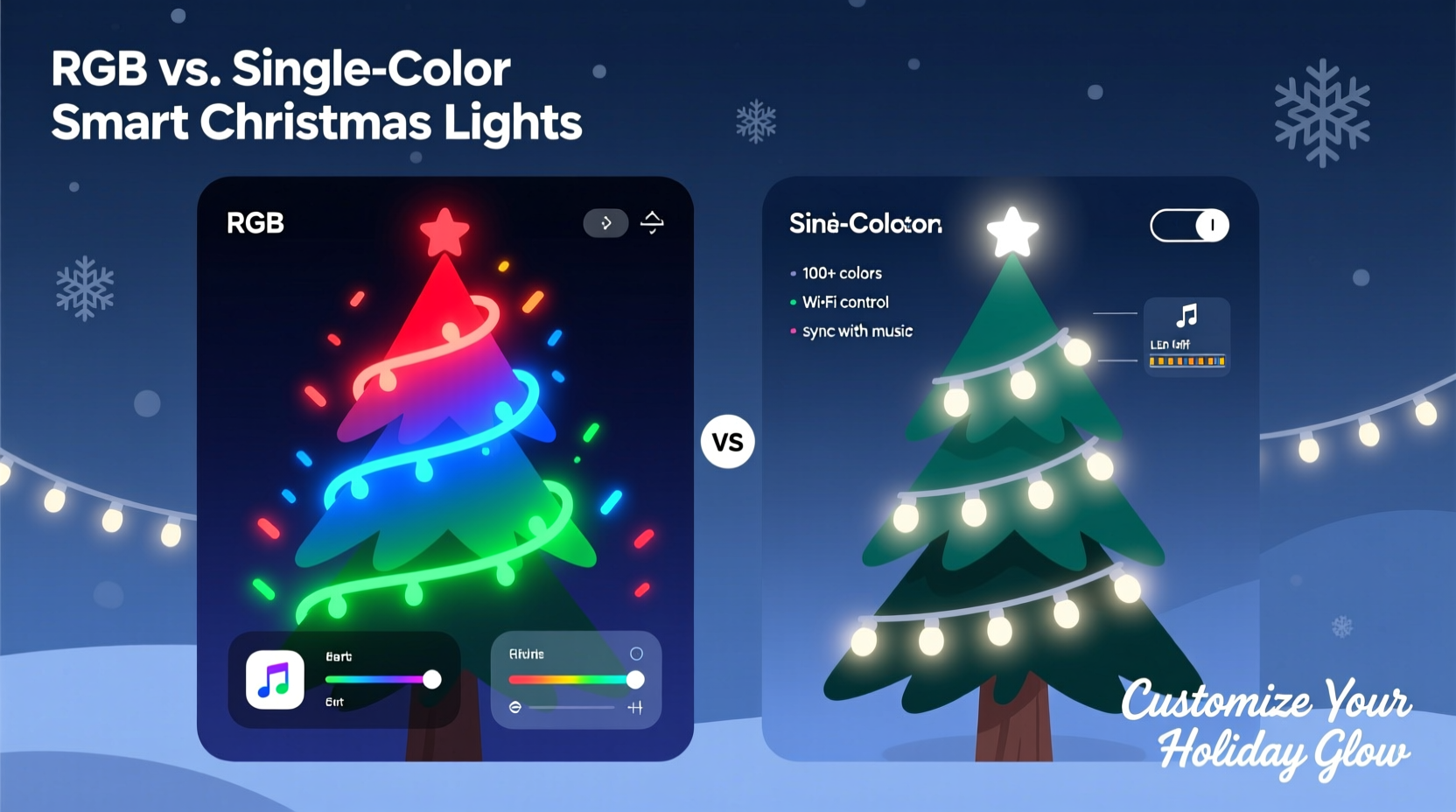
At the heart of the comparison lies a fundamental trade-off: versatility versus predictability. RGB (Red-Green-Blue) smart lights use individual LEDs capable of producing millions of colors by mixing varying intensities of red, green, and blue light. This allows each bulb—or segment of bulbs—to be programmed independently, enabling dynamic effects like color waves, chases, fades, and music synchronization.
In contrast, single-color smart lights emit one fixed hue—typically warm white, cool white, or soft white—and cannot change color. Their smart features are limited to brightness adjustment, on/off scheduling, and sometimes dimming patterns like twinkling or pulsing. They mimic traditional Christmas lights but with modern convenience.
This distinction shapes everything from installation effort to long-term enjoyment. RGB lights open the door to artistic expression, while single-color lights prioritize elegance and ease.
Customization Capabilities Compared
When evaluating customization, consider not just color options but also pattern control, zoning, and personalization potential.
- RGB Lights: Allow full spectrum color selection, custom animations, scene saving, voice-triggered effects, and multi-zone programming. You can set the roofline to pulse red and green while the tree slowly cycles through pastels—all controlled from one app.
- Single-Color Lights: Offer limited customization. You might adjust brightness from 10% to 100%, schedule gradual dimming at night, or activate a “twinkle” mode. But the core output remains unchanged: consistent white light that blends naturally with snow or architectural details.
For those who view their holiday display as an extension of personal style, RGB lights provide unparalleled creative freedom. For purists who value subtlety and cohesion, single-color lights deliver timeless charm without distraction.
Control Systems and App Experience
Both RGB and single-color smart lights connect via Wi-Fi, Bluetooth, or proprietary hubs, integrating with platforms like Alexa, Google Assistant, and Apple HomeKit. However, the depth of control varies dramatically.
RGB systems typically come with advanced apps that include:
- Color pickers with hex code input
- Animation builders (speed, direction, transition type)
- Saving and naming custom scenes (“Santa’s Arrival,” “New Year’s Eve Pulse”)
- Music-reactive modes using microphone input
- Zoning tools to group different strands into separate controls
Single-color smart lights usually feature simpler interfaces focused on:
- On/off timers
- Brightness sliders
- Preset effects like fade or blink
- Geofencing (turning lights on when you arrive home)
The user experience reflects this divide. Managing RGB setups often requires more time and technical comfort. Single-color systems are plug-and-play by comparison—ideal for users who want automation without complexity.
“RGB lighting turns your house into a canvas. But if you're not ready to paint every night, a single-color setup gives you reliability and warmth without the learning curve.” — Daniel Reeves, Smart Home Lighting Designer
Installation and Maintenance Considerations
Installation difficulty increases with functionality. RGB lights often require more planning due to data lines, power requirements, and segmentation rules. Many models use 5V DC power with controllers that must be protected from moisture. In contrast, most single-color smart lights operate on standard 120V AC and function like traditional strings, making them easier to daisy-chain and mount.
Maintenance is another factor. RGB strips and nodes have more components—individual LEDs, IC chips, and data drivers—that can fail. A single malfunctioning pixel can disrupt an entire segment. Single-color strings, especially LED filament types, are more durable and less prone to partial failures.
| Feature | RGB Smart Lights | Single-Color Smart Lights |
|---|---|---|
| Color Range | 16 million+ colors | One fixed white tone |
| Brightness Control | Yes (per color/scene) | Yes (dimming only) |
| Animation Effects | Multiple (wave, chase, strobe, etc.) | Limited (twinkle, fade) |
| Power Requirements | Often 5V DC + controller | Standard 120V AC |
| Durability | Moderate (more failure points) | High (fewer components) |
| App Complexity | Advanced (scenes, zones, music sync) | Basic (on/off, dimming) |
| Price per Foot | $2.50–$5.00 | $1.00–$2.50 |
Energy Efficiency and Longevity
Both types use LED technology, so energy consumption is low compared to older incandescent sets. However, RGB lights consume slightly more power due to active color mixing and controller overhead. A typical 50-light RGB string may draw 4–6 watts, while a comparable single-color set uses 3–4 watts.
Lifespan averages 25,000 to 50,000 hours for both, but real-world longevity favors single-color lights. Fewer electronic components mean fewer points of failure. Additionally, cheaper RGB sets may degrade faster in extreme temperatures due to exposed circuitry.
Real-World Example: Two Homes, Two Approaches
Consider two neighbors preparing for the holidays:
Home A belongs to Maya, a graphic designer who loves hosting themed parties. She installs addressable RGB lights along her eaves, porch columns, and driveway trees. Using her smart lighting app, she programs a rotating weekly schedule: classic red/green the first week, icy blue/silver during a snowstorm, and a synchronized music show every weekend. Her display becomes a local attraction, shared widely on social media.
Home B is owned by Tom, a retired architect who values curb appeal and restraint. He lines his roofline and front steps with warm-white smart lights. They turn on automatically at dusk, dim to 30% after midnight, and shut off at 11 PM on weekdays. The effect is elegant, unobtrusive, and consistent—complementing his historic home without overpowering it.
Neither approach is superior. Maya thrives on engagement and spectacle; Tom prioritizes harmony and simplicity. Their choices reflect personal taste as much as technical preference.
Step-by-Step: Choosing the Right Option for Your Needs
Follow this process to determine which system aligns with your goals:
- Assess Your Display Vision – Do you want dramatic color changes and motion, or a steady, inviting glow?
- Evaluate Technical Comfort – Are you comfortable configuring apps, updating firmware, and troubleshooting connectivity?
- Calculate Coverage Area – Measure linear feet needed. RGB lights cost nearly twice as much per foot; budget accordingly.
- Check Power Access – Ensure outlets are nearby or plan for weatherproof extension solutions, especially for low-voltage RGB controllers.
- Test Integration – Confirm compatibility with your existing smart home ecosystem (Google, Alexa, HomeKit).
- Start Small – Try one RGB strand on a tree or railing before committing to a full-house setup.
- Plan for Storage – Use reels or bins labeled by zone to preserve wiring integrity between seasons.
Expert Recommendations and Common Pitfalls
Seasoned installers emphasize balance. Overuse of RGB effects can appear chaotic rather than festive. A common mistake is setting all lights to maximum brightness with rapid flashing—this overwhelms the eye and may annoy neighbors.
Experts recommend:
- Using RGB lights selectively—for focal points like trees, signs, or windows—while framing them with static white lights.
- Limiting animated sequences to special occasions (Christmas Eve, New Year’s) rather than running them nightly.
- Matching color temperature of single-color lights to surroundings (warm white for brick homes, cool white for modern exteriors).
“The best displays tell a story. Too many colors shouting at once don’t create joy—they create noise.” — Lena Choi, Professional Holiday Lighting Consultant
FAQ
Can I mix RGB and single-color smart lights on the same controller?
No, not directly. Most smart systems require uniform light types within a channel. However, you can manage both types simultaneously using a central hub like Home Assistant or a platform like SmartThings that supports multiple device categories.
Do RGB lights look good in daylight?
Generally, no. RGB LEDs are designed for nighttime visibility. During the day, colors appear washed out unless extremely bright. For curb appeal in daylight, architectural design and placement matter more than light color.
Are single-color smart lights worth it if they can’t change color?
Absolutely. Their strength lies in consistency and ambiance. Automated warm-white lights enhance safety, welcome guests, and elevate property aesthetics without requiring attention. They’re ideal for year-round porch or pathway lighting too.
Final Checklist Before Buying
- ✅ Define your primary goal:
- Artistic expression (choose RGB) or ambient enhancement (choose single-color).
- ✅ Confirm voltage and power needs:
- Outdoor RGB often needs transformers; single-color works with standard outlets.
- ✅ Verify app usability:
- Read reviews about interface stability and update frequency.
- ✅ Check weather resistance:
- Look for IP65 or higher, especially for exposed locations.
- ✅ Consider neighbor impact:
- Avoid overly bright or flashing displays that could cause complaints.
- ✅ Plan for scalability:
- Choose brands that allow expansion (e.g., Govee, Philips Hue, LIFX) so you can add strands later.
Conclusion: Make Your Holidays Reflect Your Style
The choice between RGB and single-color smart Christmas lights isn’t about which is better—it’s about which aligns with your vision. RGB lights empower creators, tech enthusiasts, and entertainers to craft immersive experiences. They transform homes into dynamic galleries of light and motion. Single-color smart lights serve those who appreciate refinement, tradition, and effortless elegance. They bring warmth without spectacle.
Many homeowners eventually adopt a hybrid approach: using RGB for seasonal highlights and single-color lights for permanent, tasteful illumination. Whatever path you take, let intention guide your decision. With thoughtful planning, your holiday lighting can delight your family, impress your community, and become a cherished part of your seasonal rhythm for years to come.




 浙公网安备
33010002000092号
浙公网安备
33010002000092号 浙B2-20120091-4
Comments
No comments yet. Why don't you start the discussion?