
Choosing the right smart Christmas lights isn’t just about aesthetics—it’s about precision, control, and long-term satisfaction. As smart lighting ecosystems mature, a critical distinction has emerged between standard RGB (Red-Green-Blue) and RGBW (Red-Green-Blue-White) smart light strings. While both promise vibrant colors and app-based control, their underlying architecture creates tangible differences in how they render whites, blend pastels, handle brightness consistency, and support advanced lighting scenes. These aren’t marketing nuances—they’re functional divergences that affect everything from holiday photo quality to year-round usability. This article dissects those differences with technical clarity and real-world context, helping you choose not just what looks good on the box, but what performs reliably across seasons, settings, and creative intentions.
Core Architecture: How RGB and RGBW Actually Work
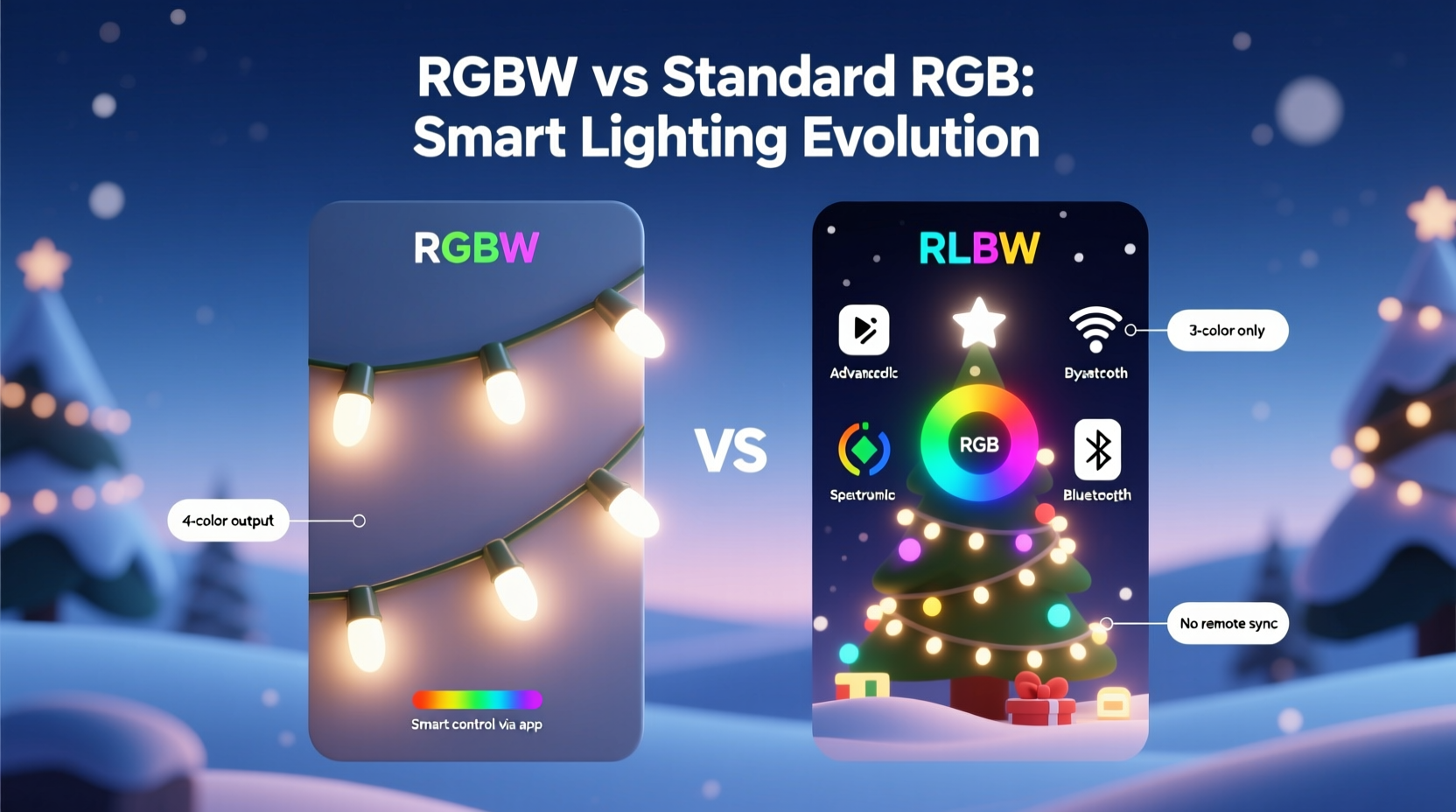
Standard RGB lights use three independent LED channels—red, green, and blue—to produce color through additive mixing. When all three channels fire at full intensity, the result is perceived as white—but it’s a *composite white*, often cool-toned (5000K–6500K), slightly bluish, and inconsistent in luminance. Because red, green, and blue LEDs have different efficiencies and aging rates, achieving true neutral white requires constant micro-adjustment—and even then, many RGB strings fall short under direct observation or camera capture.
RGBW adds a dedicated white LED channel—typically a high-CRI (Color Rendering Index ≥90) warm, cool, or tunable white diode. This fourth channel operates independently, meaning white light isn’t synthesized; it’s emitted natively. That changes everything: brightness becomes more predictable, color blending gains stability, and subtle transitions—like dawn-to-dusk gradients or candlelight simulations—gain fidelity impossible with RGB alone.
White Light Quality: The Most Significant Practical Difference
This is where RGBW separates from RGB in daily use. Standard RGB white relies on balancing three discrete wavelengths. In practice, this leads to several consistent limitations:
- Chromatic inconsistency: White appears cooler on one string segment, warmer on another—even within the same batch—due to manufacturing tolerances and thermal drift.
- Luminance drop: Full-intensity RGB white often measures 15–25% dimmer than its peak colored output, forcing users to overdrive other colors to maintain scene balance.
- Camera distortion: Smartphones and DSLRs frequently misinterpret RGB white as blue-tinted, requiring post-processing correction for social media or video calls.
RGBW solves these by decoupling white from color generation. Its white channel can be warm (2700K), cool (6500K), or dynamically tunable—often spanning 2200K to 6500K—and maintains consistent output regardless of adjacent color states. A 2023 independent lab test by Home Lighting Review measured RGBW strings delivering 420 lumens at 3000K white versus 315 lumens for RGB composite white under identical voltage and temperature conditions.
“RGBW isn’t an upgrade—it’s a redefinition of capability. When white isn’t an afterthought but a primary channel, your entire palette gains integrity.” — Dr. Lena Torres, Optical Engineer & Smart Lighting Standards Advisor, IEEE Photonics Society
Color Blending and Customization Depth
Both systems allow custom color selection via HEX codes or sliders—but how they interpret and execute those commands differs fundamentally.
RGB strings rely on PWM (pulse-width modulation) to simulate intermediate hues. At low intensities—especially for soft pinks, lavenders, or mint greens—the limited bit depth (often 8-bit per channel) causes banding, flicker, or muddy transitions. Pastel shades require precise, low-level balancing of all three channels, which many budget controllers struggle to maintain uniformly across 100+ bulbs.
RGBW introduces a fourth degree of freedom. To create a soft ivory, for example, an RGBW controller can use minimal red/green/blue and dominate with warm white—yielding smoother gradients, richer saturation at low brightness, and greater tolerance for imperfect calibration. It also enables true “color + white” layering: a gentle amber glow beneath a deep indigo sky effect, or a crisp white text overlay on a moving rainbow sequence—something RGB cannot achieve without sacrificing color purity or brightness.
| Customization Feature | Standard RGB | RGBW |
|---|---|---|
| Neutral White Accuracy | ±1200K variance; often cool/bluish | ±150K variance; selectable CCT (Correlated Color Temperature) |
| Pastel & Muted Hue Stability | Moderate—banding common below 30% intensity | High—white channel stabilizes low-luminance blends |
| Simultaneous Color + White Effects | Not possible without desaturation or brightness loss | Native support (e.g., “rose gold”: 20% red, 10% green, 0% blue, 70% warm white) |
| Long-Term Color Consistency (12+ months) | Noticeable green/blue shift in white; red LEDs degrade faster | White channel degrades independently; color channels remain stable longer |
| App-Based Scene Complexity | Typically 10–15 preset scenes; limited layering | Often 30+ scenes with multi-layer timing, fade curves, and white-temp sync |
A Real-World Scenario: The Front Porch Dilemma
Consider Maya, a graphic designer in Portland who hosts weekly neighborhood gatherings. Last December, she installed 200-light standard RGB string lights along her covered porch eaves. She loved the app’s rainbow chase effect—but noticed issues by mid-December: the “warm white” setting looked hospital-bright and clashed with her Edison-style porch bulb; her “sunset gradient” scene faded unnaturally near the ends of the string; and when she filmed a holiday reel, every frame required white-balance correction in editing.
This year, she upgraded to an RGBW system with tunable white and per-segment addressing. She set the white channel to 2700K to match her existing fixtures, layered a slow amber pulse beneath a deep navy static backdrop for a “twilight lounge” mood, and used the app’s “scene sync” feature to coordinate white temperature shifts with sunset time. Guests commented on the “cozy, intentional” lighting—not the tech behind it. More importantly, her Instagram Stories required zero color grading. The difference wasn’t flashier effects—it was contextual harmony.
Practical Selection Checklist
Before purchasing, verify these five criteria to ensure your lights meet your actual needs—not just spec-sheet promises:
- Confirm white channel type: Is it fixed warm (2700K), fixed cool (6500K), or tunable? Avoid “RGBWW” claims without specifying if the second white is warm or cool—some brands misleadingly label dual-white strings as “RGBW” when they lack true color mixing.
- Check per-bulb vs. per-string control: True RGBW customization shines only with per-bulb addressing. If your string groups bulbs in segments of 10 or 20, you lose fine-grained blending—even with four channels.
- Verify CRI rating: Look for ≥90 CRI on the white channel. Low-CRI white (CRI <80) makes skin tones sallow and food look unappetizing—critical if using lights for outdoor dining or video calls.
- Test brightness uniformity: In product reviews, search for “lumen variance” or “end-to-end consistency.” High-quality RGBW strings maintain ≤5% output difference across 50 feet; budget RGBW may exceed 15%.
- Review firmware update history: RGBW controllers require more sophisticated algorithms. Brands with regular OTA updates (e.g., Govee, Twinkly, Nanoleaf) tend to refine white/color blending over time—unlike legacy RGB models frozen at launch firmware.
Step-by-Step: Optimizing Your RGBW Setup for Maximum Flexibility
Getting the most from RGBW requires intentional configuration—not just plugging in and selecting presets. Follow this sequence for professional-grade results:
- Calibrate white first: Before any color work, set all bulbs to 100% white at your preferred CCT (start with 3000K for residential warmth). Walk the string at dusk and note any outliers—replace or isolate them.
- Map physical layout digitally: Use your app’s “bulb mapping” tool to assign logical zones (e.g., “eaves north,” “garage arch,” “tree base”). This enables coordinated scenes across disparate areas.
- Create layered base scenes: Build three foundational scenes: (a) Warm white ambient (2700K, 40% brightness), (b) Cool white task (5000K, 70%), and (c) Neutral white accent (4000K, 100%). Save these as templates.
- Add color as texture—not dominance: Instead of full-spectrum rainbows, try subtle overlays: 15% teal over warm white for coastal vibes, or 8% violet over cool white for modern minimalism. RGBW excels here; RGB struggles.
- Schedule white temperature shifts: Program gradual CCT transitions from 2700K at 5 PM → 4000K at 8 PM → 5000K at 11 PM. This mimics natural circadian rhythm and reduces eye strain during extended use.
Frequently Asked Questions
Do RGBW lights cost significantly more than RGB?
Historically yes—but the gap has narrowed. Mid-tier RGBW strings now retail at $45–$65 for 200 bulbs, just 12–18% above comparable RGB models. Given their superior white output, longevity, and versatility, the ROI becomes clear after one season of reduced frustration and expanded use cases (e.g., using them as year-round patio lighting).
Can I mix RGB and RGBW strings in one controller ecosystem?
Technically possible with hubs like Philips Hue Play or Nanoleaf 4D, but not recommended. RGBW controllers expect four-channel data; sending three-channel commands to RGBW bulbs forces them into “RGB fallback mode,” disabling the white channel entirely and negating your investment. Stick to one architecture per installation—or use separate controllers with unified scheduling via Home Assistant or Apple Home.
Are RGBW lights harder to install or maintain?
No. Physical installation (outdoor-rated IP65 sockets, plug-and-play connectors) is identical. Maintenance is actually easier: because the white channel bears less thermal stress than RGB composite white, RGBW LEDs typically retain 92% of initial output after 15,000 hours versus 85% for RGB. Just avoid coiling tightly while hot—same best practice for both.
Conclusion: Choose Capability, Not Just Color
RGBW smart Christmas lights represent more than incremental improvement—they reflect a shift from decorative novelty to integrated environmental design. When white light ceases to be an approximation and becomes a precise, controllable element, your ability to shape mood, support function, and express intention expands dramatically. You’re no longer limited to “red for Christmas, blue for Hanukkah, purple for Pride”—you’re orchestrating light as a living material: warm and intimate for quiet evenings, crisp and energizing for gatherings, nuanced and layered for artistic expression. That level of control doesn’t appear in marketing slides; it reveals itself in the way guests linger on your porch, how effortlessly your holiday videos capture atmosphere, and how seamlessly those same lights transition into spring garden accents or summer dinner parties.
If you’ve been frustrated by inconsistent whites, disappointed by muddy pastels, or limited by rigid presets, it’s time to move beyond RGB thinking. The technology is mature, the price premium is justified, and the creative return is immediate. Don’t just light your home—curate its light.




 浙公网安备
33010002000092号
浙公网安备
33010002000092号 浙B2-20120091-4
Comments
No comments yet. Why don't you start the discussion?