
Choosing lighting for your holiday tree isn’t just about brightness or length—it’s about intention. A well-lit tree sets the emotional tone of your home: warm and nostalgic, crisp and modern, playful and dynamic, or serene and meditative. Yet most people default to traditional incandescent or basic LED string lights without realizing how profoundly RGBW smart strips have redefined what “mood lighting” actually means—not as a marketing buzzword, but as a functional, responsive, and deeply personal experience. This isn’t about swapping one bulb for another. It’s about shifting from passive illumination to active expression.
What RGBW Really Means (and Why It’s Not Just “RGB Plus White”)
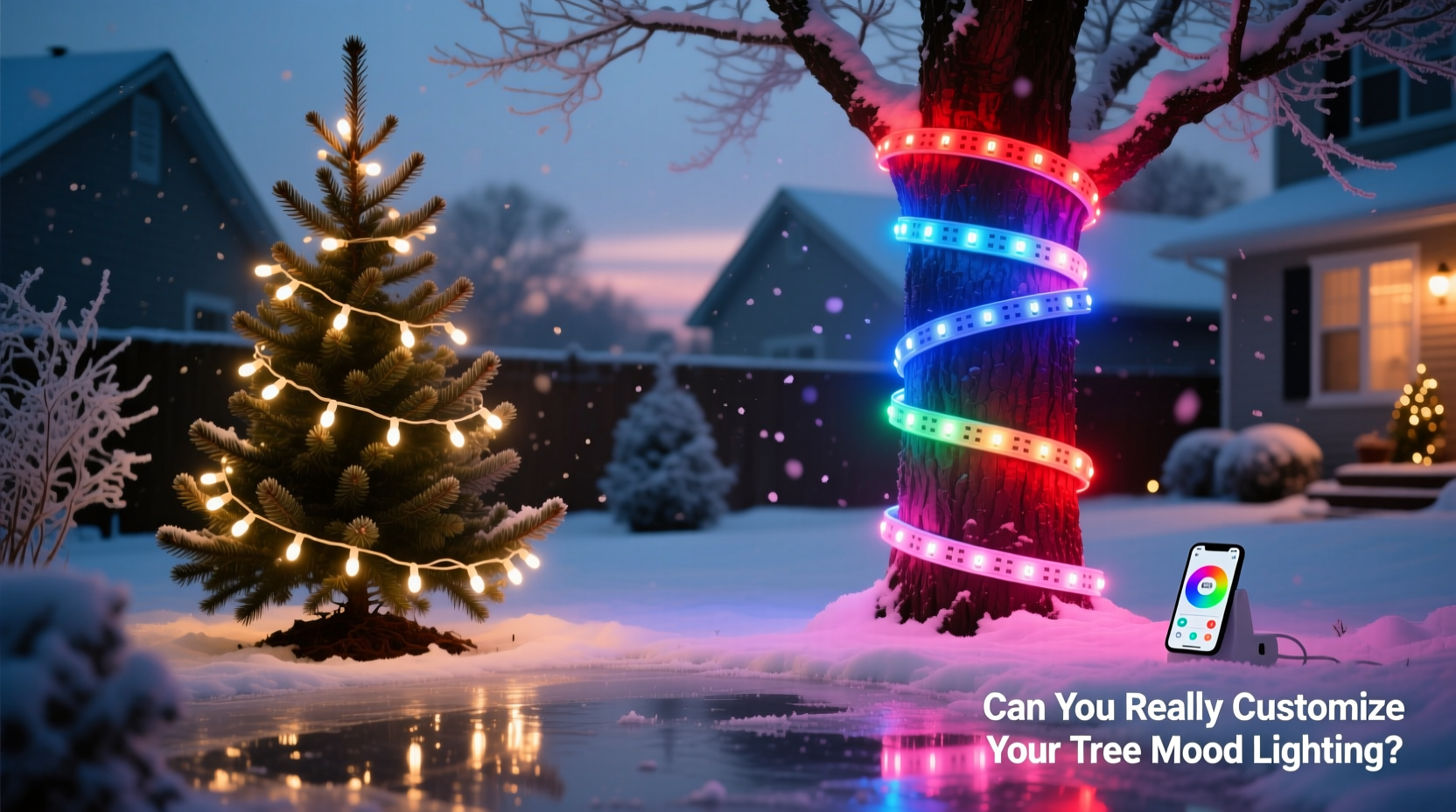
At first glance, RGBW seems like a simple upgrade: red, green, blue, plus white. But that “W” carries technical weight. Unlike standard RGB strips—which mix red, green, and blue diodes to approximate white light (often resulting in cool, bluish, or uneven tones)—RGBW strips include dedicated white LEDs. These are typically split into two channels: warm white (2700K–3000K) and cool white (6000K–6500K), or sometimes a single high-CRI (Color Rendering Index ≥90) white diode. The result? True whites with accurate temperature control, richer pastels, smoother gradients, and far more convincing amber, cream, and ivory tones—critical when simulating candlelight or dusk ambiance on delicate ornaments.
Crucially, RGBW strips operate on 4-channel controllers (or 5+ if including tunable white), enabling independent dimming and blending. That means you can hold a soft 2700K white base while gently overlaying 15% saturated amber for warmth—or pulse a cool white at 1Hz while cycling through muted teals in the background. Regular string lights lack this layering capacity entirely. Their “white mode” is usually a fixed, unadjustable output—often harsh and sterile—and their color modes are pre-programmed sequences with no user-defined timing, intensity, or transition logic.
The Customization Gap: What You Can Actually Control
Real customization isn’t measured in how many colors a device claims to offer—but in how granularly you can shape light over time and space. Here’s where RGBW smart strips deliver measurable advantages over even premium “smart” string lights:
- Per-LED addressability: High-end RGBW strips (e.g., WS2815, SK6812) allow individual LED control along the entire strip. You can make the bottom third of your tree glow amber while the top pulses lavender—something impossible with string lights, which group LEDs into fixed segments (typically 3–10 bulbs per zone).
- Dynamic timing precision: Smart strip controllers let you define fade durations (e.g., 8.3 seconds), hold times (e.g., 2.1 seconds), and transition curves (linear, ease-in, bounce). String lights offer only preset “fade,” “jump,” or “twinkle” modes—with no way to adjust speed, duration, or rhythm.
- Scene persistence & recall: With compatible apps (like WLED, Tuya Smart, or Govee), you can save and name scenes (“Winter Solstice,” “Midnight Jazz,” “Kids’ Storytime”) and trigger them via voice, schedule, or automation. String lights rarely retain more than 2–3 factory presets—and resetting often wipes them.
- Environmental responsiveness: Advanced RGBW setups integrate with motion sensors, ambient light detectors, or even music analyzers. One user synced their tree to local weather data: shifting from cool blue during snowfall to golden amber when sunrise hit—automatically. No string light system offers native API access or open-source firmware for this level of integration.
“True mood lighting requires temporal intelligence—not just color variety. If you can’t define *when* a hue appears, *how long* it lingers, and *how it evolves*, you’re decorating, not curating.” — Dr. Lena Torres, Lighting Psychologist & Author of Chroma & Calm
Practical Comparison: RGBW Strips vs. Regular String Lights
| Feature | RGBW Smart Strips | Regular String Lights (Even “Smart” Models) |
|---|---|---|
| White Light Quality | Dedicated warm/cool white diodes; adjustable CCT (Correlated Color Temperature); CRI ≥90 available | Fixed white output; often cool/blue-tinted; CRI rarely specified (typically 70–80) |
| Color Accuracy | Wide gamut coverage (NTSC ≥110%); calibrated profiles for skin tones, wood, fabric | Limited gamut; oversaturated reds/greens; poor fidelity for natural hues |
| Control Granularity | Per-LED addressing; millisecond-level timing; custom easing functions | Segment-based (3–20 bulbs per zone); fixed animation speeds |
| Installation Flexibility | Cuttable every 1–3 LEDs; adhesive backing; works on irregular surfaces (branches, garlands, trunk wraps) | Rigid spacing; plug-and-play only; limited drape or contouring ability |
| Long-Term Usability | Firmware-upgradable; open-source options (WLED); supports Home Assistant, Matter | Proprietary apps; frequent server deprecation; no local control fallback |
A Real-World Example: Sarah’s Tree Transformation
Sarah, a graphic designer in Portland, used traditional 200-bulb warm-white incandescent strings for 12 years. Her tree looked “festive,” but she described it as “static”—a backdrop, not a presence. Last November, she installed 12 meters of addressable RGBW strip (WS2815) with a WLED-powered ESP32 controller and a custom-wrapped copper wire frame to follow her Fraser fir’s natural taper. She didn’t just pick colors. She built moods:
- Morning: 20% warm white + 5% soft peach—simulating dawn light filtering through windows.
- Dinner Party: Slow amber-to-ivory gradient, holding at 2700K for 45 seconds before shifting to deep moss green (for her husband’s favorite vintage glass ornaments).
- Quiet Evenings: Single-color breathing effect: 2800K white pulsing at 0.3 Hz—matching her resting heart rate, per a biofeedback app integration.
What changed wasn’t just aesthetics. Guests paused longer. Her children asked fewer “are we done yet?” questions. She noticed herself lingering in the living room after work—not to scroll, but to watch light move across pine needles. “It stopped being decoration,” she told us, “and became a quiet collaborator in how I feel at home.”
Your Action Plan: Setting Up Meaningful Tree Lighting (Step-by-Step)
Customization only matters if it’s accessible. Here’s how to implement RGBW lighting without engineering a degree:
- Measure & Plan (15 min): Wrap measuring tape around your tree’s widest section, then up its height. Add 20% for overlap, contouring, and controller placement. Note branch density—sparse trees need denser strip placement (every 2–3 inches); full trees can use 4–6 inch spacing.
- Select Hardware (20 min): Choose 12V or 24V RGBW strips (24V recommended for >5m runs to prevent voltage drop). Pair with a controller supporting at least 4 channels and WLED firmware (e.g., ESP32-WROOM-32 dev board + DIY power supply). Avoid “plug-and-play” kits with sealed controllers—they limit future upgrades.
- Mount Strategically (45 min): Use removable double-sided tape (3M Command™ Outdoor) or plastic zip ties—not staples or nails. Start at the base, spiraling upward with consistent tension. Leave 15cm slack near the trunk for controller access and heat dissipation.
- Configure & Calibrate (30 min): Flash WLED firmware via USB. In the web interface, set your strip type, length, and GPIO pins. Use the “White Balance” tool to match your warm white to existing room lighting (e.g., 2700K bulbs). Save as “Base Warm.”
- Build Your First Mood (20 min): Create a scene named “Candle Glow”: Warm white (100%), Amber (12%), Fade Time: 12s, Transition: Ease-In-Out. Schedule it to activate at sunset using your phone’s location services. Test for 3 evenings—then refine based on how it feels, not how it looks.
FAQ: Addressing Common Concerns
Do RGBW strips get hot enough to damage my tree or ornaments?
No—modern 24V RGBW strips run at under 35°C (95°F) surface temperature even at full brightness. That’s cooler than incandescent strings (which exceed 80°C/176°F) and safer than halogen mini-lights. Just avoid direct contact with delicate paper or silk ornaments for extended periods; airflow around the strip prevents localized heat buildup.
Can I mix RGBW strips with my existing string lights?
Yes—but not electrically. Use separate circuits and controllers. You can synchronize them via automation platforms (e.g., Home Assistant) by triggering both devices with the same event (e.g., “Sunset”). Don’t splice wires or share power supplies—voltage mismatches risk controller failure.
Is the setup worth it if I only use lights for 6 weeks a year?
It depends on your definition of “worth.” Financially, RGBW strips cost 3–5× more upfront than quality string lights. But functionally, they last 50,000+ hours (vs. 2,000–5,000 for incandescents, 15,000–25,000 for basic LEDs). More importantly, they transform seasonal ritual into year-round utility: use the same strip for desk lighting, under-cabinet accenting, or gallery wall highlighting. One user repurposed hers as a “calm corner” light for meditation—proving mood lighting isn’t seasonal. It’s contextual.
Final Thought: Lighting Is Emotional Infrastructure
Your tree isn’t just a tradition. It’s a focal point where memory, expectation, and presence converge. Regular string lights illuminate space. RGBW smart strips illuminate feeling—making visible the subtle shifts in energy you want to invite, sustain, or release. They don’t promise perfection. They offer agency: the ability to say, “Tonight, I choose stillness,” or “This hour, I honor joy,” and have light respond—not as decoration, but as resonance. That level of intentionality doesn’t come from more features. It comes from deeper control, truer color, and the quiet confidence that what you’ve built reflects who you are—not what a manufacturer assumed you’d want.




 浙公网安备
33010002000092号
浙公网安备
33010002000092号 浙B2-20120091-4
Comments
No comments yet. Why don't you start the discussion?