
Choosing the right video doorbell often comes down to more than just image quality or design—it's about what you get without paying a monthly subscription. For many homeowners, ongoing costs are a deciding factor. Ring and Nest (now Google Nest) dominate the smart doorbell market, but their approach to free features differs significantly. While both offer optional premium plans, understanding what each provides at no cost can help you make a smarter, more economical decision.
This comparison dives deep into the free-tier capabilities of the Ring Video Doorbell and the Google Nest Hello, evaluating motion detection, video storage, alert options, two-way talk, smart integrations, and long-term usability. If you're looking for a reliable, no-subscription-required solution, this breakdown will clarify which system delivers more value out of the box.
Motion Detection & Alerts: How Smart Are They Without Paying?
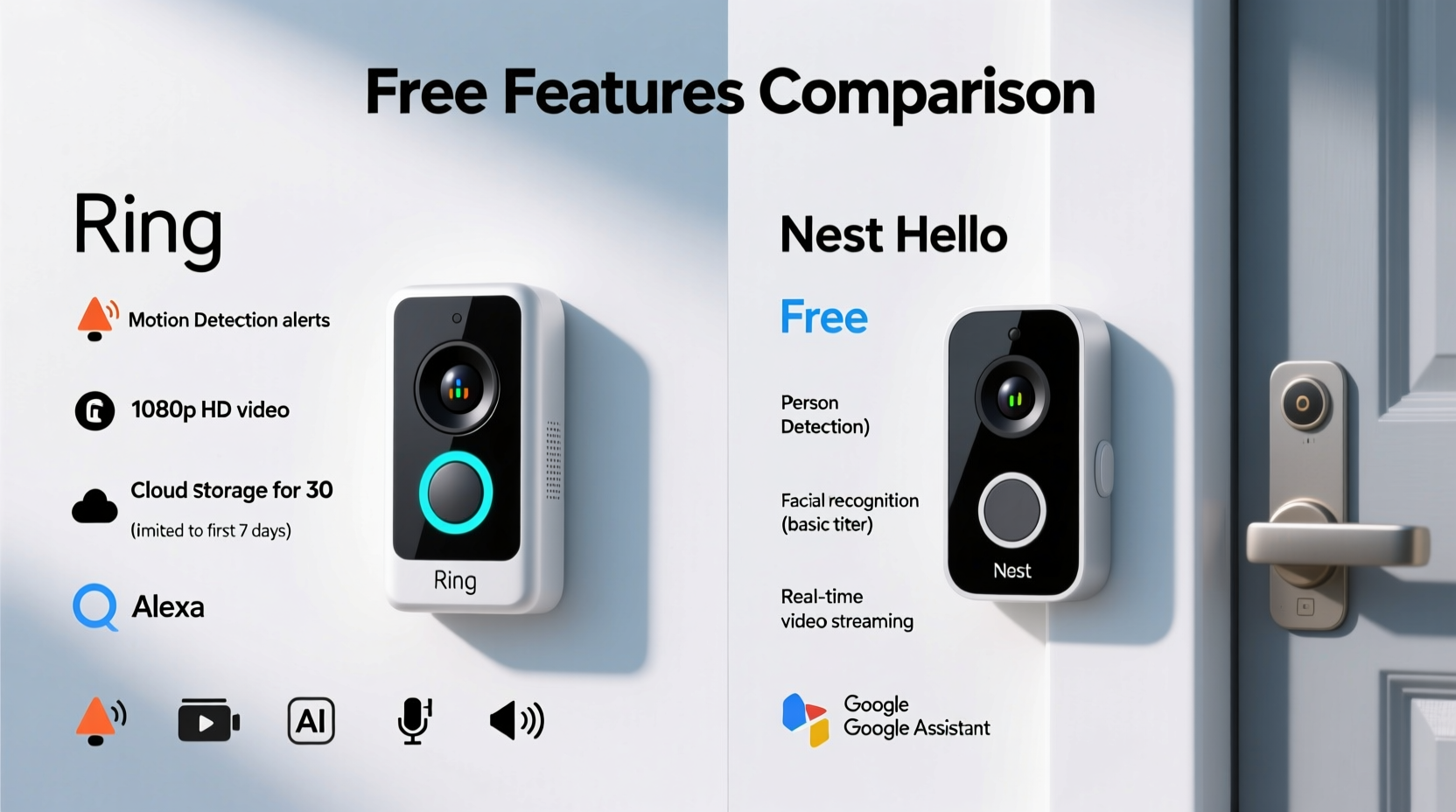
One of the core functions of any video doorbell is detecting motion and notifying you when someone approaches your door. Both Ring and Nest Hello include basic motion alerts in their free tiers, but how they function—and how customizable they are—varies.
Ring’s free plan offers real-time push notifications when motion is detected. However, customization is limited. You can adjust sensitivity between low, medium, and high, but there are no advanced settings like motion zones or person-specific alerts without upgrading to Ring Protect Basic ($3/month). This means you may receive frequent false alerts from passing cars or swaying trees if your doorbell faces a busy street.
Nest Hello, on the other hand, includes intelligent alerts even on its free tier. Thanks to Google’s AI processing, it distinguishes between people, animals, vehicles, and packages—sending categorized notifications accordingly. This feature remains available without a subscription, making Nest Hello far more precise in identifying relevant activity. You also get facial recognition for familiar faces, though full history requires a paid plan.
The advantage here clearly goes to Nest Hello. Its ability to filter alerts using AI-driven classification gives users meaningful information without requiring payment. Ring’s simpler alerts may suffice for quiet neighborhoods, but lack the intelligence that makes notifications truly useful.
Video Storage & Playback: Who Keeps Footage Longer—for Free?
When it comes to reviewing past events, video storage is critical. Without cloud storage, a doorbell is only useful in real time. Unfortunately, both brands limit free storage, but in different ways.
Ring provides 60 days of rolling cloud recording for free—but only for videos triggered by doorbell presses. Motion-triggered clips are not saved unless you subscribe to a Ring Protect plan. This means that if someone walks up to your porch unnoticed, you won’t have access to that footage later. The only recorded events available for free are those where the visitor actually rang the bell.
Nest Hello takes a different approach. It does **not** offer any cloud-based video history for free. Once an event ends, you cannot replay it unless you manually save it during or immediately after it happens. There’s no automatic retention period. However, Nest allows unlimited manual saving of clips directly to your phone or Google Drive. So while there’s no passive archive, proactive users can still preserve important moments at no extra cost.
“Free storage policies are designed to showcase value—but true peace of mind usually requires a subscription.” — Marcus Lin, Home Security Analyst at TechHaven Review
In practical terms, Ring wins for doorbell-press events, offering automatic 60-day retention. But Nest Hello provides greater control over what you save, assuming you act quickly. Neither offers full-motion history for free, but Ring edges ahead in passive convenience.
Two-Way Talk & Real-Time Monitoring: Are They Truly Free Forever?
Luckily, both Ring and Nest Hello allow unlimited two-way audio communication at no cost. Whether you're speaking through the app to a delivery driver or warning off a suspicious visitor, this feature works seamlessly without any subscription.
Live streaming is also completely free on both platforms. Open the app, tap your doorbell, and view the live feed instantly. There are no time limits, watermarks, or hidden paywalls. This is one area where both companies deliver full functionality upfront, ensuring users aren’t locked out of core interactivity.
However, there is a subtle difference in reliability. Nest Hello uses Google’s robust server infrastructure, which tends to result in faster connection times and smoother video during live viewing. Ring, while generally dependable, occasionally experiences brief buffering delays, especially during peak hours or on slower internet connections.
Additionally, Nest Hello supports continuous power via wired installation, enabling constant monitoring without battery concerns. Most Ring models are battery-powered (though some support hardwiring), meaning frequent recharging or replacement may interrupt availability. For uninterrupted live access, Nest holds a slight edge due to its always-on power design.
Smart Integrations & Ecosystem Compatibility
If you already use smart home devices, compatibility matters. Both doorbells integrate with voice assistants, but their ecosystems differ in openness and depth.
Ring works primarily within Amazon’s ecosystem. It integrates tightly with Alexa-enabled devices such as Echo Show, Fire TV, and select third-party displays. Saying “Alexa, show the front door” pulls up the live feed instantly. Ring also supports Apple HomeKit via supported hubs like the Homebridge platform, though native support is limited.
Nest Hello, being part of Google’s ecosystem, integrates natively with Google Assistant, Android devices, and Nest Hub displays. You can say “Hey Google, show who’s at the door” and see the feed on your smart display. It also supports Matter, Apple Home, and Siri shortcuts—making it more versatile across platforms. With recent updates, Nest Hello appears in Apple’s Home app with full camera streaming, provided you set it up correctly.
| Feature | Ring (Free Tier) | Nest Hello (Free Tier) |
|---|---|---|
| Motion Alerts | Basic motion detection; no zones | AI-powered: people, animal, vehicle, package detection |
| Video Storage (Free) | 60-day history for doorbell rings only | No automatic history; manual saving allowed |
| Two-Way Talk | Unlimited, free | Unlimited, free |
| Live View | Free, occasional lag | Free, faster load times |
| Smart Integrations | Alexa-focused; limited Apple support | Google Assistant, Apple Home, Matter, broader compatibility |
| Power Options | Battery or wired (varies by model) | Wired only – continuous operation |
Real-World Example: Sarah’s Experience With No Subscription
Sarah lives in a suburban neighborhood and wanted a doorbell to monitor deliveries and keep an eye on her dog walker. She chose the Nest Hello because she owns a Nest Hub Max and an iPhone. After setup, she received instant alerts labeled “Person at front door” and could view the live feed on her kitchen display.
One afternoon, her dog walker arrived early. Sarah saw the notification, checked the camera, and used two-way talk to confirm the visit was expected—all without opening the door. Later, she manually saved the clip to Google Drive as a record.
When a package was delivered the next week, she got a “Package detected” alert and watched the delivery live. Though she couldn’t review old motion clips, the real-time intelligence gave her confidence. Had she chosen Ring instead, she would’ve seen the delivery only if the driver rang the bell—and might have missed it entirely.
Sarah values precision and cross-device functionality, and Nest’s free AI-powered alerts made the difference—even without a subscription.
Checklist: What to Evaluate Before Choosing a Free-Tier Doorbell
- ✅ Does the doorbell send intelligent alerts (e.g., person vs. car) without a fee?
- ✅ Is live view and two-way talk fully functional with no time limits?
- ✅ How long are video events stored automatically for free?
- ✅ Can you manually save clips to your device or cloud storage?
- ✅ Does it work with your existing smart home devices (Alexa, Google Assistant, Apple Home)?
- ✅ Is it powered by battery or hardwired? How often would maintenance be needed?
- ✅ Does the app feel responsive and easy to navigate during live viewing?
Frequently Asked Questions
Can I use Ring or Nest Hello without any subscription?
Yes, both doorbells function without a subscription. You’ll get live view, two-way talk, and basic motion alerts. However, Ring only saves doorbell-pressed videos for 60 days for free, while Nest Hello doesn’t store motion events unless you manually save them.
Does Nest Hello still offer facial recognition for free?
Nest Hello continues to identify familiar faces in real time without a subscription. However, the history of recognized faces and associated labels is not retained long-term unless you have a Nest Aware plan. The real-time feature itself remains active on the free tier.
Which doorbell is better for Apple users?
Nest Hello is the better choice for Apple users. With native support in the Apple Home app and compatibility with Siri shortcuts, it integrates more smoothly than Ring, which lacks full HomeKit support and relies on third-party workarounds.
Final Verdict: Which Offers Better Free Features?
While both Ring and Nest Hello deliver solid performance, Nest Hello offers superior free features overall. Its AI-powered alerts, accurate activity classification, fast live streaming, and broad smart home compatibility give it a clear edge. The lack of automatic video history is a drawback, but the ability to manually save clips and receive intelligent notifications compensates significantly.
Ring wins on one key point: automatic 60-day storage of doorbell press events. If your primary concern is capturing visitors who ring the bell—and you don’t need motion history—Ring’s free tier may be sufficient. But for users who want smarter alerts, better ecosystem flexibility, and seamless integration with modern smart homes, Nest Hello delivers more value without ever opening a wallet.
Ultimately, the best choice depends on your priorities. If simplicity and occasional use are enough, Ring works well. But if you want a smarter, more future-proof doorbell that leverages AI and cross-platform support—even without paying—Nest Hello is the stronger option.




 浙公网安备
33010002000092号
浙公网安备
33010002000092号 浙B2-20120091-4
Comments
No comments yet. Why don't you start the discussion?